When the counter closes: who is left behind when city services go online?
Albania closed counters when it moved services to e-Albania; Belgium counts 40% of its adults as digitally vulnerable; France's rights ombudsman says complaints about online-only services keep coming. Cities are where people go when the portal fails them. What the barometers, audits and help desks show about who is left out, and what keeps a door open.

The day the counter closed
J.S. is sixty-five and lives in the countryside near Elbasan, in central Albania. He cannot use e-Albania, the portal through which the state now hands out its documents. “Every time I’ve needed to get documents or download them, someone else has helped me,” he told BIRN. He once applied for some papers and still does not know whether they were ever issued.

Albania is not a country that stayed offline. 86.2% of 16–74-year-olds use the internet. The national agency for the information society says 13% of its users are over 62, and reads that as proof that older people have taken to it. Yet the statistics institute finds that 6.7% of over-65s could not get into the portal at all, and a third of users rate it “not very easy” or “not at all easy”. Firms are split too: asked by the Investment Council whether they wanted more online contact with their municipality instead of counters, 47% of businesses said they would rather keep physical counters.
The counters went first. When e-Albania launched, contact centres closed, and the European Commission wrote in a 2023 report that this “raised concerns over access to services to vulnerable and digitally less-apt citizens”. Reopening some was under consideration. By the spring of 2025 the only official help left was a call centre run by ADISA, the agency for integrated services.
For S.P., who is visually impaired, the trouble starts after the form is sent. The portal hands out documents as image-based PDFs, which a screen reader cannot read, so S.P. converts them with other software. “Ideally, we shouldn’t have to do that,” S.P. said. A 2024 UNDP report found that none of the municipalities it assessed had website features for vulnerable groups.
The concern has been on the record for years. Read the timeline for what changed between its first entry and its last.
- 2023[source]
The Commission flags the closed counters
Closing contact centres with the launch of e-Albania “raised concerns” over access for vulnerable and digitally less-apt citizens; reopening some is being considered.
- 2024[source]
UNDP: access is a “significant challenge”
Older people and people with disabilities struggle to reach services; none of the municipalities assessed has website features for vulnerable groups.
- 2024[source]
Most adults are online
The national ICT survey finds that 86.2% of 16–74-year-olds use the internet.
- Apr 2025[source]
One call centre left
The only official support is a call centre run by ADISA; a third of users rate the portal “not very easy” or “not at all easy”.
- 2025[source]
Still “unaddressed”
The Commission’s annual report: online services keep expanding, while accessibility issues for vulnerable groups, including persons with disabilities, remain unaddressed.
Every warning since 2023 names the same people: older residents, people with disabilities and anyone without the skills or the equipment. The 2023 report and the UNDP study are quoted as BIRN reports them.
Very little. In its 2025 report the Commission notes that the government keeps adding online services while “outstanding accessibility issues for vulnerable groups, including persons with disabilities, remain unaddressed”. Albania is early, not unusual. It closed its counters faster than most, but the portal-first road is the one most of Europe is on. How many people across Europe stand where J.S. stands? Belgium has counted.
How many are left out?
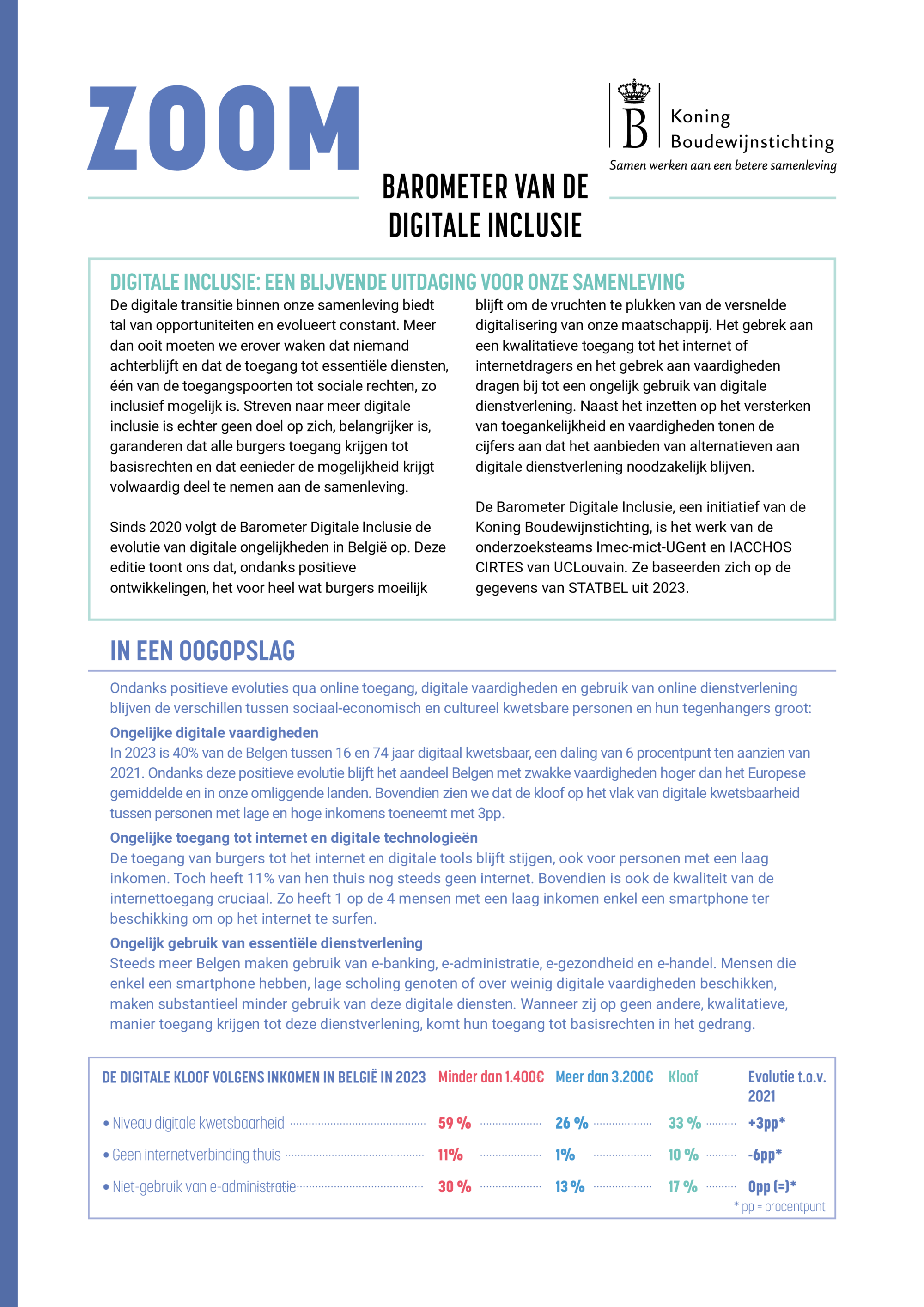
Four Belgians in ten. In 2023, 40% of Belgians aged 16 to 74 were digitally vulnerable, meaning they either did not use the internet or had weak digital skills, according to the King Baudouin Foundation’s digital inclusion barometer. That is 6 points better than in 2021, and still above the European average.
The national figure hides who is behind it. In the chart, look at which groups sit to the right of the national line, and how far.
Digitally vulnerable means not using the internet or having weak digital skills. Belgians aged 16–74, Statbel data for 2023; income bands as the barometer gives them. Source: King Baudouin Foundation, Barometer van de Digitale Inclusie 2024
Schooling is the steepest divide: people whose schooling stopped at lower-secondary level are three times as likely to be vulnerable as graduates. Income, ill health, age and looking for work come close behind. Age is not a shield either. Among young people with little schooling, 52% have weak digital skills, against 10% of young graduates.
Income draws the second line, and it is not only about skills. The next chart sets the lowest income band against the highest on three counts.
Belgium, 2023. Since 2021 the gap between the two bands widened by 3 points on vulnerability, narrowed by 6 on home internet and stayed the same on e-government. Source: King Baudouin Foundation, Barometer van de Digitale Inclusie 2024
Since 2021 the gap in vulnerability between the two bands has widened by 3 points. One in four people on a low income reaches the internet only through a smartphone, which turns attaching a document to an email into a chore. And about 30% of Belgians have already asked someone for help with an online service; among people with little schooling it is 53%.
Germany measures from the other end, by asking who did not go online at all. In the eGovernment Monitor 2025, 33% of Germans who needed an authority in the past year dealt with it wholly offline: 38% of people with little formal education against 26% of the highly educated, and 38% in the countryside against 29% in cities. France’s online-services observatory, running since 2019, scores the procedures rather than the people who fail at them.
So who exactly? People with little schooling first. Then those on low incomes, those living with a disability or a long-term illness, older people and job seekers: the residents most likely to need a benefit, a permit or a school place, and least able to chase one through a portal. What happens to them when the counter has gone? France’s rights ombudsman keeps the file.
What the ombudsman’s file shows
In 2021 France’s Défenseur des droits, the independent rights ombudsman, received nearly 115,000 complaints. 91,000 of them concerned public services, against 35,000 in 2014. Year after year, more than 80% of the complaints it receives are about difficulties with public services, Claire Hédon, the Défenseure, wrote in her follow-up report on moving them online. People arrive at her delegates’ surgeries exhausted, sometimes desperate, relieved “to be able, at last, to talk to someone in flesh and blood” (« parler à quelqu’un en chair et en os »).
The report surveyed its 530 delegates, who handle most of the cases, in September 2021. They said complaints tied to online procedures had been rising for two years. Asked which services the complaints were about, they named the ones nobody can avoid.
Services delegates cited for complaints about online procedures, survey of September 2021. The shares add up to more than 100 because delegates named several. Source: Défenseur des droits, Dématérialisation des services publics : trois ans après (2022)
The cases behind the bars are small and harsh. A homeless man could not file his quarterly declaration online while the France services office he relied on was shut for the summer, and the family benefits fund ended his payments. A job seeker living in an area with no mobile signal was struck off for missing two appointments that had been sent to him by text and email.
Hédon’s diagnosis is that moving services online, as it had been done so far, came with “a systemic shift onto the user of tasks and costs that used to fall on the administration” (« un report systémique sur l’usager de tâches et de coûts qui incombaient auparavant à l’administration »). Some users carry more than others: in 2019 only 5% of public websites were accessible to disabled people, and the report still counts 13 million people in difficulty with digital tools, the same as in 2019.
In Brussels the argument reached parliament. On 13 December 2023 Daniel Flinker of Lire et Ecrire, a literacy association, told the MPs examining the “Brussels digital” ordinance that its article on offline routes asked authorities for a counter, a phone line and post “or any other measure”, which in his reading guaranteed none of them. Another clause let authorities skip the offline routes if they imposed a “disproportionate burden”, and they had five years to set them up.
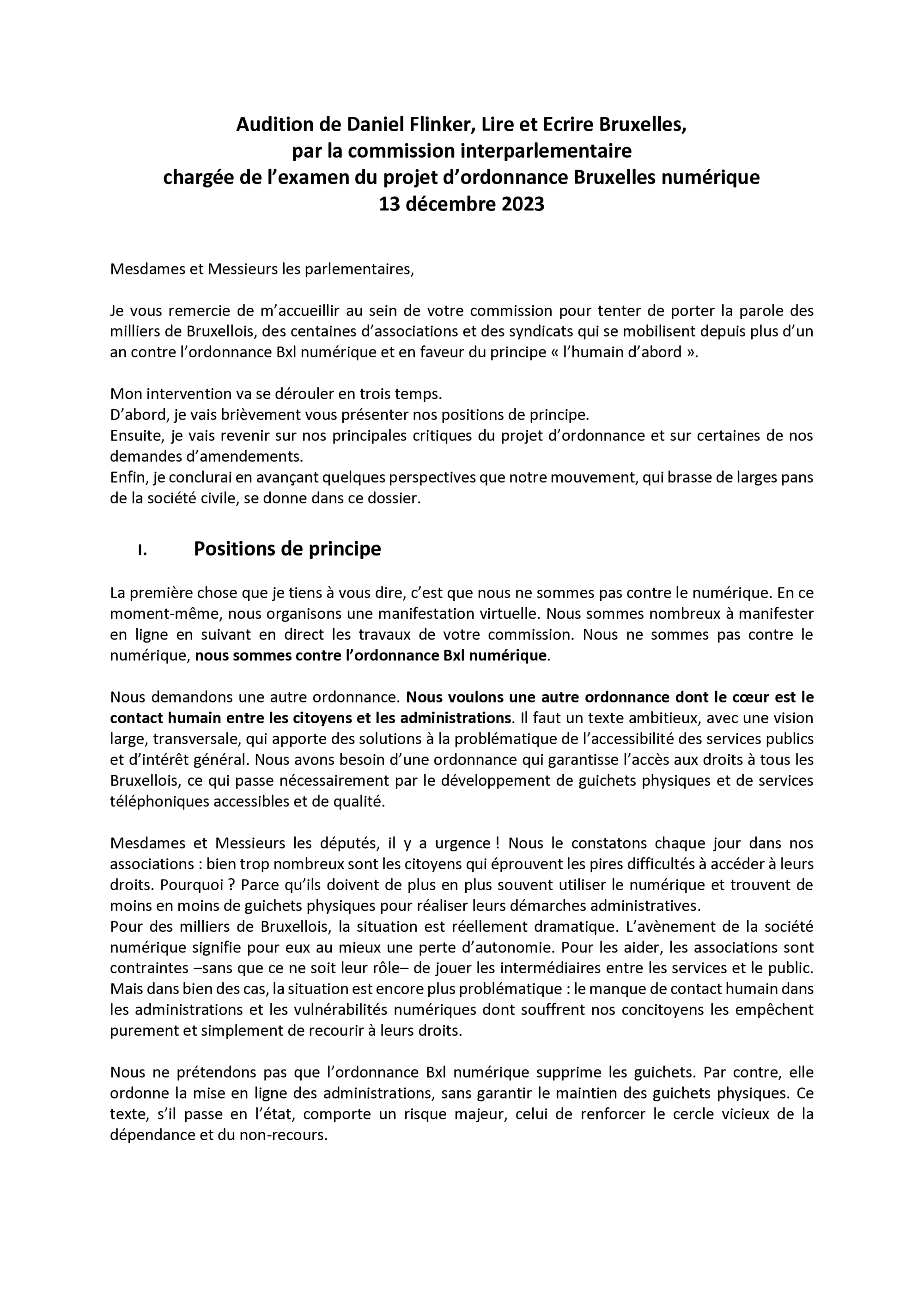
I am not a digital expert. But I have become, by force of circumstance, an expert in the distress, the suffering and the anger that all-digital causes.Both arrive at the same demand: a right to a route that is not digital. Hédon asks for “the systematic maintenance of an alternative access” (« le maintien systématique d’un accès alternatif »). The Council of Europe resolution Flinker read out to the committee asks states to move from fully dematerialised to fully accessible public services. Governments usually answer that the portal saves money. Does it, and whose work does the saving rest on?
Savings that moved the work
Since November 2014 everyone in Denmark has had to receive post from the public sector digitally; businesses had to from November 2013. The bill behind it estimated savings of up to DKK 1bn a year across the public sector at full roll-out, from postage, materials and the staff time spent handling letters.
In January 2016 the state auditors found that the Ministry of Finance had not yet shown the whole saving could be realised. In central government only DKK 48m of a calculated DKK 244m had been taken out of budgets. Savings on wages and overheads were uncertain, and the digitisation agency would follow up only what authorities saved on postage. What would be followed up, in other words, was the authorities’ own postage bill.
Austria’s auditors found the same blind spot closer to the ground. In 2023 they examined four small towns: Groß-Enzersdorf, Hallein, Mödling and St. Johann im Pongau. All four saw savings from their online services, none could say how large, because none kept cost accounts, and none had asked residents what they needed before building. The next chart shows how many applications still arrived on paper.
Applications for club grants, kindergarten places, events and dog registration. Groß-Enzersdorf offered a web form for none of them; Hallein took kindergarten sign-ups online only. Source: Rechnungshof Österreich, Digitales Leistungsspektrum ausgewählter Gemeinden (2024)
The spread follows the offer more than the residents. Groß-Enzersdorf had no web form for any of the four procedures, while Hallein’s kindergarten sign-up went wholly online. Across the four towns, 42% of applications still came on paper in 2022.
Germany shows the back office lagging on a larger scale. Its online access law obliged every level of government to offer its services online by the end of 2022. Three years later Saxony’s audit office found the state second to last among the Länder.
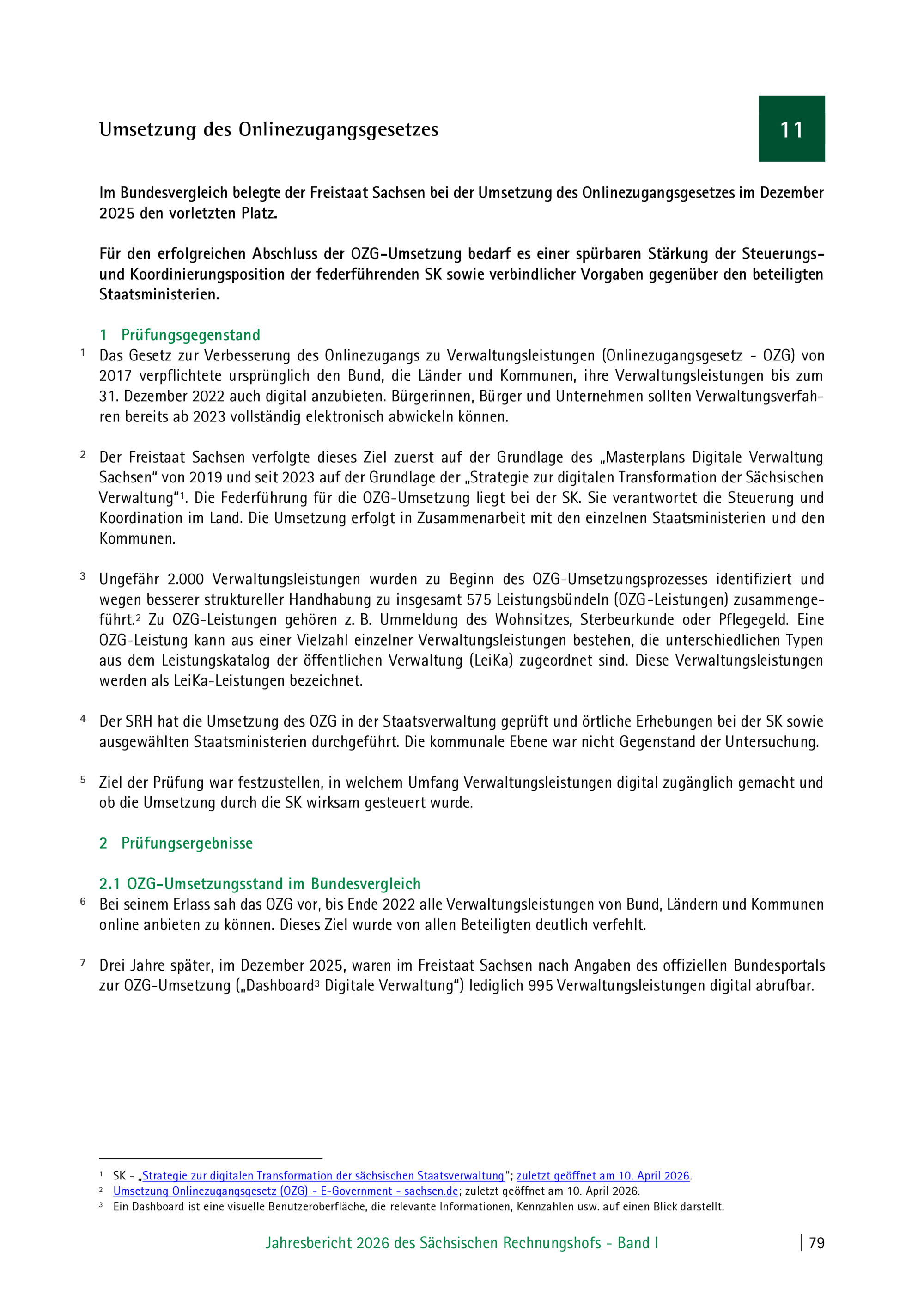
The top two and bottom three Länder on the federal dashboard, as the audit office quotes them; the other eleven are not given. The counts include services that do not yet meet the law’s standard, and the dashboard does not say how many do. Source: Sächsischer Rechnungshof, Jahresbericht 2026, Band I: Umsetzung des OZG
The reasons the auditors give sit behind the screen: no central budget, ministries saying they were not responsible for services assigned to them, and a tracking tool with entries untouched since February 2022. In Berlin the digital case file rolled out since 2022 had about 3,600 people in 40 authorities working in it, against a target of about 60,000; the city cites software that needs fixing and too few staff. In Britain, nearly half of central government services still rely on phone calls and paper forms.
When the front door goes online and the back office does not, someone carries the paper between them, usually a relative or a volunteer. Who now does the work the counter did?
Who helps at the desk?
At a digipunt in Flanders, a digihelper sits beside a visitor who cannot log in. Since 2022 the Flemish government has paid for 54 digibanken in Flanders and Brussels with temporary EU money: local partnerships that lend laptops, run classes and staff these help points.
The evaluation published in June 2025 found that their biggest effect is not new skills but reassurance: visitors know where to go, and they value helpers who are patient and avoid jargon. It also found the limits. People with almost no digital skills are barely reached, and the help is technical, logging in to the tax portal rather than filling in the return. Many smaller municipalities say they have no budget to carry on when the project grant ends.

London built a bigger version. Get Online London, the UK’s first digital inclusion service, has supported about 125,000 Londoners and grown to more than 1,100 community hubs, from 90 in July 2022. City Hall could not fund it past June 2025; a £300,000 government underspend bought eighteen more months, to December 2026, for an estimated 108,000 more people.
Paris has written the door into policy. Its responsible-digital strategy commits the city to offer, “systematically” (« systématiquement »), an alternative to the online route: a counter, a phone line and at the least help with the procedure, through digital advisers in district town halls and social centres.
Pennsylvania shows what happens when the money is someone else’s. In May 2025 the federal government cancelled two Digital Equity Act grant programmes, taking more than $25m from the state’s broadband authority, which planned public Wi-Fi, skills classes and cheap laptops, and almost $12m from Philadelphia for skills teaching and low-cost internet subscriptions. “What experience has shown is that this is not a ‘if you build it they will come’ situation,” said Kate Rivera of the Technology Learning Collaborative in Philadelphia.
Put the obligations and the help on one line and the clock that runs the help shows.
- Nov 2014[source]
Denmark makes Digital Post compulsory
Citizens must receive public-sector post digitally; the bill estimated savings of up to DKK 1bn a year.
- 2022[source]
Flanders funds digibanken
54 local help networks open in Flanders and Brussels on temporary EU money; a June 2025 evaluation finds many smaller municipalities have no budget once the grant ends.
- Mar 2025[source]
Get Online London extended
A £300,000 government grant extends the service to December 2026; it has grown from 90 hubs in July 2022 to more than 1,100.
- May 2025[source]
Pennsylvania’s grants cancelled
The Digital Equity Act grants go: more than $25m for the state broadband authority, almost $12m for Philadelphia.
- 2025[source]
Paris promises an offline route
The responsible-digital strategy pledges to offer an alternative to the online route systematically: a counter, a phone line or at least help with the procedure.
Obligations and warnings come from governments and ombudsmen; most of the help is project-funded and dated.
Reaching the people the barometers name is the hardest part. Every digibank struggles to reach people in poverty, newcomers who speak another language and the long-term unemployed. The researchers advise working through organisations those groups already trust, and warn that counting unique visitors says little about whether a help point reaches them, because each of those visitors takes more time.
What makes a help desk last is plain in the evaluations: a budget line rather than a project grant, partners the people it wants to reach already trust, and a better measure than counting visitors. The Flemish researchers add a warning for the services themselves: responsibility for inclusive digital services cannot simply be handed to the help desks.
Keep a door open
A city does not have to wait for its national government to settle this. Five checks, each drawn from the evidence above, can be run on any service it moves online.
- Keep a counter, a phone line and post as a right, with no “or any other measure” clause. Paris already offers an alternative to its online procedures as policy.
- Ask before you build, and measure after. None of the four Austrian towns studied what residents needed or how they used what was built.
- Test with the people the barometers name, and with a screen reader: a document a blind user cannot open is a closed counter. Before accepting digital-only services, Germans ask for phone help (42%), a personal contact point (40%) and plain language (39%).
- Count the work you move. A savings case that tracks postage but not the hours residents and help desks spend misses half the ledger.
- Put the help desk in a budget line, run it with partners people already trust, and judge it by more than visitor counts.
Urban Tech Map gathers the services, studies and help desks behind this read under Digital Government, GovTech & Inclusion. If your city runs a help point or an offline route that works, add it on the participate page so the next city can find it.
References
From our libraries17
- Digital Divide: The Albanians Left Behind by Move to Online Public Services (BIRN, 25 Apr 2025) — Knowledge
- On Digital Transformation of Public Local Services for Businesses (Investment Council Albania, March 2025) — Knowledge
- Albania 2025 Report (European Commission, SWD(2025) 750) — Knowledge
- Barometer van de Digitale Inclusie 2024 — Zoom (Koning Boudewijnstichting; imec-mict-UGent and UCLouvain CIRTES, Statbel 2023 data) — Knowledge
- eGovernment MONITOR 2025 (Initiative D21 / TU München) — Knowledge
- Observatoire de la qualité des démarches en ligne — Vos démarches essentielles (DINUM, édition 14, juillet 2026) — Knowledge
- Dématérialisation des services publics : trois ans après, où en est-on ? (Défenseur des droits, 2022) — Knowledge
- Audition de Daniel Flinker, Lire et Ecrire Bruxelles, par la commission interparlementaire chargée de l'examen du projet d'ordonnance Bruxelles numérique (13 décembre 2023) — Knowledge
- Beretning om besparelsespotentialet ved obligatorisk Digital Post på ca. 1 mia. kr. om året (Rigsrevisionen 9/2015) — Knowledge
- Digitales Leistungsspektrum ausgewählter Gemeinden — Bericht des Rechnungshofes (Reihe Niederösterreich 2024/4, Salzburg 2024/2) — Knowledge
- Sächsischer Rechnungshof, Jahresbericht 2026, Band I: Umsetzung des Onlinezugangsgesetzes — Knowledge
- 7. Umsetzungsbericht E-Government-Gesetz Berlin und IKT-Zukunftsbericht (Bericht des Regierenden Bürgermeisters an den Hauptausschuss, rote Nummer 0400 J) — Knowledge
- State of digital government review (Department for Science, Innovation and Technology, January 2025) — Knowledge
- Evaluatiestudie naar de werking en impact van digibanken (Kennisplatform Werk en Sociale Economie; AP Hogeschool and Universiteit Antwerpen, 2 June 2025) — Knowledge
- MD3355 Extension of the Mayor's Get Online London programme (GLA Mayoral Decision, 18 March 2025) — Knowledge
- Stratégie numérique responsable de Paris — dossier de presse — Knowledge
- Millions for public Wi-Fi, digital skills classes in Pa. cut as Trump targets 'racist' broadband program (Spotlight PA via WPSU, June 2025) — Knowledge
Further sources8
- BIRN, Digital Divide: The Albanians Left Behind (25 Apr 2025) — BIRN, Digital Divide: The Albanians Left Behind (25 Apr 2025) · 2023
- European Commission, Albania 2025 Report — European Commission, Albania 2025 Report · 2025
- Daniel Flinker, Lire et Ecrire Bruxelles, to the Brussels parliament’s committee on the “Brussels digital” ordinance, 13 December 2023 — Daniel Flinker, Lire et Ecrire Bruxelles, to the Brussels parliament’s committee on the “Brussels digital” ordinance, 13 December 2023
- Rigsrevisionen, Beretning 9/2015 on Digital Post — Rigsrevisionen, Beretning 9/2015 on Digital Post · Nov 2014
- Vlaanderen, Evaluatiestudie digibanken (June 2025) — Vlaanderen, Evaluatiestudie digibanken (June 2025) · 2022
- Greater London Authority, MD3355 (18 Mar 2025) — Greater London Authority, MD3355 (18 Mar 2025) · Mar 2025
- Spotlight PA via WPSU (4 Jun 2025) — Spotlight PA via WPSU (4 Jun 2025) · May 2025
- Ville de Paris, Stratégie numérique responsable (2025) — Ville de Paris, Stratégie numérique responsable (2025) · 2025