Two languages, many commuters and skills that lag the cables
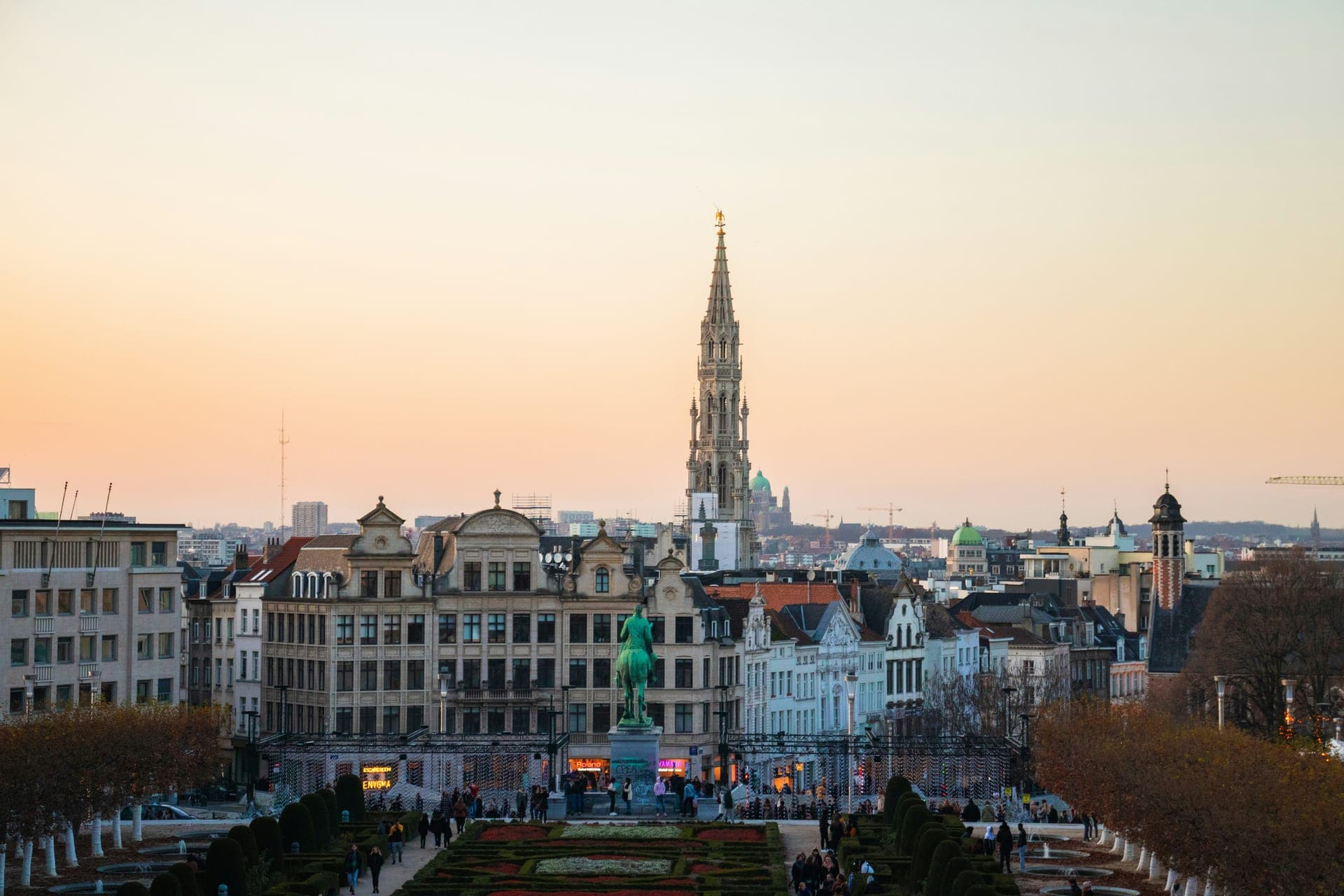
In this profile, Brussels means the Brussels-Capital Region, one of Belgium’s three regions, with its own parliament and government. It has 19 municipalities and had 1,255,834 residents on 1 January 2026. Transport, climate policy, open data and the digital agency are regional matters. The City of Brussels, the historic centre with 198,674 residents, is one of the 19 and is named as such where it acts alone.
It is a region of newcomers and commuters. 37% of residents hold a foreign nationality, 185 nationalities in all, while public business runs in French and Dutch. About half of its 729,685 jobs are held by people who live outside the Region. By the Region’s own count, the EU institutions and other international bodies employ about 52,000 people directly.
Residents mostly travel without a car. Brussels Mobility, the regional transport administration, surveyed households from November 2023 to November 2024. In that survey 66.6% of residents’ trips were on foot, by bike or by metro, tram and bus, and 29.2% were by car. In 2025 cycle-lane counts rose 12% on the year before, while STIB, the regional public-transport operator, carried 1.4% fewer trips.
Main mode of all trips made by residents aged 6 and over on an average day. The survey ran from November 2023 to November 2024 with 5,914 respondents. Commuters who live outside the Region are not included. Source: Brussels Mobility, household travel survey ECD7 (summary)
Climate targets are fixed in an ordinance, a law of the regional parliament. The 2021 climate ordinance sets cuts in direct emissions of 40% by 2030 and 67% by 2040 against 2005, and aims for neutrality by 2050. The 2023 air-climate-energy plan raised the 2030 aim to 47%. In 2024 the Region emitted 3,192 kilotonnes of CO₂-equivalent, 30% below 2005 but 0.6% more than in 2023. Bruxelles Environnement, the regional environment agency, says the cut must be strengthened to meet its 2025 and 2030 goals.
kilotonnes CO₂-equivalent
Show the numbers
| Measured | Target | |
|---|---|---|
| 1990 | 4,041 | — |
| 2004 | 4,648 | — |
| 2005 | 4,565 | — |
| 2024 | 3,192 | 3,192 |
| 2030 | — | 2,419 |
| 2040 | — | 1,506 |
| 2050 | — | 457 |
All greenhouse gases emitted on the Region’s territory, not corrected for weather. 1990 is derived from the stated 21% cut since then. Targets against 2005: 47% lower by 2030 (the 2023 air-climate-energy plan), 67% by 2040 and at least 90% by 2050 (the 2021 climate ordinance), when the Region aims for neutrality. Source: Bruxelles Environnement, greenhouse-gas inventory 1990–2024 and targets
By the same agency’s inventory, heating homes and offices produced about 55% of direct emissions in 2024, and transport about a quarter. Housing is the other pressure. Average rent reached €1,321 a month in 2024, and 55,000 households were on the social-housing waiting list that year.
The connections are in place. 83.5% of households can order fibre, against 35.7% across Belgium. 95% of households have internet at home and 85% of residents surveyed use online public services. IRISbox, the regional online counter run by Paradigm, the Region’s digital agency, counted 286,395 active users in 2025. The City of Brussels’ own open-data portal lists 208 datasets.
The gap is skills and confidence, not cables. In 2023, 36% of the Region’s 16- to 74-year-olds were digitally vulnerable, either offline or with weak skills. Across Belgium the share was 59% among people earning under €1,400 a month. The Region’s digital-inclusion plan for 2021 to 2024 has no published evaluation, and in June 2025 its successor was still being drafted.
The sharpest dispute is about counters. The Bruxelles numérique (“digital Brussels”) ordinance of 2024 puts every procedure online while keeping offline alternatives. About 200 associations campaigned against it, led by Lire et Écrire, a literacy organisation. In April 2026 it said several municipalities still did not apply the ordinance systematically. Residents’ own verdict has slipped too. In the IMD Smart City Index, a survey of residents’ perceptions that does not say which “Brussels” it covers, the city fell from 48th in 2025 to 59th of 148 in 2026.
We do not claim that the Brussels digital ordinance abolishes counters. But it orders administrations online without guaranteeing that physical counters are kept.An agency under audit, a research fund on pause
Paradigm runs most of the Region’s public digital services. It was founded in 1987 as CIRB, the Region’s IT centre, and took its new name in February 2023. Besides IRISbox it runs MyPermit, for planning applications, 90% of which were filed digitally in 2025. It has also faced a governance case. Both former directors faced disciplinary procedures, and the Brussels prosecutor opened an investigation in December 2024. A report by the Court of Audit, the body that audits public accounts, confirmed accounting errors and weak internal control. Consultants were cut from 192 in 2023 to 76 in 2025.
Innoviris, the regional research and innovation agency, saw its budget cut by a fifth, from €39m in 2025 to €30m in 2026. It is financing no new projects this year and has suspended its calls until 2027; hundreds of researchers signed open letters in protest. Innoviris also coordinates the Region’s place among the EU’s 100 Mission cities for climate neutrality, though the Region has not received the Mission Label that Antwerp and Leuven hold.
FARI, an institute for public-interest AI, belongs to the Dutch-speaking VUB and the French-speaking ULB universities. It received €9.91m from the EU recovery fund and began four pilots in 2022, from simpler administrative procedures to job matching; no evaluation of them has been published. Its building prototype for the Region’s digital-twin initiative was due by the end of 2024 and has published no results.
The public companies hold the networks. STIB carried 396.1 million trips in 2025, and 40 million had been paid by contactless bank card by July 2025. Sibelga, the electricity and gas grid operator, rolls out smart meters by target group rather than to every home. Participants in energy-sharing schemes rose from 454 to 1,280 in a year.
Hub.brussels, the regional enterprise agency, supported 3,100 businesses in 2025. Finance&invest.brussels, the regional development bank, took a €50m loan from the European Investment Bank in November 2025 to back about €140m of lending to small firms. BeCentral, a digital campus at Brussels-Central station, had trained or reached more than 600,000 people by 2023. Its founder, Laurent Hublet, is now the regional minister for the economy. Go Vocal, a participation platform founded in Brussels in 2015 as CitizenLab, says it serves more than 600 governments in 20 countries.
Civil society often takes its case to court. BRAL, a Dutch-speaking residents’ movement, was one of four associations that had the postponement of the clean-air zone annulled in December 2025. Lire et Écrire led the case on digital access. By July 2026 BRAL and two urban-planning associations, Inter-Environnement Bruxelles (IEB) and ARAU, had sent the Region Prémétro+, a cheaper plan built on trams, as an alternative to Metro 3.
Seven parties, a deficit and the judges in between
After the regional election of 9 June 2024 it took 613 days to agree a government. Meanwhile the outgoing ministers handled current affairs, and from January 2025 the Region ran on provisional twelfths: each month it could spend a twelfth of the previous year’s outlay, plus indexation. In June 2025 the rating agency S&P downgraded the Region from A+ to A, citing the absence of a government. The seven-party Dilliès government was agreed on 12 February 2026 and sworn in two days later.
From the French-speaking side come the liberal MR, the Socialist PS and the centrist Les Engagés; from the Dutch-speaking side, Groen (Greens), Anders (liberals, formerly Open Vld), Vooruit (social democrats) and CD&V (Christian democrats). Boris Dilliès of the MR, formerly mayor of the southern municipality of Uccle, is Minister-President, the head of the regional government. Digitalisation sits with the budget minister, Dirk De Smedt of Anders. The Region has no chief digital officer, and its digital-strategy page publishes no targets or budget.
Money limits every plan. The 2026 budget, approved on 5 March, runs a deficit of €957m and aims for balance by 2029, with €1.2bn of structural savings. The Court of Audit put the Region’s gross consolidated debt at €14bn in 2024. EU money fills some gaps. The recovery fund gave €341m for 23 projects, including FARI and Floya. The regional development fund gives €121.3m for 2021–2027, and nine of the 24 projects chosen in May 2024 are digital.
Judges have shaped the rules as much as ministers. In October 2024 the MR, PS and Les Engagés led a vote to delay the clean-air zone’s 2025 stage by two years, a stage affecting about 35,000 Brussels cars. They confirmed it in March 2025 by 67 votes to 14, calling the transition socially fair and economically balanced; Ecolo (French-speaking Greens) and DéFI (French-speaking liberals) voted against. In December 2025 the Constitutional Court annulled the delay as a breach of the right to health. In September 2025 it had rejected a challenge to Bruxelles numérique, but held that the ordinance guarantees a counter, a telephone line and post.
Security and data are moving up the agenda. The federal government has approved merging the Region’s six police zones into one by 2027, against the opposition of all 19 mayors. By the MR’s own summary, the agreement centralises cameras with the federal police and adds “smart” cameras against fly-tipping.
Mobility divides the coalition most openly. The MR’s summary says the agreement explicitly abandons the logic of Good Move, the regional mobility plan, and the LEZ is to be “socially adapted”. Elke Van den Brandt of Groen, mobility minister before and again now, keeps the plan in amended form; the Brussels Times reports it will be renamed.
Every euro invested in a tram, an electric bus, a cycle lane, a pavement or a safe school environment yields a triple return: less congestion and less pollution, more safety and more economic activity.Opposition is local and organised. In Anderlecht, a municipality in the west of the Region, a 7,000-signature petition preceded the council’s decision in December 2025 to suspend the third phase of its own traffic plan in Cureghem.
We are not against change. Residents also want a healthier environment, but not a change imposed against them.- Jan 2018[source]
Low Emission Zone
The Region-wide clean-air zone starts, with stricter stages fixed in advance.
- June 2021[source]
Climate ordinance
The Region writes its emission targets into law and aims for neutrality by 2050.
- June 2024[source]
Election
The regional election of 9 June opens a government formation that lasts 613 days.
- Oct 2024[source]
Clean-air delay voted
Parliament votes to postpone the zone’s 2025 stage by two years; it re-votes the delay in March 2025.
- Sept 2025[source]
Digital ordinance upheld
Ruling 126/2025 rejects the challenge but holds that counter, telephone and post are guaranteed.
- Dec 2025[source]
Clean-air delay annulled
Ruling 174/2025 annuls the postponement as a breach of the right to health.
- Feb 2026[source]
Dilliès government
Seven parties agree a government on 12 February; it is sworn in on the 14th.
- Dec 2026[source]
Floya scheduled to close
STIB plans to shut its journey app on 31 December; shared e-scooters are to be banned from January 2027.
- 2029[source]
Budget and election
Target year for a balanced budget, and the next regional election.
- 2035[source]
Charging points
Target: 22,000 public charging points, one within 150 m of every home.
- 2040[source]
Climate milestone
Target: direct emissions 67% below 2005.
- 2050[source]
Neutrality
The Region aims for climate neutrality, with direct emissions at least 90% below 2005.
From the clean-air zone and the climate law through a long government formation to the targets now in front of the Dilliès government.
A clean-air zone the courts kept, a metro cut back, an app that closes
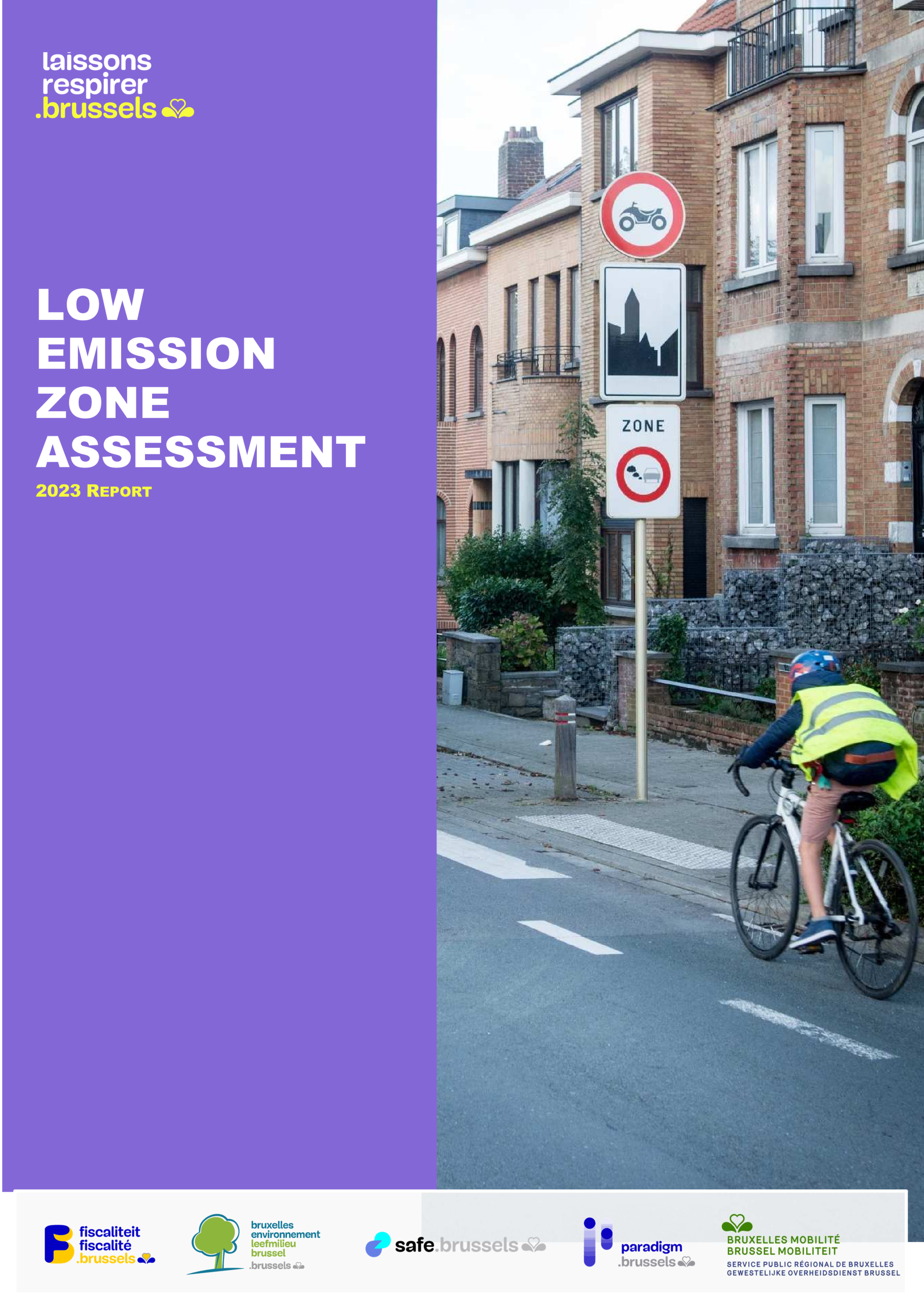
The Low Emission Zone has covered the whole Region since 2018 and is run by Bruxelles Environnement. Its 2023 assessment found that diesel’s share of cars fell from 62.4% to 25.8%. Fleet renewal cut nitrogen oxides by 36% and black carbon by 65%. Modelling put the fall in nitrogen dioxide at about 30% on the busiest roads. Only 19% of fines were paid for vehicles registered in Brussels. Since the court ruling the delayed stage applies, softened: from April 2026 a €350 fine at most once a year per vehicle, with a new framework planned for January 2027.
Good Move, the regional mobility plan for 2020 to 2030, routes through-traffic round residential areas. In the Pentagone, the City of Brussels’ historic centre, car traffic fell 27% after one year and peak-hour cyclists rose 36%, while cycling was growing across the Region. The City reported 21% fewer accidents in 2023; Fabian Maingain of DéFI called its figures selective. In a 2024 survey for Brussels Mobility, 60% of about 1,900 drivers at least partly agreed with cutting through-traffic.
The City of Brussels’ central pedestrian zone, closed to cars in 2015, counted 29,100 passages a day in 2024. It cost €27.8m against €20m budgeted, and critics say it serves visitors more than residents.
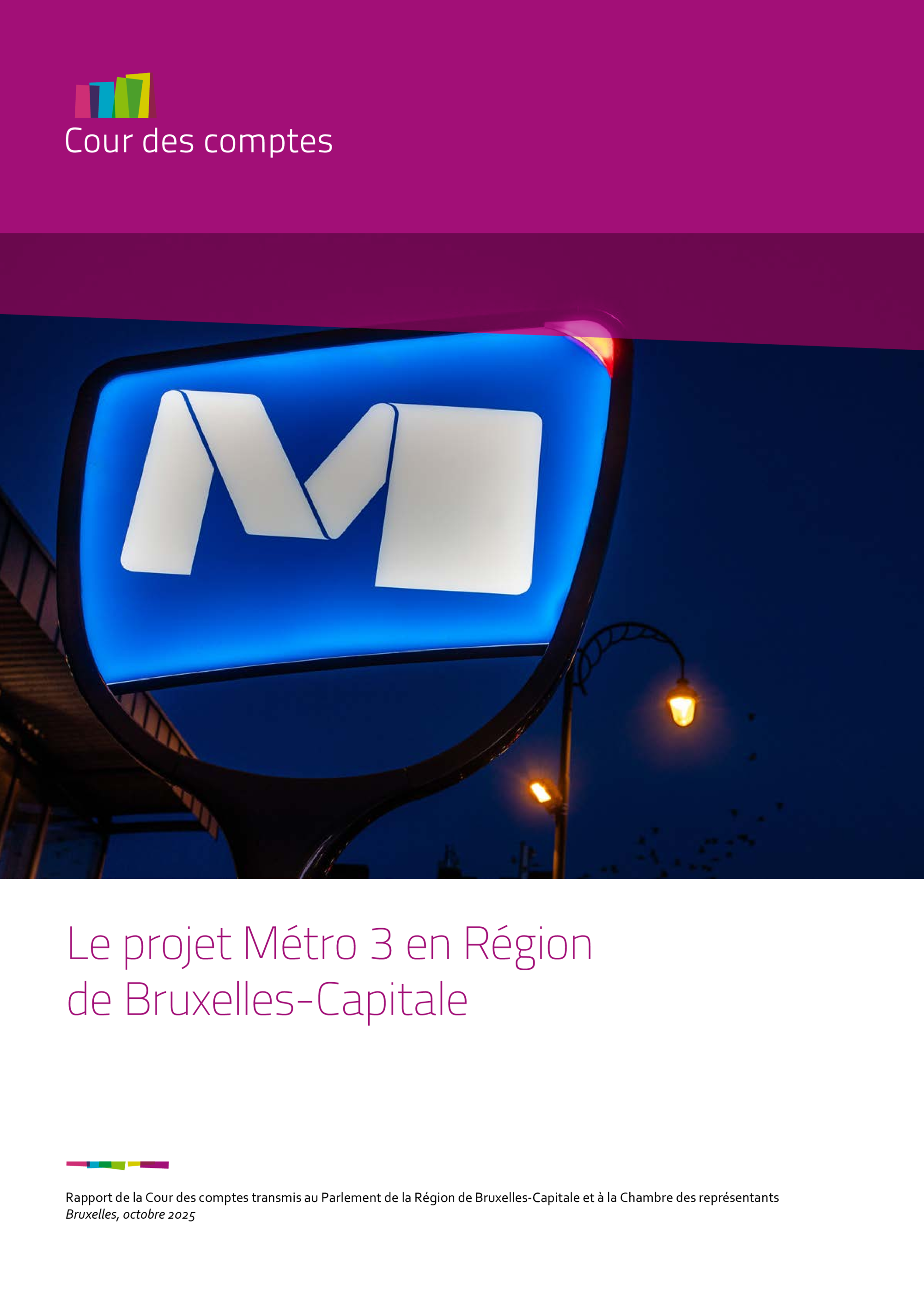
Metro 3, a 10.3 km line planned from Albert in the south to Bordet in the north, is the costliest stall. In a report adopted on 8 October 2025, the Court of Audit put its estimated cost at €4.76bn in December 2024, against €1.34bn in 2015, with the full line no earlier than 2035. It found two of three worksites halted for more than 26 months and procurement law not systematically respected. The prosecutor opened an investigation that month. In July 2026 a special committee of parliament advised finishing the tunnel between Anneessens and Gare du Midi for trams and re-evaluating the northern section. A study in the journal Brussels Studies found the full line would add transfers, the shortened Albert–Nord version would lengthen average journeys, and Prémétro+ would cut both.
Floya, STIB’s app for planning and paying for trips across operators, was built by the software company Trafi and launched in September 2023 with EU recovery money. It was downloaded 433,416 times, but its monthly users were a small fraction of the 350,000 on STIB’s own app, and about half its transactions were e-scooter rides. STIB plans to close it on 31 December 2026, after spending about €8.5m, as the Region bans shared e-scooters from January 2027.
FixMyStreet Brussels, run by Paradigm for the Region and the 19 municipalities since 2013, logged 150,045 reports in 2023, and about 130,000 problems were resolved. A study by VUB researchers, funded by Innoviris, found reports uneven across neighbourhoods. It also warned that the app raises expectations the services cannot meet and risks residents policing one another.
Renolution, the regional renovation programme, awarded €279m in premiums on 33,126 files for works carried out from 2022 to 2024, 79% of it for energy work. IBSA, the regional statistics institute, found that owner-occupiers, houses and the wealthier south-east used them most. The Region suspended new premiums in August 2024 because demand had exhausted the budget. Public charging for electric cars has grown under concessions such as ENGIE Vianeo’s, awarded in March 2026 for 1,640 on-street points: 10,877 points on 1 October 2026, against 22,000 targeted by 2035.
The clean-air zone survived because a law and a court held it. When Parliament voted to delay its next stage, the Constitutional Court annulled the delay as a step back on the right to health. The renovation premiums depended on money. Demand exhausted them in August 2024, and from January 2025 the Region could spend each month only a twelfth of the previous year’s outlay. The Dilliès government’s first budget has since added stops of its own: Innoviris’s 2026 calls, the northern metro and, on 31 December, Floya.
References
Statistics1Click on any number to see the source
Population & migration
From our libraries7
- Annual Report 2024 of the Brussels Commissioner for Europe and International Organisations — Knowledge
- Baromètre de l'inclusion numérique 2024 (ZOOM) — Fondation Roi Baudouin — Knowledge
- Audition de Daniel Flinker, Lire et Ecrire Bruxelles, par la commission interparlementaire chargée de l'examen du projet d'ordonnance Bruxelles numérique (13 décembre 2023) — Knowledge
- IMD Smart City Index — Knowledge
- Cour constitutionnelle, arrêt n° 174/2025 du 11 décembre 2025 (annulation du report de la zone de basses émissions bruxelloise) — Knowledge
- Low Emission Zone Assessment 2023 Report — Knowledge
- Le projet Métro 3 en Région de Bruxelles-Capitale (Cour des comptes, rapport adopté le 8 octobre 2025) — Knowledge
Further sources25
- Population par commune au 1er janvier 2026 — Statbel · June 2026
- Chiffres clés de la Région — IBSA
- Enquête sur les comportements de déplacement ECD7 — résumé — Brussels Mobility · 2025
- Émissions de gaz à effet de serre — Bruxelles Environnement · 2026
- La population bruxelloise et le numérique — édition 2025 — IBSA · June 2025
- Bilan 2025 : une année record pour les services Paradigm — Paradigm · 2026
- Smart City Index 2026 — Brussels — IMD World Competitiveness Center · 2026
- Paradigm : la Cour des comptes confirme des dérives — BX1 · 14 Nov 2025
- Les coupes budgétaires chez Innoviris provoquent la polémique — BX1 · 7 Apr 2026
- Cities with the EU Mission Label — European Commission · July 2026
- White smoke: Brussels finally has a new government — Brussels Times · Feb 2026
- No emergency budget for Brussels in 2025 — Brussels Times · 2025
- Feu vert jusqu’en 2027 pour les diesel Euro 5 à Bruxelles — Paris Match Belgique · 4 Oct 2024
- Le Parlement bruxellois adopte une nouvelle ordonnance correctrice de report de la LEZ — BX1 · 21 Mar 2025
- Brussels government approves 2026 budget with reduced deficit — Brussels Times · 5 Mar 2026
- 1 billion euro in expenditure excluded from Brussels regional government’s savings plan — VRT NWS · 18 Feb 2026
- Arrêt n° 126/2025 (Bruxelles numérique) — Constitutional Court of Belgium · 25 Sept 2025
- Arrêt n° 174/2025 — communiqué de presse — Constitutional Court of Belgium · 11 Dec 2025
- Enfin un nouveau gouvernement à Bruxelles — MR (party document) · Feb 2026
- Low Emission Zone — assessment 2023 — Bruxelles Environnement · 2024
- Le projet Métro 3 en Région de Bruxelles-Capitale — Cour des comptes · 8 Oct 2025
- Plan to replace Metro 3 project with tram lines sent to Brussels Region — Brussels Times · July 2026
- L’abandon de l’application Floya, chronique d’un échec à 8 millions d’euros — BX1 · June 2026
- FixMyStreet ! Faire fonctionner la participation numérique des citoyens — Innoviris / VUB · May 2025
- Primes Renolution : comment ont-elles été utilisées ? — IBSA · 13 July 2026