Upgraded cable reaches almost every home; fibre does not
Belgium is a federation of three Regions, Flanders, Wallonia and Brussels-Capital, and three language Communities. After a series of state reforms, most of what a smart-city official touches belongs to the Regions. They also age differently: 22.1% of Flemish residents are 65 or older, against 20.6% in Wallonia and 13.4% in Brussels.
There is no national climate law. In March 2019 a constitutional revision that would have allowed one won 76 votes to 66 in the Chamber, short of the two-thirds it needed. The targets that exist are regional, and only Wallonia’s are in law: its 2023 decree requires a 55% cut on 1990 by 2030 and carbon neutrality by 2050 at the latest. A 2021 Brussels ordinance aims at neutrality by 2050. Flanders has a plan, adopted in July 2025, to cut emissions outside the EU’s emissions-trading system by 40% on 2005, against the 47% the EU expects of Belgium.

A court has filled part of the gap. In November 2023 the Brussels Court of Appeal ordered the federal State, Flanders and Brussels to make the same 2030 cut, which Wallonia had written into law two weeks earlier. Flanders appealed to the Court of Cassation, where, as far as we could find, the appeal is still pending; its environment minister, Zuhal Demir of the Flemish nationalist N-VA, said the ruling “imposes collective impoverishment”. The national energy and climate plan the EU requires was agreed only in October 2025, more than a year late, after months of waiting for Flanders’ own plan.
Emissions in 2024 were 32.6% below 1990, against 38% for the EU, and rose slightly that year for the first time since 2021 because of industry in Flanders. Transport, a quarter of the total, is the only sector up sharply since 1990, by 19%. Since 1990 the cut has averaged about 1.4 million tonnes a year. Reaching neutrality by 2050 would take almost three times that pace, and meeting the court’s order would take nearly four times it: a third of 2024’s emissions gone in six years.
index, 1990 = 100
Show the numbers
| Belgium | EU-27 | Court-ordered path | |
|---|---|---|---|
| 1990 | 100.0 | 100.0 | — |
| 1991 | 101.9 | 97.8 | — |
| 1992 | 101.5 | 94.7 | — |
| 1993 | 100.7 | 93.1 | — |
| 1994 | 103.8 | 92.6 | — |
| 1995 | 105.3 | 93.7 | — |
| 1996 | 107.7 | 95.6 | — |
| 1997 | 101.9 | 94.0 | — |
| 1998 | 105.5 | 93.2 | — |
| 1999 | 101.1 | 91.6 | — |
| 2000 | 101.9 | 91.4 | — |
| 2001 | 100.8 | 92.4 | — |
| 2002 | 100.8 | 92.1 | — |
| 2003 | 101.0 | 93.7 | — |
| 2004 | 101.6 | 93.7 | — |
| 2005 | 99.5 | 93.2 | — |
| 2006 | 97.7 | 93.3 | — |
| 2007 | 95.1 | 92.2 | — |
| 2008 | 95.1 | 90.2 | — |
| 2009 | 86.5 | 84.1 | — |
| 2010 | 91.4 | 85.7 | — |
| 2011 | 84.2 | 83.3 | — |
| 2012 | 82.3 | 81.8 | — |
| 2013 | 82.4 | 80.0 | — |
| 2014 | 78.4 | 77.1 | — |
| 2015 | 81.4 | 78.0 | — |
| 2016 | 80.4 | 78.0 | — |
| 2017 | 80.0 | 78.5 | — |
| 2018 | 80.5 | 76.7 | — |
| 2019 | 79.8 | 73.4 | — |
| 2020 | 73.3 | 67.4 | — |
| 2021 | 75.3 | 70.9 | — |
| 2022 | 70.5 | 69.0 | — |
| 2023 | 67.2 | 63.5 | — |
| 2024 | 67.4 | 62.0 | 67.4 |
| 2025 | — | — | 63.7 |
| 2026 | — | — | 59.9 |
| 2027 | — | — | 56.2 |
| 2028 | — | — | 52.5 |
| 2029 | — | — | 48.7 |
| 2030 | — | — | 45.0 |
Greenhouse-gas emissions excluding land use and international aviation and shipping, indexed to 1990, for Belgium and the EU-27. Belgium has no national climate law. The third line runs straight from 2024 to the 55% cut on 1990 by 2030 that the Brussels Court of Appeal ordered the federal State, Flanders and Brussels to reach in 2023, a ruling Flanders has appealed to the Court of Cassation. One step on the axis is one year. Source: Eurostat, env_air_gge (greenhouse gases excluding land use and international transport)
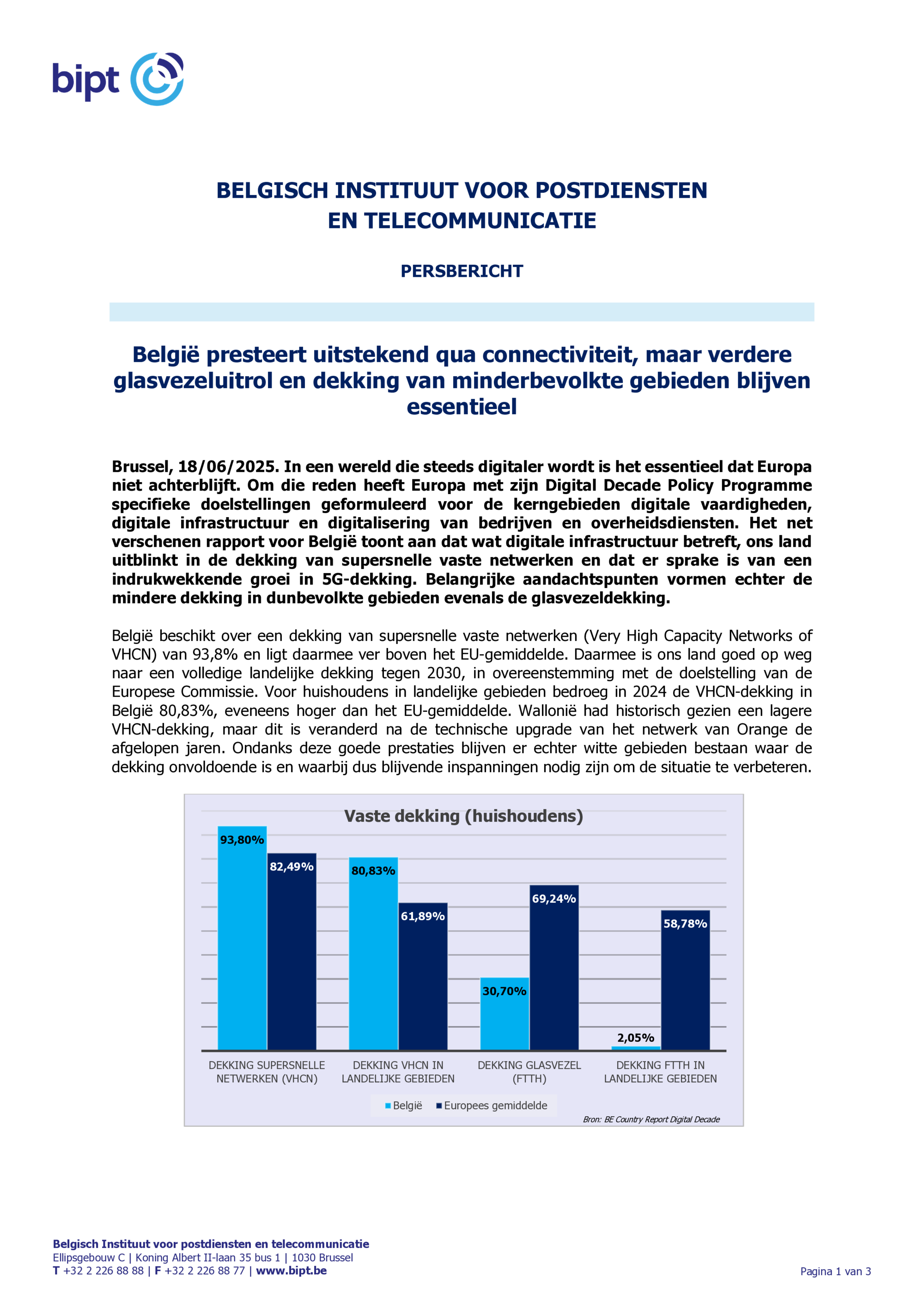
The networks were fast before fibre arrived. After upgrades to Telenet’s cable in Flanders and Orange’s in Wallonia, 96.2% of homes can get a very-high-capacity connection. Fibre to the premises passes only 35.5%, against 74.1% across the EU, and in 2024 it reached just 2.05% of rural homes. BIPT, the federal telecoms regulator, says the cable networks compensate for that.
Fibre is now being built over the cable. Proximus, the incumbent, and its joint ventures aim to pass seven in ten households by 2028. Wyre, which Telenet owns with the municipal utility Fluvius, aims at 78% of its northern area by 2038. In July 2026 the competition authority let the two share the build for more than 2m homes in medium-density Flanders, while the big cities stay open to competition.
Belgium is well above the EU-27 on gigabit-capable networks, adults dealing with the authorities online and firms using AI, and furthest behind on fibre to the premises and on renewables. Most of its gigabit coverage is upgraded cable, which is why the two network rows differ so much. Coverage figures are for 2025, from the Commission’s Digital Decade report; use, skills and AI figures are Eurostat surveys for 2025; renewables are for 2024. Source: European Commission, Digital Decade (DESI 2026); Eurostat (isoc_ciegi_ac, isoc_sk_dskl_i21, isoc_eb_ai, nrg_ind_ren)
Online services are well used: 69.6% of adults dealt with a public authority online in 2025, against 57.7% across the EU. Most people log in with itsme, a private app owned by four banks and three telecom operators, in which the federal investment company FPIM took 20% in 2021. By its own count it passed eight million users in Belgium in 2025, and was used 1.6 million times a day. The government’s own app, MyGov.be, needs Android 10 or iOS 16 or later, which excludes older phones.
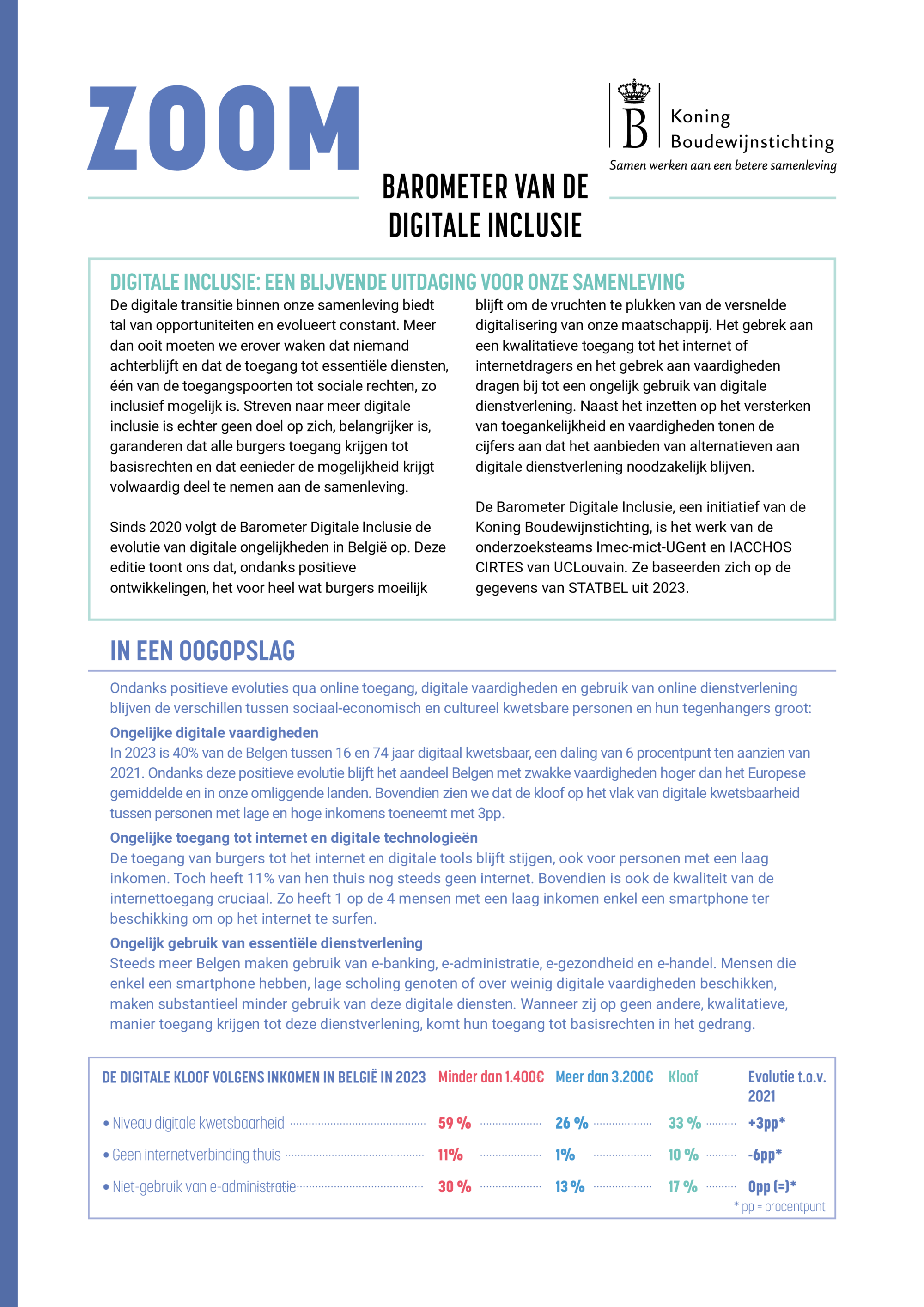
The gap is skills and income. The King Baudouin Foundation counted four in ten people aged 16 to 74 as digitally vulnerable in 2023, either offline or with weak skills: 45% in Wallonia, 39% in Flanders and 36% in Brussels. Among those earning under €1,400 a month, three in ten did not use online public services, against 13% of those earning over €3,200, and one in four went online only by smartphone. Flanders funds 54 digibanken, local help desks, on temporary EU money; their evaluation found they reassure visitors but barely reach people with no digital skills at all.
The Regions hold the dials
The official list of regional powers runs from “transport (except Belgian Railways)” and energy to “town and country planning” and the “supervision of the provinces, communes and intercommunal utility companies”. The Communities hold education and “the use of languages”. A city’s levers therefore sit mostly one level up:
- Broadband: telecoms are federal, overseen by BIPT, and private operators build. No city lays fibre, but Flemish cities co-own a network: their utility, Fluvius, holds 33.2% of Wyre. Wallonia asked towns in its 2023 smart-region call to give up taxes on masts and antennas.
- Public transport: the Regions run it through De Lijn in Flanders, LETEC in Wallonia and STIB in Brussels; rail is federal. Cities control their own local roads.
- Clean air: the Regions write the rules for low-emission zones. Flanders set a stricter 2026 stage for its two zones, then cancelled it, and gave the cities more say over individual exemptions.
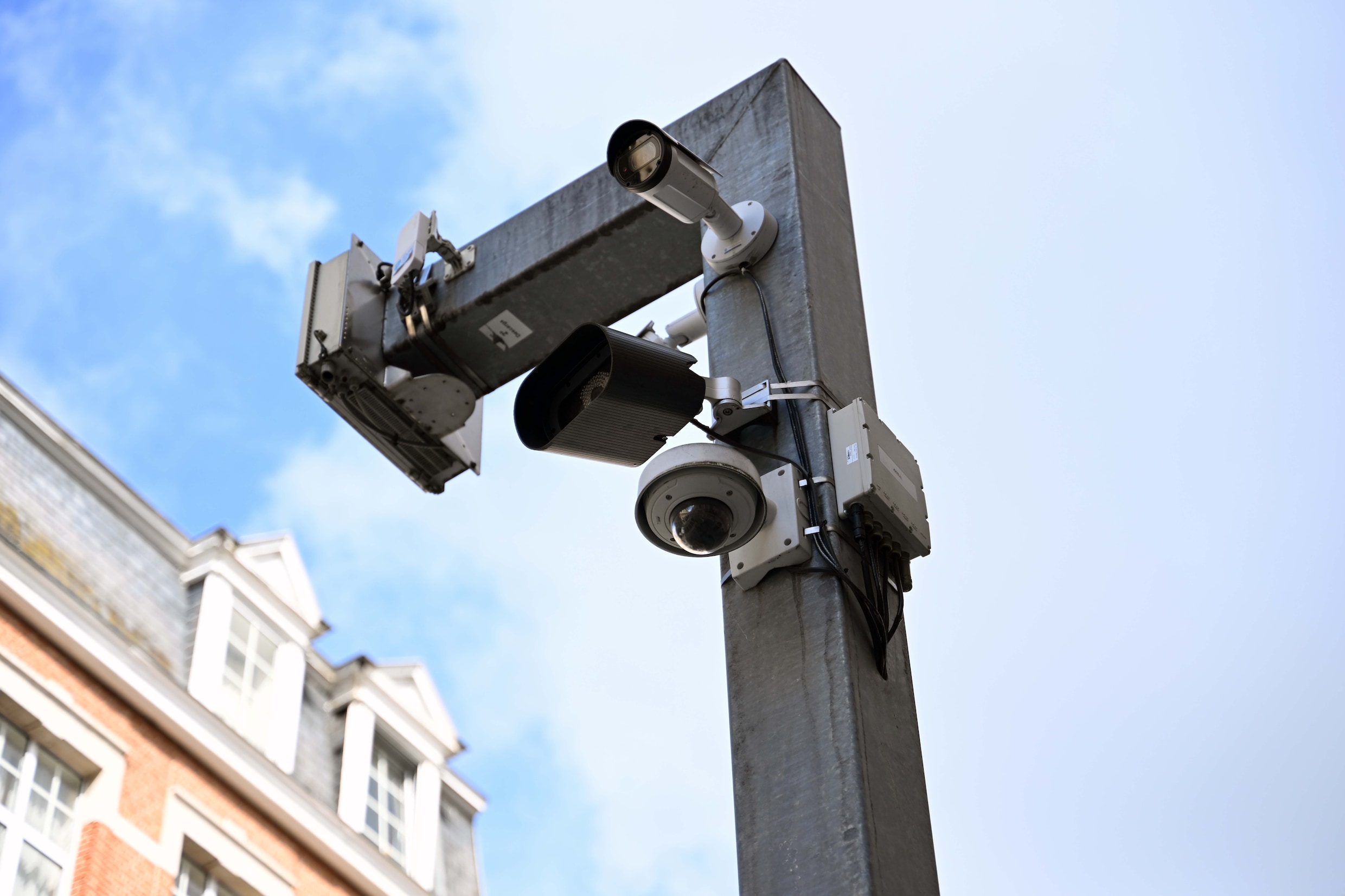
- Policing and cameras: policing is organised by federal law on two levels, a federal police and about 180 local police zones run by the mayors of the towns they cover; the interior minister wants about 60. Cities buy number-plate cameras for clean-air zones or speed checks, and since July 2025 these can feed one national police platform.
- Energy and heat: energy is regional, nuclear power and the high-voltage grid federal. Fluvius, wholly owned by the Flemish cities and municipalities, runs electricity, gas, street lighting, sewers and heat networks.
- Planning: each Region has its own planning law, so a building rule that works in Ghent cannot simply be copied in Liège.
- Open data: each level legislates for its own bodies. Flemish councils must publish their decisions and other documents as linked open data, which people and search engines can reuse.
- Online services and e-ID: the federal level issues the identity card and runs MyGov.be, each Region and Community builds its own portals, and the most used login, itsme, is private.
- Procurement: one federal law of 2016 applies at every level. The Regions push reuse through grants; Flanders’ 2025 City of Things call wants solutions that other cities and municipalities can use.
- Skills: schools belong to the Communities and inclusion schemes to the Regions, while towns and local partners host the help desks.
The split favours Flemish cities where the Region hands them a duty with a shared standard, as with council decisions, or where they own the asset, as with Fluvius. It works against them where the Region keeps the dial. Ghent’s mobility alderman, Filip Watteeuw of the Flemish greens, Groen, still sees “polluting De Lijn buses” in a city with a clean-air zone. Size is a regional choice too: Flanders took over €273m of debt to merge 28 municipalities into 13 in 2025.
Around the cities sit their associations: the VVSG in Flanders, the UVCW in Wallonia and Brulocalis in Brussels. Flemish councils also share IT work and purchasing through V-ICT-OR. imec, the Flemish research centre for digital technology, and the VUB-SMIT media institute supply much of the research. Public power over the networks sits in shareholdings rather than statutes: the Flemish municipalities own Fluvius, and through it a third of Wyre, the federal investment company owns a fifth of itsme, and the federal State is Proximus’s largest shareholder. Watching them are Bond Beter Leefmilieu, the Flemish environmental federation, and Klimaatzaak, the citizens’ group that won the climate case on appeal.

Flanders writes the clean-air rules, and it loosened them
Bart De Wever of the N-VA has led the federal government since February 2025, a five-party coalition nicknamed “Arizona”. In July 2026 it approved a Federal Digital Agency inside FPS BOSA, the federal support service, proposed by the digital minister, Vanessa Matz of the francophone centrist Les Engagés; no budget has been published. For cities the Regions matter more. Flanders’ Minister-President, Matthias Diependaele (N-VA), keeps digitalisation himself. In Wallonia it belongs to Pierre-Yves Jeholet of the francophone liberal MR, who in June 2025 put the Agence du Numérique at the centre of the Region’s digital policy. Local government answers to Hilde Crevits (CD&V) in Flanders and François Desquesnes (Les Engagés) in Wallonia. The capital waited longest: the Brussels-Capital Region went 613 days without a government, until February 2026.
Today Wallonia has boarded the digital train, but it is not yet at the controls. What is missing is coordinated acceleration, better governance and mass take-up.Flanders has built the most machinery for reuse. Its Vlaanderen Radicaal Digitaal programme aimed in 2016 to digitise all public services by 2020, with €10m a year to back projects, according to VUB-SMIT; no published evaluation says whether it did. City of Things began as a living lab of Antwerp, the Region and imec, into which Flanders put €4m a year. It became a grant line: the 2025 call offers up to €2m a project, four-fifths of it subsidised, for solutions other councils can reuse. Ghent signed up to several bids, one of them extending a shared website platform built by Kortrijk and its intermunicipal company, Leiedal.
Wallonia’s first Smart Region call, in 2019, drew 88 bids from towns and intermunicipal companies and produced 35 finished projects. The second, worth €3.1m, was built for transfer: it offered 70% of a project’s cost, up to €200,000, for replicating, improving or scaling existing smart projects, the first call’s 35 included. Neither its winners nor any evaluation of what spread have been published that we could find.

Belgium’s EU recovery plan is worth €5.3bn, 27% of it for digital aims, including €448m to digitise administration, justice and health. In July 2026 the Commission approved the fifth payment request; once it is paid, Belgium will have received €3.86bn, 73% of the plan. In September the federal cabinet approved the final request. Four Belgian places joined the EU mission for climate-neutral and smart cities in 2022.
The sharpest argument is over who may loosen a clean-air rule. Antwerp opened Belgium’s first low-emission zone in 2017, and Ghent followed. Stricter rules were due in both from January 2026, which would have banned diesel cars of the Euro 5 standard. In November 2025 the Flemish government cancelled them, against the advice of the Council of State, the top administrative court, and two months after the Constitutional Court had suspended Brussels’ postponement of its own tightening on the right to health. It promised an evaluation in 2027. Ghent’s own coalition will scrap its zone if the evaluation cannot prove its value, though it brings in about €1m a year. Wallonia had already dropped, in 2024, its plan to make the whole Region a zone from 2025.
Because the current standards are being met everywhere, further tightening of the LEZ is not necessary.That the Flemish government ignores a clear ruling of the Constitutional Court and so puts the health of so many people at risk is incomprehensible.Surveillance is the other argument. In November 2024 the VTC, the Flemish supervisor for data protection in public bodies, warned Flemish cities and municipalities about number-plate cameras. They are often installed first, it wrote, with their purposes decided afterwards and a legal basis sought last. The federal coalition agreement opens the door to police facial recognition to trace convicts and suspects, which no specific law yet covers. In 2021 the interior minister, Annelies Verlinden, said federal police had used Clearview AI, a use she called illegal under Belgian law.
- Feb 2017[source]
First low-emission zone
Antwerp starts Belgium’s first clean-air zone.
- Mar 2019[source]
Climate law blocked
The Chamber rejects the constitutional change a special-majority climate law needed.
- Jan 2021[source]
Solar promise annulled
The Constitutional Court strikes down Flanders’ net-metering guarantee for digital meters.
- Apr 2022[source]
Four Mission cities
Antwerp, Leuven, La Louvière and the Brussels-Capital Region join the EU Cities Mission.
- Jul 2023[source]
Wyre starts building
The network company of Telenet and the municipal utility Fluvius begins work.
- Nov 2023[source]
Climate case won on appeal
The court sets a 2030 target for three of the four governments; Flanders goes to Cassation.
- Jan 2025[source]
Flemish mergers
Voluntary mergers take effect, paid for by the Region.
- Feb 2025[source]
De Wever government
The five-party “Arizona” coalition takes office for 2024–2029.
- Jul 2025[source]
National ANPR platform
The police network for number-plate cameras goes live.
- Nov 2025[source]
Clean-air step cancelled
Flanders drops the 2026 stage in Antwerp and Ghent; an evaluation follows in 2027.
- Jan 2028[source]
One Brussels police zone
The capital region’s six police zones merge.
- 2030[source]
Climate deadline
A 55% cut on 1990 under the court order and Wallonia’s decree; 47% on 2005 outside emissions trading under EU law.
From the first clean-air zone to the court-ordered climate target.
What the next city copied, and what the State took over
Leuven’s circulation plan of 2016 split the centre into five sectors around a car-free core, so cars could no longer cross town inside the ring road. A year on, cycling in the centre was up 32%, on the ring road 9%, and bus ridership 12%. The plan was drawn on streets the city controls. Ghent followed in April 2017, and the City of Brussels did the same in its central Pentagone district in August 2022, under the Region’s Good Move plan.
Ghent’s plan is the better measured. The Flemish environment agency measured air quality at 20 points before and after. By the mobility alderman’s account, nitrogen dioxide fell by almost a fifth on average, and by up to 30% in places. A 2017–2020 evaluation by Transport & Mobility Leuven, a consultancy, found access on foot, by bike and by public transport clearly better, and access by car differently organised but of similar quality. Both plans remain in force.
ANPR@GPI, the national platform for number-plate cameras, came from a city. Bernard Quintin, the federal interior minister, says it was developed by the Antwerp police with the federal police. Live since mid-July 2025, it shows officers a plate’s recent locations, and each search must state a reason. Belgium had about 4,500 such cameras in 2023, 3,650 of them in Flanders, and the aim is a “shield” of 10,000.
Fluvius, the company the cities own, fitted the digital meters the Flemish government ordered across every Flemish city at once. By February 2025 it had fitted 4.4 million electricity and gas meters, in almost 7 of 10 homes and small businesses, and 742,000 households followed their use online. In 2021 the Constitutional Court struck down the Flemish promise of net metering, and about 101,000 solar-panel owners who already had the meter lost the guarantee they had been given.
Liège’s tram took the Walloon route: the Region’s transport authority ordered it through a public-private partnership. It opened in April 2025, two and a half years late. Counted as investment it cost €430m, of which €380m is repaid to the consortium Tram’Ardent in quarterly fees until 2052. La Libre gave €1.173bn as the latest estimate of the whole budget. In its first year it carried 12 million passengers and reliability rose from 95% to 97%, but 17% of riders did not pay, against about 4% on De Lijn. The extensions to Herstal and Seraing have been cancelled.
Leuven was also the first Belgian city to receive the EU mission label for its climate contract, in March 2024. The contract says its breakthrough projects can cut the city’s emissions by about 10%, and only scaling them up would make 80% possible. Antwerp holds the label too; the Brussels-Capital Region and La Louvière, Wallonia’s only mission city, which submitted its contract in 2024, are not on the 2026 list.
In the IMD Smart City Index, a survey of how residents see their own city, Belgium’s only entry is the capital, 59th of 148. Among 17 cities in Germany, France, Spain, the Netherlands and Belgium, its residents are among the most positive about their online ID services, and the least convinced that they can see or shape what their local government decides.
IMD’s score from 0 to 100 for how far residents agree with the statement, in 17 cities in Germany, France, Spain, the Netherlands and Belgium; Brussels, the only Belgian city in the index, in ink. The IMD Smart City Index surveys residents on how they experience their city; it measures perception, not performance. Source: IMD World Competitiveness Center, Smart City Index 2026 (resident survey)
What happens to a city’s idea at its Region depends on who holds the lever. A plan drawn on a city’s own streets went from Leuven to Ghent in a year and, inside the Region’s own mobility plan, to the heart of Brussels. Antwerp’s sensor lab became Flanders’ grant line for solutions other councils can reuse. Clean-air zones, whose rules Flanders writes, were frozen by Flanders, and Wallonia dropped its own before it began. Antwerp’s number-plate software went past the Region altogether, to the federal police, and is now the national platform.
References
Statistics1Click on any number to see the source
Population & migration
From our libraries9
- Vlaams Energie- en Klimaatplan (VEKP) 2021-2030 — definitieve actualisatie (Vlaamse Regering, 18 juli 2025) — Knowledge
- België presteert uitstekend qua connectiviteit, maar verdere glasvezeluitrol en dekking van minderbevolkte gebieden blijven essentieel (BIPT press release on the Digital Decade country report, 18 June 2025) — Knowledge
- Barometer van de Digitale Inclusie 2024 — Zoom (Koning Boudewijnstichting; imec-mict-UGent and UCLouvain CIRTES, Statbel 2023 data) — Knowledge
- Evaluatiestudie naar de werking en impact van digibanken (Kennisplatform Werk en Sociale Economie; AP Hogeschool and Universiteit Antwerpen, 2 June 2025) — Knowledge
- IMEC — Organisation
- Vrije Universiteit Brussel - SMIT Research — Organisation
- Circulaire — second appel à projets « Territoire intelligent / Smart Région » (Gouvernement wallon, Plan de relance, 2023) — Knowledge
- Dix motivations qui poussent les communes wallonnes à porter des projets smart city. Analyse empirique de l'appel à projets « Territoire Intelligent » (Heynen, Guarino, Esposito — ULiège, 2021) — Knowledge
- Richtlijn en waarschuwing ANPR-camera's en trajectcontroles voor steden en gemeenten (Vlaamse Toezichtcommissie, 2023–2024) — Knowledge
Further sources20
- Competences of the Regions — belgium.be
- The Chamber rejects the revision of article 7bis — VRT · 29 Mar 2019
- Belgium’s long-term strategy: Commission summary — European Commission
- Demir appeals the climate ruling in Cassation — VRT · 1 Dec 2023
- Belgium agrees its national energy and climate plan — VRT · 7 Oct 2025
- Belgium’s greenhouse-gas emissions paused their fall in 2024 — La Libre (Belga) · 18 Mar 2026
- Competition Authority clears fibre cooperation in Flanders — Van Bael & Bellis · July 2026
- itsme grows to eight million users — itsme · 17 Mar 2026
- No stricter low-emission zones in Antwerp and Ghent — VRT · 28 Nov 2025
- One Brussels police zone from 2028 — VRT · 13 May 2026
- Reform of the Walloon digital ecosystem — Cabinet of Pierre-Yves Jeholet · 12 June 2025
- Radicaal Digitaal in Vlaanderen: policy brief — VUB-SMIT · 18 Feb 2016
- City of Things 2025: Ghent’s project proposals — Stad Gent · 2025
- Belgium’s recovery and resilience plan — European Commission
- Brussels ANPR cameras first to be linked to federal police network — newmobility.news · 6 Nov 2025
- Cycling in Leuven increases by 32% following its ban on through traffic — EU Urban Mobility Observatory · 19 Aug 2019
- Evaluation of the Ghent circulation plan — Transport & Mobility Leuven
- 12 million passengers for Liège tram, but 17% ride without paying — newmobility.news · 28 Apr 2026
- Leuven Climate City Contract — Leuven 2030
- Smart City Index 2026 — IMD World Competitiveness Center · 2026