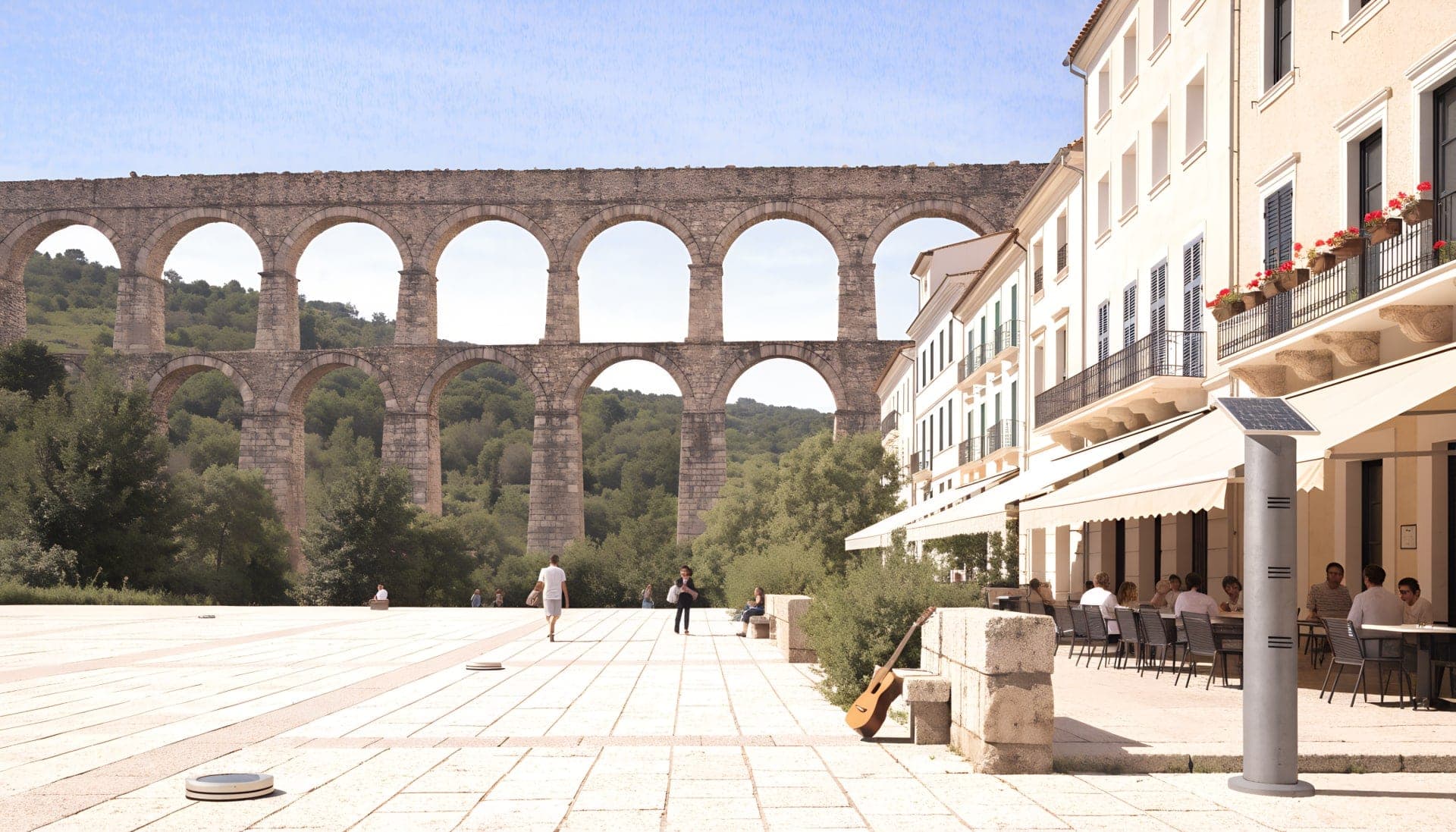
Going online often books a place in a queue
Spain is a State of 17 autonomous communities, the regions, and 8,131 municipalities. Most of them are villages: 4,986 have fewer than 1,000 inhabitants and hold 3% of the population, while 39.9% of people live in municipalities of more than 100,000. In January 2026 the country had more residents than ever, and for the first time over 10 million of them had been born abroad.
The climate law of 2021, Ley 7/2021, requires emissions at least 23% below 1990 by 2030 and climate neutrality before 2050. In 2024 the government’s national energy and climate plan, the PNIEC, raised its own 2030 aim to 32% below 1990. The law also created a committee of independent experts to report to parliament every year. In 2026 the Real Instituto Elcano, a think tank on international affairs, noted that it was still to be set up.
By 2024 Spain’s emissions were only 5.9% below 1990, against 38% across the EU. The figure hides a rise and a fall. Emissions climbed by 56% to a peak in 2007, then fell by 40% to 2024, while the population grew by more than a quarter. In 2025 they rose again, by 1.1%. Transport, the largest source at 34.2% of the total, grew by 2.4%. Power stations emitted 5.5% more as gas plants ran under the reinforced security regime adopted after the blackout of 28 April 2025.
index, 1990 = 100
Show the numbers
| Spain | EU-27 | Climate-law path | |
|---|---|---|---|
| 1990 | 100.0 | 100.0 | — |
| 1991 | 102.8 | 97.8 | — |
| 1992 | 105.9 | 94.7 | — |
| 1993 | 102.5 | 93.1 | — |
| 1994 | 108.3 | 92.6 | — |
| 1995 | 114.0 | 93.7 | — |
| 1996 | 111.4 | 95.6 | — |
| 1997 | 116.6 | 94.0 | — |
| 1998 | 120.1 | 93.2 | — |
| 1999 | 129.6 | 91.6 | — |
| 2000 | 135.0 | 91.4 | — |
| 2001 | 134.7 | 92.4 | — |
| 2002 | 141.2 | 92.1 | — |
| 2003 | 143.8 | 93.7 | — |
| 2004 | 149.4 | 93.7 | — |
| 2005 | 154.7 | 93.2 | — |
| 2006 | 152.6 | 93.3 | — |
| 2007 | 156.2 | 92.2 | — |
| 2008 | 144.5 | 90.2 | — |
| 2009 | 131.0 | 84.1 | — |
| 2010 | 125.7 | 85.7 | — |
| 2011 | 125.1 | 83.3 | — |
| 2012 | 122.3 | 81.8 | — |
| 2013 | 112.9 | 80.0 | — |
| 2014 | 112.8 | 77.1 | — |
| 2015 | 116.8 | 78.0 | — |
| 2016 | 112.9 | 78.0 | — |
| 2017 | 117.5 | 78.5 | — |
| 2018 | 115.6 | 76.7 | — |
| 2019 | 109.1 | 73.4 | — |
| 2020 | 95.5 | 67.4 | — |
| 2021 | 101.4 | 70.9 | — |
| 2022 | 102.8 | 69.0 | — |
| 2023 | 94.9 | 63.5 | — |
| 2024 | 94.1 | 62.0 | 94.1 |
| 2025 | — | — | 91.3 |
| 2026 | — | — | 88.4 |
| 2027 | — | — | 85.6 |
| 2028 | — | — | 82.7 |
| 2029 | — | — | 79.9 |
| 2030 | — | — | 77.0 |
| 2031 | — | — | 73.2 |
| 2032 | — | — | 69.3 |
| 2033 | — | — | 65.5 |
| 2034 | — | — | 61.6 |
| 2035 | — | — | 57.8 |
| 2036 | — | — | 53.9 |
| 2037 | — | — | 50.1 |
| 2038 | — | — | 46.2 |
| 2039 | — | — | 42.4 |
| 2040 | — | — | 38.5 |
| 2041 | — | — | 34.7 |
| 2042 | — | — | 30.8 |
| 2043 | — | — | 26.9 |
| 2044 | — | — | 23.1 |
| 2045 | — | — | 19.3 |
| 2046 | — | — | 15.4 |
| 2047 | — | — | 11.5 |
| 2048 | — | — | 7.7 |
| 2049 | — | — | 3.9 |
| 2050 | — | — | 0.0 |
Greenhouse-gas emissions excluding land use and international aviation and shipping, indexed to 1990, for Spain and the EU-27. The third line runs straight from 2024 through the targets of Ley 7/2021: at least 23% below 1990 by 2030, and neutrality by 2050 (drawn as zero, before any removals). The 2024 national energy and climate plan aims further, at 32% below 1990 by 2030. One step on the axis is one year. Source: Eurostat, env_air_gge (greenhouse gases excluding land use and international transport)
The networks tell the opposite story. Fibre to the premises passes 96% of homes, against 74.1% across the EU, and gigabit coverage of any kind is no higher, at 96%. In 2009 the telecoms regulator, since merged into the CNMC, made Telefónica, the former State telephone company, rent space in its ducts to rivals. By 2016 more than 200 operators had signed contracts. Telefónica closed its first copper exchange in 2015 and the last 661 of its 8,526 in May 2025.
Fibre also reaches the countryside: 86.3% of rural households in the Commission’s 2025 report, against an EU rural average of 58.8%. State subsidies fill the gaps, through a programme that aims to bring fibre to 6.3 million properties. 5G covers 99.2% of populated areas.
Spain is above the EU-27 average on every row shown, and furthest ahead on fibre to the premises. Coverage figures are for 2025, from the Commission’s Digital Decade report; use and skills figures are Eurostat surveys for 2025. Renewables and firms using AI, each within half a point of the EU average, are left out. Source: European Commission, Digital Decade (DESI 2026); Eurostat (isoc_ciegi_ac, isoc_sk_dskl_i21, isoc_eb_ai, nrg_ind_ren)
Spaniards also deal with the State online more than the EU average: 62.6% of adults did so in 2025, against 57.7% across the EU. What they do there is distinctive. 62.0% of all adults booked an appointment with a public service online, against 38.1% across the EU, while filing a tax return online was level with the EU average. Booking online is the door to the cita previa, the appointment that many public offices require before they see anyone in person.
At the State’s own offices that door is often shut. In 2026 the consumer organisation OCU made six attempts over two weeks to book appointments at two State offices, Social Security and the employment service, in 26 provinces. More than half found no slot in the same city; in Granada, Tarragona, Valencia and Zaragoza none succeeded, and in Albacete, Bilbao and Oviedo the first slots were 28 to 32 days away. The OCU wants compulsory appointments abolished. Town halls use them too: in 2023 the Ombudsman asked Teror, a town on Gran Canaria, to let people in without one, and Teror refused.
Older people lag: 39.4% of 65–74-year-olds dealt with the authorities online in 2025. The Commission’s 2026 report on Spain asks it to make digital public services work together across the regions, to avoid regional imbalances.
Digitalisation processes must be compatible with face-to-face assistance.A town hall can fine a car but needs permission for a police camera
The Constitution keeps telecoms, public security and the bases of energy for the State, and gives the regions planning and housing. The local-government law of 1985 sets municipal duties by size, and the provincial councils, the diputaciones, must run electronic administration for towns under 20,000.
- Broadband: the State legislates, the CNMC, the competition and markets authority, regulates, and private operators build. Town plans may not restrict networks disproportionately; small antennas need no permit.
- Urban transport: a municipal duty above 50,000 inhabitants. Since December 2025 every town over 20,000 must adopt a sustainable mobility plan, and State mobility aid requires one.
- Streets: cities regulate and fine urban traffic under the State’s traffic law. The 2021 climate law required a low-emission zone, a ZBE, in every municipality over 50,000 by 2023. Courts annulled Madrid’s and Barcelona’s first zones, Madrid’s for weighing costs and benefits too thinly; in 2026 Málaga’s fell too, for penalising cars that pay road tax elsewhere, and it stopped fining in October.
- Policing and cameras: public security is the State’s, with regional police forces in Catalonia and the Basque Country. A local police force needs outside permission for a fixed camera: the State’s Government Delegate gives it after a commission chaired by the regional High Court’s president, or the regional government where it has its own police.
- Energy: the State sets the bases. Since 2018 power made and used on one’s own roof has carried no charges or tolls. Since March 2026 municipalities may also promote and join citizen energy communities.
- Planning: land use and housing law belong to the regions, so urban rules differ 17 ways. Towns make plans and grant licences; building energy standards are national.
- Open data: a 2007 State law binds local government too and requires high-value datasets free and by API. FEMP, the federation of municipalities and provinces, lists 80 essential datasets for councils.
- Online services and e-ID: the State sets one administrative procedure and the identity systems; each administration runs its own e-office. Residents may choose paper or digital at any time; companies must go online.
- Software and procurement: before buying or building an application, an administration must check the State’s general directory of applications and reuse what it finds, unless it justifies otherwise. One procurement law applies everywhere.
- Tax: the three Basque provinces and Navarre collect their own taxes under historical agreements; everywhere else the State does.
- Skills: the State’s 2021 digital-skills plan was announced with €3.75bn; the regions run schools, and municipalities have a statutory duty to promote residents’ use of information technology.
The split makes one thing easy. Where a State law gives towns a duty, often with a condition on money, the same instrument appears in many places, as low-emission zones have. Where the lever stays with the State, cities depend on it: the fibre came from the regulator and the operators, and no local police force can put up a fixed camera without outside permission. Size is the other limit: most municipalities are villages, and they depend on their province for electronic administration.
Around the town halls sit a few national bodies. FEMP speaks for municipalities to the State and manages their new urban data space. RECI, the Spanish Network of Smart Cities, has more than 170 cities and provincial councils as members. Red.es, the State’s digital agency, and SEGITTUR, its company for tourism innovation, run the programmes cities apply to. Civio, a transparency foundation, the OCU and the Ombudsman press from outside, and the AEPD, the data-protection agency, has fined companies for facial recognition.
The State’s money reaches hundreds of places, slowly
Pedro Sánchez of the Socialist Party (PSOE) has led a minority coalition with Sumar, a left-wing alliance, since the July 2023 election, at which the conservative People’s Party (PP) won the most seats but no bloc had a majority. Junts, a Catalan pro-independence party, broke with the government in October 2025 and tabled amendments to all 25 of its bills. Spain has had no new State budget since 2023, and the government let the 1 October 2026 deadline for a 2027 budget pass. On 2 October Congress rejected the government’s housing decrees. On 5 October Sánchez dissolved parliament and called a general election for 29 November 2026.
One ministry, under Óscar López, holds both digital transformation and the civil service. Urban policy sits with the housing ministry. Red.es’s first five smart-city calls awarded more than €200m to 59 projects: 25 cities, 24 tourist destinations, seven building schemes and three island territories. In September 2026 a sixth, RedCyTI, added 52 projects with more than €94m from Red.es and EU regional funds.
Recovery money then funded calls for town halls: in 2021, €89.4m was awarded to 145 municipalities over 50,000; in 2022, €154.5m was awarded to 242 smaller ones, 53 provincial councils and other bodies. In February 2026 the Tribunal de Cuentas, the Court of Audit, reported on Red.es’s share of the recovery money. By the end of 2024 the agency had committed €4,046.7m and paid out €1,016.3m, a quarter.
Kit Digital, its grant scheme for small firms, alone had €2,220m awaiting payment, and the court found the agency had lacked sufficiently detailed planning in its first years. One recovery line shows how far plans and spending drifted: Red.es budgeted €140m for sectoral data spaces and used €13m of it, all for one direct grant to FEMP, made in October 2024, to build the municipalities’ urban data space. In May 2026 parliament’s audit committee asked the government to evaluate what the recovery funds had achieved.
We are not seeing in private investment the catalytic effect or the leverage effect that these funds should have had.Spain’s recovery plan is worth €102bn, €79bn of it EU grants, and €22.2bn of it is for digital aims. With its sixth payment, in August 2026, Spain had received €78bn, about three-quarters of its plan. On 30 September it filed the seventh and final request, for €25.86bn, which the Commission has until the end of the year to pay. Seven Spanish cities, Barcelona, Madrid, Seville, Valencia, Valladolid, Vitoria-Gasteiz and Zaragoza, are in the EU mission for climate-neutral and smart cities by 2030, and all seven hold the mission label (since March 2024). Valencia hosts the EU consortium for local digital twins, CitiVERSE, set up in December 2024 with more than €80m from the Digital Europe programme to build reusable tools for cities; it has published no results yet.
The aim is to drive digitalisation that serves citizens, and not, as so often happens, one where citizens have to adjust to the technology.The State is building some tools of its own. ALIA, a family of open language models trained by the Barcelona Supercomputing Center and publicly funded, covers Spanish, Catalan, Basque and Galician among 35 languages. SEPI, the State holding company, owns 10% of Telefónica and 28% of Indra, an IT and defence group.

The argument is about who checks the machines. The AEPD fined the supermarket chain Mercadona €2.5m in 2021 for facial recognition in its shops, and Aena, the airports operator, more than €10m in 2025. In September 2025 the Supreme Court ordered the government to give Civio the source code of BOSCO. The software decides who gets a discount on electricity bills, and Civio had asked for its code in 2018.
In December 2025 the government replaced the first director of AESIA, the new AI supervisory agency in A Coruña, which then planned to reach 55 staff. The national AI bill that would have given it powers to fine reached parliament in May 2026 and lapsed, still in committee, when parliament was dissolved in October. In 2023 Judith Membrives of Lafede.cat, a Catalan federation of civil-society groups, asked how the agency would observe AI’s social impact “without people from the humanities or social sciences” on its staff.
- Apr 1985[source]
Local-government law
Municipal competences are set by population; urban buses become a duty above 50,000.
- 2011[source]
RECI founded
Cities form the Spanish Network of Smart Cities.
- Jan 2015[source]
First smart-city standard
UNE 178301 sets out how cities should publish open data.
- Oct 2015[source]
Reuse before you build
Ley 40/2015 obliges administrations to look for reusable applications first.
- May 2021[source]
Climate law
Ley 7/2021 sets targets for 2030 and 2050 and orders low-emission zones.
- Apr 2022[source]
Mission cities
Seven Spanish cities join the EU mission for climate-neutral and smart cities.
- Aug 2023[source]
Police face matching
ABIS, the police facial-recognition system, goes live.
- Sep 2025[source]
BOSCO ruling
The Supreme Court opens a public algorithm’s source code to a civil-society request.
- Dec 2025[source]
Sustainable Mobility Act
Mobility plans for towns over 20,000, and data for the State’s mobility data space.
- Nov 2026[source]
Snap general election
Royal Decree 806/2026 dissolves the Cortes; Spain votes on 29 November and the new chambers meet on 23 December.
- 2030[source]
Climate targets
At least 23% below 1990 in law, 32% in the national plan.
- 2050[source]
Neutrality
The latest date the climate law allows for a climate-neutral Spain.
From the law that sets what a town must do to the targets the next governments inherit.
From Santander’s sensors to Benidorm’s certificate
SmartSantander was an EU-funded city-wide sensor testbed of 2010–2013. It cost €8.47m, €6m of it from the EU, was coordinated by Telefónica’s research arm and planned more than 20,000 sensors. The testbed’s own afterlife is not documented. A later municipal contract shows what can go wrong: in 2024 a city audit of a €850,000 underground-bin contract found no fill-level sensors installed, and the manager of the city’s SmartCity platform said it had received no data from them for years. Santander is now one of the 12 data offices of the municipalities’ urban data space.
Vitoria-Gasteiz and Valladolid were lighthouse cities in EU projects that ended around 2020. In Vitoria’s Coronación district, Visesa, the Basque public housing company, managed the works for private owners. There, 302 homes in 26 buildings were retrofitted with subsidies of 54–100%, with a 90% cut in CO₂ emissions, by the housing company’s figures. Valladolid’s REMOURBAN retrofitted more than 400 homes in the FASA district and, with the utility Iberdrola, installed 86 public charging points. No replication of either model has been reported.
Seville’s CartujaQanat, a €5m project 80% funded by the EU, built an underground water store, a sunken market square and planted pergolas between 2021 and 2022. It aims to cool the ground by 6–7 °C over an area the size of two football pitches; measured results have so far appeared only in secondary reports. The city has since put scaled-down versions into bus stops.
Benidorm became the first municipality certified as a Smart Tourist Destination, under the UNE 178501 standard, in January 2019. The model then spread through SEGITTUR’s network: more than 255 destinations have been assessed and more than 700 bodies belong to it. A 2026 analysis by the University of Alicante for SEGITTUR found average compliance with the model of 35.7%: 42.2% in urban destinations and 27.9% in rural ones, where specialised staff and money are short.

Low-emission zones show how a State duty travels. The 2021 law set 2023 as the deadline, and the State’s transport subsidy now requires a zone in operation during 2026. By September 2026 the motoring magazine Motor16 counted 68 active zones among the 149 towns over 50,000 that the law obliges. The ministry’s own map, which also counts islands and polluted smaller towns, showed 55 of 164 in force in January.
CONSUL, the open-source software behind Madrid’s participation portal, shows how code travels. Madrid’s participatory budget began in 2015 with €100m, was halved in 2020 by a conservative city government, and was in its eighth cycle in June 2026. The software is used by more than 250 cities and organisations worldwide, Tenerife and Málaga among them. Barcelona’s Decidim, a parallel platform, says hundreds of organisations around the world use it.

Residents see the State’s door differently from the OCU. In the IMD Smart City Index, a survey of how residents experience their city, Bilbao ranks 30th of 148, Madrid 37th, Zaragoza 63rd and Barcelona 94th. Asked whether processing identification documents online has cut their waiting times, residents of Bilbao, Madrid and Zaragoza agree more than those of almost any of 17 cities in Germany, France, Spain, the Netherlands and Belgium. Zaragoza is also one of the four cities where the OCU found no appointment at all.
IMD’s score from 0 to 100 for how far residents agree with the statement, in 17 cities in Germany, France, Spain, the Netherlands and Belgium; Spanish cities in ink. The IMD Smart City Index surveys residents on how they experience their city; it measures perception, not performance. Source: IMD World Competitiveness Center, Smart City Index 2026 (resident survey)
The State order moved town halls once money was tied to it: fewer than half the towns obliged to run a low-emission zone had one by autumn 2026, three years after the legal deadline and after the transport subsidy began to require one. The State’s grants reached hundreds of town halls, but none has published what they changed. The EU’s showcase pilots in Santander, Vitoria and Valladolid stayed where they were built. What travelled furthest was code another administration had already paid for: Madrid’s CONSUL now runs in Tenerife, Málaga and cities abroad, under a law that tells every administration to look for such code before it builds its own.
References
Statistics1Click on any number to see the source
Population & migration
From our libraries8
- Ley 7/2021, de 20 de mayo, de cambio climático y transición energética — Knowledge
- La reconfiguración de la gobernanza climática en 2026 (Real Instituto Elcano) — Knowledge
- Avance del Inventario de Emisiones de GEI del año 2025 (MITECO) — Knowledge
- Digital Decade 2026 Short Country Report: Spain (Annex to COM(2026) 288, Council doc 10476/26 ADD 27) — Knowledge
- Barcelona Supercomputing Center (BSC) — Organisation
- Transparencia algorítmica: el Supremo avala el acceso al código fuente de la Administración (STS 1119/2025, caso BOSCO) — Knowledge
- Análisis del modelo Destino Turístico Inteligente de SEGITTUR: la perspectiva de los destinos (SEGITTUR / Universidad de Alicante, 2026) — Knowledge
- Decidim — Organisation
Further sources20
- Padrón municipal: infographic — INE
- PNIEC 2023–2030 approved — MITECO · 24 Sept 2024
- Telefónica closes its last copper exchanges — Xataka Móvil · 25 Aug 2026
- OCU on appointment waits at Social Security and SEPE — El Debate · 16 Mar 2026
- Direct access to registry offices without an appointment (Teror) — Defensor del Pueblo · 21 June 2023
- Ley 40/2015 de Régimen Jurídico del Sector Público — BOE
- Ley 7/1985 reguladora de las Bases del Régimen Local — BOE
- The Supreme Court rejects Madrid’s appeal against the ruling that annulled its ZBE — Diario de Transporte · 2026
- VI Congreso RECI — RECI / FYCMA · 23 July 2026
- Tribunal de Cuentas: control failures at Red.es — The Objective · 5 Mar 2026
- Spain’s recovery and resilience plan — European Commission
- Herrero (AIReF) on the recovery plan’s impact — Bolsamanía · 26 May 2025
- ALIA-40b model card — Barcelona Supercomputing Center (Hugging Face)
- Real Decreto 806/2026: dissolution of the Cortes and general election — BOE · 6 Oct 2026
- More than 300 bills lapse with the end of the legislature — Civio · 5 Oct 2026
- Government replaces AESIA’s director — Forbes España · 19 Dec 2025
- Real Decreto-ley 17/2025: transport-pass subsidies — Derecho Local
- Santander’s underground containers were never connected to SmartCity — El Faradio · 5 Feb 2024
- SmartSantander — CORDIS
- Smart City Index 2026 — IMD World Competitiveness Center · 2026