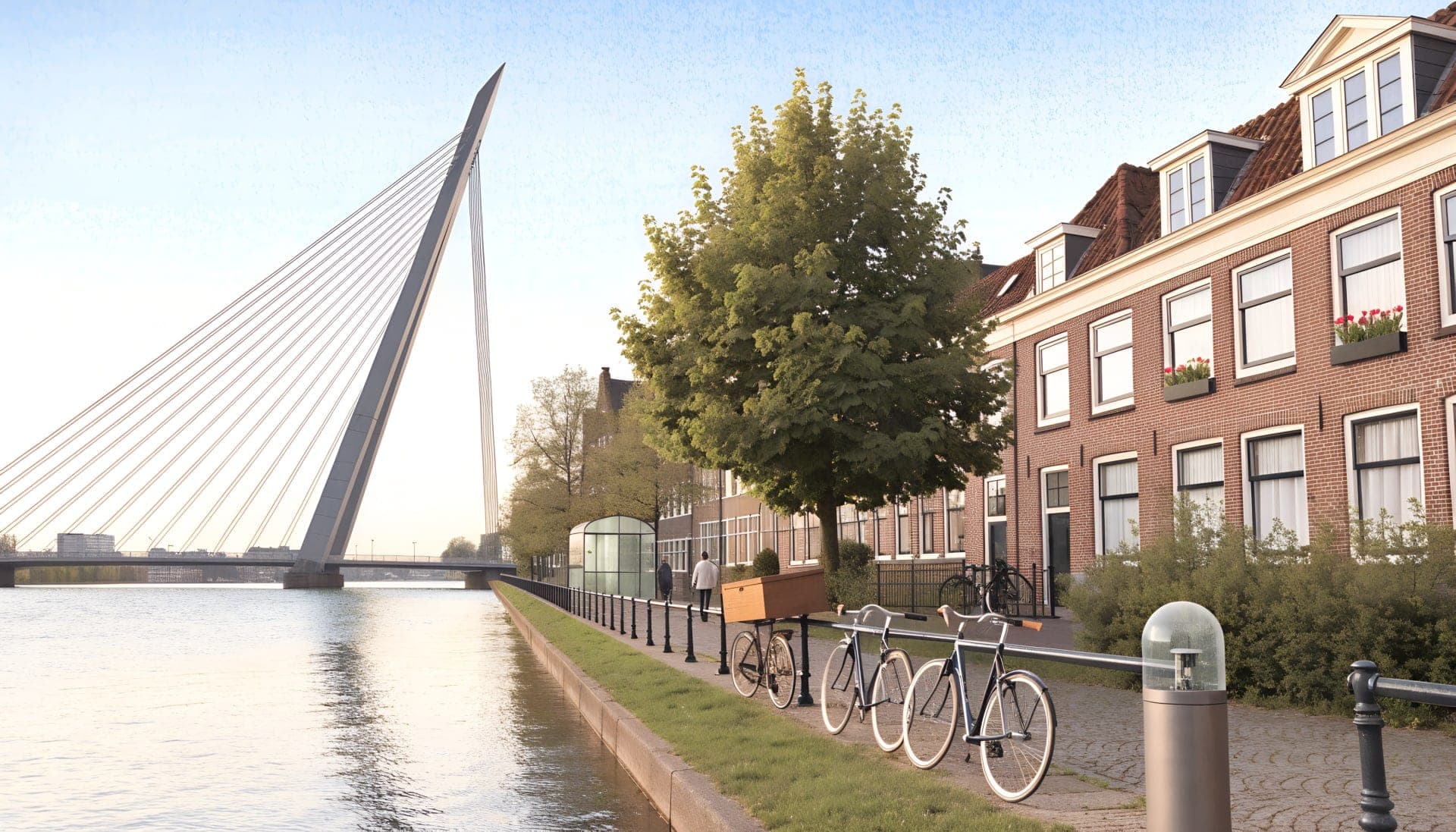
Nearly everyone is online; 4.5m adults cannot manage it
Much of the Dutch state’s daily work happens in its 342 municipalities: welfare and its fraud control, planning, heat and local services. The country is ageing. People aged 65 and over were 21% of the population in 2025, and the national statistics office expects 25% by 2040.
The Climate Act requires net emissions of zero by 2050 at the latest and aims for a cut of 55% on 1990 by 2030. By 2024 emissions were 36.8% below 1990, slightly less than the EU’s 38%, and in 2025 they rose by 0.3 million tonnes as electricity cancelled out falls in industry and transport. In September 2026 PBL, the Netherlands Environmental Assessment Agency, put the chance of the 2030 aim at under 5%: “Political deadlock has taken the pace out of the energy transition.”

index, 1990 = 100
Show the numbers
| Netherlands | EU-27 | Climate Act | |
|---|---|---|---|
| 1990 | 100.0 | 100.0 | — |
| 1991 | 103.5 | 97.8 | — |
| 1992 | 103.7 | 94.7 | — |
| 1993 | 103.8 | 93.1 | — |
| 1994 | 104.1 | 92.6 | — |
| 1995 | 104.1 | 93.7 | — |
| 1996 | 108.8 | 95.6 | — |
| 1997 | 104.9 | 94.0 | — |
| 1998 | 105.0 | 93.2 | — |
| 1999 | 99.4 | 91.6 | — |
| 2000 | 98.7 | 91.4 | — |
| 2001 | 99.1 | 92.4 | — |
| 2002 | 98.2 | 92.1 | — |
| 2003 | 98.5 | 93.7 | — |
| 2004 | 99.1 | 93.7 | — |
| 2005 | 96.5 | 93.2 | — |
| 2006 | 94.3 | 93.3 | — |
| 2007 | 93.7 | 92.2 | — |
| 2008 | 93.6 | 90.2 | — |
| 2009 | 91.1 | 84.1 | — |
| 2010 | 96.5 | 85.7 | — |
| 2011 | 90.1 | 83.3 | — |
| 2012 | 88.2 | 81.8 | — |
| 2013 | 88.1 | 80.0 | — |
| 2014 | 84.4 | 77.1 | — |
| 2015 | 87.4 | 78.0 | — |
| 2016 | 87.7 | 78.0 | — |
| 2017 | 86.4 | 78.5 | — |
| 2018 | 84.1 | 76.7 | — |
| 2019 | 81.5 | 73.4 | — |
| 2020 | 74.1 | 67.4 | — |
| 2021 | 75.3 | 70.9 | — |
| 2022 | 68.7 | 69.0 | — |
| 2023 | 64.1 | 63.5 | — |
| 2024 | 63.2 | 62.0 | 63.2 |
| 2025 | — | — | 60.2 |
| 2026 | — | — | 57.1 |
| 2027 | — | — | 54.1 |
| 2028 | — | — | 51.1 |
| 2029 | — | — | 48.0 |
| 2030 | — | — | 45.0 |
| 2031 | — | — | 42.8 |
| 2032 | — | — | 40.5 |
| 2033 | — | — | 38.3 |
| 2034 | — | — | 36.0 |
| 2035 | — | — | 33.8 |
| 2036 | — | — | 31.5 |
| 2037 | — | — | 29.3 |
| 2038 | — | — | 27.0 |
| 2039 | — | — | 24.8 |
| 2040 | — | — | 22.5 |
| 2041 | — | — | 20.2 |
| 2042 | — | — | 18.0 |
| 2043 | — | — | 15.8 |
| 2044 | — | — | 13.5 |
| 2045 | — | — | 11.3 |
| 2046 | — | — | 9.0 |
| 2047 | — | — | 6.8 |
| 2048 | — | — | 4.5 |
| 2049 | — | — | 2.3 |
| 2050 | — | — | 0.0 |
Greenhouse-gas emissions excluding land use and international aviation and shipping, indexed to 1990, for the Netherlands and the EU-27. The third line runs straight from 2024 through the Climate Act’s aim of 55% below 1990 by 2030 to net zero by 2050 (drawn as zero). One step on the axis is one year. Source: Eurostat, env_air_gge (greenhouse gases excluding land use and international transport)
For cities the grid is now the hard limit on electrification. At the end of 2025 large users had more than 15,000 connection requests waiting at the regional grid operators, about 1,000 more than six months earlier. The old practice of reserving capacity for new housing is being wound down. From 1 October 2026 a municipality may instead request capacity for planned homes and schools up to ten years ahead, in an order the municipal association VNG coordinates.
Renewables lag too. They supplied 20.2% of final energy in 2024, against 25.2% across the EU; PBL expects 31–37% in 2030 against a national goal of 39%, with wind at sea doing half the work.
The digital networks, by contrast, are nearly complete. Fibre to the premises passes 91.5% of homes, against 74.1% across the EU, and it was built by competing private companies rather than a state programme. KPN, the former monopoly; Glaspoort, its joint venture with the pension fund APG; Delta Fiber, owned by EQT; and the KKR-backed Open Dutch Fiber compete against a cable network that reaches 95% of households.
The Netherlands is ahead of the EU-27 on every digital measure here, most of all on adults dealing with the authorities online, and behind it on renewable energy. Coverage figures are for 2025, from the Commission’s Digital Decade report; use, skills and AI figures are Eurostat surveys for 2025; renewables are for 2024. Source: European Commission, Digital Decade (DESI 2026); Eurostat (isoc_ciegi_ac, isoc_sk_dskl_i21, isoc_eb_ai, nrg_ind_ren)
Dealing with the state online is normal: 84.9% of adults did so in 2025, against 57.7% across the EU. Digitaal 2017, a programme to put all government business online by 2017, ended with 90% of it available. In 2025 there were 16.6m active DigiD accounts, the national login, and 645m logins.
Accounts are not people. The latest research, reported in 2023, found about 4.5m adults who could not adequately find government information or use its online services, and people aged 65 and over asked six in ten of the questions at the help desks. Those desks, in public libraries, answered 164,591 questions in 2025, up from 130,025 the year before.
With DigiD three difficult things come together: you must identify yourself within a limited time, you need several devices at once, and there are regular security updates that change things you had just got used to.Planning shows the same gap. Since 2024 permit applications are meant to go through the Omgevingsloket, the national online counter built for the new Environment and Planning Act. In January 2026 the law’s evaluation committee wrote that complaints about it persisted and that its promise of “one click on the map” was not being kept. Some councils were using their own forms or asking residents to come to the counter.
Councils run welfare and heat; the state runs the logins
Dutch municipalities run a great deal, but under national law and largely on national money. The split below shows where a city can act alone and where it waits for someone else.
- Broadband: private builders lay the lines and the competition authority ACM regulates them. A city coordinates street works; it neither builds nor subsidises networks.
- Public transport: the provinces award most bus concessions, a few metropolitan transport regions award their own, and the minister awards rail. Most cities negotiate with their province.
- Policing and cameras: there is one national police force. The mayor directs it on public order and may place public-order cameras if the council allows it by bylaw. Experiments with analysis are the police’s own: in Roermond the police scored every car entering the town.
- Welfare and its algorithms: municipalities pay social assistance and police its fraud themselves, under the Participation Act. That is why the welfare-fraud models of Rotterdam and Amsterdam were the councils’ own.
- Electricity grids: the regional operators are publicly owned, with provinces and municipalities as shareholders, and the ACM sets the order in which spare capacity is handed out. A city owns a stake but cannot buy capacity.
- Heat: under the Collective Heat Act, passed in December 2025, municipalities lead the switch to heat networks, and heat companies must come under majority public ownership.
- Planning: the municipality writes its own omgevingsplan, the single local plan, but applications are meant to arrive through the state’s online counter.
- Open data and algorithms: the Open Government Act, in force since May 2022, sets the same transparency duties for every authority. Publishing algorithms in the Algoritmeregister, the national algorithm register, is voluntary.
- Online services and the e-ID: the state builds DigiD and the citizen portal MijnOverheid through Logius, its digital-infrastructure agency; each municipality builds its own front end. Since July 2023 the Digital Government Act has required every authority to accept approved logins and secure its websites to set standards.
- Procurement, open source and skills: listed open standards are mandatory unless an authority explains why not, publishing source code is a request rather than a duty, and the state funds digital help desks in public libraries.
The split explains a pattern. Dutch cities are strong where a national law hands them a duty and a common standard. Every council must accept the national logins, so a shared component can reach dozens of them, and the heat law gives them control of district heating. They are weak where the decisive asset is national or private: fibre, grid capacity, police analytics, the planning system.
In 2024 VNG warned of a structural shortfall of about €2.4bn a year from 2026, the year councils call the ravijnjaar, the cliff-edge year. Around the councils sit a handful of national bodies. The Autoriteit Persoonsgegevens, the data-protection authority, is also the coordinating supervisor of algorithms. VNG runs Common Ground, a programme for councils to build software once and share it. Research comes from TNO, the national applied-research organisation, the universities and institutes such as the AMS Institute in Amsterdam.
We presented it too vaguely and too technically, with too small a group.Civil society holds the other end. A coalition of rights groups brought the case against SyRI, the national welfare risk-profiling system. Investigative newsrooms, Lighthouse Reports, Argos, Vers Beton and Follow the Money, obtained Rotterdam’s welfare-fraud model in full.
A national register that no council has to fill in
Rob Jetten’s cabinet of D66 (social liberals), the VVD (conservative liberals) and the CDA (Christian Democrats) took office in February 2026 after an early election in October 2025. It holds 66 of the 150 seats in the lower house, a minority. There is no digital ministry: Eric van der Burg, a state secretary at the Interior, runs digital government, while Willemijn Aerdts, at Economic Affairs, holds the digital economy and sovereignty.
Two scandals still frame the Dutch argument about public algorithms. In February 2020 a court in The Hague struck down the law behind SyRI, a system that linked welfare and tax data to flag possible fraud. It found the law too opaque to check and in breach of the right to private life. In December 2020 a parliamentary inquiry, Unprecedented Injustice, found that the tax office’s fraud hunt in childcare benefits had violated the basic principles of the rule of law. By June 2026, 44,045 parents had been confirmed as victims, and the repair budget stood at €11.8bn.
The national register began in a city. Amsterdam’s 2020 algorithm register now redirects to the Algoritmeregister, which grew from 1,224 descriptions in November 2025 to 1,573 from 353 public bodies on 2 October 2026. Of the 342 municipalities, 208 have published at least one; 86 have joined without publishing and 48 have not joined. In July 2025 the data-protection authority found a fundamental-rights assessment for only 5% of registered algorithms and asked for a legal duty to register.
This does not inspire enough confidence for careful follow-up of the 1,263 SyRI risk signals.Sovereignty has become the second theme. In July 2025 the state, provinces, municipalities and water boards adopted one digitalisation strategy, with a government cloud among its six priorities. When a US company agreed to buy Solvinity, the firm whose servers run DigiD, the opposition MP Barbara Kathmann of GroenLinks-PvdA, the Green–Labour alliance, warned that Trump could soon switch off the digital government at the push of a button. In May 2026 the government prohibited the takeover on national-security grounds; Solvinity is appealing, and its DigiD contract runs to August 2028.
In July 2026 the cabinet chose to build an open-source cloud in its own data centres. It is a decision, not yet a build: no budget has been set, and a proof of concept runs in the government’s Digilab.
In cloud technology, the government now finds itself in a situation that is no longer tenable.The Dutch recovery plan has €5.44bn in EU grants, 25.6% of it for digital aims; the fourth payment, approved in September 2026, will bring the total paid to €3.73bn. Six Dutch entries, covering seven municipalities, are in the EU mission for climate-neutral and smart cities: Amsterdam, Eindhoven with Helmond, Groningen, Rotterdam, The Hague and Utrecht. All but Utrecht held the mission label for their plans by July 2026.
- 2013–2017[source]
Digitaal 2017
A programme to put all government business online ends with 90% of it available.
- Dec 2020[source]
Unprecedented Injustice
A parliamentary inquiry finds the fraud approach in childcare benefits violated the rule of law.
- May 2022[source]
Open Government Act
One set of transparency duties for every authority comes into force.
- Jul 2023[source]
Digital Government Act
Authorities must accept approved logins and meet set security standards.
- Jan 2024[source]
Planning law and counter
The Environment and Planning Act and its national online counter go live.
- Mar 2025[source]
Motions on US cloud
Parliament asks for alternatives to American technology giants.
- Jul 2026[source]
Government cloud
The cabinet chooses an open-source cloud of its own; no budget is set yet.
- Jul 2026[source]
Enschede case closed
The Council of State upholds the annulment of the city’s wi-fi tracking fine.
- Oct 2026[source]
Grid requests for homes
Councils may request grid capacity for housing ten years ahead.
- 2030[source]
Climate aim
A cut of 55% on 1990; PBL puts the chance below 5%.
- 2032[source]
Local plans complete
The deadline for every council’s integrated omgevingsplan.
- 2050[source]
Net zero
The Climate Act’s deadline for net-zero emissions.
From digital by default to a government cloud of its own, with the laws in between.
What the councils stopped, and what they shared
In Rotterdam, SyRI flagged 1,263 addresses in Hillesluis and Bloemhof, two of the city’s poorest neighbourhoods, in 2018. The national steering group kept rejecting the project plan over doubts about data-protection law, and in July 2019 Mayor Ahmed Aboutaleb stopped it. The city’s own welfare-fraud model scored about 30,000 recipients a year on 315 variables, and young mothers and people with poor Dutch scored highest. The city’s audit office warned in 2021, and the model was stopped that year.
The model spread faster than the lesson. Two years later Amsterdam built its own welfare model, the Slimme Check, and stopped it in November 2023 when bias persisted.
Enschede tested where counting ends and tracking begins. From May 2018 to April 2020 the city counted pedestrians in its centre by picking up the wi-fi signals of their phones. The data-protection authority fined it €600,000 for tracking people. A court annulled the fine in February 2024 because the authority had not shown that anyone could be identified, and in July 2026 the Council of State upheld that ruling.
Helmond’s Brainport Smart District was planned from 2016 as a testbed of about 1,500 “smart” homes in Brandevoort. In October 2023 the city put it on hold and chose a new course: the deficit on its land development was heading from €35m towards €67m, and the National Growth Fund offered €7.5m of the €20m in innovation money the city had counted on. “It is financially irresponsible to carry on the old way,” said alderman Arno Bonte.
Groningen chose early what the law now requires. The city and its water company founded WarmteStad as a public heat company; by December 2025 it supplied 9,000 households and buildings, using waste heat from a data centre and a solar-heat park. Under the Collective Heat Act, heat companies must now come under majority public ownership, so that councils can steer the switch.
Signalen shows what keeps a shared tool alive. Built in Amsterdam as an open-source app for reporting problems in public space, it was taken up through VNG’s Common Ground programme and ran in 39 municipalities by 2024. Amsterdam still funds the core team, councils pool about €400,000 a year scaled by population, and a partnership with Denmark’s OS2 network has begun.
Utrecht is testing the grid’s side of the story. Utrecht Energized started in June 2025 with 50 shared electric cars that can feed power back, and aims for 500, which together could lend the grid up to 5 MW. No result has been published yet.
Residents are split on transparency. In the IMD Smart City Index, a survey of how residents experience their city, Amsterdam ranks 17th of 148, Rotterdam 52nd and The Hague 54th. Asked whether online information has increased their trust in the authorities, Amsterdam ties for second among 17 cities in Germany, France, Spain, the Netherlands and Belgium and Rotterdam comes fourth. The Hague, seat of the national government, comes twelfth.
Share of surveyed residents who agree or strongly agree, in 17 cities in Germany, France, Spain, the Netherlands and Belgium; Dutch cities in ink. The IMD Smart City Index surveys residents on how they experience their city; it measures attitudes, not outcomes. Source: IMD World Competitiveness Center, Smart City Index 2026 (resident survey)
The limits so far have been drawn case by case: by a mayor and a city audit office in Rotterdam, by a court in The Hague, and by the courts again when the regulator fined Enschede and lost. The lesson travelled more slowly than the models did. What spread between councils was a tool they own and pay for together, such as Signalen. Registering an algorithm is still voluntary, and 134 councils have published none.
References
Statistics1Click on any number to see the source
Population & migration
From our libraries7
- Klimaat- en Energieverkenning 2026 (PBL Planbureau voor de Leefomgeving) — Knowledge
- Kamerbrief Aanpak netcongestie (Staatssecretaris Klimaat en Groene Groei, 30 juni 2026) — Knowledge
- Monitor Digitale Overheid 2026 (Ministerie van BZK) — Knowledge
- Werk aan de winkel — Reflectierapport Omgevingswet 2025 (Evaluatiecommissie Omgevingswet) — Knowledge
- AMS Institute — Organisation
- Voortgangsrapportage hersteloperatie toeslagen, januari–juni 2026 (23e VGR) — Knowledge
- Kamerbrief stand van zaken verkenning soevereine overheidscloud (Kamerstuk 26643 nr. 1537, 1 juli 2026) — Knowledge
Further sources17
- Klimaatwet — Overheid.nl
- Waiting list for the grid grows to 15,000 requests — Solar Magazine · 3 Apr 2026
- Dutch FTTH market — Fibre Horizons (FTTH Conference) · 2025
- 4.5 million Dutch people struggle with digital government — NOS · 10 July 2023
- Koninklijke Bibliotheek annual report 2025 — Koninklijke Bibliotheek
- Algoritmeregister dashboard — Overheid.nl · read 2 Oct 2026
- Common Ground: without cooperation we will not make it — VNG Magazine · May 2024
- Judgment on SyRI, ECLI:NL:RBDHA:2020:865 — Rechtbank Den Haag · 5 Feb 2020
- Final report of the parliamentary inquiry into childcare benefits — Tweede Kamer · 17 Dec 2020
- AP: algorithm registration in the Netherlands must improve — Dutch IT Channel · 13 July 2025
- Logius opens up on the DigiD file — Dutch IT Channel · 29 June 2026
- Rotterdam stops SyRI — Binnenlands Bestuur · 3 July 2019
- Algorithm sees young mothers and non-native speakers as a risk group — Binnenlands Bestuur · 6 Mar 2023
- Court annuls Enschede wi-fi tracking fine — NOS · 2 Feb 2024
- Helmond stops its costly smart district — Eindhovens Dagblad (archive) · Oct 2023
- Utrecht Energized launched — electrive · 11 June 2025
- Smart City Index 2026 — IMD World Competitiveness Center · 2026