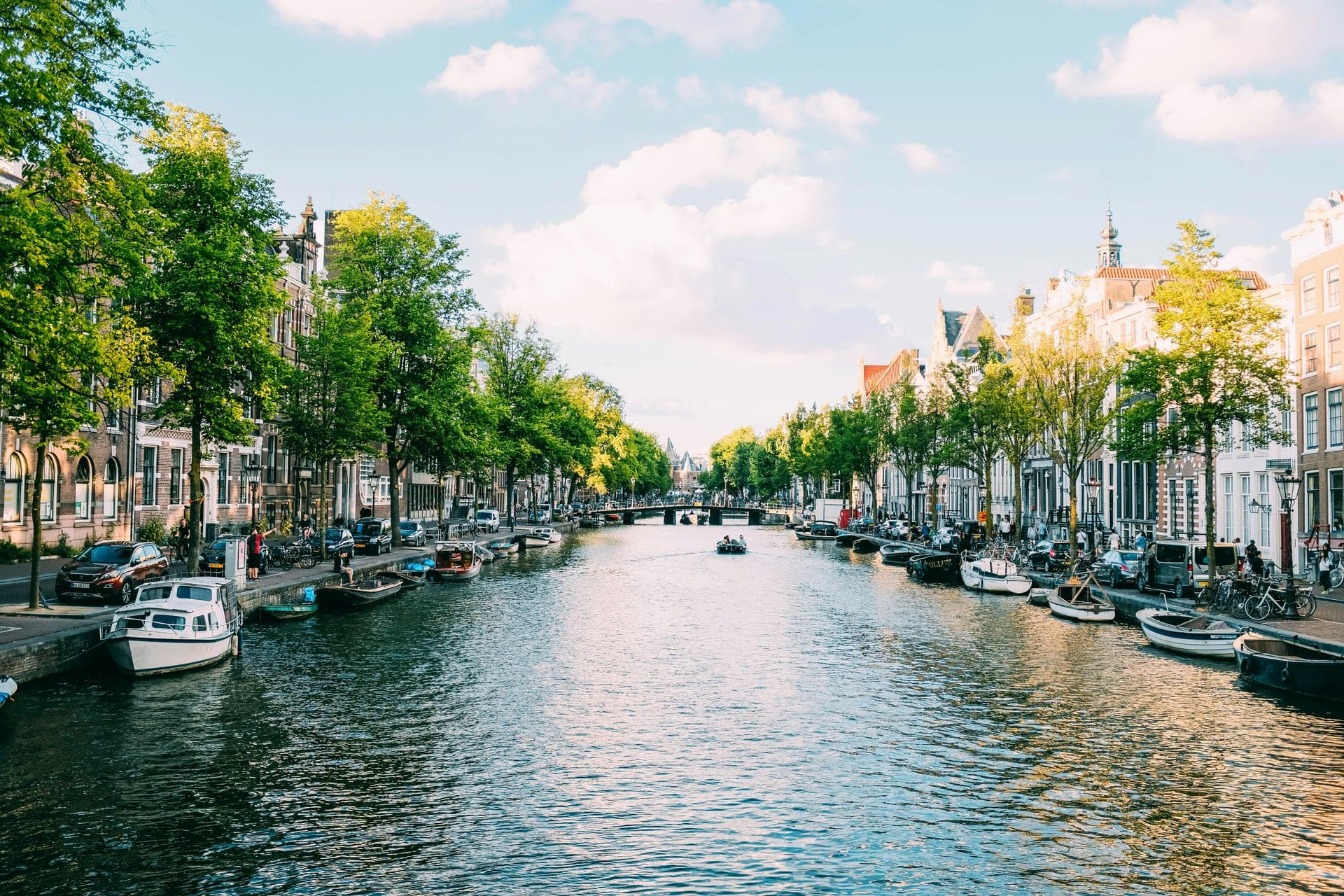
A city of cyclists on a grid that is full
In IMD’s 2026 resident survey for its Smart City Index, 87.1% of Amsterdam respondents named affordable housing as a priority, more than any other issue. The social rented stock grew to 223,000 homes in 2025, and the average wait for one has fallen slightly but is still almost ten years. The city keeps growing, with 941,927 registered residents on 1 January 2026, about 7,400 more than a year earlier.
The bicycle carried 35% of residents’ trips in 2023, more than any other way of getting about. With walking and public transport it accounted for 76%, according to the national travel survey ODiN as processed by O&S, the city’s research and statistics office. For drivers who have gone electric, the city counted about 10,000 public charging points and 240 fast chargers in March 2026.
Share of all trips made by Amsterdam residents, 2023, from the national travel survey ODiN as processed by the city’s research office. Visitors and commuters from outside the city are not included. Source: Gemeente Amsterdam O&S, De Staat van de Stad Amsterdam XIII (ODiN 2023)
Emissions have moved far more slowly. The 2020 climate roadmap aims for a climate-neutral city by 2050. The coalition that took office in June 2026 kept the interim goal of cutting CO₂ by 60% from 1990 levels by 2030. In 2022, the latest year measured, greenhouse-gas emissions were 10.1% below 1990, at 3.45 million tonnes. Buildings produced 2.05 million tonnes of that. CE Delft, a research consultancy working for the city, projects a cut of about 46% by 2030 on current policies.
million tonnes of CO₂ equivalent
Show the numbers
| Measured | Projected (CE Delft) | Target (−60% by 2030) | |
|---|---|---|---|
| 1990 | 3.84 | — | — |
| 2021 | 3.70 | — | — |
| 2022 | 3.45 | 3.45 | 3.45 |
| 2030 | — | 2.08 | 1.54 |
| 2050 | — | 0.68 | — |
All greenhouse gases emitted within the municipal boundary (scope 1 and 2). 2022 is the latest measured year; 2021 comes from CE Delft’s 2024 update on the same 1990 baseline. The projection is CE Delft’s for current national and municipal policy; the target line joins 2022 to the 60% cut the city aims for by 2030. Source: CE Delft for Gemeente Amsterdam, Raming Amsterdam klimaatneutraal – update 2025 (Table 22)
Electrifying that heat and traffic runs into a full grid. In November 2025 Liander, the regional grid operator, found 74 MW of spare capacity and connected 138 businesses. In January 2026 a recalculation moved about 150 waiting applications in Amsterdam, fed from the Diemen substation of TenneT, the national transmission operator, from late 2036 to the end of 2037.
On 1 October 2026 the city’s data API listed 106 public datasets. Fibre take-up is low: only a quarter of households use it despite more than 455,000 connections, according to the comparison site internetvergelijk.nl.
The gap lies with residents who cannot keep up. Waag Futurelab, a public-interest technology research group, estimates that about 20% of Amsterdammers cannot manage digitally, without naming its source. It also reports that 14% of lower-income residents have no computer or tablet at home. A June 2026 article by Waag and its partners describes a man with urgent housing status who could not answer listings for weeks, until someone sat beside him every week. The new coalition promises low-income families a free laptop every five years and digital help in every branch of the OBA, the city’s public book-lending network.
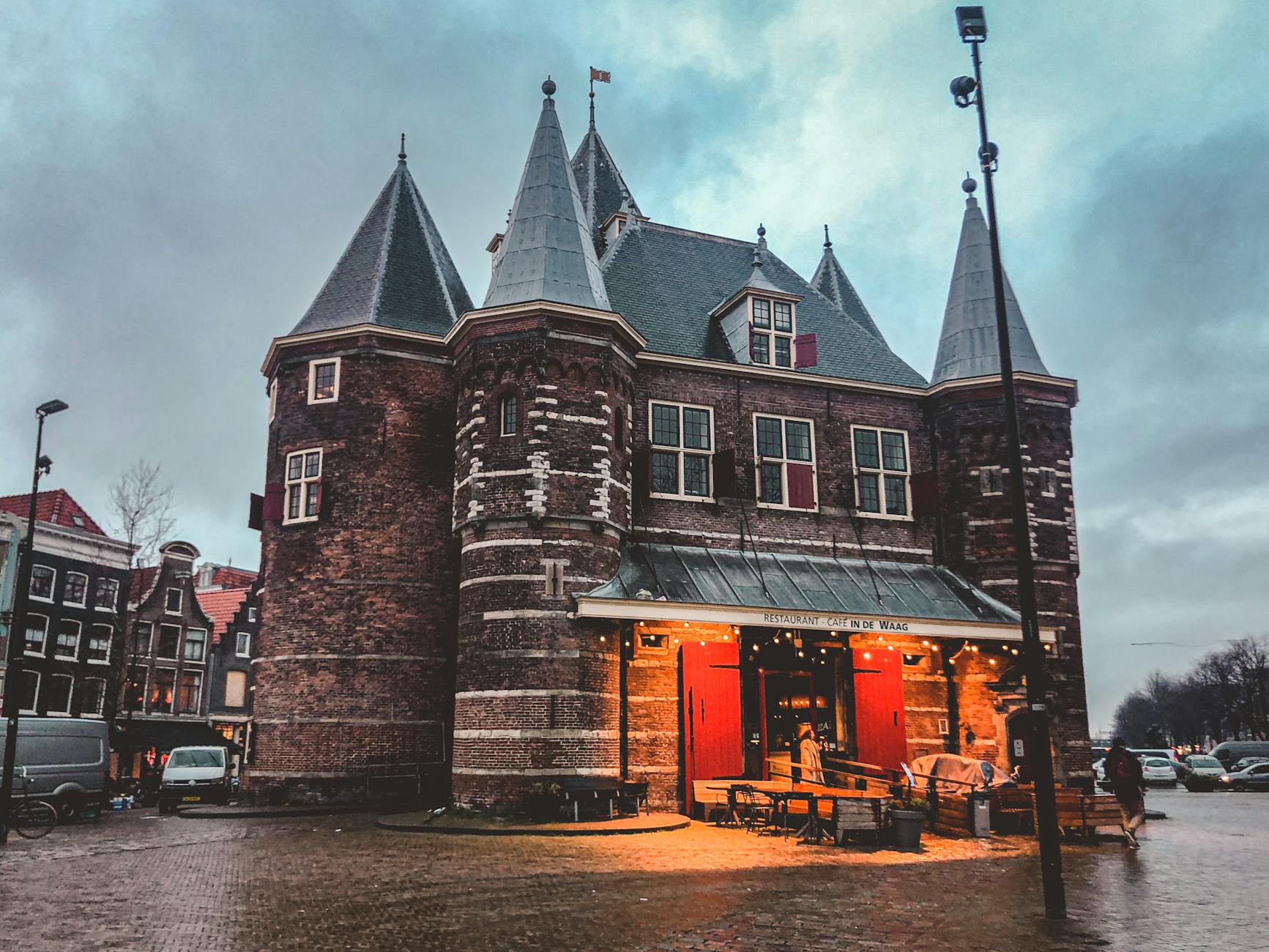
Residents can look up some of what watches them. A city bylaw requires sensors in public space to be registered, and only those of private individuals are exempt. The register lists 2,429 devices, 2,328 of them the city’s own and most of them cameras. Binnenlands Bestuur, a trade magazine for public administration, reported in April 2026 that the duty is hardly complied with.
If you put a terrace on the pavement in front of your bar, an enforcement officer visits within the hour. But if you hang up a camera, you can film the street for years without anyone coming to enforce.After the smart-city brand, a regional board
Amsterdam Smart City, the partnership platform whose name long stood for the city’s innovation work, no longer runs. Renamed Amsterdam InChange, it was wound down during 2025, according to the Amsterdam Economic Board’s annual report. Its innovation lab and network were folded into the Board, and its articles moved to Open Research Amsterdam, the city’s own platform for research and knowledge.
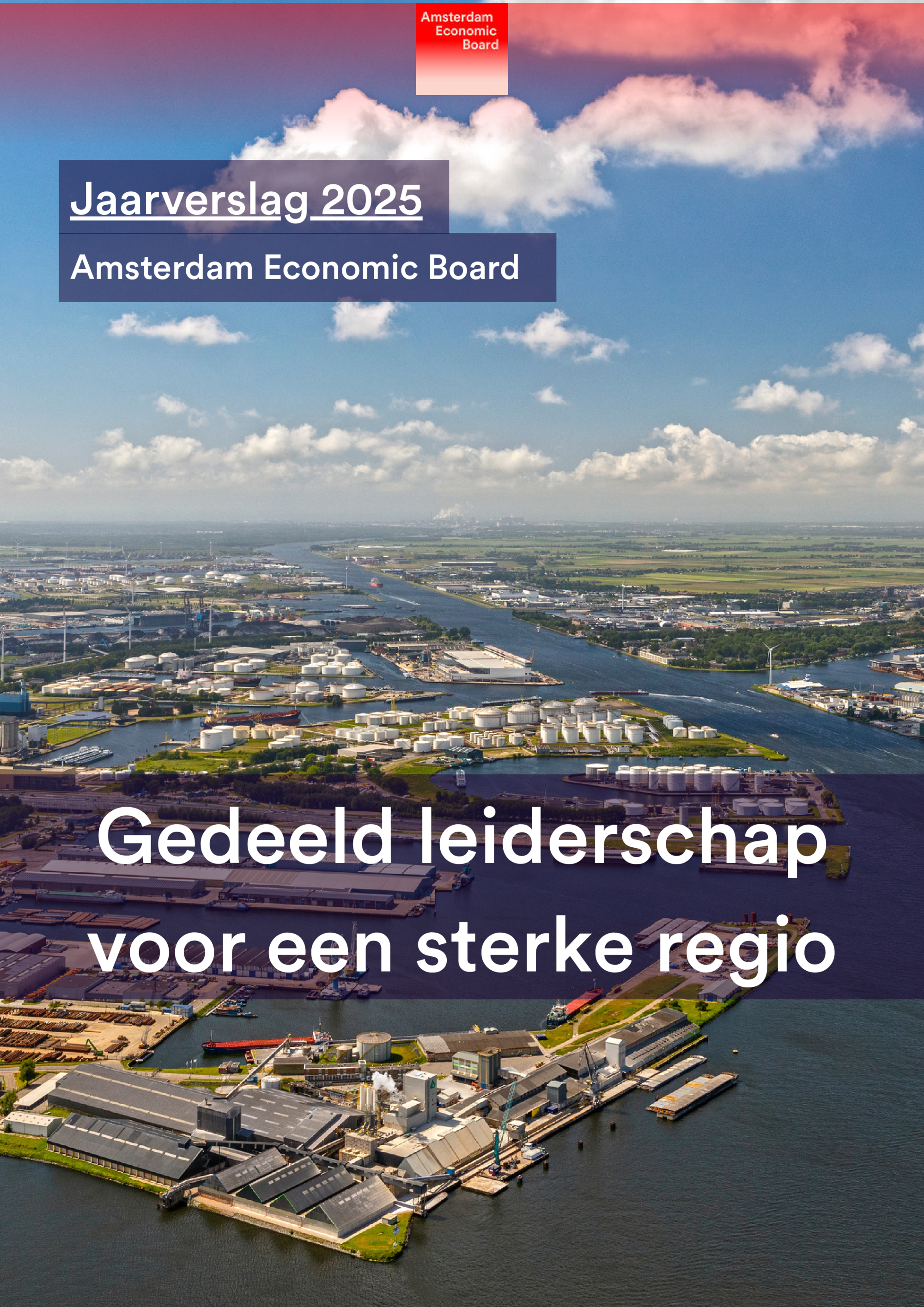
The Board brings together companies, universities and governments across the metropolitan region, with about 130 paying partners at the end of 2025. In its tech and AI work the city is a lead partner with the payments company Adyen, the city of Almere, the Vrije Universiteit (VU), the Amsterdam University of Applied Sciences and Waag. With Rabobank and AMS Institute among others, the Board is also exploring how start-ups and small firms can become digitally autonomous.
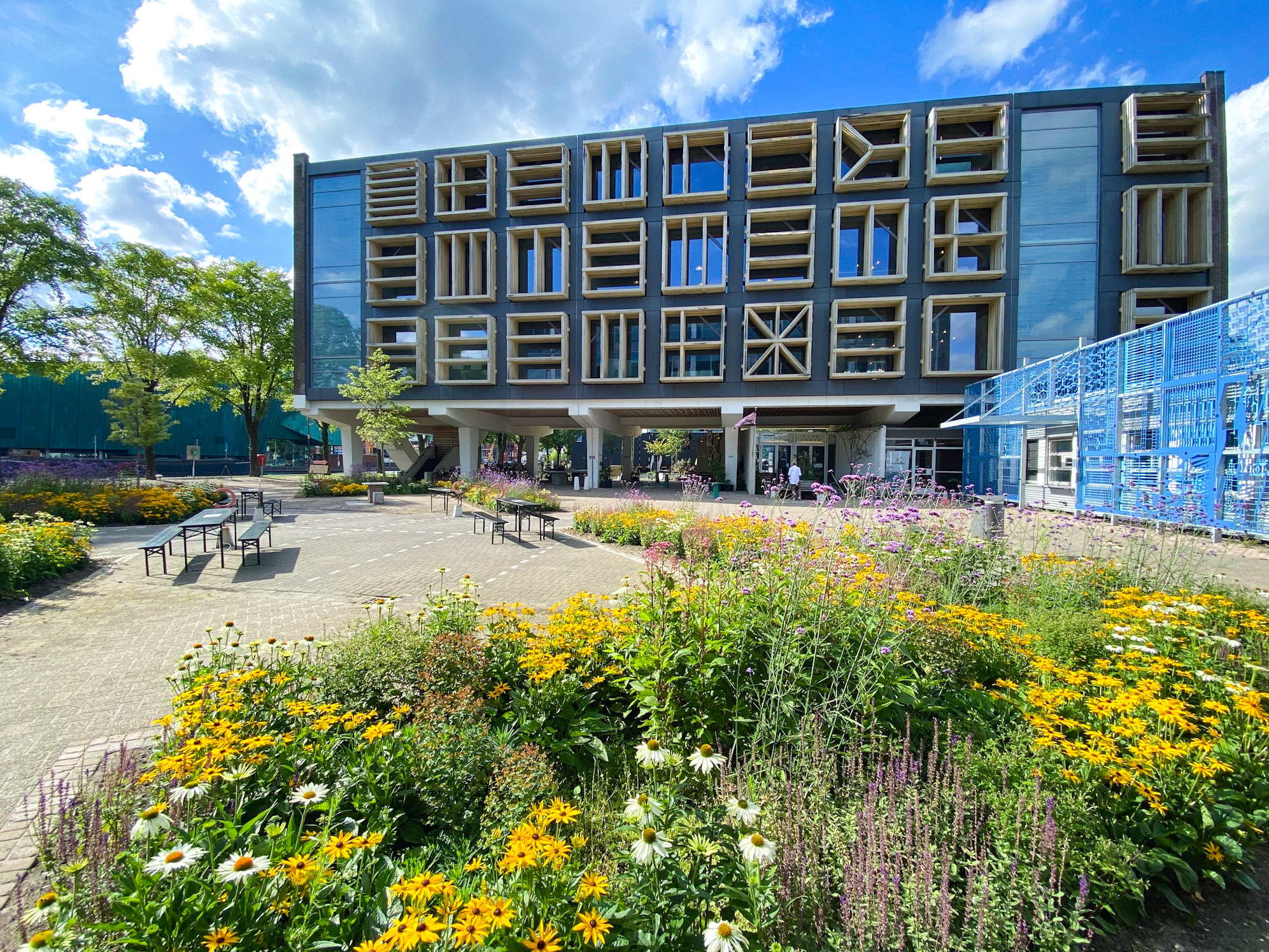
AMS Institute is an independent urban-research institute set up by TU Delft, Wageningen University & Research and MIT, and it works in partnership with the city. Researchers at the University of Amsterdam, the VU and the applied-sciences university add work on responsible IT and energy. On the Marineterrein, a former naval yard beside the old centre, an independent bureau runs a living lab on land and water. A project plan adopted in 2023 foresees about 800 homes on the site.
Waag works with Commons Network, a policy group on shared public goods, and with Cybersoek, which gives residents free digital help and hands out refurbished laptops. Together they warned the new coalition in June 2026 that data centres built by Microsoft, Google and Meta had set off a contest for scarce energy and water. Lighthouse Reports, an investigative newsroom, examined the city’s welfare-risk model in a partnership with MIT Technology Review and the Dutch newspaper Trouw.
Venture money is counted nationally. Dutch tech companies raised €2.64bn in 2025, and the country had 11,301 active tech companies, according to Techleap’s State of Dutch Tech 2026. Its summary gives no figure for Amsterdam alone. For anyone building here, the binding limit is the grid: about 560 customers were still waiting for a connection in November 2025.
Autonomy on paper, Azure in practice
Amsterdam elected its council on 18 March 2026, on a turnout of 47.3%. GroenLinks (GreenLeft) won 10 of the 45 seats, D66 (social liberals) 8 and the PvdA (Labour) 7. GroenLinks and the PvdA then formed one group, PRO Amsterdam, and with D66 hold 25 seats. Their executive took office in June under Femke Halsema, the mayor since 2018; Dutch mayors are appointed, not elected. The agreement places digital affairs in a D66 package with economic affairs, which Melanie van der Horst took.
Their agreement, Jouw stad is mijn stad (“Your city is my city”), says Amsterdam should become as digitally independent as possible of (American) tech giants. By 2030 at least 30% of the city’s cloud storage and applications should come from Dutch or European suppliers. It rules out facial recognition and keeps the registration duty for sensors. Every algorithm the city uses is to be tested against ethical principles and entered in the public register.
The targets come from the Meerjarenstrategie Digitale Autonomie 2026–2035 (multi-year digital autonomy strategy), adopted by the previous executive on 20 January 2026. Its starting point is candid: the public cloud is organised around Microsoft Azure, and the city also runs about 1,300 small cloud services from outside suppliers. A sourcing and cloud strategy presented the next day sets the rule “autonomous, unless” for business-critical systems and confidential data.
The first phase, with pilots of Nextcloud, open-source file-sharing software, and of a national standard platform, was costed at €3.2–4.5m and not yet funded when the strategy was adopted. A first estimate by the consultancy Deloitte puts the extra running cost at €7m a year. The coalition agreement says it will make money available to carry the strategy out, without naming a sum.
A (more) autonomous environment will ultimately be one in which big tech’s all-in-one solution has largely been replaced by several smaller components that can be swapped quickly but together form a whole. That means researching alternatives, building knowledge and building new infrastructure.The first tender in which the city tried to steer towards autonomy was won by Solvinity, a Dutch cloud provider that also runs the platform behind DigiD, the national login. By February 2026 Solvinity faced a takeover by the American firm Kyndryl, an outcome Binnenlands Bestuur called a debacle. In May the national government banned the takeover on the advice of its investment-screening bureau, and in July a Rotterdam court declined to suspend the ban. ChatAmsterdam, the staff AI assistant in use since November 2024, is hosted on Microsoft’s cloud.
But the plans do not explicitly address how we, as a city, become digitally independent. […] A European platform that creates the same dependency as an American one changes little.The national digitalisation strategy shares the city’s cloud target, and Amsterdam works with VNG, the association of Dutch municipalities, towards a government cloud. Debate on public algorithms recalls the toeslagenaffaire, the childcare-benefits scandal: in December 2020 a parliamentary inquiry found that the basic principles of the rule of law had been violated. More than 5,000 Amsterdam parents had registered as affected by 2022.
Amsterdam was the first municipality with an algorithm register, according to its audit office, the Rekenkamer. In September 2023 the register listed only 29 algorithms where there may have been hundreds. Of the 12 the audit examined, only the Slimme Check (“smart check”), a welfare-fraud risk model, had a bias analysis, and that covered 4 of the 16 characteristics the city had flagged. The register now redirects to the national Algoritmeregister, which lists 72 Amsterdam algorithms, 52 of them in use.
- Mar 2020[source]
Climate roadmap
The executive adopts Nieuw Amsterdams Klimaat, aiming for a climate-neutral city by 2050.
- Dec 2020[source]
Benefits-scandal inquiry
A parliamentary inquiry finds that the fraud approach to childcare benefits violated the basic principles of the rule of law.
- Apr 2022[source]
EU Mission city
Amsterdam is selected for the EU mission for climate-neutral and smart cities.
- Nov 2023[source]
Welfare model stopped
The alderman for social affairs stops the Slimme Check pilot.
- 2025[source]
Smart-city platform wound down
Amsterdam InChange, formerly Amsterdam Smart City, is phased out and folded into the Economic Board.
- Jan 2026[source]
Digital autonomy strategy
The executive adopts a ten-year strategy to reduce dependence on large cloud suppliers.
- June 2026[source]
New coalition
PRO Amsterdam and D66 take office with a majority on the council.
- 2030[source]
Cloud and climate targets
Targets: 30% of cloud services from Dutch or European suppliers, and CO₂ 60% below 1990.
- 2035[source]
Sensitive data at home
Target: all sensitive municipal data stored and managed autonomously.
- 2050[source]
Climate neutrality
The roadmap’s deadline for a climate-neutral Amsterdam.
From the climate roadmap and the benefits scandal to a digital-autonomy strategy, and the targets the 2026 coalition has signed up to.
What Amsterdam shared, measured and switched off
Signalen is the tool that travelled. Amsterdam built the open-source app in 2018 so residents could report problems in public space, and by 2024 it ran in 39 Dutch municipalities. Now maintained with VNG, it serves about 3 million residents, and about 2,800 civil servants handle more than 800,000 reports a year with it. VNG has published no figures on how quickly the reported problems are fixed.
The Slimme Check was meant to pick out welfare applications for extra investigation. The city’s welfare department spent three years developing it and trained it on 3,400 past investigations. In March 2022 the Participatieraad, an advisory council of welfare recipients that was disbanded in 2024, advised stopping it on the grounds that it would harm residents’ fundamental rights. A live pilot ran on about 1,600 applications from April to August 2023.
Independent reporting by MIT Technology Review and Lighthouse Reports found that the model flagged more applicants rather than fewer and was no better than caseworkers at finding cases that warranted scrutiny. Reweighting before the pilot had evened out its treatment of Dutch and non-Dutch applicants. In the pilot it wrongly flagged women and Dutch nationals more often. Rutger Groot Wassink, the GroenLinks alderman for social affairs, stopped it in late November 2023, at an estimated cost of about €500,000 plus €35,000 for Deloitte. The city’s own page on the project says the model appeared to perform better than the old method, with fewer false positives, and calls the bias analysis inconclusive.

The city-wide 30 km/h limit has been in force since 8 December 2023. In its first year, crashes involving a motor vehicle fell by 11% on the roads concerned, from 926 to 823, and those with cyclists or pedestrians by 15%. Total crashes rose, because cyclists had more crashes with each other or on their own. 63% of drivers stayed at or under 35 km/h. Buses lost about 40 seconds a trip and trams 10, while emergency services lost none.
Smart traffic lights were dropped in January 2025. The city had tested lights that gave cyclists priority over cars in the rain at two junctions, and a year earlier had said every light would become intelligent. Melanie van der Horst, then alderman for traffic, cited cybersecurity and privacy concerns, a limited effect and maintenance costs well above those of ordinary lights. She had also announced that parking scan cars would no longer be used to look for stolen cars, with privacy the deciding factor.
Public Eye, which counted people in crowded places from camera images, ran from 2019 to 2021 and reached about 90% accuracy by the city’s own account. Druktebeeld, a public crowd map started in 2022, is out of use too; the city could not independently establish that the location data from its supplier, Resono, were fully anonymised. The Langzaam Verkeer Monitoringsysteem (slow-traffic monitoring system) still counts pedestrians and cyclists. Its register entry concedes that at very low counts, combined with other data, one passer-by’s route past several sensors could in theory be followed.
ATELIER, an EU-funded project to make Buiksloterham, a former industrial area north of the IJ, a positive-energy district, ended in April 2026 after an eighteen-month extension. It did not reach a fully energy-positive balance. The Amsterdam University of Applied Sciences, a partner, names a delayed waste-recovery station, grid congestion and slow permits for more renewables. The shared battery has covered its grid-transport costs from market revenue since September 2025.
The registers make the switching-off visible: anyone can look up that the welfare model went out of use in September 2023 and the camera head-counts in January 2021. Control has followed ownership more than listing. Signalen, written and owned by the city, is still running and now serves dozens of other councils. The autonomy strategy names the opposite case, a public cloud built on a single supplier, as the dependence it sets out to reduce.
References
Statistics1Click on any number to see the source
Population & migration
From our libraries9
- Raming Amsterdam klimaatneutraal – update 2025 (CE Delft) — Knowledge
- Waag Futurelab — Organisation
- Amsterdam Economic Board – Jaarverslag 2025 — Knowledge
- AMS Institute — Organisation
- Marineterrein Amsterdam Living Lab — Organisation
- Jouw stad is mijn stad. Coalitieakkoord 2026–2030 PRO Amsterdam en D66 Amsterdam — Knowledge
- Meerjarenstrategie Digitale Autonomie 2026–2035 — Knowledge
- Algoritmen – Hoe Amsterdam algoritmen beter kan toepassen (Rekenkamer Amsterdam, onderzoeksrapport, 20 oktober 2023) — Knowledge
- Inside Amsterdam’s high-stakes experiment to create fair welfare AI — Knowledge
Further sources26
- De Staat van de Stad Amsterdam XIII — Gemeente Amsterdam, Onderzoek en Statistiek · Sept 2025
- Raming Amsterdam klimaatneutraal – update 2025, achtergrondrapport — CE Delft for Gemeente Amsterdam · Aug 2025
- Nieuw Amsterdams Klimaat – Routekaart Amsterdam Klimaatneutraal 2050 — Gemeente Amsterdam · Mar 2020
- Liander vindt ruimte op stroomnet voor 138 Amsterdamse bedrijven — Solar Magazine · 7 Nov 2025
- De digitale kloof overbruggen — Waag Futurelab · Mar 2026
- Amsterdam, wees expliciet over technologie — Waag Futurelab, Commons Network and Cybersoek · 4 June 2026
- Wie heeft zicht op alle camera’s in de publieke ruimte? — Binnenlands Bestuur · 1 Apr 2026
- Amsterdam Economic Board — Jaarverslag 2025 — Amsterdam Economic Board · Aug 2026
- State of Dutch Tech 2026 — TNO / Techleap · 11 Feb 2026
- Uitslag gemeenteraadsverkiezingen Amsterdam 2026 — Rodi · 19 Mar 2026
- Amsterdam 2026 municipal election results — DutchReview · Mar 2026
- New Amsterdam executive team sworn in after council backs PRO–D66 coalition deal — NL Times · 11 June 2026
- Jouw stad is mijn stad. Coalitieakkoord 2026–2030 — PRO Amsterdam and D66 Amsterdam · 3 June 2026
- Meerjarenstrategie Digitale Autonomie 2026–2035 — Gemeente Amsterdam · 20 Jan 2026
- Amsterdam kiest voor autonoom, tenzij — Binnenlands Bestuur · 3 Feb 2026
- Staatssecretaris verbiedt overname bedrijf achter DigiD — Binnenlands Bestuur · 26 May 2026
- Rechtbank laat verbod op overname DigiD-beheerder in stand — TaxLive · 14 July 2026
- Algoritmeregister — Gemeente Amsterdam — Algoritmeregister (Dutch government) · read 1 Oct 2026
- Algoritmen – Hoe Amsterdam algoritmen beter kan toepassen (samenvatting) — Rekenkamer Amsterdam · 20 Oct 2023
- Eindverslag onderzoek kinderopvangtoeslag overhandigd — Tweede Kamer · 17 Dec 2020
- Open source municipal services: case study Signalen — Open Source Observatory (OSOR), European Commission
- Inside Amsterdam’s high-stakes experiment to create fair welfare AI — MIT Technology Review · 11 June 2025
- Slimme Check: working with a citizen panel for innovation in the social domain — Open Research Amsterdam (Gemeente Amsterdam) · 24 June 2024
- Amsterdam road safety increased after lowering speed limit to 30 km/h — NL Times · 27 June 2025
- Geen groen licht voor slimme verkeerslichten — Binnenlands Bestuur · 6 Jan 2025
- What can six years of research into positive energy districts teach us? — Amsterdam University of Applied Sciences · June 2026