
A city of short trips, facing climate extremes
Barcelona is a city of short distances. Its residents’ average weekday trip is 3.3 km, and 1,729,963 people were on the municipal register, the padró, on 1 January 2026, a fall of 0.1% on the year before. The average resident is 44.6 years old, and 26.6% hold a foreign nationality.
The weekday mobility survey, EMEF (Enquesta de mobilitat en dia feiner), is run by the regional transport authority ATM with the Catalan statistics institute Idescat. In its 2024 round, 83.3% of residents’ trips were on foot, by bike or scooter, or by public transport. In the wider region the car is gaining ground: walking and cycling fell from 51.1% of trips in 2023 to 47.5% in 2025, and private vehicles rose to 34.3%.
Trips made by residents of the city on an average working day, 2024, including trips that leave the city. “On foot, bike or scooter” is the survey’s active-modes group. The survey report states the first two shares; private vehicles are the remainder. Source: EMEF 2024 (ATM, Idescat and Institut Metròpoli), territorial report
The Pla Clima, the city’s climate plan, aims to cut greenhouse-gas emissions 45% below their 2005 level by 2030 and to reach climate neutrality by 2050. As one of the EU’s Mission cities, Barcelona has also signed a Climate City Contract setting out a path towards neutrality by 2030. The climate emergency the council declared in January 2020 added a target of 50% below 1992 by 2030. Its progress report counts emissions differently, from a 1992 baseline of 4.74 million tonnes, so its figures cannot be set beside the plan’s.
The energy agency’s monitoring workbook tracks the plan’s target, counting electricity at the average emissions of the Spanish grid. It shows 6.26 million tonnes of CO₂-equivalent in 2005 and 2.79 million in 2023, a cut of 55.4%. On that grid-mix accounting, and if the provisional 2023 figure holds, the 2030 target has been met early. Homes, offices and shops account for most of the fall, down 61–64%. Transport fell by just under a third and is now the largest source. Renewable plants inside the city met 1.91% of its energy use in 2024, against a target of 6.5% of its electricity by 2030.
million tonnes of CO₂-equivalent
Show the numbers
| All sources | Electricity | Transport | |
|---|---|---|---|
| 2005 | 6.26 | 2.88 | 1.28 |
| 2010 | 4.47 | 1.66 | 1.12 |
| 2015 | 4.52 | 2.06 | 1.10 |
| 2019 | 3.50 | 1.12 | 0.97 |
| 2020 | 2.70 | 0.72 | 0.73 |
| 2021 | 2.94 | 0.73 | 0.89 |
| 2022 | 3.26 | 0.99 | 0.94 |
| 2023 | 2.79 | — | 0.90 |
Emissions from energy used in the city plus waste treatment, on the Pla Clima’s 2005 baseline, with electricity counted at the Spanish grid’s mix. 2023 is provisional; the workbook splits out electricity only to 2022. The rule marks the plan’s 2030 target, 45% below 2005. The climate-emergency declaration’s 1992 baseline uses different accounting and is not shown. Source: Agència d’Energia de Barcelona, Pla Clima monitoring workbook
The public-health agency ASPB’s modelled estimate is about 370 heat deaths in summer 2025, or 21 per 100,000 residents, against 18 in 2023 and 14 in 2024. Drought put the city and the rest of the Ter-Llobregat water system under an emergency cap of 200 litres per person a day in February 2024. The restrictions were lifted in May 2025, with reservoirs almost two-thirds full. The opposite extreme came in October 2026. On 3 October the Fabra observatory recorded 159 litres per square metre, its wettest October day since its records began in 1914. After more rain, the mayor declared a municipal emergency to speed up repairs.
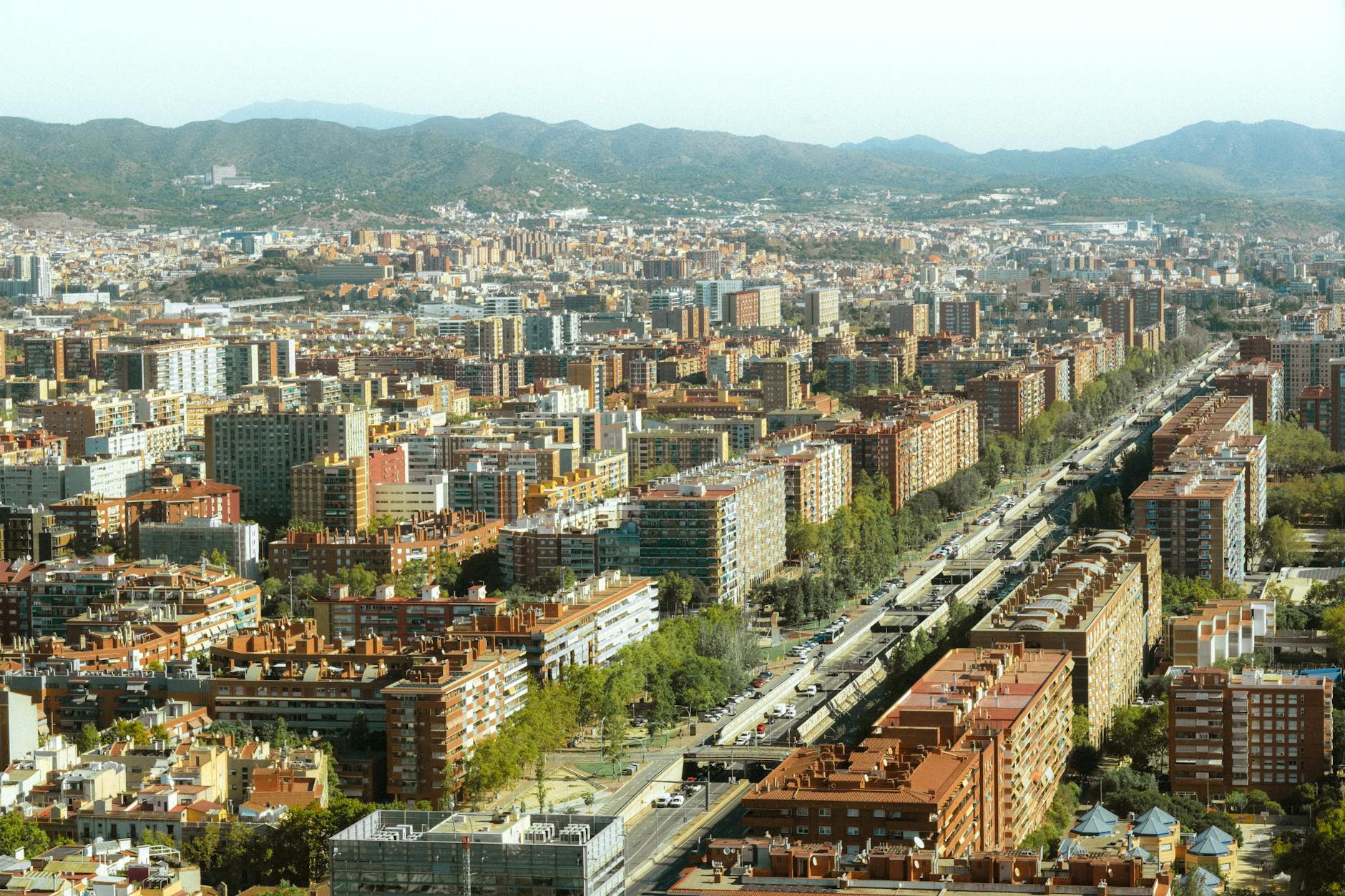
Operators reported fibre to the home available to 99.3% of households in June 2025. The open-data portal lists 555 datasets, and the city wrote two platforms of its own: Decidim for participation and Sentilo for sensor data.
Residents give the city 37.5 out of 100 on whether they contribute to decision-making, in the IMD Smart City Index, a survey of residents’ perceptions that placed Barcelona 94th of 148 in 2026. Agreement that finding a home with rent at most 30% of a monthly salary is not a problem scored 16.9, the lowest of any statement. New leases averaged €1,137 a month in the first quarter of 2026.

For some residents the first barrier is the register itself, which unlocks health care and benefits. In October 2023 people without a fixed address were sent through social-services appointments to register, and some waited months. The city’s ombudsman documented dozens of cases; the council denied it had changed its policy. No later figures on these waits were found.
An in-house IT institute at the centre
The council’s own IT is run by the Institut Municipal d’Informàtica (IMI), its in-house institute. In December 2025 the full council turned it into Barcelona Innovació i Tecnologia (BIT). Its budget has grown from €63m in 2021 to €113m, against a goal of €130m, or 3.5% of the city budget. Staff are to rise from 230 in 2022 to 300 by 2030. Jordi Valls, the deputy mayor for the economy, housing, finance and tourism, to whom the institute reports, calls the private sector an “essential part of the city’s digital project”.

Services the public touches sit in municipal companies and agencies. Barcelona de Serveis Municipals (BSM) runs Bicing, the public bike-share, and Endolla, the council’s charging network for electric vehicles. ASPB measures what street changes do to air, noise and health. Barcelona Activa, the city’s economic-development agency, trains people for technology jobs through its IT Academy.
The supercomputers in the city are national and European infrastructure. The Barcelona Supercomputing Center (BSC) runs MareNostrum 5, a machine in the EU’s EuroHPC network inaugurated in December 2023 at a total cost of €202m. A contract signed in January 2026 adds AI capacity for about €129m, half of it from EuroHPC, the EU’s joint undertaking for supercomputing. The BSC also opened Spain’s first quantum computer built with European technology in February 2025. ISGlobal, a health research institute, models what the street programme could do for health.

Civic technology has an institution of its own. The Decidim Association, which looks after the participation software the council first commissioned, counts more than 500 installations. Its committee of public institutions includes the Generalitat (Catalonia’s government), the Diputació de Barcelona (the provincial council), the City of New York and Brazil’s federal government.
Private firms cluster in the city. ACCIÓ, the Catalan government’s business-competitiveness agency, counted 1,508 start-ups based in Barcelona at the end of 2025, out of 2,403 in Catalonia. Catalan start-ups raised €1,131m in 2025, or €834m without two very large rounds. The 22@ district in Poblenou, an industrial area rezoned for knowledge firms, counted 11,500 companies in the council’s 2022 plan; its job and housing figures for 2030 are targets.
Barcelona is also a city of trade fairs. GSMA, the mobile-industry body that organises the Mobile World Congress at Fira de Barcelona, the city’s trade-fair institution, puts its own estimate of the 2026 edition’s economic impact at €588m. The Smart City Expo World Congress drew more than 27,000 attendees in November 2025.
Public code under Colau, partnerships under Collboni
Jaume Collboni of the Socialists’ Party of Catalonia (PSC) has been mayor since June 2023. Xavier Trias of Junts, the centre-right Catalan nationalist party, won the most seats. Barcelona en Comú, the left-wing platform of the former mayor Ada Colau, and the conservative People’s Party (PP) voted for Collboni to keep Trias out. He governs in a minority, with 10 of 41 seats. The council rejected both his 2024 and his 2026 budgets, and each took effect automatically after he lost a vote of confidence. ERC, the Republican Left of Catalonia, has ruled out joining his government before the election of May 2027.
Under Colau, from 2015 to 2023, the council built its own digital agenda. Its Digital Transformation Plan, led by the chief technology officer Francesca Bria, committed 70% of the budget for new digital services to free and open-source software. No public account of how much was finally spent that way could be found. DECODE, an EU research project on residents’ control of their own data, ran pilots in Barcelona and Amsterdam from 2016 to 2019. The EU’s project record lists its aims and no measured results.
In this way cities end up solving technology problems since they are locked-in by proprietary, non-interoperable solutions and unsustainable business models. My mission instead, is to democratise data and technology, and rethink their governance in a way that they can serve the people.Collboni’s government has kept Decidim running and has turned more to companies. In March 2025, during the Mobile World Congress, the council signed a memorandum of understanding with Huawei on the city’s command centre, smart buildings, connectivity and IT training through Barcelona Activa. Public reports of it go no further than the signing. The IMI’s strategic plan for 2024–2030 lists digital governance, personalised services, a data-driven culture and hybrid cloud among its aims.
This collaboration, which strengthens Barcelona’s position as a technology capital, is an important step towards promoting digital inclusion and guaranteeing equitable access to technology.The council’s strategy for algorithms and data promised a public register of the algorithms it uses and clauses for buying AI. CIDOB, a Barcelona think tank, found both planned but not fully in place in December 2024. In March 2026 the council presented an AI strategy worth €9.4m over three years, with 37 actions.
Money and rules also come from other levels of government. Barcelona has held the EU Mission Label for climate-neutral cities since March 2024. In March 2025 the European Investment Bank lent it €175m for its 2024–27 investment plan, the first Spanish city backed under the Cities Mission. The Generalitat has been led since August 2024 by Salvador Illa of the PSC, the mayor’s party. Its 2023 decree on tourist flats is the legal basis for ending their licences in the city by 2028. Collboni also chairs the AMB, the metropolitan area, which manages about €2.5bn a year.
On the streets, Collboni has changed course. In July 2024 he set aside Colau’s plan for large green axes through the Eixample, the 19th-century grid district, in favour of small works: 22 hectares across 71 sites by 2027, for €150m. In March 2025 Catalonia’s high court, the TSJC, upheld the annulment of the council agreement behind the Consell de Cent green axis, and the city is appealing to the Supreme Court.

- Feb 2016[source]
Decidim goes live
The council’s own participation platform opens for the 2016–19 municipal action plan, built for €58,000.
- Jan 2020[source]
Climate emergency
The council declares a climate emergency and adds a target of 50% below 1992 levels by 2030.
- June 2023[source]
Collboni elected mayor
Jaume Collboni (PSC) takes office with the votes of Barcelona en Comú and the PP.
- Mar 2024[source]
EU Mission Label
Barcelona receives the label for its plan towards climate neutrality under the EU Cities Mission.
- Mar 2025[source]
Huawei memorandum
The council and Huawei sign a memorandum on the city command centre, smart buildings, connectivity and IT training.
- Dec 2025[source]
IMI becomes BIT
The full council approves the municipal IT institute’s new name and role as Barcelona Innovació i Tecnologia.
- Mar 2026[source]
AI strategy
The council presents a three-year strategy for ethical, democratic and sustainable use of AI.
- May 2027[source]
Municipal election
Barcelona elects its next council.
- 2030[source]
Pla Clima target
Emissions 45% below their 2005 level, on the plan’s accounting.
- 2050[source]
Climate neutrality
The neutrality date in the adopted city plan.
From a home-built participation platform to EU climate money, and the target years still ahead.
Superblocks, a voting platform and a travelcard years late
Superblocks (superilles in Catalan) close groups of blocks in the city’s grid to through traffic and hand the streets to people on foot. The first began operating in Poblenou in September 2016, followed by Sant Antoni in 2018. The health agency’s 2021 evaluation measured 25% less nitrogen dioxide and 17% less coarse particulate matter (PM10) in Sant Antoni, and daytime noise 3.5 decibels lower. In Horta it found no important change. In the first year of the Consell de Cent green axis, weekday traffic on four parallel streets changed by between −4.6% and +2.8%.
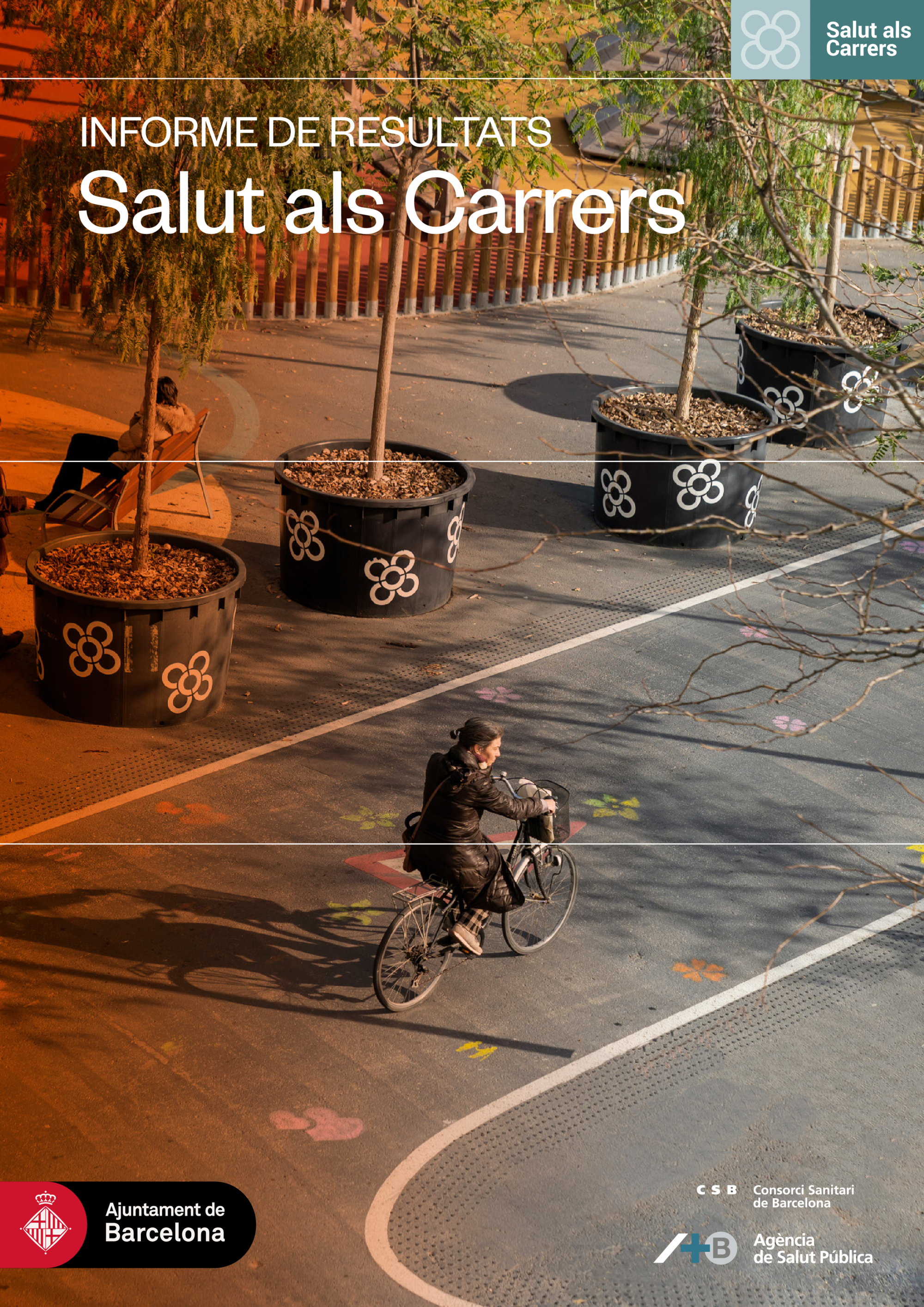
The gains come with costs and limits. Researchers at Pompeu Fabra and Erasmus universities, studying 573,000 rental listings from 2018 to 2024, found rents 12–14% higher nearest the green axes. ISGlobal’s modelled estimate of about 700 premature deaths avoided each year assumes that all 500 planned superblocks are built. In its original form the programme has stalled.
Decidim’s first big process, the 2016–19 municipal action plan, drew more than 22,600 registered users and 10,300 proposals. In the 2024–27 participatory budget, 48,796 people voted, up from 39,433 in 2021, and chose 76 projects worth €29.3m; by April 2026 the council put their delivery at about a quarter complete. The voters were about one resident in 35. On 10 March 2025, the first day of voting, the site was down for hours. The platform is still the council’s channel for participation.
Bicing, the public bike-share, has scaled. In November 2025 it counted 166,000 active users, 557 stations and 8,000 bikes, 5,000 of them electric, and expected 20 million journeys in the year. Eight in ten trips are made on an e-bike. BSM’s release counts use; it gives no figure for car trips replaced.

Endolla, the council’s charging network, reached 1,000 points in March 2024. The council planned 2,000 more for 2024–25, but BSM counted 1,091 in September 2026. Use has grown faster than the network: 53,500 users and 17,000 charges a month in late 2025, up 40% and 13% on the year.
The low-emission zone (ZBE) inside the ring roads has applied since January 2020, with fines from that September. The courts annulled its first ordinance for lacking reports on its economic and social impact, and the council cancelled about 140,000 unpaid fines. A new ordinance from 2023 keeps the zone in force. It was suspended for two months in early 2026, while the regional rail network was in crisis. The health agency’s first assessment found a modest effect on nitrogen dioxide in 2020, hard to separate from the pandemic’s fall in traffic. In 2024 the city recorded its lowest nitrogen-dioxide levels yet, credited to more public transport and fewer polluting vehicles. The Eixample and Gràcia–Sant Gervasi stations would still exceed the EU’s 2030 limit of 20 µg/m³.
T-mobilitat, the contactless travelcard for the whole metropolitan network, has run years late. It was due in 2017, and its contract grew from €72m at tender to €116m. In January 2022 it had about 55,000 active users. Its website and app failed on 27 November 2023, the eve of the switch-off of two cardboard travelcards, though the gates kept validating. Single tickets began moving onto it in May 2025 at FGC, the Catalan government’s railway, and on the metro that October; no report that every operator has finished was found.
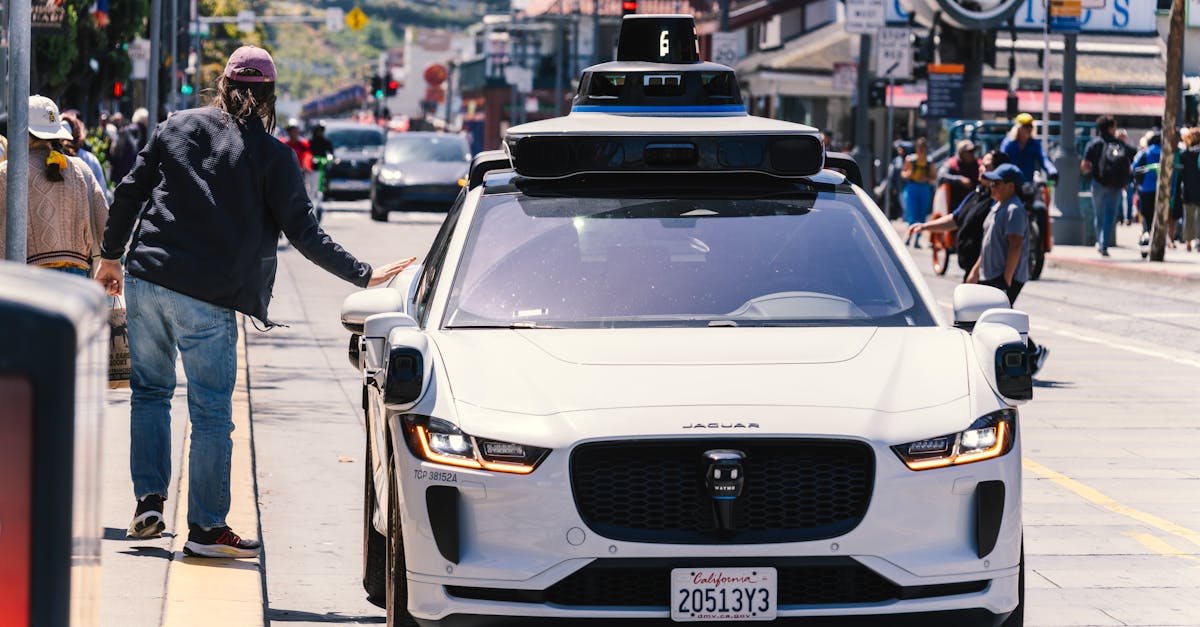
Sentilo, the open-source sensor platform the council built, has gone quiet. Its last release came in December 2022, and its public code repository was last updated in December 2023. The council’s page on it gives no current count of sensors.
Climate shelters, public buildings opened as cool refuges in heatwaves, doubled from 200 in 2022 to 400 in 2025. The council has published no figures on how many people use them, and critics point to closures at midday and at weekends, and to rooms without air conditioning.
Decidim gives Barcelona’s residents a channel, and other councils trust its code enough to run it. In the city itself, the latest participatory budget drew a small minority of residents, lost its first day of voting to an outage, and a year later was about a quarter delivered. Residents still give low marks to their say in decisions.
References
Statistics1Click on any number to see the source
Population & migration
From our libraries20
- Enquesta de mobilitat en dia feiner 2024 (EMEF 2024). Informe territorial a l'àmbit del SIMMB — Knowledge
- Mortalitat atribuïble a la calor a la ciutat de Barcelona: actualització 2025 (ASPB) — Knowledge
- Open Data BCN — Barcelona Open Data Portal — Knowledge
- 2026 IMD Smart City Index: The quest for trust and transparency — Knowledge
- Institut Municipal d'Informàtica (IMI) — Organisation
- Barcelona Activa — Organisation
- Barcelona Supercomputing Center (BSC) — Organisation
- Decidim — Organisation
- Decidim Activity Report 2025 — Knowledge
- 22@ Barcelona Innovation District — Organisation
- GSMA — Barcelona Office — Organisation
- Fira de Barcelona — Organisation
- Smart City Expo World Congress — Organisation
- Estudis de cas de marcs de governança de la IA urbana — Estudi de cas 1: Barcelona (CIDOB, Atles d'intel·ligència artificial urbana, 2025), Alexandra Vidal D'Oleo — Knowledge
- Àrea Metropolitana de Barcelona (AMB) — Organisation
- Collboni passa pàgina als grans eixos verds de Colau i aposta per petites actuacions (3Cat, 17 Jul 2024) — Knowledge
- Salut als carrers: avaluació de l'impacte en salut de les superilles (Agència de Salut Pública de Barcelona, 2021) — Knowledge
- The Consell de Cent green axis toll: an additional 14% increase in rents (Ara, 24 Aug 2025) — Knowledge
- Bicing — Barcelona Bike-Sharing — Project
- T-mobilitat — Smart Public Transport Ticketing — Project
Further sources33
- La població de Barcelona: lectura del padró municipal d’habitants a 01/01/2026 — Ajuntament de Barcelona, Oficina Municipal de Dades · May 2026
- Enquesta de mobilitat en dia feiner 2025 — resum executiu — Institut Metròpoli / ATM / Idescat · July 2026
- Seguiment Pla Clima (monitoring workbook) — Agència d’Energia de Barcelona · 2025
- Indicator 7.2.2 — Proportion of energy consumed in Barcelona that has been locally generated using renewable resources — Ajuntament de Barcelona · Feb 2026
- Balanç de la Declaració d’Emergència Climàtica — Ajuntament de Barcelona · March 2023
- Emergència climàtica: compromisos i crida a l’acció — Ajuntament de Barcelona · Jan 2020
- Barcelona is lifted from the alert and Catalonia bids farewell to the drought — Ara · May 2025
- Lloguers a Barcelona per districtes i barris — Generalitat de Catalunya, Habitatge (Incasòl deposit data) · Jan–Mar 2026
- Aiguats excepcionals de més de 200 litres: Barcelona viu un episodi de pluja històrica — betevé · 4 Oct 2026
- Barcelona, en situació d’emergència per les pluges — TOT Barcelona · 7 Oct 2026
- Barcelona Innovation and Technology is born — Ajuntament de Barcelona — IMI · 1 Dec 2025
- About us — Barcelona Innovació i Tecnologia — Ajuntament de Barcelona — BIT
- Analysis of the startup ecosystem in Catalonia 2026 — ACCIÓ, Generalitat de Catalunya · 2026
- Barcelona Supercomputing Center unveils MareNostrum 5 — Catalan News · 21 Dec 2023
- Interview with Francesca Bria: Public Money? Public Code! — Free Software Foundation Europe · 5 July 2018
- Huawei and Barcelona City Council sign a strategic memorandum of understanding — Huawei (PR Newswire) · 12 Mar 2025
- Barcelona adopts a strategy for ethical, democratic and sustainable AI — Consorci AOC · March 2026
- EIB and Barcelona sign a €175 million loan for urban regeneration — European Investment Bank · 6 Mar 2025
- Collboni ratified in office and budget approved — VilaWeb · Nov 2025
- Setback for Barcelona City Council: the high court upholds the ruling against the superblock — Ara · March 2025
- 76 projects win Barcelona’s participatory budget — betevé · 2025
- Bicing on track to reach 20 million journeys in 2025 — Barcelona de Serveis Municipals · 5 Nov 2025
- Delays and overruns at T-mobilitat — 3Cat · Feb 2022
- Barcelona now has 1,000 charging points for electric vehicles — NacióDigital · 11 Mar 2024
- Endolla Barcelona grows 40% in users and reaches 17,000 charges a month — betevé · 3 Nov 2025
- Barcelona, at the forefront of electromobility with Spain’s largest public charging network — Metrópoli · 18 Sep 2026
- Barcelona will cancel 140,000 fines from the low-emission zone struck down by the Supreme Court — TOT Barcelona · 9 Apr 2024
- Barcelona reactivates the low-emission zone after the Rodalies chaos — TOT Barcelona · 15 Mar 2026
- Single and airport tickets arrive on T-mobilitat — TMB · 12 Oct 2025
- The council has reached a quarter of the delivery of the 2024–2027 participatory-budget projects — Ajuntament de Barcelona · 4 Apr 2026
- Air quality in Barcelona improves for second year in a row — Catalan News · 10 Jan 2025
- Cities and extreme heat: a review of Barcelona’s climate-shelter model — El Salto · Aug 2025
- Informe científic: impacte en salut de les superilles — ISGlobal · May 2022