Buildings make most of the carbon; heat and water test the rest
New York City had 8.58 million residents in July 2025, on the Census Bureau’s revised estimates: a steady population, not the shrinking one older figures suggested. In the city’s 2024 mobility survey, 61.2% of trips within the five boroughs were on foot, by transit or by bike; transit’s share, 24.7% in 2019, has recovered only to 20.7%.
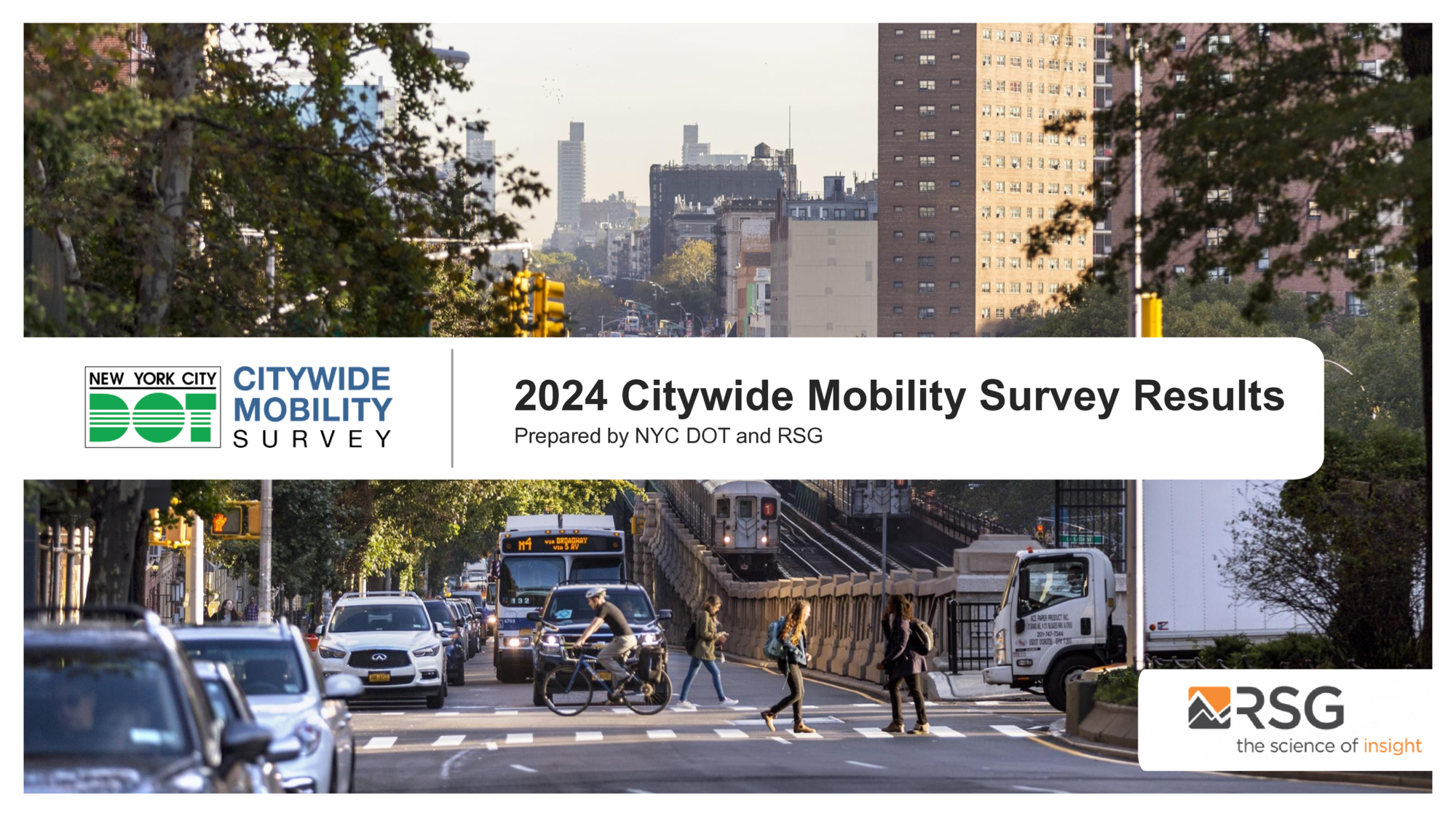
Main mode of all trips that started and ended in New York City, from the city’s 2024 Citywide Mobility Survey. Transit had fallen from 24.7% of trips in 2019 to 17.3% in 2022 and has partly recovered. Source: NYC Department of Transportation, Citywide Mobility Survey 2024
Buildings produce over two-thirds of the city’s greenhouse gases. The city’s inventory counts 47.9 million tonnes in 2024, 25.2% below 2005; on the State’s broader accounting the cut is only 19%. The goal is carbon neutrality by 2050, a policy target; the binding law, Local Law 97, caps emissions from large buildings and requires them to reach net zero by the same year.
% of the 2005 level
Show the numbers
| Citywide emissions | Straight line to the 2050 goal (reference) | |
|---|---|---|
| 2005 | 100.0 | — |
| 2019 | 82.1 | — |
| 2023 | 78.6 | — |
| 2024 | 74.8 | 74.8 |
| 2050 | — | 0.0 |
Citywide emissions from buildings and energy, transport and waste, from the city’s own inventory (100-year warming potentials): 64.1 Mt in 2005, 47.9 Mt in 2024. On New York State’s broader accounting, which adds upstream emissions and uses 20-year warming potentials, the fall is 19%. The dotted line runs straight from 2024 to the city’s 2050 goal of carbon neutrality for reference only; it is not a city plan, and neutrality may allow offsets. Source: City of New York, citywide greenhouse-gas inventory (NYC Open Data)
Hot weather contributes to about 500 deaths a year, by the health department’s 2026 estimate, mostly by worsening an existing illness. Deaths recorded as heat stress averaged seven a year over the past decade but reached 21 in 2025. In every heat-stress death at home where it was known, the person had no air conditioning running, and Black New Yorkers die of heat stress at three times the rate of white New Yorkers. Water is the other test. FloodNet, a street-level sensor network, has logged more than 2,400 flood events since 2020. In 2025 the federal government cancelled $351m of resilience grants for 19 city projects; a federal court has since ruled the cancellation unlawful, and we have not confirmed whether the money has reached the projects.
Housing is the pressure residents name first. In 2023 only 1.4% of rental homes stood vacant, the lowest share since 1968, and in IMD’s 2026 survey 75.8% of residents put affordable housing among their city’s most urgent needs, far ahead of any other.
The connections are there but uneven. On the federal broadband map, fibre to the premises is available to about 79.3% of residential units, and cable fills most of the gaps. The city’s open-data portal, required by a 2012 law that made city data open by default, lists 2,404 datasets.
The city’s digital front door has not matched its laws. The MyCity portal, which cost more than $100m, still cannot take one application for several benefits, its auditor found, and the chatbot built into it advised businesses to break labour and housing law until it was switched off. Even the city’s 2024 mobility survey was run only in English, Spanish and Simplified Chinese, in a city of hundreds of languages.
A city, a State and a federal government, each with a lever
For a European reader the first thing to know is how much New York City does not decide. The list below shows who holds what.
- Subway, buses and the congestion toll: the MTA, an authority controlled by New York State; the mayor sets none of the fares or tolls.
- Speed cameras: run by the city’s transport department, but only as long as Albany, the State capital, authorises them; the current authorisation runs to 2030.
- Buildings and climate: the city’s own laws, chief among them Local Law 97, enforced by its Department of Buildings.
- Police and surveillance: the NYPD is the city’s, and a city law requires it to publish a policy for each surveillance technology it uses.
- Data and digital services: the city’s Office of Technology and Innovation runs the open-data programme, the MyCity portal, the 311 service and the city’s broadband programmes.
- Big infrastructure money: Washington, paid mostly to the MTA and the tunnel’s project body rather than to the City. In October 2025 it froze about $18bn for the Hudson rail tunnel and the Second Avenue Subway; after lawsuits, payments to both have resumed.
Much of the city’s digital street furniture is run by contract. CityBridge holds the franchise for LinkNYC’s kiosks, Citi Bike uses city kerbs, and commercial cable companies supply the free public-housing broadband. In 2021 the State Comptroller found CityBridge had installed none of its promised kiosks between 2018 and 2021 and was $68.93m behind on its revenue share to the city.
The technology office is run by Lisa Gelobter, appointed Chief Technology Officer in February 2026, who led digital services at the US Department of Education under President Obama and later founded a workplace-equity start-up. In July 2026 the new administration began a “PIT Crew”, a public-interest technology team, to hire technologists in-house and lean less on vendors.

Technology impacts how people experience government every day — from accessing services to trusting that systems work fairly and responsibly.Outside City Hall, the universities build some of the tools the city relies on: NYU’s engineering school, the City University of New York and Brooklyn College run FloodNet, whose data the city’s emergency managers and the National Weather Service use live. Civic groups press from the other side. The Surveillance Technology Oversight Project tracks police technology, Brooklyn Defender Services brought the lawsuit over public-housing cameras, and NYC Mesh, a volunteer community network, won a State broadband grant.
A new mayor switches off his predecessor’s chatbot
Zohran Mamdani, a democratic socialist elected as a Democrat and on the ballot line of the Working Families Party, a small progressive party, won the November 2025 election with 50.8% of the vote and took office on 1 January 2026. He kept the police commissioner, Jessica Tisch, who as the NYPD’s technology chief had led its move to body cameras and smartphones. A week later the City Council elected Julie Menin, who represents the Upper East Side, as its speaker.
The previous administration’s AI Action Plan of October 2023 listed 37 actions, and by October 2025 the technology office said it had started or finished 35. Mamdani switched off the city’s best-known AI tool within five weeks. The MyCity chatbot, which reporters had caught telling businesses they could take a cut of workers’ tips, went offline on 4 February 2026; the mayor called it “functionally unusable”.
Rules for the city’s own algorithms are slower to arrive. A 2025 city law requires an independent Office of Algorithmic Accountability to set standards for the city’s algorithms. It was due by June 2026 and is funded for six staff, but at an October Council hearing the technology office said it was still hiring and had yet to name a director. In September 2026 the mayor and the schools chancellor put a one-year pause on generative AI for pupils up to the eighth grade.
Surveillance divides the city most. The NYPD’s Domain Awareness System joins live camera feeds, licence-plate readers, gunshot sensors and police records, and a city law obliges the force to publish how it uses each technology. In August 2026 two public-housing tenant associations sued the City, the NYPD and the housing authority, saying Big Apple Connect’s free broadband had been used to give police live access to cameras in two dozen buildings, without the published policy the city’s law requires and in breach of their constitutional rights. The City had not answered the suit publicly in the reporting we read. Privacy campaigners also want limits on police drones, which the NYPD flies more than 1,000 times a month by their count; “We just simply have no idea when and where we’re being filmed,” said Eleni Manis of the Surveillance Technology Oversight Project.
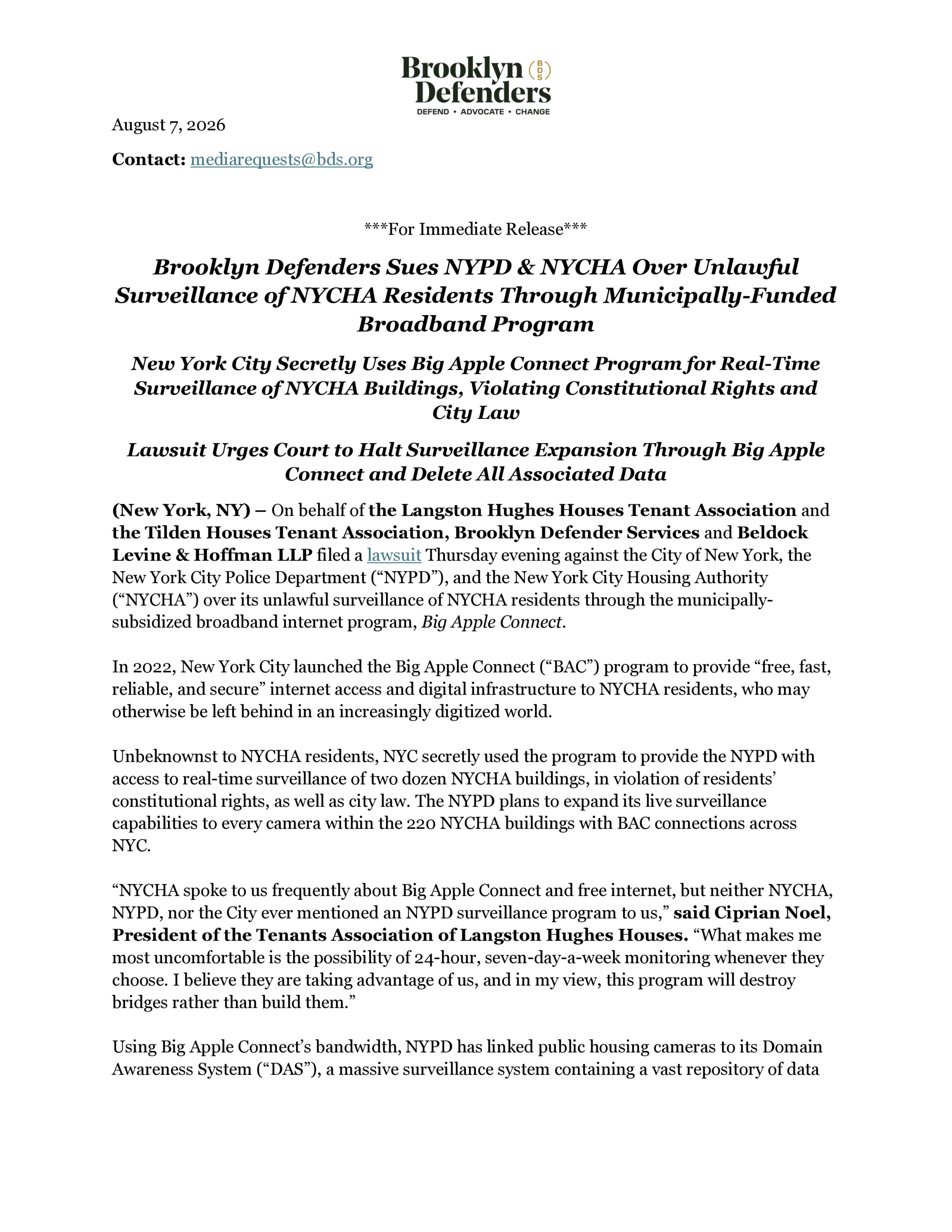
NYCHA spoke to us frequently about Big Apple Connect and free internet, but neither NYCHA, NYPD, nor the City ever mentioned an NYPD surveillance program to us.Levels of government pull against each other too. The State’s congestion toll has so far survived a federal attempt to stop it: in March 2026 a federal judge found the transport secretary’s order to end it “arbitrary and capricious”. “Congestion pricing is legal, it works, and it is here to stay,” said the governor, Kathy Hochul. Washington’s appeal is pending, and in July the federal appeals court upheld the dismissal of a separate challenge from two suburban counties. The federal rail freezes have gone to court as well. The Hudson tunnel’s frozen money was paid in February 2026 under a court order, and in June a federal judge struck the freeze down. The Second Avenue Subway’s funds were released in April after the MTA sued. The City has also joined two dozen states and other cities in suing the Environmental Protection Agency over its repeal of the federal finding that greenhouse gases endanger health.
- Mar 2012[source]
Open by default
The Open Data Law comes into force.
- 2019[source]
Local Law 97
Emissions caps for large buildings.
- Nov 2022[source]
Broadband plan dropped
The Internet Master Plan’s public network is cancelled.
- Jul 2023[source]
AI-hiring law enforced
Employers must audit hiring algorithms for bias.
- Oct 2023[source]
AI Action Plan
Thirty-seven actions for the city’s use of AI.
- Jan 2025[source]
Congestion toll
The MTA starts charging to enter Manhattan south of 60th Street.
- Jan 2026[source]
Mamdani takes office
The chatbot goes offline a month later.
- Aug 2026[source]
Tenants sue
Over police camera access through free broadband.
- Jun 2028[source]
Broadband contract ends
Big Apple Connect’s current extension runs out.
- 2050[source]
Carbon neutrality
The city’s policy goal; large buildings must reach net zero.
From the open-data law to the climate goal.
A toll and a cap with numbers; a portal and kiosks without
Congestion pricing, which the State calls the first in the nation, cut the number of vehicles entering Manhattan below 60th Street by 11% in its first year, 27 million fewer, by the State’s count. Fine-particle pollution in the zone fell 22%, according to a Cornell University study, and net revenue reached $518m by November 2025, backing the MTA’s capital programme.

Falls inside the Congestion Relief Zone, Manhattan south of 60th Street, after the toll began on 5 January 2025, as reported by New York State: traffic, crashes and injuries for the first year, greenhouse gases to September 2025, and fine particles from a Cornell University study. The toll is run by the MTA, a State authority, not by the City. Source: Office of the Governor of New York, January 2026
Local Law 97’s first year of reporting went as designed. Of 19,963 properties required to report on 2024, 95% filed; of the properties under the main limits that filed, 9,951 met them and 470 exceeded them, while compliance for 8,927 mostly affordable-housing properties under a separate article has not yet been determined. The first limits were set so that about four in five buildings already met them in 2019. About 1,400 properties that missed their limits or failed to file face notices of deficiency, with penalties to follow; we found no report of a penalty issued by April 2026. The stricter limits of 2030 are the real test.
The high compliance rate in this first round of annual reporting for Local Law 97 is more than a milestone; it’s proof that coordinated climate action can work at scale in a city as large and complex as ours.School-zone speed cameras, running around the clock since 2022 under State authority, cut speeding at camera sites by 94%, by the transport department’s figures; Albany renewed them to 2030. FloodNet, which reached 400 sensors in July 2026 and aims for 500 by the end of the year, is now used live by the city’s emergency managers.
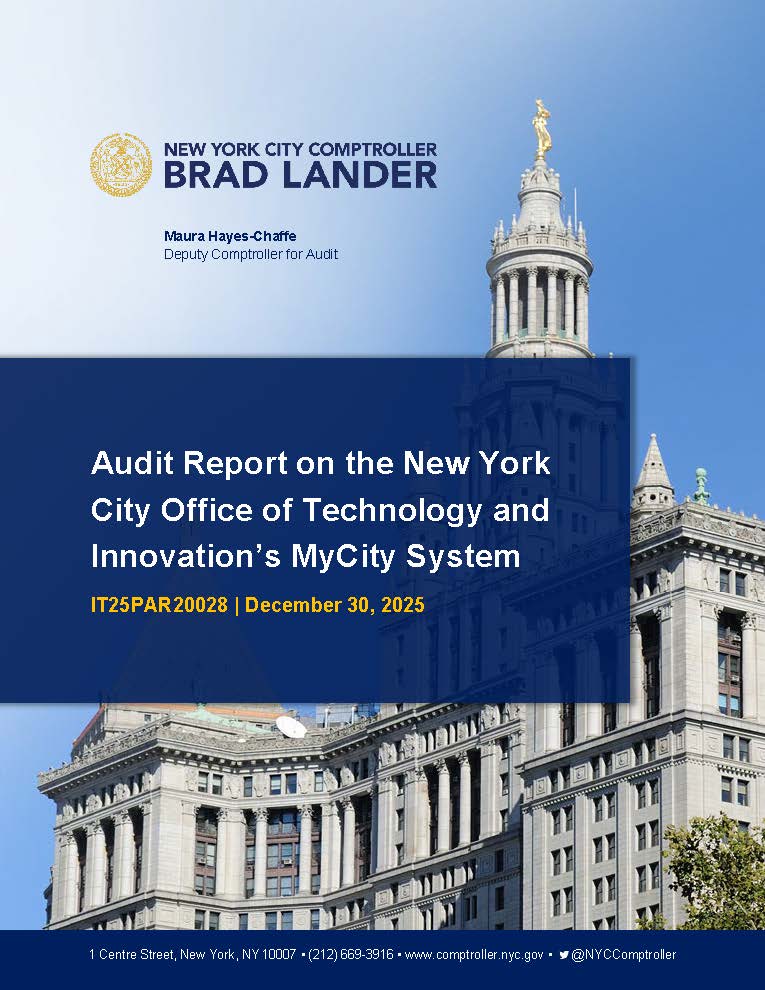
MyCity, the previous mayor’s one-stop portal, cost more than $100m. In December 2025 the City Comptroller, the city’s elected auditor, found that 46% of the 140,760 childcare applications made through it were ineligible, and that its chatbot left 23 of the 48 questions in the technology office’s own weekly test report unanswered. The technology office, under the previous administration, rejected every finding. The Comptroller recommended considering whether to end the portal; instead, in April 2026 the new administration put its online permit application for childcare providers on it.
The city’s broadband promises shrank too. Its 2020 Internet Master Plan, which was to put $157m into an open public network for poorer neighbourhoods, was cancelled in November 2022 and replaced by Big Apple Connect, which pays commercial providers to serve about 330,000 public-housing residents for free. LinkNYC’s operator planned nearly 2,000 5G kiosks by 2026; the city’s own data showed 208 in service in April 2026, with nine months of the deadline left.
Local Law 144 has since July 2023 required employers that use automated hiring tools to have them audited for bias. New York State’s Comptroller, who audits city agencies too, found the city’s enforcement “ineffective”: in 32 audits the Department of Consumer and Worker Protection found one problem, where the Comptroller’s staff found at least 17. The department accepted most of the recommendations.
Citi Bike, the privately operated bike share on city street space, carried 44 million rides in 2024 to mid-December, already a record year, and 246 million since it opened in 2013. In December 2024 the city announced an expansion from autumn 2025 of more than 250 stations and 2,900 bikes in the Bronx, Brooklyn and Queens. It declared the work finished in October 2026 with more than 230 stations, leaving about 62% of New Yorkers inside the service area.
Big Apple Connect itself runs on: it started at 100 public-housing sites in 2022, now reaches 220 developments, and was extended in September 2025 to June 2028. The tenants’ lawsuit asks a court whether a broadband programme can also carry police cameras without the policy the city’s own law requires.
New York ranks 45th of 148 in the IMD Smart City Index, a residents’ survey. Among 27 European and American cities we compared, New Yorkers are the most likely to say online information has raised their trust in the authorities, and the most worried about corruption among city officials.
What New York can show had a number written into a rule and someone obliged to count it: cars into the zone, tonnes per building, speeding at each school camera. Two of the three belong to the State, and the building caps have yet to reach their hard years. What fell short promised a platform without a measure of success: a portal that still cannot take one form for several benefits, kiosks a tenth of the number planned, and an AI-hiring law whose enforcer found one problem where the State’s auditors found seventeen. The question for Europe’s AI rules is the last one: who counts.
References
Statistics1Click on any number to see the source
Population & migration
From our libraries8
- 2024 Citywide Mobility Survey — results (NYC Department of Transportation) — Knowledge
- Local Law 97: 2024 Compliance and Reporting Rates (NYC Department of Buildings) — Knowledge
- Audit Report on the New York City Office of Technology and Innovation's MyCity System (IT25PAR20028) — Knowledge
- Mamdani to kill the NYC AI chatbot we caught telling businesses to break the law (The Markup, 30 January 2026) — Knowledge
- Mamdani's government has started to embrace AI. Will he? (Route Fifty / City & State, 21 July 2026) — Knowledge
- Brooklyn Defenders Sues NYPD & NYCHA Over Unlawful Surveillance of NYCHA Residents Through Municipally-Funded Broadband Program (press release, 7 August 2026) — Knowledge
- Domain Awareness System (DAS): Impact & Use Policy (NYPD, updated 4 February 2026) — Knowledge
- Less Traffic, Better Transit: On Its First Anniversary, Governor Hochul Celebrates Transformational Impact of Congestion Pricing — Knowledge
Further sources10
- New York City population estimates and trends — NYC Department of City Planning · Mar 2026
- Citywide greenhouse-gas inventory — City of New York (NYC Open Data)
- 2026 NYC Heat-Related Mortality Report — NYC Health Department · Jun 2026
- FloodNet reaches 400 sensors — NYU Tandon · Jul 2026
- Mayor Mamdani announces key appointments — City of New York · Feb 2026
- AI Action Plan progress report, year 2 — NYC OTI · Oct 2025
- Judge rules congestion-pricing termination unlawful — amNY · Mar 2026
- Critical audit of NYC AI hiring law — DLA Piper · Jan 2026
- NYC kills Internet Master Plan — Benton Institute · Nov 2022
- Smart City Index 2026 — IMD World Competitiveness Center · 2026