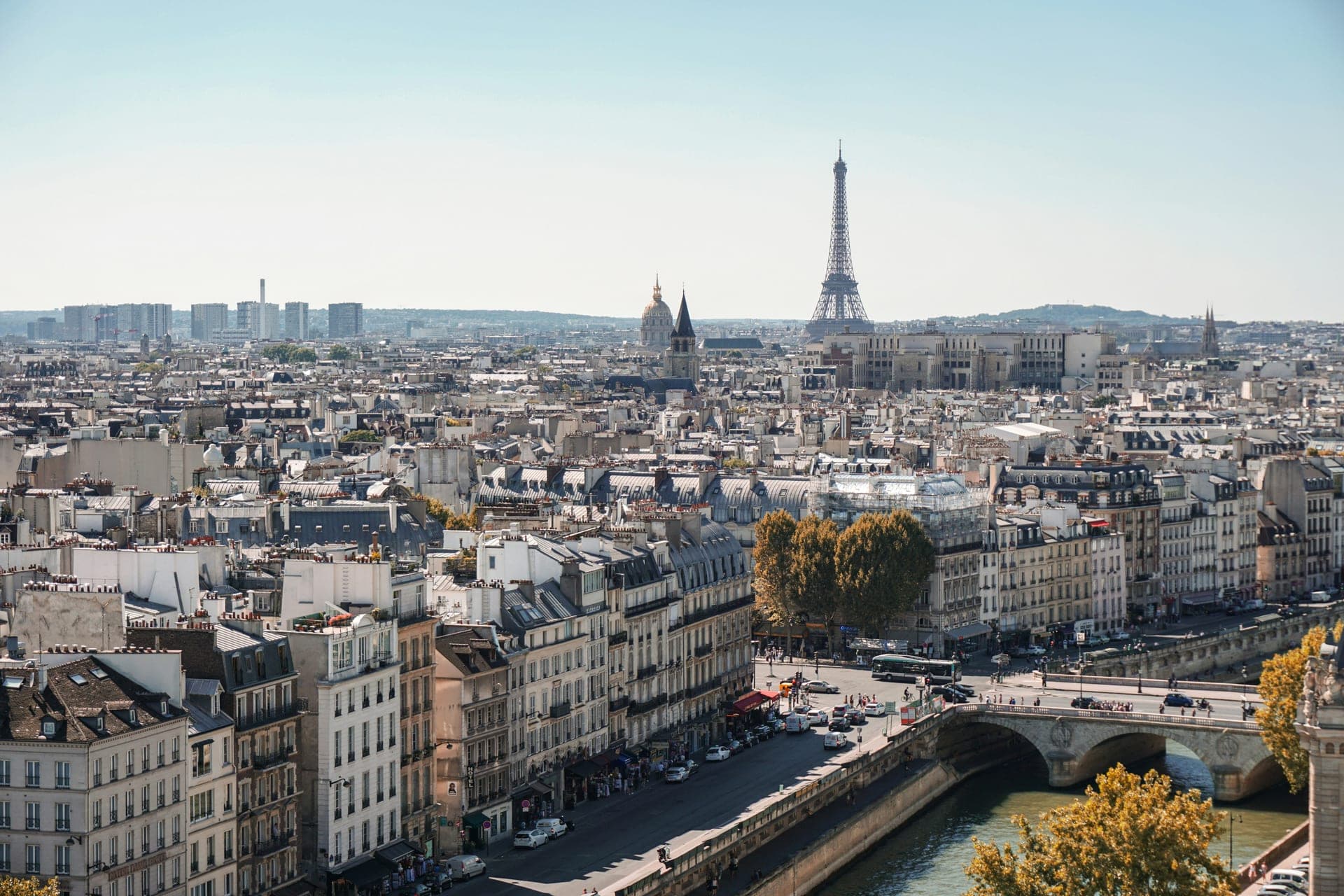
A shrinking city on emptier roads
Paris has spent two decades taking road space from cars. The city counts 60% less car traffic inside its boundary than in 2002, and what remains moves at an average 9.6 km/h. It now has more parking spaces for bikes than for cars: 136,510 against 119,623.
The city is also shrinking. The census put its population at 2.1 million in 2023, against 2,187,526 in 2017, a fall of 0.6% a year. The Métropole du Grand Paris, the metropolitan authority around it, groups 130 communes and 7.2 million people.
The figures quoted most often for how people travel in Paris measure different things. A GPS survey by the Institut Paris Région, the regional planning agency, tracked 3,337 residents of the wider Île-de-France region from October 2022 to April 2023. Of their trips inside Paris, 11.2% were by bike and 4.3% by car, a sample of the region’s residents rather than of Parisians alone. The census asks only about the journey to work, and among working Parisians it puts the bike narrowly ahead of the car.
Main mode for the journey to work of working residents aged 15 and over, census 2022 (survey years 2019–2024); a further 5% do not travel to work. Commuting is only part of all travel, and the census does not count other trips. Source: Ville de Paris, travel report 2025 (INSEE census RP2022)
The Plan Climat 2024–2030, adopted by the Conseil de Paris (the city council) in November 2024, measures progress against 2004. It sets a 50% cut in local emissions by 2030 and carbon neutrality by 2050. Local emissions come from buildings, traffic and waste inside the city. By 2023 they were 31% below 2004 and no lower than in 2022, which leaves them 0.76 million tonnes above the city’s own path to neutrality. The wider carbon footprint, which adds imported goods, food and flights, fell by 34%.
Buildings produce about two-thirds of local emissions, and theirs rose in 2023, while transport emissions inside Paris are down 48% since 2004. The plan also promises every resident a cool island, a shaded or green refuge from heat, within 7 minutes’ walk.
% of the 2004 level
Show the numbers
| Local emissions | Local target | Carbon footprint | Footprint target | |
|---|---|---|---|---|
| 2004 | 100 | — | 100 | — |
| 2023 | 69 | 69 | 66 | 66 |
| 2030 | — | 50 | — | 60 |
| 2050 | — | 0 | — | 20 |
Local emissions come from buildings, traffic and waste inside Paris; the carbon footprint adds imported goods, food and flights. The city reports local emissions of 5.07 Mt in 2022, 31% below 2004, and stable in 2023. The target lines join the latest figures to the Plan Climat goals for 2030 and 2050. Source: Ville de Paris, greenhouse-gas balance (May 2026); Plan Climat 2024–2030
On 30 June 2026, 95.9% of homes and business premises could get fibre to the home, according to Arcep, the telecoms regulator. Paris Data, the city’s open-data portal, listed 490 datasets on 1 October 2026, and the national register shows 5,633 public charging points in Paris open to anyone.
Only 48.0% of Parisians in the IMD Smart City Index survey would share personal data to ease congestion, against 57.9% across comparable cities. The index ranks cities on what about 120 residents each report, pooled over three years, and it placed Paris 71st of 148 in 2026, down from 49th in 2024. Security and affordable housing were each named a priority by 68% of respondents.

Proximity thins out towards the edges. The 15-minute city puts daily needs within a short walk or ride, and a 2024 study in Frontiers in Big Data was the first to test how well Paris fits it. It found the city fairly even overall, but with a highly accessible centre and a less well-equipped periphery, where lower-income neighbourhoods are more common. The contrast grows once the inner suburbs are included.
Digital tools bring their own limits. A doctoral study carried out inside the city administration warns that digital participation tools can create new forms of exclusion. No Paris-level figure for residents who cannot use online public services could be found.
Incubators at home, infrastructure on contract
Paris&Co is the innovation agency of Paris and the Métropole, and incubates about 500 start-ups a year. It runs five Quartiers d’Innovation (innovation districts): two in Paris, in Paris Rive Gauche and around La Chapelle since 2018, and three more in the Métropole from 2023. Up to 40 pilots a year are tested across them, with the stated option of stopping those that fail. The programme’s published description gives no count of how many went on to wider use.

In 2025 Paris&Co launched the Défis Parisiens (Paris challenges), five calls asking firms to work on municipal problems such as low-carbon building sites, predictive maintenance of heating and saving water. Paris Innovation Amorçage, a seed-grant scheme run since 2009 with Bpifrance, the state investment bank, has given €61.5m to more than 1,700 start-ups. Station F, a private campus in the 13th arrondissement, says it hosts more than 1,000 start-ups, with Google, LVMH and Meta among the firms on site; the figures are its own.
A firm hoping to sell software to the city meets an empty chair: the city’s organisation chart of 9 September lists the head of the DSIN, its IT and digital department, as vacant.
Much of the city’s infrastructure is run by others. Agemob, a joint body of Paris and neighbouring communes known until 2024 as the SAVM, contracts Vélib’, the shared-bike scheme, to the operator Smovengo. Most public chargers belong to TotalEnergies, which holds the city’s Belib’ concession with 2,252 points, and to Saemes, a car-park company linked to the city. Île-de-France Mobilités, the regional transport authority, organises the metro, trams and buses that RATP and other operators run. The State’s Société des grands projets is building the Grand Paris Express metro.
Digital inclusion runs through social-economy organisations. The Stratégie parisienne d’inclusion numérique (Paris digital-inclusion strategy) has worked with them and with refurbished equipment since 2017, according to the city’s 2025 digital strategy.
Research also sits inside the administration. Mélody Tonolli, deputy mayor for universities and research, coordinates the city’s scientific council, and the city places CIFRE doctoral students, PhDs funded jointly with an employer, in its own departments. Paris en Selle, a cycling association, tracks the Plan Vélo in an independent observatory. La Quadrature du Net, a digital-rights group, has fought algorithmic video surveillance in court.
A climate plan standing in for a smart-city plan
Emmanuel Grégoire of the Parti socialiste (Socialist Party) became mayor on 29 March 2026, elected by the Conseil de Paris with 103 votes to succeed Anne Hidalgo. For the first time, Parisians had chosen all 163 councillors on one city-wide vote. His list of Socialists, Les Écologistes (the Greens) and Communists won 50.52% in the second round, against 41.52% for Rachida Dati of the centre-right Les Républicains.
None of the 36 deputy mayors appointed on 30 March has digital technology, data or the smart city in their title; innovation sits with Richard Bouigue, deputy for economic development. Grégoire’s inaugural speech set out children, housing, renovation and policing as priorities, without the French words for digital, data or artificial intelligence.
Paris has no smart-city strategy in force; its 2014–2018 programme of calls for projects was experimental. The working plan is the climate plan, with about 500 actions. The digital strategy is one of restraint: a Stratégie numérique responsable (responsible digital strategy), which a 2021 law requires of every commune of more than 50,000 people. Paris debated its 27 actions in November 2025, about 11 months after the legal deadline.
The strategy puts digital technology at about 1 million tonnes of CO₂ a year, 5% of the city’s carbon footprint. Under its heading on an exemplary administration, it aims to cut digital’s environmental footprint by two-fifths by 2035. The same session voted to set up an AI ethics committee with unions and citizens; the strategy adds executive approval and public notice for every AI use. In April 2026 the city still described the committee as a proposal, and no meeting has been reported.
Many levers sit elsewhere. The region’s transport authority sets fares and routes. In April the Métropole re-elected Patrick Ollier of Les Républicains as its president, and Grégoire wants it to become a body that really decides. Paris also holds the label of the EU’s mission for climate-neutral and smart cities by 2030, while its own plan sets neutrality for 2050.
On transport, higher education, economic attractiveness, innovation, solidarity, housing, the right scale is the metropolis. Paris bigger than Paris.The sharpest argument is about cameras the city does not run. Policing in Paris belongs to the Préfecture de police, the State’s police headquarters. A 2023 law for the Olympic Games allowed an experiment with algorithmic video surveillance. At Paris 2024 it was used by the Préfecture, by RATP, which runs the metro and buses, by SNCF, the national railway, and by the town of Cannes. The State committed about €886,000, and most of the software came from the French start-up Wintics.
In January 2025 the official evaluation committee found its performance uneven: good on intrusions and crowd density, very poor on fires and falls, with very few police interventions following its alerts. No breach of the law was found. The experiment ended in March 2025. After the Conseil constitutionnel (Constitutional Council) struck down a first extension, the law for the 2030 Winter Olympics revived it to the end of 2027. A security law known as Ripost, upheld by the Conseil constitutionnel in August 2026, now runs it to the end of 2030 in public places exposed to serious risk. The city’s own AI rules cover only its own services.
Under the guise of security, the Olympic Games will in fact have served as a springboard to normalise surveillance technologies.- 2014[source]
Participatory budget
Residents begin voting on projects paid for from the city’s investment budget.
- Oct 2021[source]
Plan Vélo
The city launches its cycling plan for 2021–2026.
- May 2023[source]
Olympics law
Parliament authorises an experiment with algorithmic video surveillance, run by the State.
- Nov 2024[source]
Plan Climat adopted
The Conseil de Paris adopts the 2024–2030 climate plan.
- Mar 2025[source]
Camera experiment ends
The experiment reaches its legal end date; an extension is struck down in April.
- Nov 2025[source]
Responsible digital strategy
The council adopts the strategy and votes to set up an AI ethics committee.
- Mar 2026[source]
Direct election
Parisians elect the whole council city-wide for the first time; Emmanuel Grégoire becomes mayor.
- Dec 2030[source]
Camera trial ends
The end date set by the Ripost law, which the Conseil constitutionnel upheld in August 2026.
- 2030[source]
Climate milestone
Target: local emissions halved and the carbon footprint cut by 40% against 2004.
- 2050[source]
Carbon neutrality
Target: no local emissions and a carbon footprint 80% below 2004.
From a participatory budget to a climate plan, with the State’s camera experiment running alongside, and the targets still ahead.
Ballots, bike lanes and the contracts the city cannot rewrite alone
The Budget Participatif (participatory budget) lets residents propose projects and vote on part of the city’s investment spending. In its first ten years votes allocated €769m to 1,345 projects, about €77m a year on average. Turnout in the residents’ vote, open from the age of 7, rose from 92,809 in 2016 to 162,395 in 2025, when the eleventh round chose 104 winning projects.
DansMaRue, the city’s app for reporting street faults, remains in service. It logged 862,264 reports in 2023, against 46,828 in its first year, 2014.
The Plan Vélo 2021–2026 promised 180 km of protected cycle lanes for more than €250m. Cycling on the city’s 2020 counter network grew by 47% between 2020 and 2025, and the cycle network now runs to 1,607 km. Paris en Selle judged about 40% of the plan delivered when the term ended. Growth is uneven: 9 of 55 counter sites fell in 2025, notably on the southern boulevards des Maréchaux. In October 2026 the city presented a plan for 2027–2032, promising €200m for 140 km of new cycle lanes and 420 more junctions made safe.
You can see some are uncomfortable with reducing the space for cars, which is nevertheless essential to make room for the bike.Vélib’ Métropole, the shared bikes, still runs on a contract that ends in 2032. A 2023 audit for the SAVM found the service short of its contractual targets, with 16% fewer bikes than contracted in early 2022, and projected a deficit of €113m by the contract’s end. Rentals fell 3.2% in 2025, to 47.3 million, after a change in e-bike pricing, while other bike-share services grew by 25.4%.
The Périphérique carpool lane was measured within months. Since 3 March 2025 one lane of the ring road has been kept for vehicles carrying at least two people. From March to June 2025 traffic on it fell 13% on a year earlier, against 1% on the other lanes, and it moved 10 to 20 km/h faster. The lane is still in use.
The limited-traffic zone in the four central arrondissements, the city’s districts, has barred through-traffic since November 2024, but no fines had been issued by September 2026. Airparif, the region’s air-quality monitoring body, measured 18% less traffic inside the zone between 2023 and 2025, against 10–12% further out. It found a small fall in nitrogen dioxide, and says the zone alone does not explain all of the drop in traffic. The Métropole’s low-emission zone survives in law: in May 2026 the Constitutional Council struck down Parliament’s vote to abolish such zones as out of place in the bill.
The Grand Paris Express, a new metro the State is building around the city, has slipped. Line 15 South, 33 km with 16 stations, was due at the end of 2025 and is now expected in autumn 2027. The share of its station equipment linked to the control centre rose from 3% in 2024 to almost all of it by June 2026. The first section of Line 18 is due to open in the first week of December 2026.
Each of the three systems in the headline reaches Paris through someone else’s process. The shared bikes follow a syndicate’s contract and its audits, the new metro lines the State builder’s schedule, and the cameras a law that already runs them to the end of 2030. A participatory-budget ballot can pay for a project on a Paris street, but it has no say over any of the three.
References
Statistics1Click on any number to see the source
Population & migration
From our libraries10
- Paris Data Platform — Knowledge
- IMD Smart City Index — Knowledge
- 15-Minute City: A New Urban Planning Paradigm — Knowledge
- City composition and accessibility statistics in and around Paris (Thaury, Genet, Maurice, Tubaro, Berkemer — Frontiers in Big Data, 2024) — Knowledge
- Paris&Co — Organisation
- Station F Startup Campus — Organisation
- Discours d'Emmanuel Grégoire, nouveau maire de Paris (Conseil de Paris, 29 mars 2026) — Knowledge
- Stratégie numérique responsable de Paris — dossier de presse — Knowledge
- EU Mission: 100 Climate-Neutral and Smart Cities by 2030 — Knowledge
- Expérimentation de traitements algorithmiques d'images légalement collectées au moyen de systèmes de vidéoprotection — Rapport du comité d'évaluation (janvier 2025) — Knowledge
Further sources26
- Comment se sont déplacés les Parisiens en 2025 — Ville de Paris · 15 July 2026
- Inédit : le vélo surpasse la voiture à Paris et en petite couronne — Ville de Paris
- Émissions de gaz à effet de serre : où en est Paris ? — Ville de Paris · 21 May 2026
- Synthèse du Plan Climat 2024-2030 — Ville de Paris · June 2024
- Paris — Smart City Index 2026 — IMD World Competitiveness Center · 2026
- Comparateur de territoire — Commune de Paris — INSEE
- Numérique et ville de demain : comment Paris expérimente la smart city — Ville de Paris
- Élections municipales 2026 : la proclamation officielle des résultats définitifs — Ville de Paris · March 2026
- Qui sont les adjoint·e·s du maire de Paris ? — Ville de Paris · 30 March 2026
- Organigramme de la Ville de Paris — Ville de Paris · 9 Sept 2026
- Les temps forts du Conseil de Paris de novembre 2025 — Ville de Paris · Nov 2025
- Voici comment le gouvernement a prolongé la vidéosurveillance algorithmique — Amnesty International France · 24 March 2025
- Vidéosurveillance algorithmique : le Conseil constitutionnel donne son feu vert — LCP · March 2026
- Vidéosurveillance algorithmique : la loi Ripost étend encore la prolongation jusqu’en 2030 — Next · May 2026
- Paris, capitale innovante — Ville de Paris
- Les Quartiers d’Innovation — Ville de Paris
- Municipales à Paris : les candidats exposent leurs engagements sur le vélo — La Gazette France (AFP) · 8 Feb 2026
- Vélib’ Paris : un déficit de 113 millions d’euros à la fin du contrat avec Smovengo — L’Info Durable
- Aménagements et sécurité : le nouveau plan vélo voit toujours plus grand — Ville de Paris · 14 Oct 2026
- Impact sur la qualité de l’air de la mise en place de la Zone à Trafic Limité à Paris — Airparif · Sept 2026
- ZTL de Paris Centre : 18 % de trafic en moins — La Clé Publique · 25 Sept 2026
- Agemob — Rapport d’activité 2024 — Agemob
- Intelligence artificielle à Paris : où en est-on ? — Ville de Paris · 28 Apr 2026
- Smart City Index — methodology — IMD World Competitiveness Center · 2026
- Décision n° 2026-903 DC — Conseil constitutionnel · 21 May 2026
- Métro Grand Paris Express : la ligne 18 sur les rails début décembre, report de six mois pour la 15 Sud — La Gazette France (AFP) · June 2026