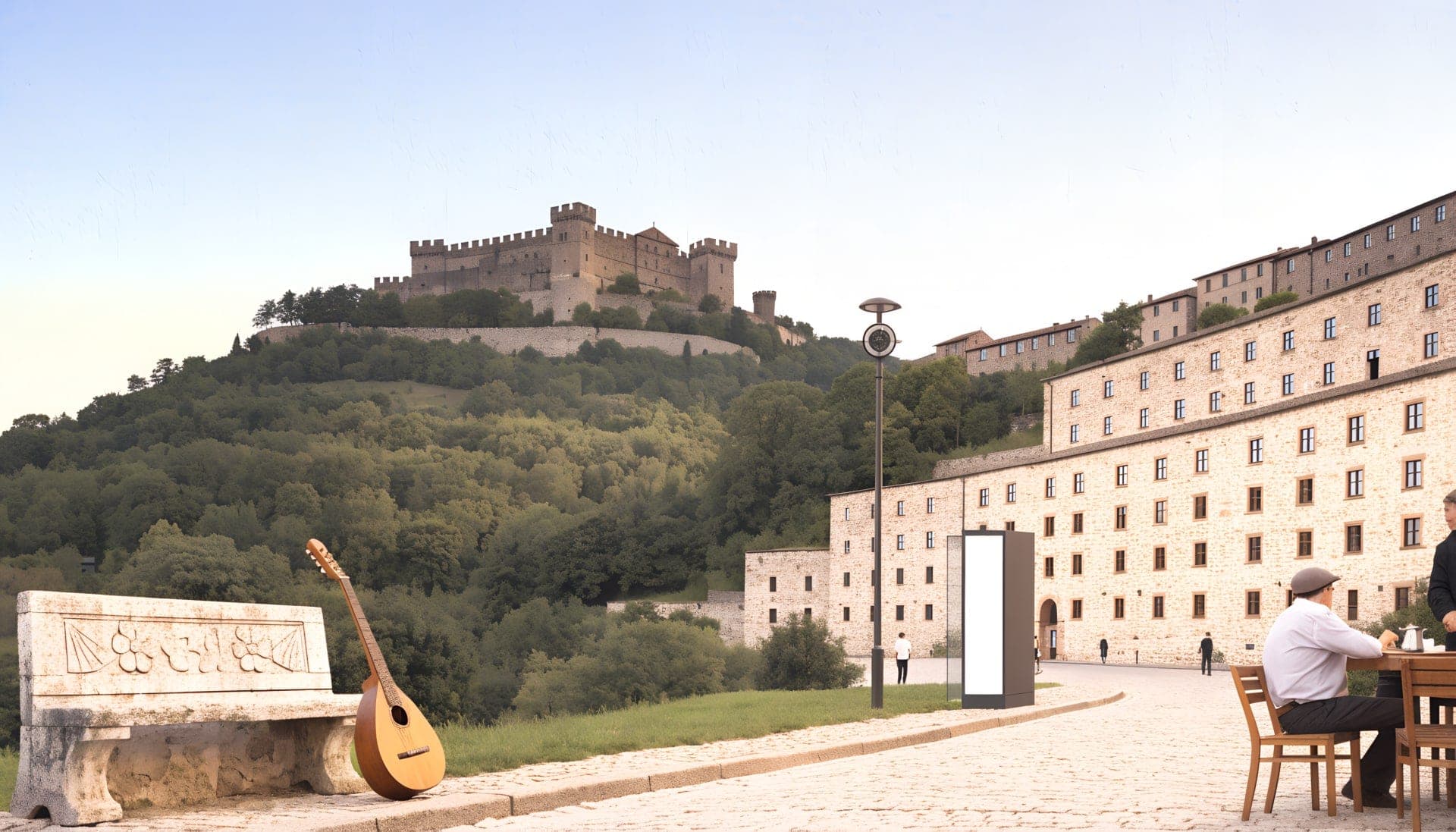
The counters closed before most adults had basic digital skills
Since a territorial reform in 2015, Albania has had 61 municipalities, the basic unit of local self-government, grouped into 12 counties (qarqe) that form a weaker second tier. On 1 January 2026 it had 2,335,930 residents, against 2,402,113 at the 2023 census and 2,831,741 in 2011. Net emigration took 28,531 people in 2025 alone, the median age is 45, and only Tirana county grew; it now holds 32.8% of the population.
Albania’s climate law of December 2020, Law 155/2020, sets out how national targets are made but names no year for net zero. The 2050 date exists only in policy: the third national climate pledge, NDC 3.0, says Albania is committed to neutrality by then. The European Commission has asked for the law to be updated to match, and notes that no emissions register exists.
The pledge, sent to the UN in September 2026, allows emissions to grow. Net emissions are to stay below 9,195 kilotonnes of CO₂ equivalent in 2035, which the NDC describes as limiting growth to 17.4% above 1990. The official figures do not add up. The European Environment Agency, using the old inventory, puts 2019 emissions at 230% of the 1990 level. The new inventory summarised in the NDC finds carbon dioxide alone about 27% lower in 2022 than in 1990.
Renewables are where Albania stands out. In 2024, 43.11% of Albania’s gross final energy came from renewables, against 25.24% across the EU, most of it from hydropower. The NDC expects emissions to rise in dry years, when the gas-fired plant at Vlorë runs.
%
Show the numbers
| Albania | EU-27 | |
|---|---|---|
| 2015 | 34.9 | 17.8 |
| 2016 | 37.0 | 18.0 |
| 2017 | 35.8 | 18.4 |
| 2018 | 36.6 | 19.1 |
| 2019 | 38.0 | 19.9 |
| 2020 | 45.0 | 22.0 |
| 2021 | 41.4 | 21.9 |
| 2022 | 44.1 | 23.0 |
| 2023 | 46.6 | 24.6 |
| 2024 | 43.1 | 25.2 |
Share of renewable energy in gross final energy consumption, Albania and the EU-27, on the same Eurostat basis. Most of Albania’s comes from hydropower, so output depends on rainfall. No emissions line is drawn: Eurostat publishes no Albanian series, and the official documents give conflicting 1990 baselines. One step on the axis is one year. Source: Eurostat, nrg_ind_ren (share of renewable energy in gross final energy consumption), read 16 October 2026
The digital state moved faster than the climate. In 2017, 14% of public services could be used online. From 1 May 2022, by government decision, about 95% were offered only online, through e-Albania, the national portal. The European Commission counts 95% of applications for 1,253 public services as offered online. In 2025, 62.11% of adults dealt with a public authority online, against 57.65% across the EU. The share had been 44.75% in 2022 and peaked at 67.88% in 2024.
We will no longer have counters, and in 2022 the counters in Albania will close.The fixed networks skipped a generation. About 75% of fixed broadband connections run on fibre to the home or building, 13% on cable, and 54% of subscriptions are faster than 100 Mbit/s. The regulator AKEP counts connections, not homes passed, so no coverage figure comparable with the EU’s exists. Rural areas, home to about 40% of residents, hold 19.5% of fixed connections. Operators’ 5G licences of November 2024 oblige them to reach every city by the end of 2028.

Share of people aged 16 to 74, unless stated, and of firms with ten or more staff, in 2025, from the surveys Eurostat publishes for both Albania and the EU-27. The Digital Decade does not cover Albania, so no fibre or 5G coverage figure is shown. Source: Eurostat, isoc_ciegi_ac (interaction with public authorities), isoc_sk_dskl_i21 (digital skills) and isoc_eb_ai (firms using AI), 2025
The skills did not follow the portal. In 2025, 27.65% of adults had at least basic digital skills, against 60.4% in the EU; among those aged 65 to 74 it was 1.89%. Only 10.3% of that age group dealt with an authority online in 2025. The Supreme Audit Office, KLSH, concluded that older people cannot use the online services, at a financial cost to them. Citing press reports, it added that many residents who cannot apply themselves hand their personal data to private offices or stationery shops, at a risk of abuse.
A third of e-Albania’s users call it “not very easy” or “not at all easy”, and the only official help is a call centre. In July 2026 the European Roma Rights Centre complained to the data-protection commissioner that many Roma and Balkan Egyptian families must pay intermediaries, handing over IDs, passwords and bank details. The portal is also not available in Romani. In a 2024 survey by the Civic Center, 79.6% of citizens preferred a mix of online services and counters.

We’re telling the Albanian government: if you’re going digital, make sure everyone can actually get online.The national portal also outruns the town halls. Municipal digital readiness averages 31 out of 100, against 73 for Tirana. Businesses reckon that only about 30% of municipalities let them deal with them online, and three companies in ten use their municipality’s digital services.
Most levers that shape an Albanian town sit in the ministries
The law on local self-government, Law 139/2015, lists what the municipalities do and allows further duties “only on the basis of law”. The national government may also set “specific standards and norms” for the tasks they already hold. In practice, most levers that shape a smart city sit with national agencies.
- Broadband and mobile: AKEP regulates and private operators build; there are 281 authorised fixed operators. A municipality grants rights of way and permits for masts.
- Public transport: local buses are a municipal duty, run as private concessions. In Shkodër the operators get no subsidy and must cover their costs from fares.
- Policing and cameras: the State Police answer to the Ministry of Internal Affairs. Municipalities keep civil protection, the fire service and administrative offences. The cities for the national camera programme were chosen with the police by crime level.
- Energy: grids and regulation are national. Since 2021 every municipality must draw up a local energy-efficiency action plan, and a new electricity law in force since July 2026 creates civic energy communities.
- Planning: municipalities plan their land and issue most permits, all through the national e-Leje system. Complex and strategic permits go to the National Territorial Council, which the Prime Minister chairs.
- Open data: a 2022 law binds public bodies. Of the 312 institutions asked by the data-protection commissioner, 177 had published a list of open datasets, and the EU’s 2025 maturity review rated local open-data initiatives as “Few”.
- Online services and e-ID: AKSHI, the National Agency for the Information Society, builds e-Albania and writes software for municipalities only at their request. In its 2025 report the Commission asked Albania to adopt an e-ID law in line with the EU’s digital-identity rules.
- Procurement: AKSHI buys IT for central government. An exceptional Albanian law lets companies from the United Arab Emirates bypass standard tenders.
- Waste: collection is a municipal duty by law, but the state waste company AKEM is to become the national operator in 2026, with municipalities as its clients.
That arrangement helps explain the speed. Since 2017 one agency has run e-government, and no town hall had to agree to the move online. It also explains the limits. A mayor cannot choose the cameras on the town’s streets, and a lever can be withdrawn. A town that holds the bus lever but has no subsidy budget cannot buy the buses it plans.
Levers have been withdrawn. On 11 July 2025 Edi Rama, the Prime Minister, told the mayors that their deputy mayors and directors had to go by the following Monday; resignations followed. The Commission said the wave “raises concerns”, including under the European Charter of Local Self-Government. On 11 September 2026 Rama made Ervin Demo, until then minister of state for local government, minister of internal affairs, and abolished the local-government post. Local affairs are to be folded into the Interior Ministry, as they once were, so one minister now answers for both the police and the municipalities.
Around them sit a few watchers and many donors. KLSH audits the portal, SPAK, the special anti-corruption prosecution, pursues the procurement, and BIRN, a network of investigative reporters, reports on both. The National Association of Municipalities works for local autonomy. Much of the money for urban plans comes from abroad: the EIB for Shkodër’s mobility plan, Interreg for Durrës, the World Bank for municipal e-services.
An AI minister on paper, a camera contract without a tender
Rama’s Socialist Party (PS) won 53.2% at the election of May 2025 and governs alone; his fourth government took office that September. In September 2025 Diella, a chatbot on e-Albania, was named Minister of State for Artificial Intelligence and Public Procurement. The Commission calls it “a virtual entity” under the Prime Minister’s authority.
The Prime Minister’s office says Diella “does not make administrative or legal decisions autonomously”. In August 2026 the head of the Public Procurement Agency said an AI procurement system was still in preparation; its terms of reference had just been finished.

Diella does not solve corruption. On the contrary, it raises a fundamental question: who is responsible for the decisions influenced by a system that has no legally defined status?The agency’s own leadership is under investigation. On 16 December 2025 SPAK placed AKSHI’s director, Mirlinda Karçanaj, and her deputy under house arrest in a case against eight people. Prosecutors say businessmen forced bidders to drop complaints about AKSHI tenders. In April 2026, with Karçanaj by then the former director, they seized more than €40m of assets. In May 2026 the Supreme Court replaced her house arrest with a duty to report to the judicial police twice a month and a travel ban; no one has been tried. A 2023 performance audit by KLSH had already found the measures taken insufficient, AKSHI 40% understaffed and the national Digital Agenda drafted by AKSHI alone.
The World Bank finances the next step. Its GovTech programme began in 2023 and grew to $145m when $80m more was approved in March 2025, for local services and AI-assisted procurement. By 2025 applications through e-Albania had risen by 40%, on a baseline the Bank does not state. The target for 2029 is ten priority services online in all 61 municipalities.
The police run the other big programme. The “Smart City” programme of the Ministry of Internal Affairs plans more than 8,657 cameras in 20 cities, some of them body cameras for police officers. Its value was put at €60m in June 2024 and at $118.5m when parliament’s committee examined the loan in March 2025. In April 2026 it stood at $113.6m, financed by a loan from Abu Dhabi.
Under the UAE agreement, the then deputy interior minister Besfort Lamallari told the committee, there would be no tender; the lender’s conditions meant the Emirates would choose the contractor. Presight, part of the Abu Dhabi group G42, had been named in April 2024 and signed the contract in December 2025. The data-protection commissioner’s office told Transitions Online, a regional magazine, that no data-protection impact assessment was carried out. AKSHI keeps no list of which institutions use AI or biometric cameras.
Has the project been tendered? With everything we’re hearing, the money comes and we see our comrades going to prison.European money comes as accession aid, not recovery funds. Of €922m allocated to Albania under the EU’s Reform and Growth Facility, €213m had been paid in three instalments by June 2026; digital transformation is one of five priorities. Albania is fully associated to Horizon Europe, the EU research programme, and opened the negotiating cluster that includes digital policy in May 2025. Its aim is membership by 2030.
The country’s digital spine leans on foreign owners. The camera network is financed and built from the Emirates. In 2022 the Hungarian IT company 4iG bought One Albania, a mobile operator, and ALBtelecom, leaving mobile to it and Vodafone. In 2021 a leaked database of 910,000 voters matched most of the fields e-Albania asks for. AKSHI rejected any link, and Rama denied the database was his party’s while acknowledging a door-to-door “system of patronage”.
- 2015[source]
Territorial reform
The country is redrawn into 61 municipalities, grouped into 12 counties.
- Dec 2020[source]
Climate law
Law 155/2020 governs the national pledges; it sets no net-zero year.
- Apr 2021[source]
Voter data leaked
A database of 910,000 voters with phone numbers and political leanings becomes public.
- Jul 2022[source]
Cyberattack
An Iranian state-linked attack disrupts government services.
- Nov 2024[source]
5G licences
Two operators win spectrum, with coverage duties for 2027, 2028 and 2030.
- Dec 2024[source]
Data-protection law
Law 124/2024 brings personal-data rules into line with the GDPR.
- Dec 2025[source]
Camera contract
The Interior Ministry signs a multi-year contract with Presight of Abu Dhabi.
- Jun 2026[source]
Adaptation plan
The government approves a National Adaptation Plan for 2026–2036.
- Sep 2026[source]
Local government moves to the Interior Ministry
The minister of state for local government becomes interior minister; his old post is abolished.
- 2035[source]
Climate pledge
The pledge’s target year, with a ceiling above the 1990 level; neutrality by 2050 is a policy aim, not law.
From the reform that drew today’s 61 municipalities to the year of the current climate pledge.
Rolled out by the state, or kept by the town that began it
e-Leje, the national building-permit system, is the clearest case of spread by law. It is the only way to apply for a building permit in all 61 municipalities. The Investment Council, a business advisory body, calls it “a successful case of service digitalisation, even though practical problems continue to arise from time to time”. Of the businesses it surveyed that had used e-Leje, 48% reported a good experience; municipalities complain of unannounced maintenance and too little training.
Elbasan and Fier show a national model that spread and failed. The government’s concessions for waste incinerators cost nearly €150m of public money. Elbasan’s, at €26m, ran for a few months and is now, in AFP’s words, “a rusting hulk”. Fier’s €23m plant never worked, and a third, for Tirana, was never built. A former minister, Lefter Koka, was jailed.
Elbasan is also Albania’s only city in the EU mission for climate-neutral and smart cities. On 16 February 2026, with Sarajevo, it became one of the first two in the Western Balkans to hold the Mission Label. Its plan links solar power and geothermal energy with farming and buildings. The announcement gives no baseline or investment figure. Meanwhile a dump fire in July 2025 sent dioxins and furans to more than seven times the limits, according to Besnik Baraj of the Academy of Sciences.
Shkodër, a northern city with a cycling tradition, measured its streets for a mobility plan paid for by the EIB. In 2024 walking, cycling and the private car each carried 32–36% of trips, while buses carried almost none. The city had about 4.3 km of protected bike lanes and a single urban bus line; when it planned three more, no operator bid. The plan was finished in late 2025.
Shkodër was also one of only four municipalities, with Berat, Përmet and Roskovec, to have an energy-efficiency action plan by November 2024, although the law has required one of every municipality since 2021. Durrës and Vlorë had taken no concrete step. Berat has run a pilot of waste separation at source since December 2024, just as waste is due to pass to a national operator.
Durrës, the main port, plans a new bike lane under SUMO 2.0. The Interreg project, with partners in Bar, Brindisi and Termoli, has €1,001,035 to the end of 2027 and a cross-border strategy for transferring its results. Durrës is also one of eight municipalities, with Elbasan, Fier and Vlorë, that had prepared a climate adaptation plan by September 2024; their implementation has not been reported.
Korçë notifies drivers of parking fines digitally, one of the local e-services the Investment Council calls “sporadic”, the product of individual municipal initiatives and lobbying. The World Bank programme is meant to replace that patchwork with ten common services by 2029.
Building permits through e-Leje are compulsory by law; the one-stop shops, about 52, were built by a donor programme; the plans are those prepared or adopted, with no implementation reported. The camera count is the cities chosen for the programme. Installation has been reported for its first phase only, about 380 cameras in 20 Tirana schools (Euronews Albania, April and August 2026); for the other cities, no state body would tell Transitions Online where cameras stand. Counts at the latest date each source gives, 2024 to 2025. Source: Investment Council Albania (March 2025); Shqiptarja (2 June 2024); European Commission, Albania 2025 Report; ACQJ (14 November 2024)
Shkodër can still count its cyclists and draw a mobility plan, Elbasan can win a label and Durrës a bike lane, mostly with a donor’s or the EU’s money. What reached the other towns was sent from the capital: permits by law in all 61, cameras by contract to 20 chosen cities, and an incinerator scheme that failed in two. A legal duty that municipalities say came without the money or staff to meet it produced plans in four municipalities of 61. And in 2025 the centre forced out deputy mayors across the country, while waste is due to pass to a national operator.
References
Statistics1Click on any number to see the source
Population & migration
From our libraries7
- Albania Third Nationally Determined Contribution – NDC 3.0 (November 2025) — Knowledge
- Albania 2025 Report (European Commission, SWD(2025) 750) — Knowledge
- Raporti Vjetor 2025 (AKEP – Autoriteti i Komunikimeve Elektronike dhe Postare) — Knowledge
- Digital Divide: The Albanians Left Behind by Move to Online Public Services (BIRN, 25 Apr 2025) — Knowledge
- On Digital Transformation of Public Local Services for Businesses (Investment Council Albania, March 2025) — Knowledge
- Porta e Alpeve – Plani i Lëvizshmërisë së Qëndrueshme Urbane, Vëllimi I: Analiza e Gjendjes (Bashkia Shkodër, EIB Economic Resilience Initiative) — Knowledge
- Albania's AI Turn: A Surveillance State Without Oversight? (Transitions, 13 Apr 2026) — Knowledge
Further sources17
- Law 139/2015 on local self-government — Ministry of Finance (Fletorja Zyrtare)
- Population of Albania, 1 January 2026 — INSTAT · 2 June 2026
- Albania, Third Nationally Determined Contribution (NDC 3.0) — Government of Albania · Nov 2025
- Performance audit: the delivery of online services — Kontrolli i Lartë i Shtetit (Supreme Audit Office) · 2023
- Albania 2025 Report — European Commission · Nov 2025
- Annual report 2025 — AKEP (Electronic and Postal Communications Authority) · 2026
- ERRC complaint on digital discrimination against Roma and Balkan Egyptians — European Roma Rights Centre · 30 July 2026
- On digital transformation of public local services for businesses — Investment Council Albania · Mar 2025
- How to appoint a mayor — Exit News · 2 Oct 2025
- Local affairs merged into the Ministry of Internal Affairs — Balkanweb · 11 Sep 2026
- Eight accused of rigging information-agency tenders — BIRN, Balkan Insight · 16 Dec 2025
- Smart City project in the parliamentary committees — Shqiptarja · 11 Mar 2025
- EU and Albania review progress of EU-funded reforms and investments — EU Delegation to Albania · 10 June 2026
- The cost of a dirty past — AFP, via The Star · 14 Oct 2026
- Elbasan, Dortmund and Sarajevo awarded the EU Mission Label — NetZeroCities · 16 Feb 2026
- Municipalities in Albania fail to implement the energy-efficiency law — ACQJ · 14 Nov 2024
- Project SUMO 2.0 — Bashkia Durrës · June 2026