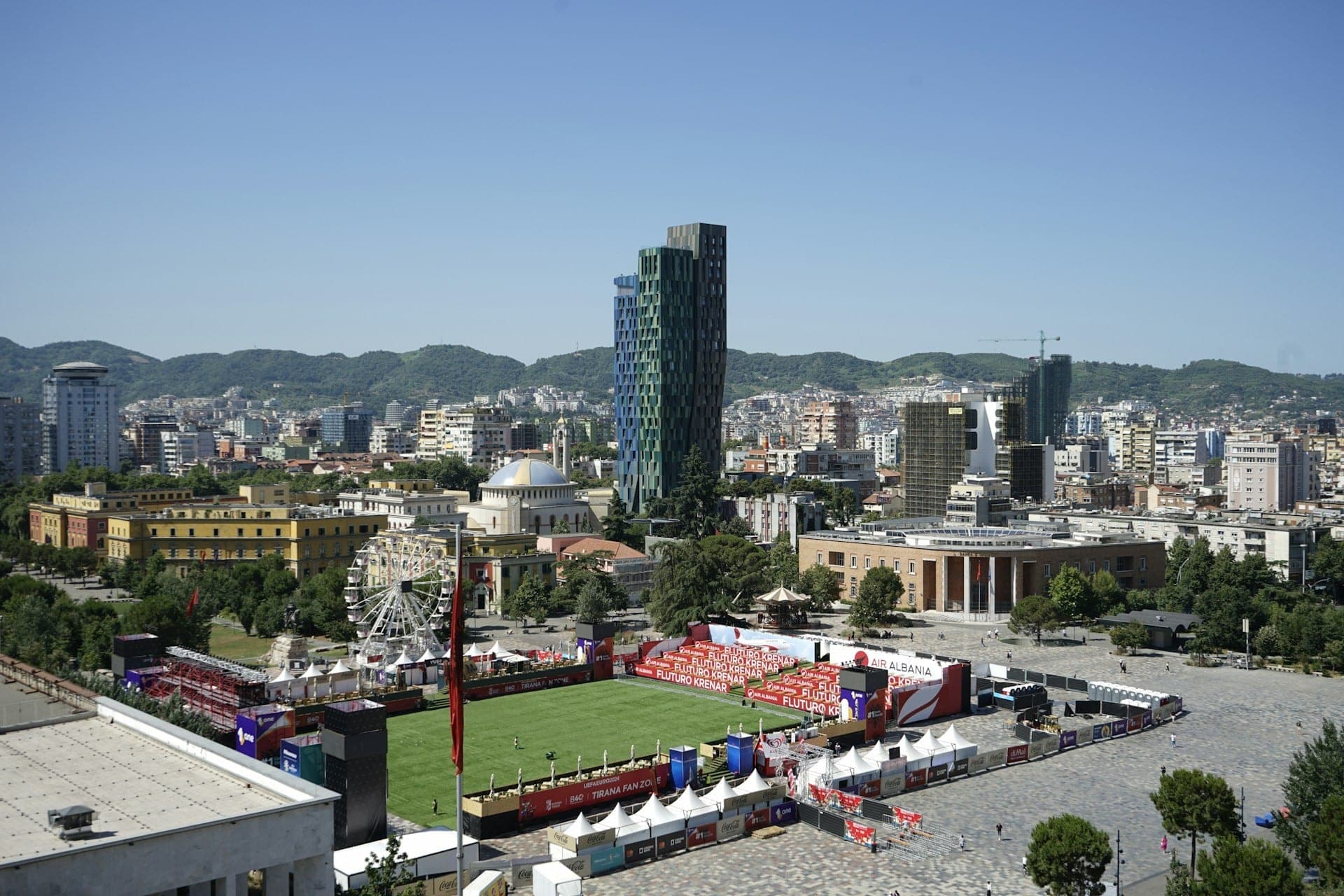
Most residents in the old city, a third in the communes it absorbed
Tirana measures some things daily and others not for decades. Three bicycle counters recorded 2,180,474 passes in 2024. Yet the newest city-wide travel survey its 2020 mobility plan could cite dates from 2008. Its only count of the city’s emissions is for 2011.
Which Tirana is meant also matters. Since the 2015 territorial reform the Municipality of Tirana has covered 24 administrative units: 11 in the old city and 13 former rural communes. The 2023 census counted 598,176 residents. About two in three live in the old city unit, and Kashar alone holds 89,395. Kamëz and Vorë are separate municipalities, and the wider Tirana qark (prefecture) counted 758,513 people.
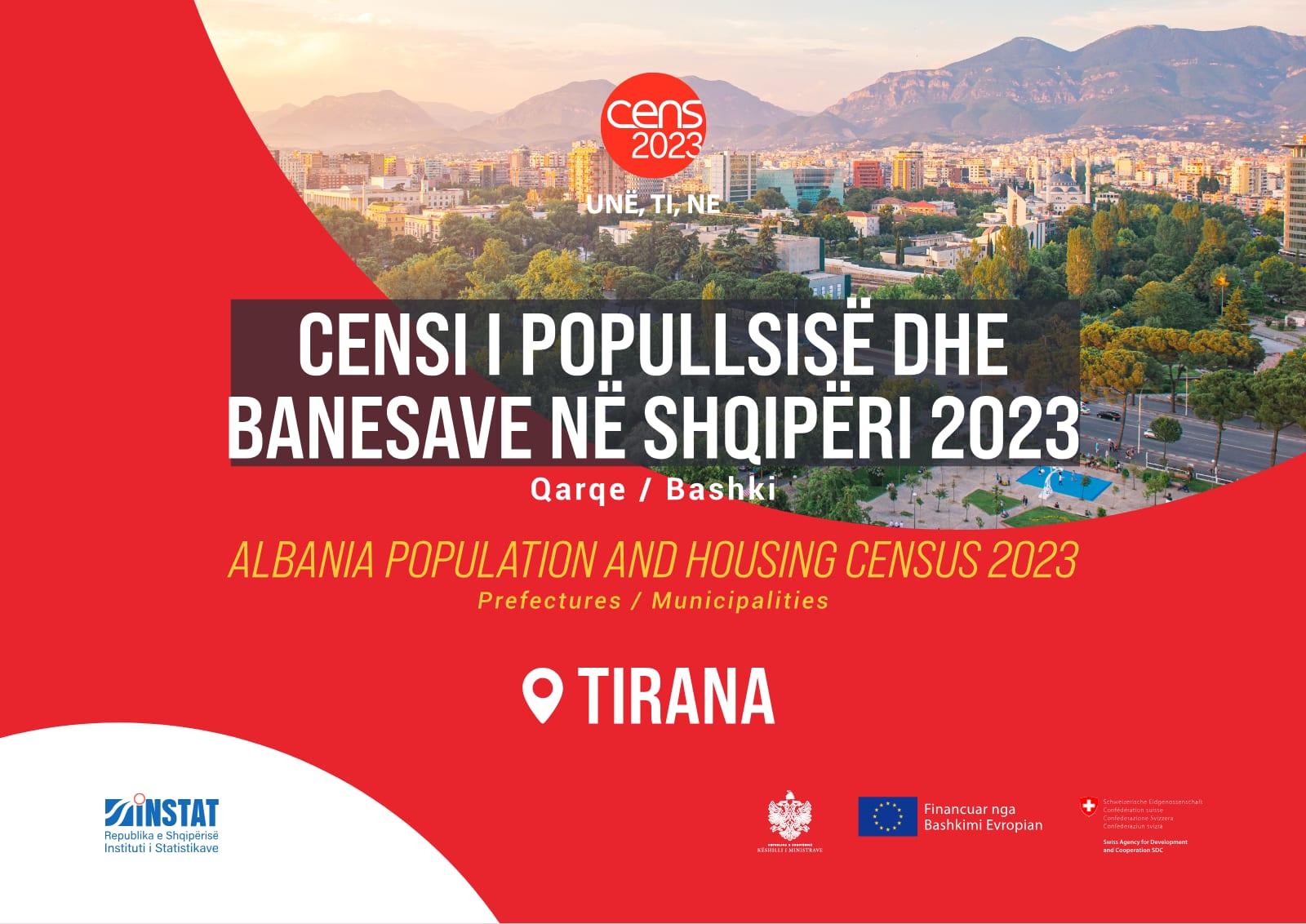
Usually resident population of the Municipality of Tirana by administrative unit on 18 September 2023. The old city unit is the pre-2015 city; the other units are former rural communes joined to it by the 2015 reform. The ten smallest former communes are summed in one bar. Kamëz and Vorë are separate municipalities and are not included. Source: INSTAT, Census of Population and Housing 2023 — Tirana prefecture
Traffic is the everyday pressure. City buses average 9 to 9.5 km/h, the mayor said when the electric bus line was launched in 2024. The sustainable urban mobility plan (SUMP) published in 2020 found that car ownership had doubled in seven years. Its modal split rests on the 2008 survey, so no current figure shows how residents travel. On three central shopping streets, surveyed in 2024, 87% of shoppers arrived without a car.
Tirana’s Sustainable Energy Action Plan (SEAP) of 2014, written under the EU Covenant of Mayors, set a baseline of 639.09 kt of CO₂ for 2011 on the old city territory. It aimed for a cut of more than 20% by 2020, and no monitoring report has been found. In its 2024 response to CDP, a climate-disclosure platform, the municipality said it had no community-wide emissions inventory and no active reduction target. It planned both within two years.
Water and air are measured mostly by others. In 2020 the European Investment Bank put the share of water lost or unbilled in the area served by UKT, the Tirana water utility, at about 60%, with piped supply averaging 13.9 hours a day in 2019. The European Commission reported in 2025 that Albania’s seven automatic air-quality stations were not operating, for lack of funds. In its 2025 monitoring, Co-PLAN, a non-profit planning institute, found 66.7% of its measuring points in Tirana above the reference value for nitrogen dioxide.
Online, the national state sets the pace. Since 1 May 2022 most public services can be requested only through e-Albania, the national portal run by AKSHI, the National Agency for the Information Society. By the European Commission’s 2025 count, 95% of applications for 1,253 public services were offered online, and 92% of households had broadband at the end of 2024. The municipality adds its own tools. Its Tirana Ime app for reporting problems counted 135,000 users by 2022, and its open-data portal holds 15 data posts.
The gap opens where the portal meets people who cannot use it. In 2025 only 27.65% of Albanians aged 16 to 74 had at least basic digital skills, against 60.4% across the EU; Eurostat has no figure for Tirana alone. Citing INSTAT, BIRN, the Balkan Investigative Reporting Network, reported in 2025 that 6.7% of people over 65 could not get into the portal. A third of users rated it not easy to use. For help, the state offers one call centre, run by ADISA.

National figures: Eurostat publishes no value for Tirana itself. Albania, an EU candidate, is covered by this survey; the 2025 values are shown rounded to one decimal. Source: Eurostat, isoc_sk_dskl_i21 (I_DSK2_BAB), 2025
Trust in the systems has been tested too. In July 2022 an attack that Microsoft attributed to Iranian state actors disrupted government websites and services. Months earlier, in December 2021, a leak had exposed the names, ID numbers and salaries of 637,138 people across Albania. AKSHI’s own director was placed under house arrest in December 2025 in a tender-rigging case; in May 2026 the Supreme Court eased that to a reporting duty, and no one has been tried.
Built by agencies and donors, checked by a newsroom
The municipality runs a handful of companies and agencies. Tirana Parking runs 12 paid car parks, three of them closed for some months in early 2025, and since April 2026 takes permit applications through an app. The Agency of Parks and Recreation looks after green space, UKT supplies water, and Tirana DC handles post-earthquake reconstruction. The municipal police issued 477,247 traffic fines through e-gjoba, the online fines system, in 2024.
The bigger digital builders are national. AKSHI runs e-Albania, ADISA (the Agency for the Delivery of Integrated Services) runs the service desks, and AKEP regulates telecoms. Under a 2022 start-up law, the state has funded 172 start-ups and 23 support organisations, with €10.2m. Albania counts about 450 active start-ups, 37% of them founded by women.
The Pyramid of Tirana, built as a memorial museum to the communist leader Enver Hoxha, now houses a technology school. The municipality and the Albanian-American Development Foundation (AADF) set up the non-profit that runs it. TUMO Tirana, its free coding and design school for teenagers, had 1,680 students in June 2024 by the mayor’s own figure. More than 20 outlets had misreported his statement as 20,000 students. An innovation hub run with the accelerator Plug and Play shares the building.
Research and planning sit in a few institutions. The Polytechnic University of Tirana trains the engineers, while POLIS University and Epoka University teach architecture, planning and computing. Co-PLAN works on the electric bus line as a sub-consultant for gender, communication and waste. Open Labs, a hackerspace, brings together open-source volunteers.
Outcome checks come mostly from reporters and watchdogs. Citizens Channel, an online newsroom, has checked the tree pledge, the railway’s deadlines and other outlets’ figures for the Pyramid’s courses against official answers. LevizAlbania, a civic programme set up with Swiss funding, monitored the Tirana Ime app; it has run without that support since October 2023. BIRN Albania follows public procurement and the courts.
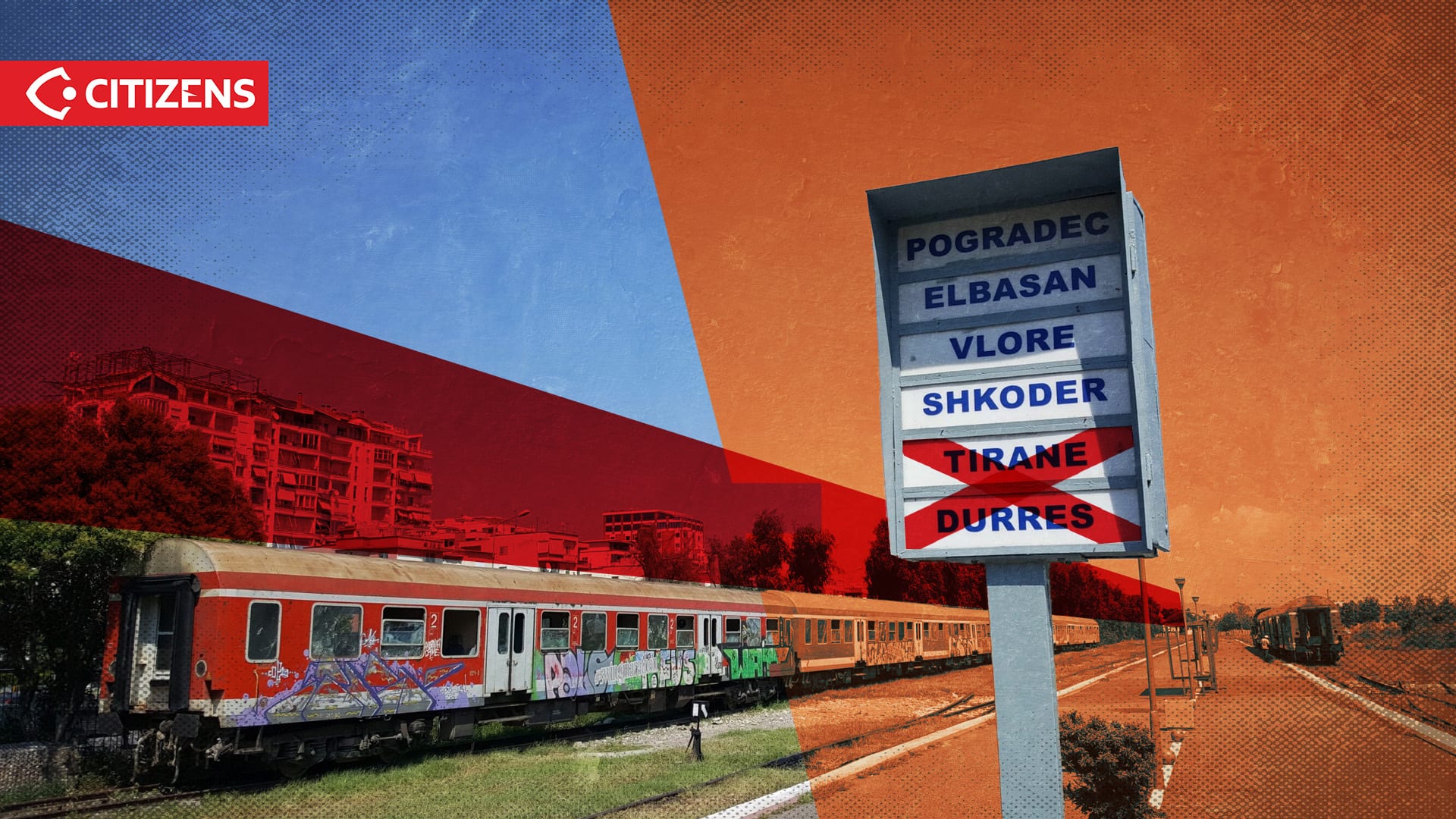
The money for the large projects comes from abroad. KfW, the German development bank, lends the largest share of the electric bus line’s cost, and the EU adds a grant. The European Bank for Reconstruction and Development (EBRD) lends most of the money for the railway to Durrës. A loan from the Abu Dhabi Fund for the Northern Boulevard is the largest the municipality is still repaying. Vodafone Albania built the Tirana Ime app and, in 2019, a set of air sensors shown in it.
Ministries and lenders hold the switches Tirana would need
Erion Veliaj of the Socialist Party (PS), Albania’s governing party, has been mayor since 2015 and was re-elected in May 2023. On 10 February 2025 he was arrested on charges brought by SPAK, the special prosecution office for corruption and organised crime. He is charged with corruption, money laundering and concealing assets, which he denies, and his trial has been repeatedly delayed. In October hearings were postponed again because defence lawyers were following a boycott called by the national Bar Chamber, and the court suspended the time limits on his detention. The council dismissed him for his absence in September 2025; on 3 November the Constitutional Court annulled that decision and the by-election was cancelled.
As of mid-October 2026 he remains the legal mayor and in pre-trial detention. The Supreme Court refused his release on 15 September, after the Constitutional Court had sent his appeal back to it. On 28 August he withdrew the powers he had delegated to Anuela Ristani, acting mayor since February 2025, and named no one in her place. Ristani and two senior officials resigned. He has since signed the payroll from prison in Durrës, and the Prime Minister’s office says he is the mayor.
The council of 61 members has a Socialist majority of 34. It approved a 2026 budget of 39.2bn lek, about €400m, in December 2025. The municipality’s own report shows that in 2025 it spent 66% of its budget and only 48% of its capital budget. In July 2025, at the Prime Minister’s request, the four deputy mayors resigned and were replaced. A new structure designed with the Tony Blair Institute gave Ristani digitalisation; who has held that brief since her resignation has not been made public.
No current smart-city or digital strategy for Tirana has been found. Its main plans date from before 2021: the energy plan of 2014, the Green City Action Plan written with the EBRD in 2018, and the mobility plan of 2020. A climate action plan was still being drafted in 2024, and a draft air-quality plan to 2040 went to the council in May 2026. Tirana applied in 2022 to the EU mission for 100 climate-neutral and smart cities by 2030. It was not chosen; Elbasan was the Albanian city selected.
Much of what a smart city needs is decided outside City Hall. e-Albania is national. A $145m World Bank programme is to turn 10 priority services into e-services in all 61 municipalities. The European Commission finds local government has a “low level of digitalisation”. In September 2026 the government moved new reconstruction work in two Tirana zones from the municipality to the Albanian Development Fund. Waste collection is also to be run nationally. And since September 2026 the interior minister, who answers for the police and the cameras, is also to answer for the municipalities.
Our vision is that even the rich man, the minister, the ambassador leaves the car and uses public transport.The sharpest argument is over cameras, and it is a national one. In December 2025 the Interior Ministry signed a contract with Presight, an Emirati AI firm, for a “Smart City” programme in 20 cities. It relies on an Albanian law that exempts companies from the United Arab Emirates from standard tenders, and the contract is unpublished. Phase one put 380 AI cameras in 20 Tirana schools.
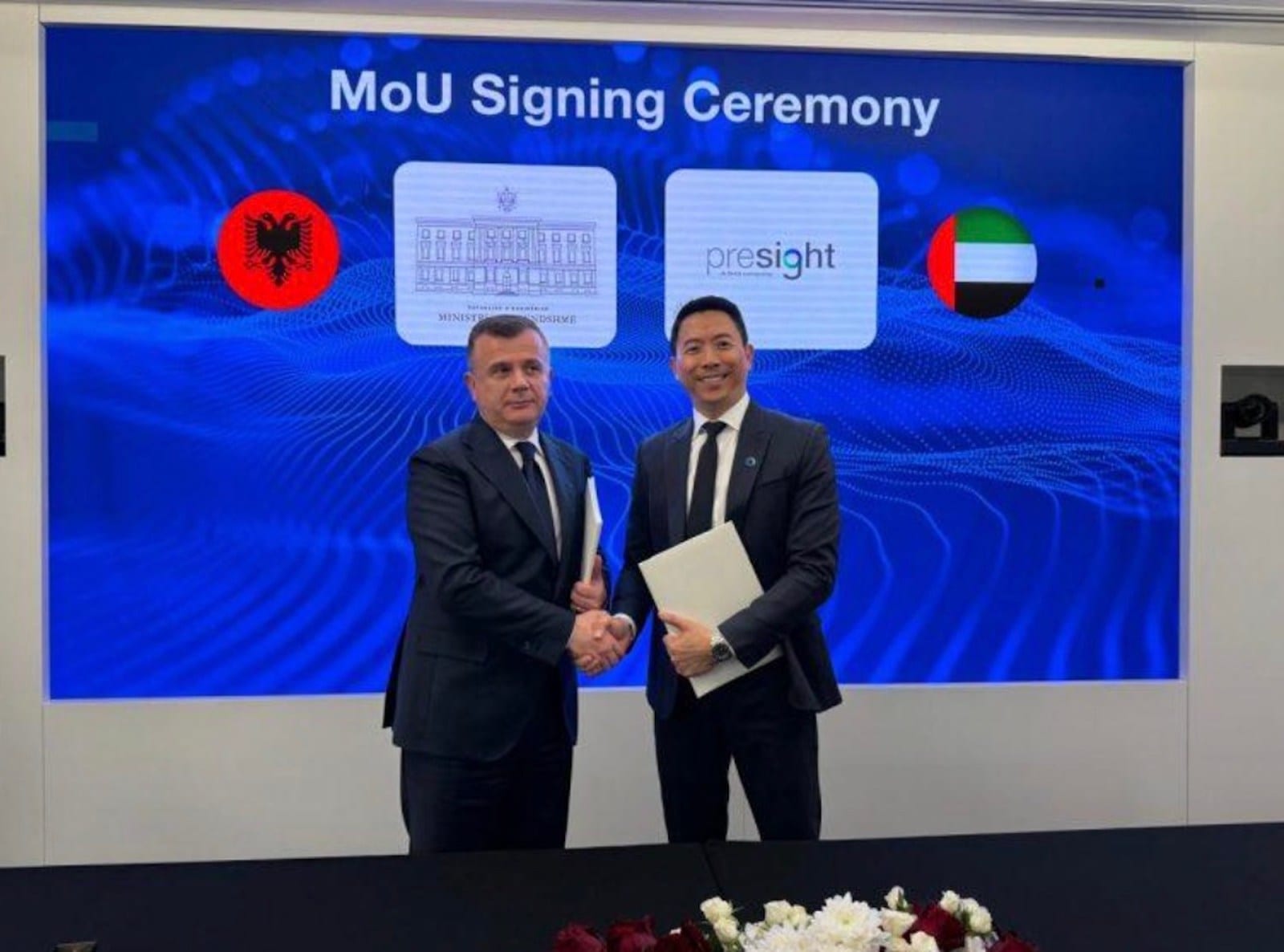
Prime Minister Edi Rama says the cameras alert school staff and police “in real time”. The data-protection commissioner confirmed that no impact assessment was done beforehand. Silva Arapi, a data-protection and AI-governance expert in Tirana, notes that such assessments “are a preventive tool”.
- 2015[source]
A larger municipality
The territorial reform joins 13 rural communes to the city; Erion Veliaj is elected mayor.
- Mar 2019[source]
Open data
The municipal open-data portal goes online; air sensors appear in the Tirana Ime app.
- Feb 2020[source]
Mobility plan
The sustainable urban mobility plan sets a horizon of 2030.
- May 2022[source]
Online by default
Most national public services can be requested only through e-Albania.
- Mar 2024[source]
Electric bus line
Green Transport Tirana is launched: €110m for three electric bus rapid-transit lines.
- Feb 2025[source]
Mayor arrested
SPAK, the anti-corruption prosecutors, arrest Erion Veliaj; he denies the charges.
- Nov 2025[source]
Dismissal annulled
The Constitutional Court annuls the council’s dismissal of the mayor; the by-election is cancelled.
- Aug 2026[source]
Delegation revoked
From detention, the mayor withdraws the powers delegated to the acting mayor and names no one in her place.
- 2027[source]
Trains to Durrës
Regular Tirana–Durrës–Rinas rail service is due by the end of the year.
- 2030[source]
Tree pledge
Target: 2 million trees planted since 2015.
From the territorial reform to the targets still on the books, with the national decisions that shape the city.
From bicycle counters to an incinerator that was never built
The cycling counters are Tirana’s most regular measurement. Three counters installed in 2021 recorded an average of 5,948 passes a day in 2024. The busiest, on Rruga e Kavajës, logged 1,188,108 of them; another was out of order for two months. They show how many people ride on those streets, not whether cycling has replaced car trips.
Tirana Ime, the municipality’s reporting app built with Vodafone Albania in 2016, is still running. It logged 41,665 reports up to 2022, and 19 municipal structures promise to handle a report within 72 hours. The municipality publishes no resolution rate. A monitoring team backed by LevizAlbania filed more than 270 reports in 2016–17; of those marked solved, it found 20 of 37 still unsolved. Friendly Wi-Fi, filtered public internet in squares, served 103,700 users on Skanderbeg Square in the first half of 2022; no later figure exists.
Open Data Tirana has stalled. The portal went online in March 2019 as a website of data stories rather than a data catalogue, with no catalogue interface for developers. It offers 29 downloadable files, and its newest post, on paid car parks, dates from 14 February 2025.
Green Transport Tirana is the largest project, and it is still on paper. It was launched in March 2024 at €110.26m: a €50m KfW loan, a €31.09m EU grant and €29.17m from the city. The plan was three electric bus rapid-transit lines, 52 km counted in both directions, to start “within this year”. By the end of 2025 no works had been tendered; in January 2026 the city signed a €7.43m consultancy contract to design the lines and supervise the works. That month the consultant presented the three lines as 24 km long. Co-PLAN, which works on the project, gives its implementation period as 2026 to 2031. The 2021 “Go Green” ring line, presented as the first electric fleet, used hybrid buses.
The Orbital Forest, a belt of woodland promised in the TR030 general plan, is far behind. In March 2023 the mayor planted what was presented as the millionth tree. A month later the municipality’s own answer to Citizens Channel counted 60,987 trees and shrubs since the plan began, and the parks agency only 2,987 in the previous 19 months. At the pace of the previous six years, about 10,000 a year, the newsroom calculated, the 2 million trees would take 200 years. No later count has been published.
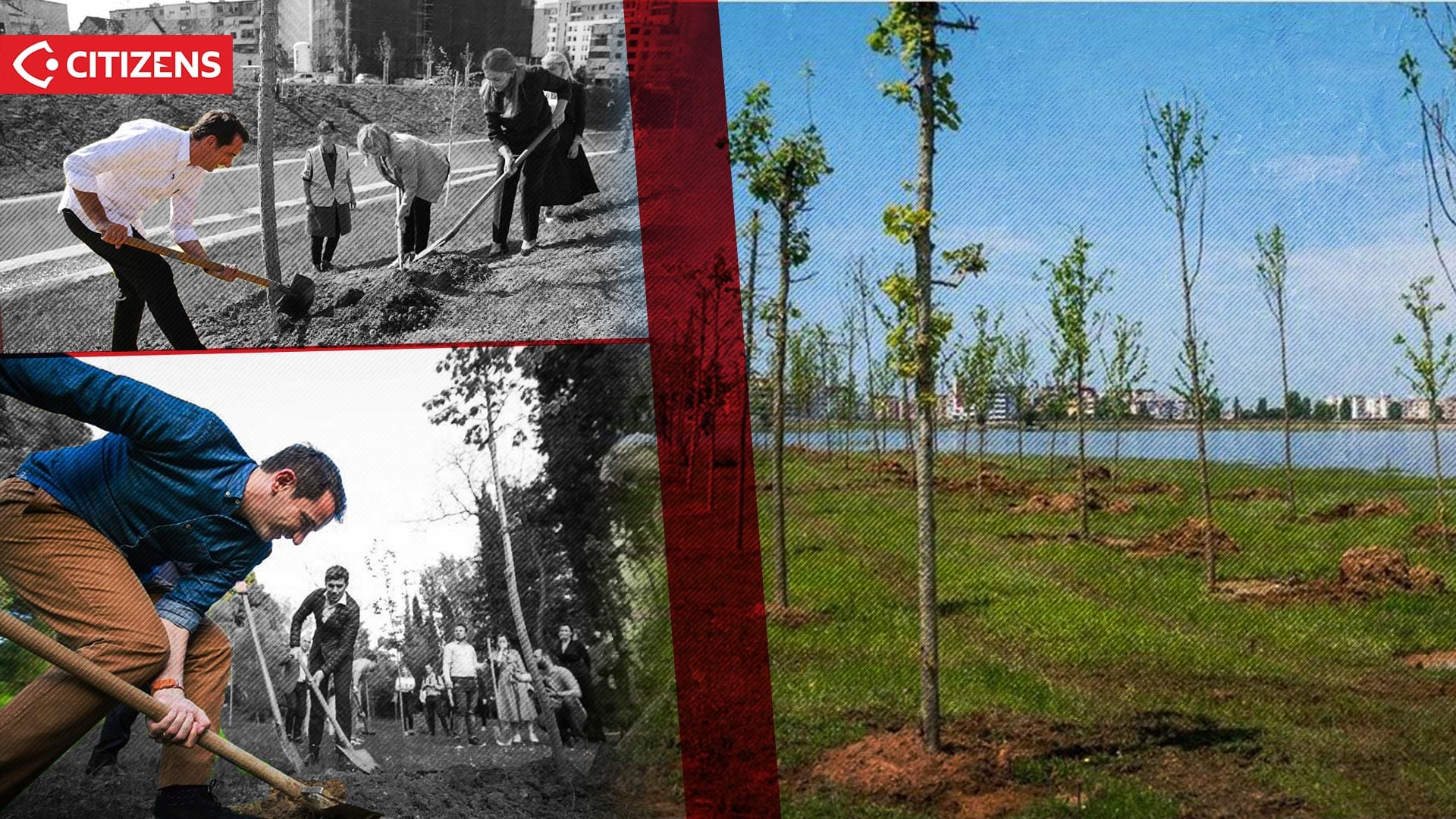
I have not seen a concrete afforestation project, only renderings, infographics and theoretical papers.The Tirana–Durrës–Rinas railway, a national project of Albanian Railways with EBRD and EU money, has slipped three times. Promised for 2023, then 2024, then early 2025, it is now due for regular service by the end of 2027. About €108.9m of roughly €113m had been spent by February 2026, and electrification needs a third contract of about €25m.
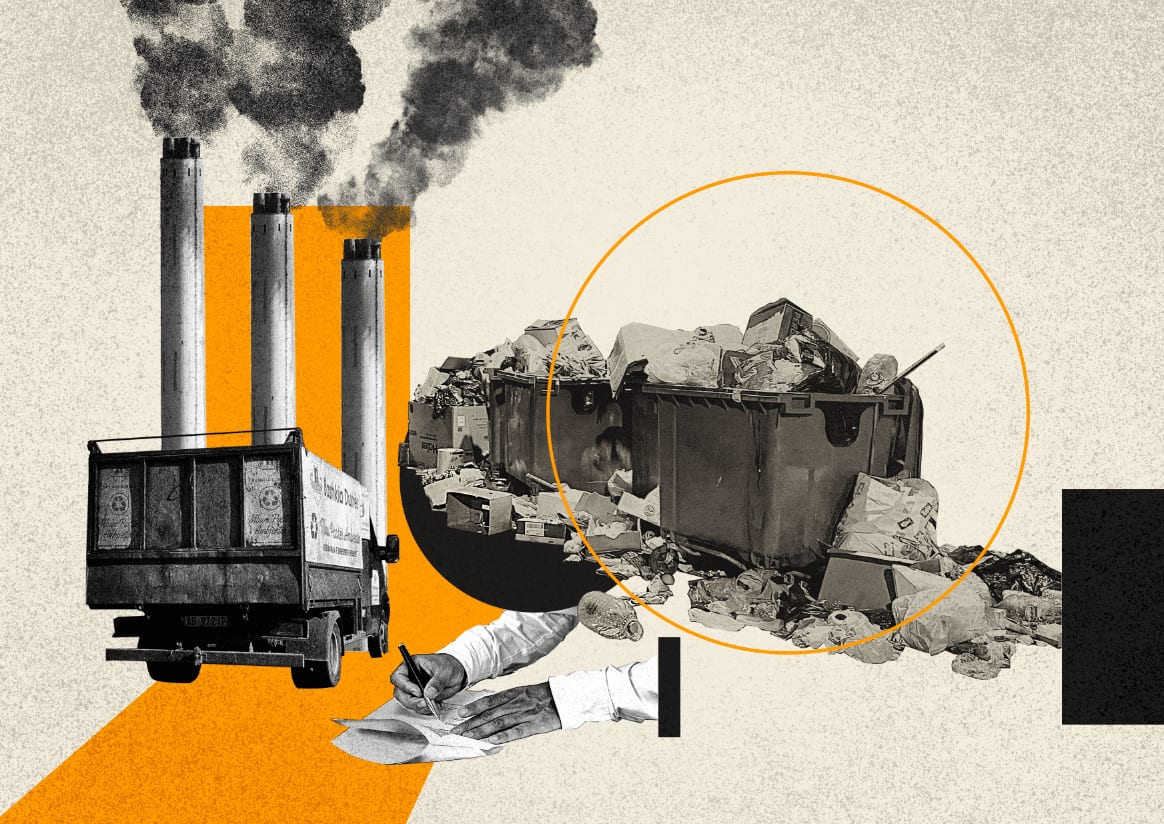
The Sharra incinerator is the costliest failure. Under a national public–private partnership agreed in the late 2010s, taxpayers paid about €86m in six years for a waste-to-energy plant that was never built. In April 2025 seven former officials, including the former environment minister Lefter Koka, were convicted of abuse of power. The owners were convicted in their absence.
The answers in Tirana come mostly from outside City Hall. The municipality counts bicycles, car parks and fines, and publishes them. The checks on the forest, the courses, the train and the incinerator came from a newsroom, an investigative network and a court. The municipality’s own budget report shows the bus line still at design stage, and only a reporter’s question established that no one assessed the school cameras’ risks in advance. Most of those checks came after the money had been committed.
References
Statistics1Click on any number to see the source
Population & migration
From our libraries8
- Censi i Popullsisë dhe Banesave 2023 — Qarku Tiranë (INSTAT) — Knowledge
- Albania 2025 Report (European Commission, SWD(2025) 750) — Knowledge
- Digital Divide: The Albanians Left Behind by Move to Online Public Services (BIRN, 25 Apr 2025) — Knowledge
- Raporti vjetor i konsoliduar i zbatimit të buxhetit të Bashkisë Tiranë për vitin 2025 — Knowledge
- Albania's AI Turn: A Surveillance State Without Oversight? (Transitions, 13 Apr 2026) — Knowledge
- Pylli Orbital i Tiranës është 200 vite larg (Citizens Channel, 27 Apr 2023) — Knowledge
- Tirana-Durrës again without a train, 'with luck' next year (Citizens.al, 13 Feb 2026) — Knowledge
- Money to Burn: Albania's Nexus of Organised Crime and Rubbish Collection (BIRN, 20 Aug 2025) — Knowledge
Further sources21
- Census of Population and Housing 2023 — Tirana prefecture — INSTAT · 2024
- Sustainable Energy Action Plan of the City of Tirana — Municipality of Tirana / Covenant of Mayors · May 2014
- 2024 Full Europe Cities Public Data (CDP-ICLEI Track) — CDP and ICLEI · 2024
- SUMP for the City of Tirana — case study — EU Urban Mobility Observatory · 2020
- Tirana Shopping Street Survey 2024 — TUMI / GIZ · July 2024
- Albania 2025 Report — European Commission · Nov 2025
- Individuals’ level of digital skills (isoc_sk_dskl_i21) — Eurostat · 2025
- Digital Divide: the Albanians left behind by move to online public services — BIRN · 25 Apr 2025
- Monitoring of polluted air and loud noise in Tirana and other cities — Citizens Channel · 12 Mar 2026
- Bicycle movement in Tirana, January–December 2024 — Municipality of Tirana — Open Data · 7 Feb 2025
- Consolidated budget execution report 2025 — Municipality of Tirana · July 2026
- Tirana mayor arrested in €1m corruption scandal — OCCRP · 11 Feb 2025
- Albania’s High Court rules against Tirana mayor’s release — BIRN · 15 Sept 2026
- Tirana municipality without a head — Top Channel · 29 Aug 2026
- Albania’s AI turn: a surveillance state without oversight? — Transitions · 13 Apr 2026
- Transforming institutions for inclusive services and human development in Albania (results brief) — World Bank · 3 Jul 2025
- EU and Germany support Green Transport Tirana — EU Delegation to Albania · 6 Mar 2024
- The Orbital Forest of Tirana is 200 years away — Citizens Channel · 27 Apr 2023
- Tirana–Durrës again without a train — Citizens Channel · 13 Feb 2026
- Money to burn: Albania’s nexus of organised crime and rubbish collection — BIRN · 20 Aug 2025
- Tirana Ime — Municipality of Tirana