Skilled users, forms that rarely come pre-filled
Switzerland settles at the ballot box many questions that other countries leave to parliament. Since 2021 its voters have decided on two e-ID laws, the climate law and an electricity act. In 2022 nearly three-quarters of residents, 6.6m people, lived in one of 52 agglomerations; the country has 2,131 communes. At the end of 2025 the population was 9,127,100, and for the first time people aged 65 and over outnumbered those under 20.
The Climate and Innovation Act, approved in June 2023 with 59.1% of the vote, sets net zero for 2050 and a cut of 75% on 1990 by 2040. Support was highest in Geneva and Basel-Stadt, while seven cantons of central and eastern Switzerland voted no. For 2030 the federal target is a cut of at least 50%, of which up to a third may come from credits bought abroad. The interim target for 2021–2024 was missed by 130,000 tonnes, because the foreign certificates it relied on were not yet available.
In 2024 Swiss emissions were 40.1m tonnes, 27.3% below 1990, while the EU-27 had cut 38% on the same basis. Buildings emitted 47% less than in 1990 and industry 33% less, but transport, a third of the total, only 10% less. In June 2026 the broadcaster SRF obtained the calculation behind the official 2030 gap of 34m tonnes from BAFU, the Federal Office for the Environment. It found that land use was left out. Adding it, SRF put the gap at 41.5 to 50.1m tonnes. The Federal Council will assess in 2027 whether the target will be met.
index, 1990 = 100
Show the numbers
| Switzerland | EU-27 | Legal path at home | |
|---|---|---|---|
| 1990 | 100.0 | 100.0 | — |
| 1991 | 103.3 | 97.8 | — |
| 1992 | 102.8 | 94.7 | — |
| 1993 | 98.2 | 93.1 | — |
| 1994 | 96.2 | 92.6 | — |
| 1995 | 97.8 | 93.7 | — |
| 1996 | 98.8 | 95.6 | — |
| 1997 | 96.7 | 94.0 | — |
| 1998 | 99.5 | 93.2 | — |
| 1999 | 99.1 | 91.6 | — |
| 2000 | 97.9 | 91.4 | — |
| 2001 | 100.6 | 92.4 | — |
| 2002 | 97.8 | 92.1 | — |
| 2003 | 99.7 | 93.7 | — |
| 2004 | 100.7 | 93.7 | — |
| 2005 | 101.9 | 93.2 | — |
| 2006 | 101.2 | 93.3 | — |
| 2007 | 97.8 | 92.2 | — |
| 2008 | 100.3 | 90.2 | — |
| 2009 | 97.6 | 84.1 | — |
| 2010 | 100.5 | 85.7 | — |
| 2011 | 92.9 | 83.3 | — |
| 2012 | 95.5 | 81.8 | — |
| 2013 | 96.9 | 80.0 | — |
| 2014 | 89.7 | 77.1 | — |
| 2015 | 88.8 | 78.0 | — |
| 2016 | 89.5 | 78.0 | — |
| 2017 | 87.8 | 78.5 | — |
| 2018 | 85.0 | 76.7 | — |
| 2019 | 84.5 | 73.4 | — |
| 2020 | 79.7 | 67.4 | — |
| 2021 | 82.1 | 70.9 | — |
| 2022 | 75.6 | 69.0 | — |
| 2023 | 73.7 | 63.5 | — |
| 2024 | 72.7 | 62.0 | 72.7 |
| 2025 | — | — | 71.7 |
| 2026 | — | — | 70.7 |
| 2027 | — | — | 69.7 |
| 2028 | — | — | 68.7 |
| 2029 | — | — | 67.7 |
| 2030 | — | — | 66.7 |
| 2031 | — | — | 62.5 |
| 2032 | — | — | 58.4 |
| 2033 | — | — | 54.2 |
| 2034 | — | — | 50.0 |
| 2035 | — | — | 45.9 |
| 2036 | — | — | 41.7 |
| 2037 | — | — | 37.5 |
| 2038 | — | — | 33.3 |
| 2039 | — | — | 29.2 |
| 2040 | — | — | 25.0 |
Greenhouse-gas emissions in each country, excluding land use and international aviation and shipping, indexed to 1990, for Switzerland and the EU-27, both from Eurostat on the same basis. The third line runs straight from 2024 through the legal targets for emissions in Switzerland: the two-thirds of the 50% cut by 2030 that must be made at home (up to a third may be bought abroad as credits), and 75% below 1990 by 2040. Net zero in 2050 balances whatever remains, international flights and shipping included, with carbon removals, so it is not drawn on this basis. One step on the axis is one year. Source: Eurostat, env_air_gge (greenhouse gases excluding land use and international transport), read 16 October 2026
We have three and a half years left until 2030; political action is needed now.The fixed networks are slower to change. By the industry’s count, fibre to the home reached 72% of households in 2025, or 54% of homes and business premises together. The Federal Council puts fibre to the building at 50% in 2024, without saying what it counted. Albert Rösti, the minister for transport, energy and communications, said that in fibre Switzerland sits “in the rear ranks” of Europe. Until now the federal role was to coordinate: from 2008 ComCom and BAKOM ran round tables on common standards.
A competition case then slowed the build. WEKO, the competition commission, objected to Swisscom’s plan to connect several homes on one fibre from the exchange. At times the dispute blocked up to half a million connections, and 170,000 were still blocked in the first half of this year. On 21 September the Federal Administrative Court annulled WEKO’s decision and its fine of about CHF 18m; the ruling is not yet final.
The people are further ahead than the cables. In 2025, 78% of Swiss adults aged 16 to 74 had at least basic digital skills, against 60.4% across the EU. Among those aged 65 to 74 the shares were 56.2% and 33.0%. Only 0.62% of adults had never used the internet. That year 71.2% looked up information on an authority’s website, against 44.2% in the EU, though the Swiss share had fallen from 75.3% in 2023.
Share of people aged 16 to 74, unless stated, in 2025, from the surveys Eurostat publishes for both Switzerland and the EU-27. Fibre coverage for Switzerland is on another basis, and Eurostat last published its headline e-government indicator for the country in 2021, so neither is shown; the Digital Decade does not cover the country. Source: Eurostat, isoc_sk_dskl_i21 (digital skills) and isoc_ciegi_ac (interaction with public authorities), 2025
The gap lies on the other side of the screen. The 2026 eGovernment Benchmark for Switzerland, which applies the EU’s method, scores Swiss public services at 57.5 points against an EU average of 76.6. That places them 27th of the 28 countries compared, and the distance has widened. A general login, AGOV or the private SwissID, works on 37.5% of Swiss services, against 82.7% for national eIDs in the EU, and on 13.6% of the services cities run.

Forms arrive pre-filled on 36% of federal services, 7.9% of cantonal ones and 4.8% of those run by cities. And residents still have no state electronic identity to open these doors with: the one voters approved in 2025 is postponed, with no date.
A commune’s room is whatever its canton grants
The Federal Constitution makes the cantons sovereign wherever it gives no power to the Confederation. It guarantees communal autonomy only “in accordance with cantonal law”, and asks the Confederation to consider the special situation of cities and agglomerations. What a Swiss city may do therefore depends on its canton as much as on the federal government.
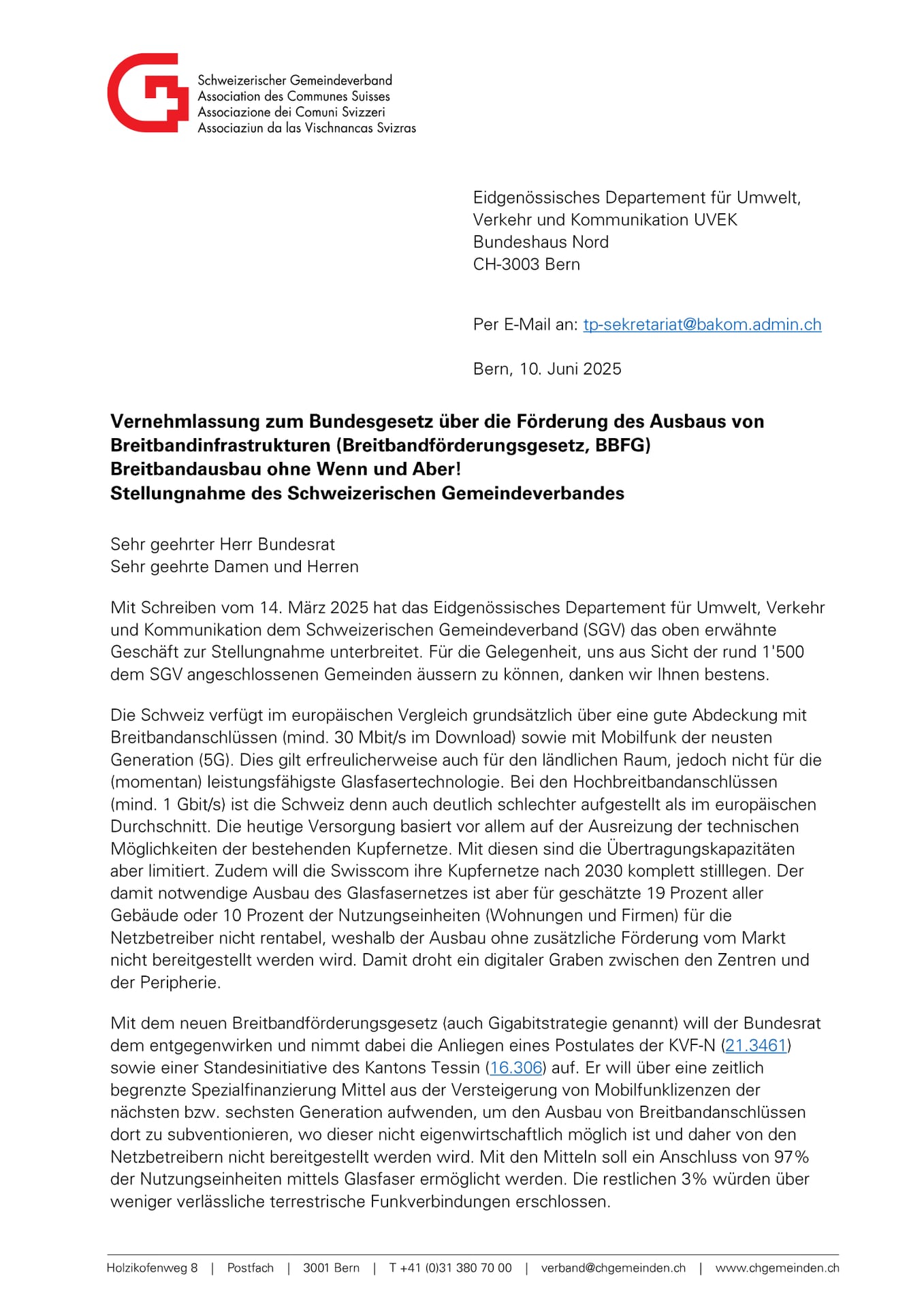
- Broadband: telecoms are federal, overseen by BAKOM, the federal communications office, and the regulator ComCom. A city can still own a network through its utility. A bill sent to Parliament in September 2026 offers up to CHF 730m; communes apply to their canton, which pays half and may pass some or all of it on to them.
- Transport: railways are federal. Trams, bus lanes and cycle routes get federal money through the agglomeration programme, 9–12% of the national roads and agglomeration fund a year. The federal share, 30–50% of the cost, is higher the more effective federal assessors judge a plan to be.
- Policing and cameras: the police are mainly cantonal. In 2024 the Federal Supreme Court struck down Lucerne’s number-plate recognition, because surveillance for prosecution needs a basis in federal criminal procedure. A city can ban face recognition in its own video rules, but police powers are set in cantonal law.
- Energy and heat: energy use in buildings is chiefly a cantonal matter. Utilities in public hands own the grids and plan heat and cooling networks: ewz belongs to the City of Zurich, IWB to the city-canton of Basel-Stadt, and SIG mainly to the canton of Geneva, with the city and the other communes.
- Planning: a cantonal task under federal principles; communes zone land and grant permits.
- Open data: since 2024 a federal law, EMBAG, makes the federal administration publish its data; cities follow cantonal law or their own choice.
- e-ID and online services: the e-ID is federal. AGOV, the common login, is run by the Confederation and offered by 14 cantons and some cities, Zurich among them, with 2,077,481 active accounts in August 2026.
- Open source and cloud: EMBAG obliges only federal bodies to publish the code they commission, and Zurich, Basel-Stadt, Bern and St. Gallen judged a cantonal rule unnecessary. In 2025 privatim, the data-protection commissioners’ conference, warned against moving especially sensitive personal data into international clouds.
Ownership is the Swiss city’s strongest lever. A city whose utility belongs to it can ask its voters for a network and build it. Where the lever sits with the canton or the Confederation, and nobody pools the cost, a city can only ask others to act. Of 124 cities and communes surveyed in 2024 by ZHAW, the Zurich University of Applied Sciences, almost 80% had no structured smart-city process or were only piloting.
Power over the digital state sits in joint bodies. Digitale Verwaltung Schweiz, run by the Confederation, cantons and communes together, steers the shared agenda. The Conference of Cantonal Governments adopts the big reforms with the Federal Council, and the cantonal police directors’ conference wrote the model text the court struck down in Lucerne.
SAB, the mountain-regions association, whose members include 22 cantons and about 600 communes, warned that making cantons and communes co-fund the broadband subsidy would in all likelihood stop it reaching its goal. The city utilities and Swisscom build the networks, and all five cantons offering online voting in November use Swiss Post’s system.
Credits for a login and a cloud, small change for smart cities
Switzerland has no prime minister. Its government, the seven-member Federal Council, decides as a college. It holds two seats each for the Swiss People’s Party (SVP), the Liberals (FDP) and the Social Democrats (SP), and one for the Centre party. Guy Parmelin of the SVP holds the rotating, one-year Federal Presidency in 2026.
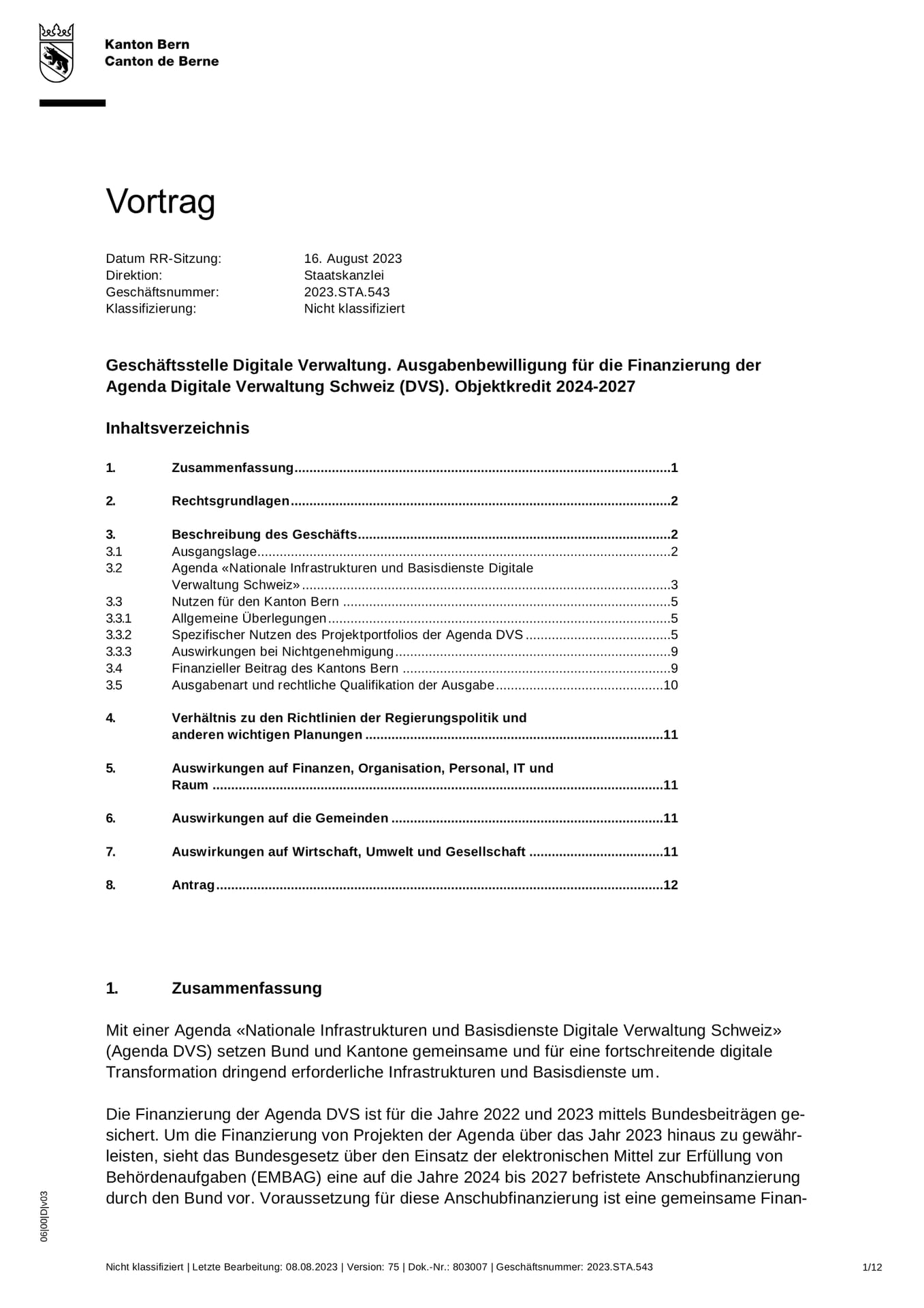
Albert Rösti, also SVP, runs the department for environment, transport, energy and communications, which also holds spatial development; there is no ministry for cities. Beat Jans of the SP runs Justice and Police, and with it the e-ID. In December 2025 the Federal Council and the cantonal governments agreed to seek a federal power to make essential standards binding on every public body. That needs a change to the constitution. A commission of the Confederation, cantons, cities and communes is drafting the concept, which the Federal Council and the cantonal governments aim to adopt in 2027.
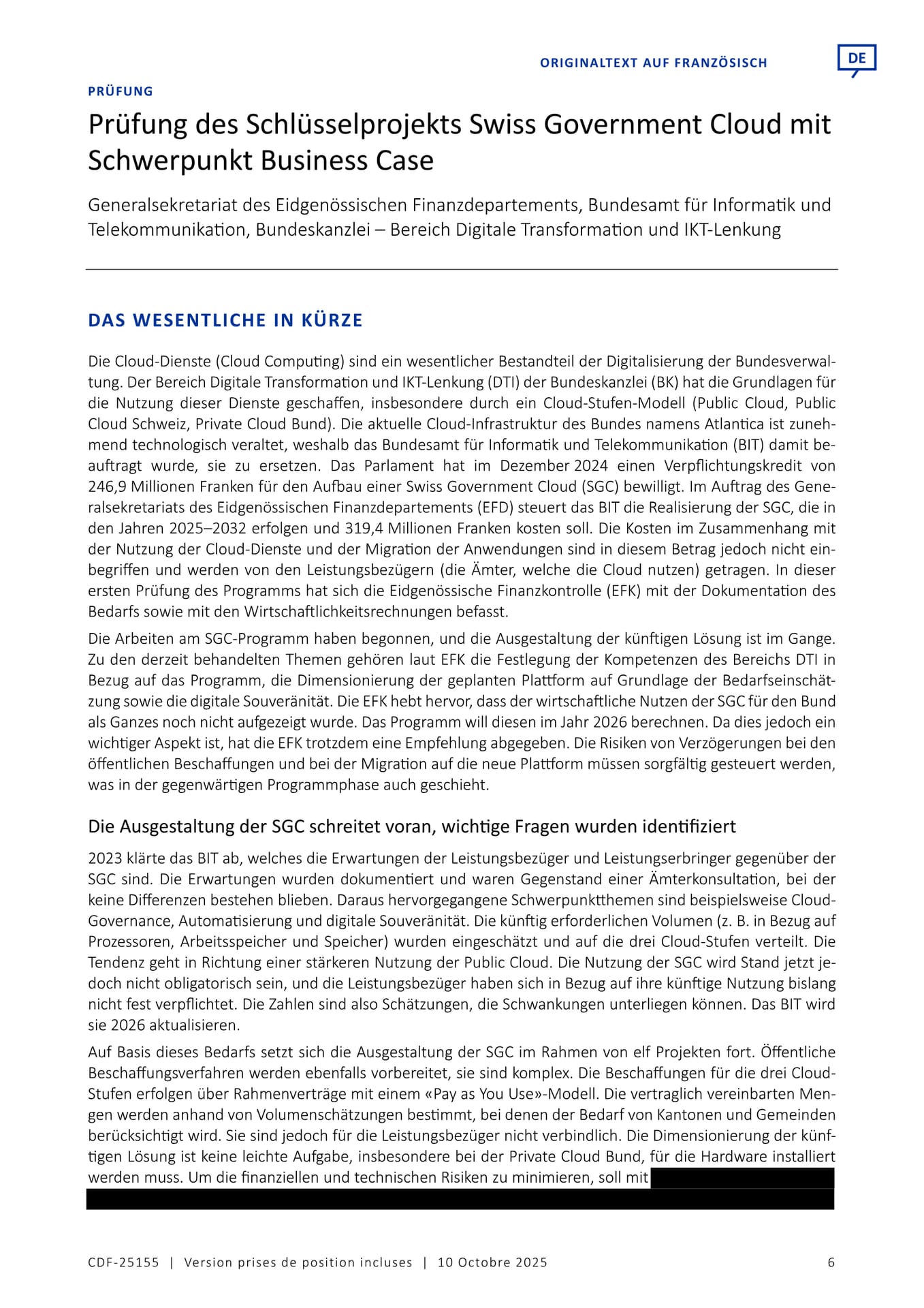
The money follows shared plumbing. The joint agenda for national infrastructure and basic services has CHF 116m for 2024–2027, up to two-thirds of it federal; how much has been spent has not been published. The login, AGOV, is the part residents can already use. The Swiss Government Cloud has a credit of CHF 246.9m. In October 2025 the Swiss Federal Audit Office found its benefit for the Confederation as a whole “not yet demonstrated”. Its sovereignty measures, the auditors added, raise “serious questions” about feasibility and cost.
Money for smart cities is small. In its 2024/25 cycle EnergieSchweiz für Gemeinden, the federal energy programme for communes, gave CHF 3.55m to 119 projects in 460 communes. Its five front-runner cities, Basel, Biel, Fribourg, Kriens and Zug, ran 19 of them: five tied energy and climate goals to their smart-city strategies, and 14 tackled mobility, municipal buildings and supply-chain emissions. The figures are the programme’s own; no independent evaluation of the cycle was found.
The larger channel is transport. For the fifth generation of agglomeration programmes, 42 agglomeration programmes asked for measures worth CHF 11.2bn, more than the fund can pay. The Federal Office for Spatial Development ranks them by effectiveness and by how much of the third generation was built.
EU money barely reaches Swiss cities. As a non-member, Switzerland receives nothing from the EU’s recovery fund, and none of its cities is among the 112 chosen in 2022 for the EU mission for climate-neutral and smart cities. It was not then associated to Horizon Europe, the EU research programme; it has been since January 2025, under an agreement signed that November.
The e-ID is the national quarrel, over who should hold a person’s identity. In March 2021, 64.4% of voters rejected an e-ID to be issued by private firms, and no canton voted yes. Both camps read the result as a rejection of private issuers, not of an e-ID. The state version passed in September 2025 with 50.39%, by 21,266 votes.
The product and the process behind it are better than in 2021.The analysis of the vote by gfs.bern, a polling institute, found that 76% agreed with the argument that a state e-ID avoids dependence on technology companies. Women voted 46% yes, and only 15% of those who see digitalisation as a social problem voted for it. Lukas Golder of gfs.bern called the result a vote of no confidence in the government.

It has to be a positive digitalisation.On 30 June 2026 the Federal Department of Justice and Police postponed the launch without a new date. It cited new risks from AI, such as deepfakes and malware on devices, and said security now weighed more than the timetable. The trust infrastructure behind the e-ID, on which cantons and communes could also issue documents such as a digital driving licence, is planned for the first half of 2027.
- Nov 2018[source]
CHvote dropped
Geneva ends the voting system that six other cantons had borrowed.
- Mar 2021[source]
Private e-ID rejected
Every canton votes against an identity issued by companies.
- Jun 2023[source]
Climate and Innovation Act
Net zero by 2050 becomes law after a referendum.
- Jan 2024[source]
EMBAG in force
Open data and open source by default for the federal administration.
- Jun 2024[source]
Electricity Supply Act
Voters back the law on renewable power with 68.7%.
- Oct 2024[source]
Number-plate ruling
Lucerne loses its automatic recognition rules in the Federal Supreme Court.
- Dec 2024[source]
Government cloud credit
Parliament approves CHF 246.9m for a federal cloud; the auditors later question its business case.
- Sep 2025[source]
State e-ID approved
The second e-ID law passes; its launch is later put off.
- 2027[source]
Binding standards
The Federal Council and the cantonal governments aim to adopt the concept for joint, binding digital standards.
- 2030[source]
Climate target
Emissions at least 50% below 1990; the proposed broadband subsidy would start the same year.
- 2040[source]
Federal administration net zero
Emissions 75% below 1990 across the country.
- 2050[source]
Net zero
The legal date in the Climate and Innovation Act, international flights and shipping included.
From a cantonal voting system that closed to the climate law’s final date.
Built by one city, or owned by several cantons
Zurich’s fibre network shows what a city with its own utility can buy. In March 2007 its voters made telecoms a public task, with 64.9%, and ewz, the city’s electricity company, says Swisscom then began building fibre too. To avoid two parallel networks they agreed to build together, and in 2012 voters approved a credit of CHF 400m. The network was finished on time and within budget at the end of 2019, reaching 39,000 buildings, about 90% of the city’s total.
Zurich’s climate date shows where a city’s vote stops. In May 2022, 74.9% of the city’s voters wrote net zero by 2040 into its charter. In September 2025 the canton of Zurich’s voters rejected, by 59.5%, an energy law that aimed for net zero by 2040 and by 2050 at the latest. Basel-Stadt, a city that is also a canton, had already set 2037 in 2022, with 64.1%.
Geneva’s CHvote travelled without its costs. The canton built a public e-voting system that voters in Vaud, Bern, St. Gallen, Lucerne, Aargau and Basel-Stadt also used. In November 2018 Geneva’s government dropped it: making it verifiable would have cost CHF 2.6m on top of the CHF 4.7m spent since 2014, and neither the Confederation nor the other cantons would share the bill. “Nous nous sommes toujours retrouvés tout seuls”, the government said: we always found ourselves on our own.
Swiss Post’s system spreads slowly and under a cap: cantons need federal permission and may offer it to at most 30% of their electorate. In March 2026, 2,048 electronic votes in Basel-Stadt could not be decrypted because the canton mishandled PIN-protected USB sticks. The Federal Council says the incident had no connection with the system itself, and Basel-Stadt has left the trials for the rest of 2026. About 222,000 voters, 3.95% of the electorate, may vote online on 29 November.
eBau, a building-permit system, shows what does spread: a component that cantons own together. Eight cantons, from Aargau to Uri, develop it as open source through the community inosca. In February 2026 St. Gallen’s government advised its parliament against an open-source law, pointing to rules it can already set with the communes and to eBau; St. Gallen is now listed among inosca’s eight cantons. AGOV, the login, spreads another way: the Federal Chancellery runs it for everyone, and cantons sign up one at a time.
St. Gallen’s city parliament voted 31 to 27 in 2022 to ban automated face recognition in public, the first in Switzerland; whether the city has written it into its video rules was not found. In 2025 Winterthur’s parliament asked Zurich’s cantonal parliament to ban it in every public place in the canton, through the police act that governs all police forces there. What reached every canton was a court ruling on number plates, because Lucerne had used the police directors’ model text.
In the IMD Smart City Index, a survey of how residents experience their city, Zurich ranks 1st of 148, Geneva 3rd and Lausanne 7th; Basel and Bern are not ranked this year. Asked whether residents contribute to local government’s decisions, the three score 77.2, 74.5 and 65.0, the highest of 25 cities in eight European countries.
IMD’s score from 0 to 100 for how far residents agree with the statement, in 25 cities in Germany, Spain, France, Poland, the United Kingdom, Denmark, Austria and Switzerland; Swiss cities in ink. The IMD Smart City Index surveys residents on how they experience their city; it measures perception, not performance. Source: IMD World Competitiveness Center, Smart City Index 2026 (resident survey)
A tool keeps running beyond its home when the places that use it share what it costs. Geneva paid for CHvote alone and closed it, although six other cantons used it. The cantons that use eBau develop it together, and St. Gallen has joined them. The Federal Chancellery runs AGOV for everyone, and federal transport money goes to plans judged effective and actually built. A city’s vote pays only for that city: Zurich’s fibre reaches nine in ten of its buildings, but its climate date stopped at the canton’s border.
References
Statistics1Click on any number to see the source
Population & migration
From our libraries6
- eGovernment Benchmark Switzerland 2026 (Capgemini for Digital Public Services Switzerland, EU eGovernment Benchmark method) — Knowledge
- Stellungnahmen der Dachverbände Gemeinden, Städte, Berggebiete zum Breitbandförderungsgesetz (BAKOM consultation responses, 2025) — Knowledge
- Vortrag: Ausgabenbewilligung für die Finanzierung der Agenda Digitale Verwaltung Schweiz (DVS), Objektkredit 2024-2027 (Regierungsrat des Kantons Bern, 16 August 2023) — Knowledge
- Prüfung des Schlüsselprojekts Swiss Government Cloud mit Schwerpunkt Business Case (Eidgenössische Finanzkontrolle, CDF-25155, 10 October 2025) — Knowledge
- Projektförderung – Förderprogramm von EnergieSchweiz für Gemeinden, Programmzyklus 2024/25: Zahlen und Fakten (BFE, January 2026) — Knowledge
- VOX-Analyse September 2025: Bundesbeschluss über die kantonalen Liegenschaftssteuern auf Zweitliegenschaften und E-ID-Gesetz (gfs.bern, November 2025) — Knowledge
Further sources18
- Federal Constitution of the Swiss Confederation — Fedlex
- Federal Act on Climate Protection Targets, Innovation and Energy Security (KlG) — Fedlex
- Greenhouse-gas inventory 2024 — Federal Office for the Environment · 13 Apr 2026
- Climate targets 2030: the emissions gap is larger than the Confederation says — SRF · 4 June 2026
- Federal Council adopts the Broadband Promotion Act — cash.ch / AWP · 9 Sep 2026
- Federal Administrative Court rules for Swisscom in the fibre dispute — cash.ch / AWP · 13 Oct 2026
- eGovernment Benchmark Switzerland 2026 — Capgemini for Digital Public Services Switzerland · 2026
- Federal Act on the Use of Electronic Means to Fulfil Government Tasks (EMBAG) — Fedlex
- Federal Supreme Court stops surveillance on the motorway — Beobachter · 8 Nov 2024
- Explanatory report on the 5th generation of agglomeration programmes — Federal Office for Spatial Development · 25 June 2026
- Swiss Smart City Survey 2024 — ZHAW · 27 Aug 2025
- Audit of the Swiss Government Cloud — Swiss Federal Audit Office · 10 Oct 2025
- Confederation and cantons push for binding e-government standards — netzwoche · 5 Jan 2026
- VOX analysis of the vote of 28 September 2025 — gfs.bern · Nov 2025
- Introduction of the e-ID postponed — Federal Department of Justice and Police · 30 June 2026
- Zurich’s fibre network is finished — ewz · 14 Jan 2020
- Geneva abandons e-voting — swissinfo · 28 Nov 2018
- Smart City Index 2026 — IMD World Competitiveness Center · 2026