Clean electricity has not cleaned up the roads
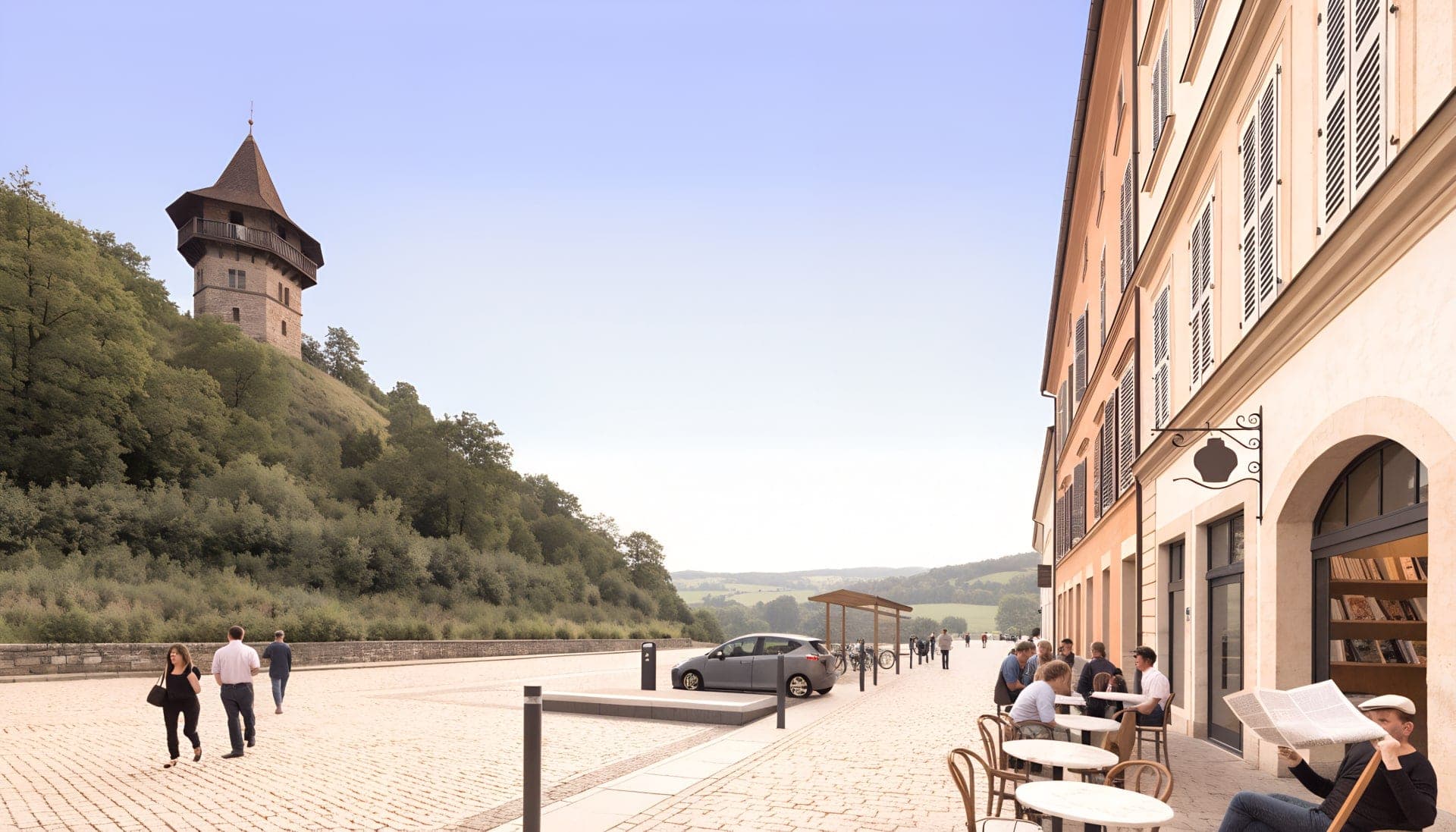
Austria is a federation of nine Länder, the states, and 2,093 municipalities, and only 259 of those have more than 5,000 inhabitants. It is more rural than the EU as a whole: in 2024, 37.7% of its people lived in rural areas and 31.7% in cities. There is no national smart-city programme today, so what a town tries depends on federal law, its Land and the companies it owns.
No climate-protection law with binding targets is in force. The targets of the 2011 climate protection act have lapsed, though the government still reports progress under it. At the launch of its successor in September 2026, Julia Herr, environment spokesperson of the governing Social Democrats, said Austria had gone “more than five years” without a binding climate law. Climate neutrality by 2040 is a government aim, written into the electricity law of December 2025 as a goal.
The draft framework law sent for consultation on 18 September 2026 would apply that aim only to emissions outside the EU’s emissions-trading system, with indicative paths for each sector. Norbert Totschnig, the climate minister, described its target figures as “declaratory”. The binding duty comes from EU law: emissions outside the trading system must fall 48% below 2005 by 2030.
By 2024 emissions were 16.4% below 1990, against 38% across the EU-27. Transport went the other way: its emissions rose 44.2% from 1990 to 2023, the largest increase of any sector. In 2023 about 11% of road-transport emissions, some 2.2 million tonnes, came from fuel sold in Austria and burned abroad, because diesel has been cheaper than in neighbouring countries.
index, 1990 = 100
Show the numbers
| Austria | EU-27 | |
|---|---|---|
| 1990 | 100.0 | 100.0 |
| 1991 | 104.6 | 97.8 |
| 1992 | 96.1 | 94.7 |
| 1993 | 96.7 | 93.1 |
| 1994 | 96.6 | 92.6 |
| 1995 | 100.8 | 93.7 |
| 1996 | 104.8 | 95.6 |
| 1997 | 104.3 | 94.0 |
| 1998 | 103.4 | 93.2 |
| 1999 | 101.5 | 91.6 |
| 2000 | 101.8 | 91.4 |
| 2001 | 106.6 | 92.4 |
| 2002 | 108.9 | 92.1 |
| 2003 | 115.6 | 93.7 |
| 2004 | 115.3 | 93.7 |
| 2005 | 116.8 | 93.2 |
| 2006 | 113.7 | 93.3 |
| 2007 | 110.3 | 92.2 |
| 2008 | 109.5 | 90.2 |
| 2009 | 101.4 | 84.1 |
| 2010 | 107.0 | 85.7 |
| 2011 | 104.4 | 83.3 |
| 2012 | 100.9 | 81.8 |
| 2013 | 101.4 | 80.0 |
| 2014 | 96.7 | 77.1 |
| 2015 | 99.5 | 78.0 |
| 2016 | 100.8 | 78.0 |
| 2017 | 103.8 | 78.5 |
| 2018 | 100.0 | 76.7 |
| 2019 | 101.4 | 73.4 |
| 2020 | 93.9 | 67.4 |
| 2021 | 98.0 | 70.9 |
| 2022 | 92.2 | 69.0 |
| 2023 | 86.2 | 63.5 |
| 2024 | 83.6 | 62.0 |
Greenhouse-gas emissions excluding land use and international aviation and shipping, indexed to 1990, for Austria and the EU-27. No national path is drawn: no Austrian climate-protection law with binding targets is in force, and climate neutrality by 2040 is a government aim written into the 2025 electricity law as a goal. One step on the axis is one year. Source: Eurostat, env_air_gge (greenhouse gases excluding land use and international transport)
Energy supply is the strong side. Renewables provided 90.1% of electricity in 2024, against 47.5% across the EU, and 43% of all gross final energy use, against 25.2%. Yet in 2025 total emissions rose 0.7% to about 67.1 million tonnes. Higher output at power and district-heating plants and in heavy industry, a colder year and much less hydropower drove the rise. The sectors outside the trading system cut their emissions by 2.8%, but still overshot their tightening EU limit for the year by about 0.8 million tonnes.
The networks depend on how they are counted. 5G reaches 99.8% of populated areas. Fibre to the premises, counting fibre to the building, passes 50.9% of homes, against 74.1% across the EU. The regulator RTR counts addresses: at the end of 2024, 30.7% of possible connection points could get fibre into the home. Fibre carried 9.0% of the broadband connections in use, while mobile routers, the “cubes” many households use instead of a fixed line, carried 37.6%.
The European Commission traces the cubes partly to early flat-rate mobile offers and to a mobile operator without fixed lines, which kept mobile competition strong. Where fibre exists, take-up is low in some areas, the Commission notes, which weakens the case for building more where it is costly. There is no plan or date for switching off copper.
This negative talk comes mainly from the frequent equation of broadband with fibre. That is fundamentally wrong.Austria trails the EU-27 average only on the two fixed-network rows. Network coverage is measured for 2025 in the Commission’s Digital Decade data; online contact with the authorities, skills and firms’ AI use come from Eurostat’s 2025 surveys, and renewables from 2024. Source: European Commission, Digital Decade (DESI 2026); Eurostat (isoc_ciegi_ac, isoc_sk_dskl_i21, isoc_eb_ai, nrg_ind_ren)
Online, the federal state has built a front door that many people use. In 2025, 62.8% of adults aged 16 to 74 dealt with a public authority online, against 57.7% across the EU, and 69.8% had at least basic digital skills, against 60.4%. ID Austria, the digital identity that replaced the mobile phone signature in December 2023, had almost 6.3 million registrations by September 2026. The government publishes no figure for how many are in active use.
Older residents do better than the EU average: among 65- to 74-year-olds, 46.3% used online public services in 2025 and 14.6% had never used the internet. The gaps lie elsewhere. In four towns examined by the Rechnungshof, the federal Court of Audit, 42% of applications in 2022 still arrived on paper.
The Commission scores Austria’s online services for citizens at 83.73 out of 100, just below the EU’s 84.64, with services for users from other countries weakest, at 72.62. The Länder’s services score 76.07, below both the federal tier at 88.78 and the municipal tier at 87.0.
What a town may do in its own right
The federal constitution lists the matters a municipality handles in its own right, among them local planning, building control and its own streets. Nearly everything else reaches a town as federal law or as the law of its Land.
- Broadband: the federal scheme Breitband Austria 2030, run by the research funding agency FFG, is planned to receive more than €1.4bn to 2030. A municipality may build passive fibre and lease it to any operator, and municipalities and Länder handle much of the permitting.
- Public transport: under the 1999 public transport act, the Länder and municipalities plan and order services beyond the basic regional rail offer.
- Streets and planning: municipalities manage their roads, police local traffic on them, zone land and issue building permits, within the planning acts each Land passes.
- Policing and cameras: the police are federal, and their cameras on public places must delete footage within 48 hours unless it is needed in a criminal case. A municipality holds only “local security policing”.
- Energy: federal law sets the market. Since 2021 residents, firms and municipalities may form energy communities that share local power; by September 2025 there were about 5,450, with an estimated 160,000 members. The December 2025 electricity law adds a social tariff for 290,000 households.
- Heating: a federal law of 2024 bars fossil heating in new buildings but sets no duty to replace existing boilers. A city can extend district heating and pay grants.
- Information and open data: since 1 September 2025 a freedom of information act has replaced official secrecy. Only municipalities above 5,000 inhabitants must publish information proactively; the other 1,834 need only answer requests.
- Online services and the e-ID: the federal state runs ID Austria and Mein Postkorb, the online mailbox through which authorities send letters, which 1.6 million people used in 2025. A town’s own forms come from its supplier: one vendor dominates municipal software, and each Land is largely served by one main provider.
- Procurement and open source: the Digital Austria Act 2.0, the government’s digital work programme of June 2025, names open standards, open-source software and European solutions.
- Skills: federal programmes train residents. The ID Austria tour made 110 stops in all nine Länder in July and August 2026, and the government wants a nationwide network of municipalities where people can register.
The split favours the town that owns its network. A town whose utility runs its trams, or whose council owns the ducts, can act on its own. Where the rule sits above the town, owning helps little: it cannot run police cameras, cannot order a boiler out and has no binding national climate path to plan against.
Online, the town depends on its supplier. The Court of Audit examined Groß-Enzersdorf, Hallein, Mödling and St. Johann im Pongau. Only Groß-Enzersdorf had a digital strategy, and none measured use or weighed costs against benefits. In all four, the contracts with suppliers left duties and responsibilities unclear, and two had none covering all the services they bought.
Two associations, the Gemeindebund for municipalities and the Städtebund for cities, speak for the towns on federal laws. The Klima- und Energiefonds, the federal climate and energy fund, co-runs the city climate mission and hosts the national office for energy communities.
Utilities are among the larger fibre providers: by active lines at the end of 2024, Energie AG Oberösterreich, Upper Austria’s energy utility, shared third place with 6.0%. Ahead of it were the cable operator kabelplus and the incumbent A1, with almost a third of all lines. Start-ups cluster in the capital: 47% of those founded since 2018 started there, against 12% each in Upper Austria and Styria. Watching the state is epicenter.works, a digital-rights group that has criticised police face recognition.
No smart-city programme, a pioneer-town mission instead
Christian Stocker of the conservative People’s Party (ÖVP) leads a coalition with the Social Democrats (SPÖ) and the liberal NEOS, sworn in on 3 March 2025. It is the first three-party federal government since 1949. Digital affairs sit with Alexander Pröll (ÖVP), a state secretary in the Federal Chancellery, who presented the Digital Austria Act 2.0 in June 2025.
Broadband moved to the ministry of the Vice-Chancellor, Andreas Babler (SPÖ), which also covers housing and culture. Transport and the city climate mission went to Peter Hanke (SPÖ), climate to Totschnig (ÖVP).
The ID Austria service tour showed again this year: the office comes to the people, not the other way round.Austria used to fund smart-city demonstrations through the Smart Cities Demo calls of the Klima- und Energiefonds; the 2020 call offered about €4.5m. Today the state funds a climate mission instead. The mission “Klimaneutrale Stadt”, climate-neutral city, run by Hanke’s ministry with the fund, counts 47 Pionierstädte, pioneer cities, home to about 40% of the population.
Its 2026 call for large cities funds three-year partnerships, with about €8m in all and at most €700,000 a city. No outcome figures have been published.
Broadband money shows how far announcing runs ahead of paying. By mid-September 2017, two years in, the “broadband billion” of 2015 had put €499.89m out to tender, awarded €247.12m and paid out €2.14m. Its successor, Breitband Austria 2030, lost its 2025 call to the budget after the new government took office.
The e-ID came late. It was meant to replace the mobile phone signature by 2020 and arrived on 5 December 2023. The Court of Audit counted €19.44m paid from 2018 to 2021 and 11,070 days of external work against 850 internal, and found that “too much of the work was outsourced”. Pröll’s aim is a digital identity for all 9 million residents by 2030.
Austria’s recovery plan holds €3.96bn in EU grants, 35% of it for digital aims. On 29 September 2026 the Commission gave a positive preliminary assessment of the last payment request, €306m. Austria has met all 166 milestones, and once that sum is paid the grants will have been paid in full.
The Court of Audit found that the broadband milestones also counted roll-out paid for by the market. The first, it wrote, “had already been overtaken” before any funded building began. Klagenfurt is Austria’s one city in the EU mission for 100 climate-neutral and smart cities.
Sovereignty has public support: 86% of Austrians want the EU to depend less on digital technology from outside it. The armed forces are replacing Microsoft Office with LibreOffice, citing digital sovereignty.
The loudest national argument is over the climate law. Totschnig says climate protection and prosperity “go hand in hand”. Katharina Rogenhofer of Kontext, a climate think tank, set the bar a year earlier: an effective law “must set out who has to cut how much, by when”.
Instead of finally changing course, the government announces a climate law without effect and without binding force.Surveillance is argued in Parliament and the courts because the police are federal. Police put facial recognition into regular use in August 2020, after a year of trials; by September it had been used 581 times. In July 2025 Parliament let the state-protection service read suspects’ messages, encrypted or not.
Sixty-two MPs of the far-right Freedom Party (FPÖ) and the Greens took the law to the Constitutional Court. It heard the case in public on 22 June 2026; no ruling was expected before the autumn, and none had been reported by mid-October.
The data-protection authority banned the job-seeker scoring system of the AMS, the public employment service, in 2020. On 1 September 2025 the Federal Administrative Court annulled the ban. By then the AMS had not used the system since January 2021, it told the court, and had deleted its data.
- May 2011[source]
A city data portal
Vienna launches an open government data portal.
- Sep 2016[source]
First tim hub
Graz’s transport company opens its first multimodal hub under the tim brand.
- 2018[source]
Broadband billion audited
The Court of Audit finds the near-universal ultra-fast broadband target far from reached.
- Apr 2022[source]
Mission cities named
Klagenfurt is among the 100 cities chosen for the EU mission.
- Feb 2024[source]
Renewable heat act in force
No new building may install fossil heating; existing boilers may stay.
- Dec 2025[source]
Electricity law passed
The National Council votes 116 to 47; climate neutrality by 2040 is among the act’s aims.
- Aug 2026[source]
ID Austria tour ends
After 110 stops in July and August, the government counts about 270,000 new registrations nationwide in those two months.
- Sep 2026[source]
Draft climate law
If Austria leaves its path, the government would have six months to adopt an emergency programme.
- End 2027[source]
First climate roadmap
The draft law’s first Klimafahrplan, the sector roadmap, would be due.
- 2030[source]
EU climate duty
The binding EU deadline for emissions outside the trading system.
- 2040[source]
Climate neutrality
The government’s aim.
From the first city data portal to the dates the government has set itself.
Hubs that reached Linz, retrofits that stayed in Innsbruck
Graz’s municipal utility, Holding Graz, runs tim, short for “täglich intelligent mobil”, intelligently mobile every day. Its stations put tram and bus stops beside car-sharing, rental cars, bike parking and public chargers; the first opened in September 2016. The city council grants public space, and housing developers build and pay for some stations under mobility contracts.
By June 2024 tim had 6,600 customers, 31 sites in Graz and 40,000 bookings a year there. No independent evaluation of its effect on car ownership has been published.
Linz followed three years later. Linz AG, the city’s utility, had helped develop tim with Graz and opened its first two sites on 2 September 2019; the federal transport ministry gave the tim project €1.8m. Linz had 11 sites by 2024, and 15 more run in the district around Graz and in Voitsberg.
Tyrol’s municipalities took their own road to fibre: they lay passive networks and lease them to any operator. At the end of 2024 Tyrol had 177 such municipal open-access networks, out of 245 passive-network operators nationally. It has the country’s highest fibre availability, shown below, and its highest take-up, 15.1% of connections. Vorarlberg, next door, has the lowest availability of any Land.
Share of potential connection points where fibre to the home is available, for Austria and the four Länder the regulator names in its text: the two highest and the two lowest. The other five Länder are not shown; fibre to the building is not counted. Source: RTR Internet Monitor, annual report 2024
Vienna opened an open-data portal in May 2011, and by 2014 the capital sat with Linz, Salzburg, Graz, the Federal Chancellery and others in the cooperation behind data.gv.at, the national portal. By October 2014 data.gv.at held 1,447 datasets from 31 publishers, with 253 applications built on them. Since 2025 it also hosts the register the information act requires.
Innsbruck’s SINFONIA, an EU-funded demonstration with Bolzano from 2014 to 2020, covered 33 buildings with 716 homes and two schools, most of them built between 1940 and 1960. Monitoring by the University of Innsbruck measured an average heating saving of 77%. The landlords were Innsbrucker Immobiliengesellschaft and Neue Heimat Tirol, which the Land and the city own in equal shares. No replication beyond them has been published.
Klagenfurt, capital of Carinthia, aims at climate neutrality by 2030 under its 2018 smart-city strategy. It plans to cut 83% of its 2011 emissions directly and offset the remaining 17% in the region, through more than 230 measures. It received the EU mission label in October 2023, after preparing in FIT4UrbanMission, a federal scheme that coached nine cities in 2021–22. Its monitoring reports go to the city council each year; the latest figures could not be checked for this profile.
Salzburg’s voters stopped a rail tunnel. On 10 November 2024, 53.2% in three districts rejected the S-Link, an underground regional line through the city, on a 42.2% turnout; in the city itself 59.6% voted no. The Land’s governor at the time, Wilfried Haslauer, said it would “not be built in the foreseeable future”.
An Austrian town that owns its network can act without waiting for a ministry. Holding Graz and Linz AG built tim between them, three years apart and with federal money for the Linz launch, and Tyrol’s municipalities laid networks of their own. Owning did not make an idea travel by itself. Vorarlberg, next door to Tyrol, has the lowest fibre availability of any Land, and SINFONIA’s landlords, one owned by the Land and the city, have no published successor.
What reached towns everywhere came by federal law, as the energy communities did. And the decisions on boilers, police cameras and a binding climate path still lie with the federal government, where no town’s utility can reach them.
References
Statistics1Click on any number to see the source
Population & migration
From our libraries8
- Fortschrittsbericht 2025 nach § 6 Klimaschutzgesetz (BMLUK, III-262 d.B. XXVIII. GP) — Knowledge
- Digital Decade 2026 country report: Austria (SWD(2026) 155 final) — Knowledge
- Digitales Leistungsspektrum ausgewählter Gemeinden — Bericht des Rechnungshofes (Reihe Niederösterreich 2024/4, Salzburg 2024/2) — Knowledge
- Österreichische Breitbandstrategie 2020 (Breitbandmilliarde) — Bericht des Rechnungshofes (Reihe Bund 2018/46) — Knowledge
- Elektronischer Identitätsnachweis (E-ID) — Bericht des Rechnungshofes (Reihe Bund 2023/7) — Knowledge
- Österreichischer Aufbau- und Resilienzplan — Bericht des Rechnungshofes (Reihe Bund 2025/31) — Knowledge
- Bundesverwaltungsgericht W256 2235360-1 (1 September 2025) — AMS Arbeitsmarktchancen-Assistenzsystem (AMAS) — Knowledge
- RTR Internet Monitor — Jahresbericht 2024 — Knowledge
Further sources24
- Federal Constitutional Act, Article 118 — Rechtsinformationssystem des Bundes
- Klimagesetz auf Schiene (draft climate law sent for consultation) — BMLUK · 18 Sept 2026
- Elektrizitätswirtschaftsgesetz passed — Parlamentskorrespondenz · 12 Dec 2025
- Greenhouse-gas emissions rose 0.7% in 2025 — news.at (Umweltbundesamt NowCast) · 2026
- Greens attack the planned climate law — ORF · 2 Sept 2026
- Freedom of information act enters into force — Bundeskanzleramt · 1 Sept 2025
- 6.3 million ID Austria issued after the service tour — Bundeskanzleramt · 8 Sept 2026
- E-government at municipal level — Rechnungshof · 6 Sept 2024
- Breitband Austria 2030: funding overview — FFG
- Energy communities conference 2025 — Klima- und Energiefonds · Sept 2025
- Austrian Startup Monitor 2025 — AIT Austrian Institute of Technology · Apr 2026
- Mission Klimaneutrale Stadt: Pionierstädte — Klima- und Energiefonds / BMIMI
- EU okays Austria’s €306 million final payout — Brussels Times · 29 Sept 2026
- Opposition takes messenger surveillance to the Constitutional Court — Vol.at · 21 Jan 2026
- Police facial recognition in regular operation — ORF · 8 Sept 2020
- tim: presentation to the City of Salzburg — Holding Graz · June 2024
- tim opens in Linz — Linz AG Linien · 2 Sept 2019
- Open Government Data Portal in Vienna launched — Open Knowledge Foundation (open-government list) · 17 May 2011
- Constitutional Court hears the messenger-surveillance case — ORF · 22 June 2026
- Beteiligungsbericht 2022: Neue Heimat Tirol — Land Tirol · 2022
- Datenverbund: open government data in Austria — Bundesministerium für Inneres · 2014
- SINFONIA brings measurable energy savings — Universität Innsbruck · 21 Dec 2022
- Klagenfurt on the way to climate neutrality by 2030 — EIPA
- S-Link: clear majority against the project — Salzburg24 · 10 Nov 2024