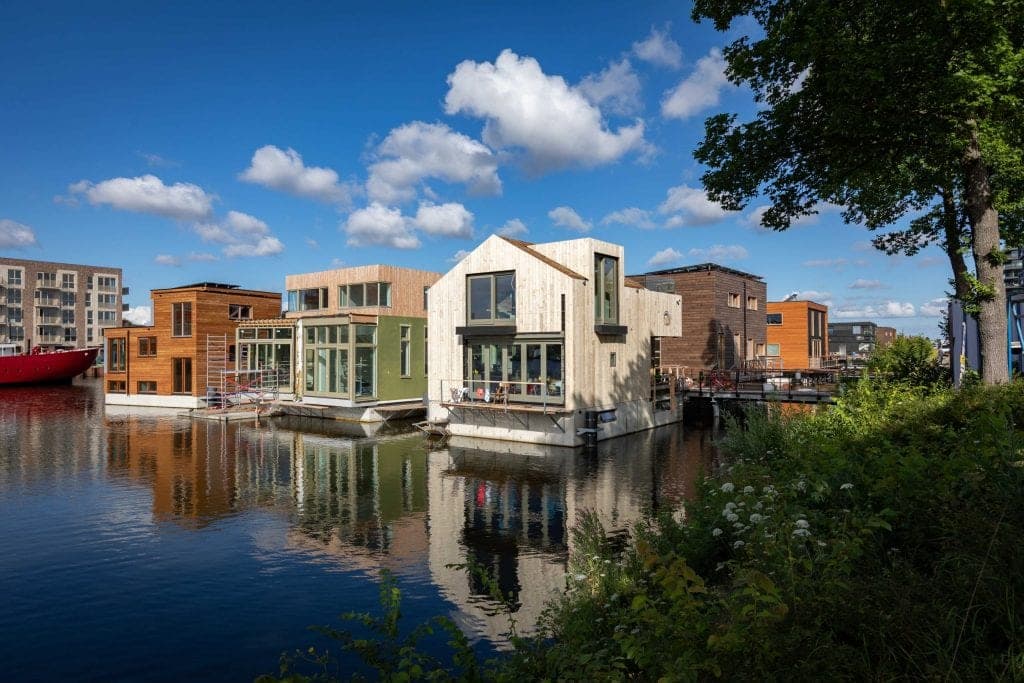
Schoonschip is a floating residential neighbourhood in Amsterdam, the Netherlands, built in the Johan van Hasseltkanaal in Buiksloterham, Amsterdam-Noord. The project began as a citizen-led initiative and grew into a long-term experiment in living on water with a strong emphasis on sustainability, shared infrastructure and community governance.
The initiative was launched in 2010 by Marjan de Blok, who brought together residents with the idea of creating an energy-neutral neighbourhood on the water. Urban planning support came from Space&Matter, while the broader development involved residents designing their own homes with architects of their choice. The project took more than a decade to complete and was officially finished in 2021. The first residents moved in during 2019, and the community has since grown to 46 households, with around 144 residents living on 30 floating homes or plots.
Schoonschip’s method combines individual home design with collective systems. A smart jetty links the homes and carries technical infrastructure while also serving as a shared social space. The neighbourhood is equipped with solar panels, heat pumps and thermal panels, and is not connected to Amsterdam’s gas network. Energy exchange between homes is managed through an internal smart grid, allowing residents to share surplus power when available and draw on the grid when needed, especially in winter.
The project has been presented as one of Amsterdam’s early circular and sustainable neighbourhoods. Its location in a former industrial area also reflects a wider urban shift in Buiksloterham toward experimental, low-carbon development.