AI-Generated Summary
About the Living Lab
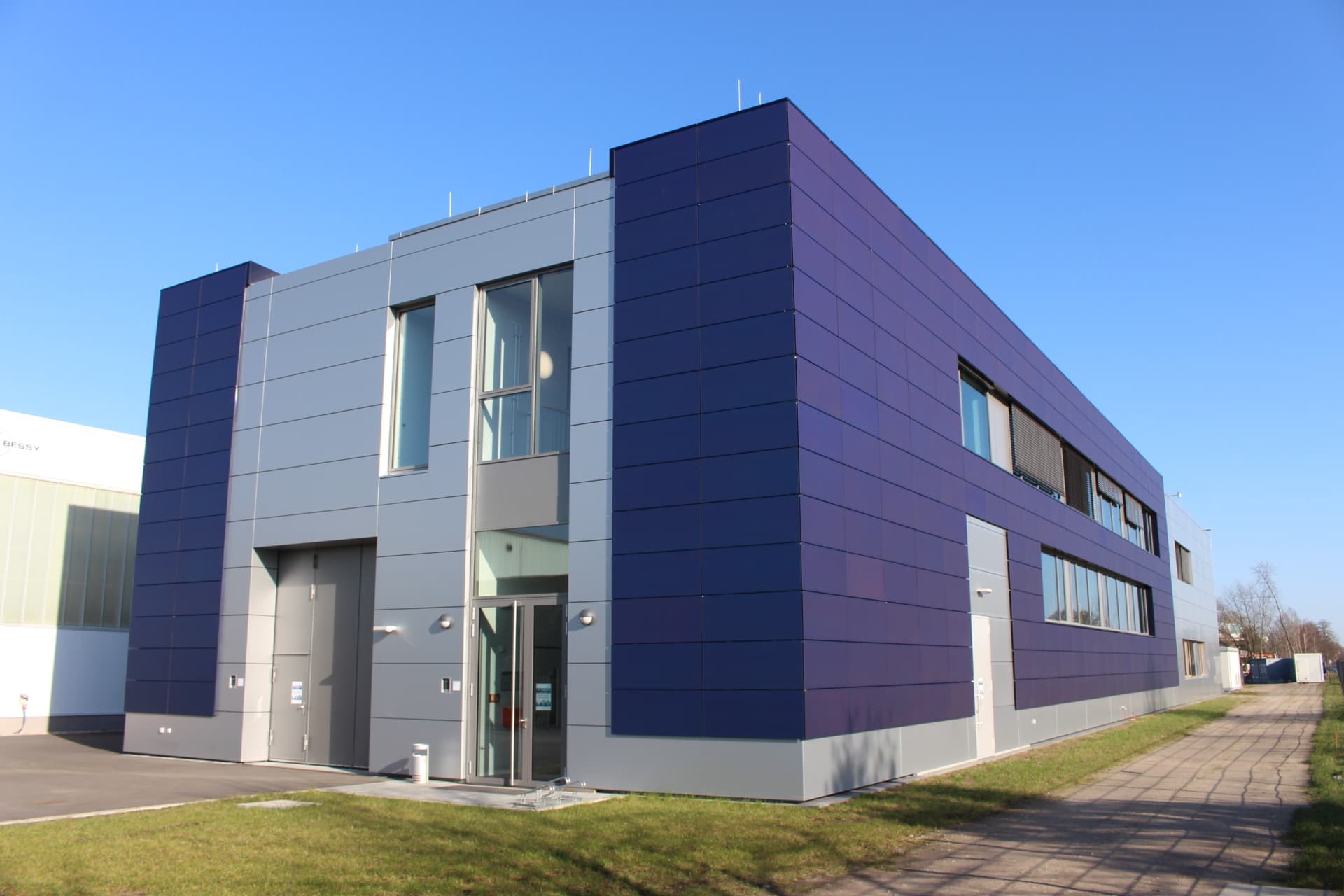
The living laboratory for building-integrated photovoltaics (BIPV) is a research building with a photovoltaic facade, operated by the Helmholtz-Zentrum Berlin für Materialien und Energie (HZB) at the WISTA science site in Berlin-Adlershof. The text states that the second construction phase of the "Testinghalle" was built as a demonstration and living laboratory, and was commissioned in 06/2021; the first part has been in operation since 2016.
Concept and Installation
- A total of 360 frameless, homogeneously colored Avancis Skala 7003 thin-film modules (135 W each) cover three facades: south, west and north.
- The installed capacity is 48.6 kWp across 38 individual strings, with an annual yield of approximately 30 MWh.
- The north side is only partly covered with PV, with 58 modules and comparable aluminum elements used to create the blue facade for economic reasons.
- The facade is a curtain-type ventilated system, with modules attached by a concealed suspension system.
Measurement Technology
- 120 measuring points and sensors record solar irradiation as well as electrical and building physics parameters.
- 10 irradiance sensors are placed at different positions on the facade, and 72 temperature sensors are glued to the backs of individual modules.
- 4 flow sensors measure the vertical rear-ventilation speed, and a weather station measures major weather parameters, including direct and indirect irradiance.
- In part of the south facade, the size of the rear-ventilation area was varied to analyse its influence on the PV system or individual strings.
Research Purpose
- The living lab is designed to provide practical experience on how solar modules and the whole PV facade system behave across different seasons, weather conditions and long periods.
- The text describes the facade as enabling long-term analysis of facade-integrated CIGS solar modules as a complete PV system under real conditions, carried out by an independent scientific research centre.
- The north side was partly covered in particular to analyse the influence of indirect and diffuse irradiation.
Project Team
- Builder: HZB. Architects: DGI Bauwerk Gesellschaft von Architekten mbH. Facade installer: SCHRAG Fassaden. Solar contractor: activ solar Schweiz GmbH.
Energy Output
- The solar facade produces approximately 30 MWh of electrical energy per year, roughly equivalent to ten 3-person households.
- This electricity is fed directly into the research campus grid and consumed in full.
Key Lessons from Integration
- The text reports that the "seamless" merging of PV modules and conventional facade elements was a challenge and has yielded important insights for the planning and execution of future projects of this kind.
- Measurement results flow directly into HZB's research and consulting activities, which the text says benefit society.
Why It Matters for Urban Policy
- The project's stated aim is to generate practical, long-term data on BIPV for the HZB's research, consulting and demonstration work, in line with the text's description of it as a research platform and demonstration laboratory for integrated PV.