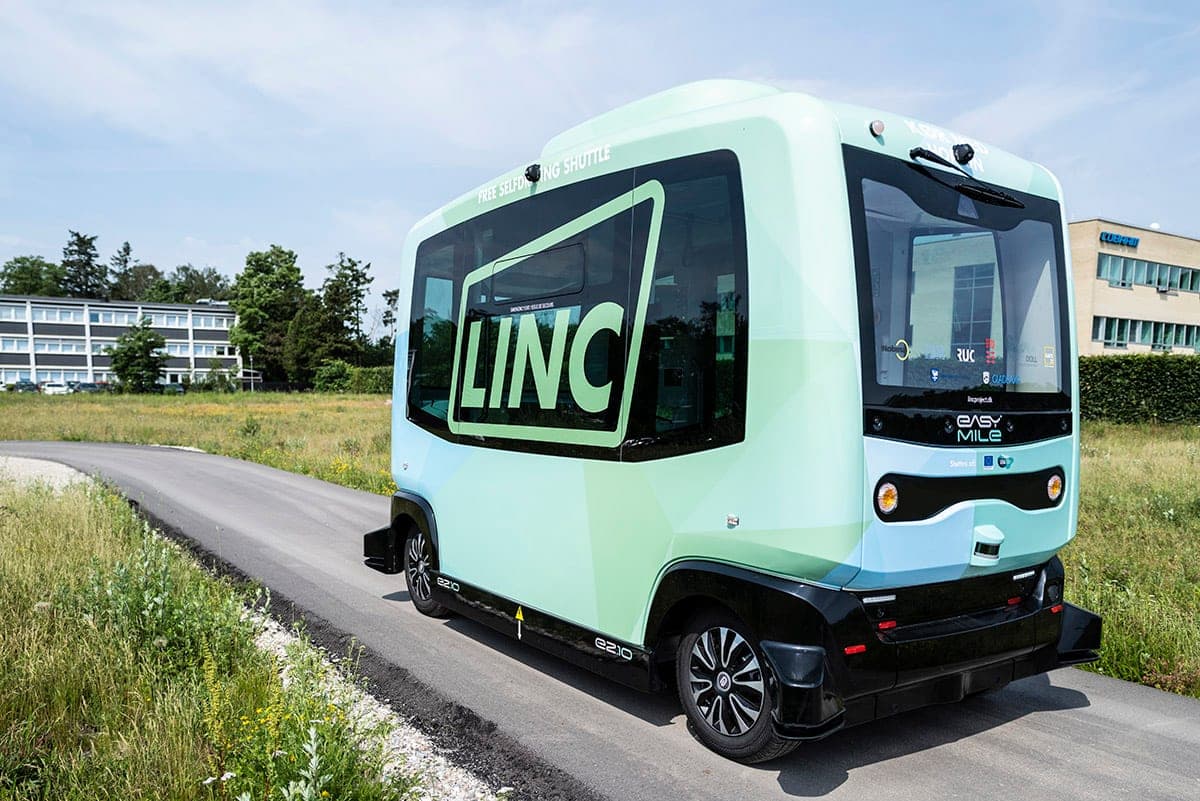
LINC set out to test whether autonomous shuttles could help connect suburban communities to public transport and support a shift away from private cars. Launched in June 2018, the three-year project was led by Albertslund Municipality and funded by its partners and the EU’s Urban Innovative Actions programme.3412
The project planned trials in two settings: DTU’s campus in Lyngby and Hersted Industripark in Albertslund. Three shuttles were tested at DTU from April to November 2021; the planned full trial in Albertslund did not take place as originally intended.2913 The consortium brought together Albertslund and Gladsaxe municipalities, Nobina, IBM, LOOP CITY, Gate 21, Roskilde University and DTU.411
The work combined real-world shuttle operations with passenger research. Researchers examined service performance, passenger experiences and interactions with other road users, while an app-based survey tested how the service might affect travel choices.21014 By the project’s close in November 2021, the shuttles had operated at DTU for more than 3,000 hours, and about 1,000 people had shared their expectations or experiences.3
The findings were mixed. The trial produced operational and user-research evidence, but the stated-preference study found little effect on overall transport-mode shares, even under scenarios with faster and more frequent shuttles. Some existing public-transport users were attracted to the service.210 LINC also documented barriers to implementation, including the need to align technology, legislation and policy.13