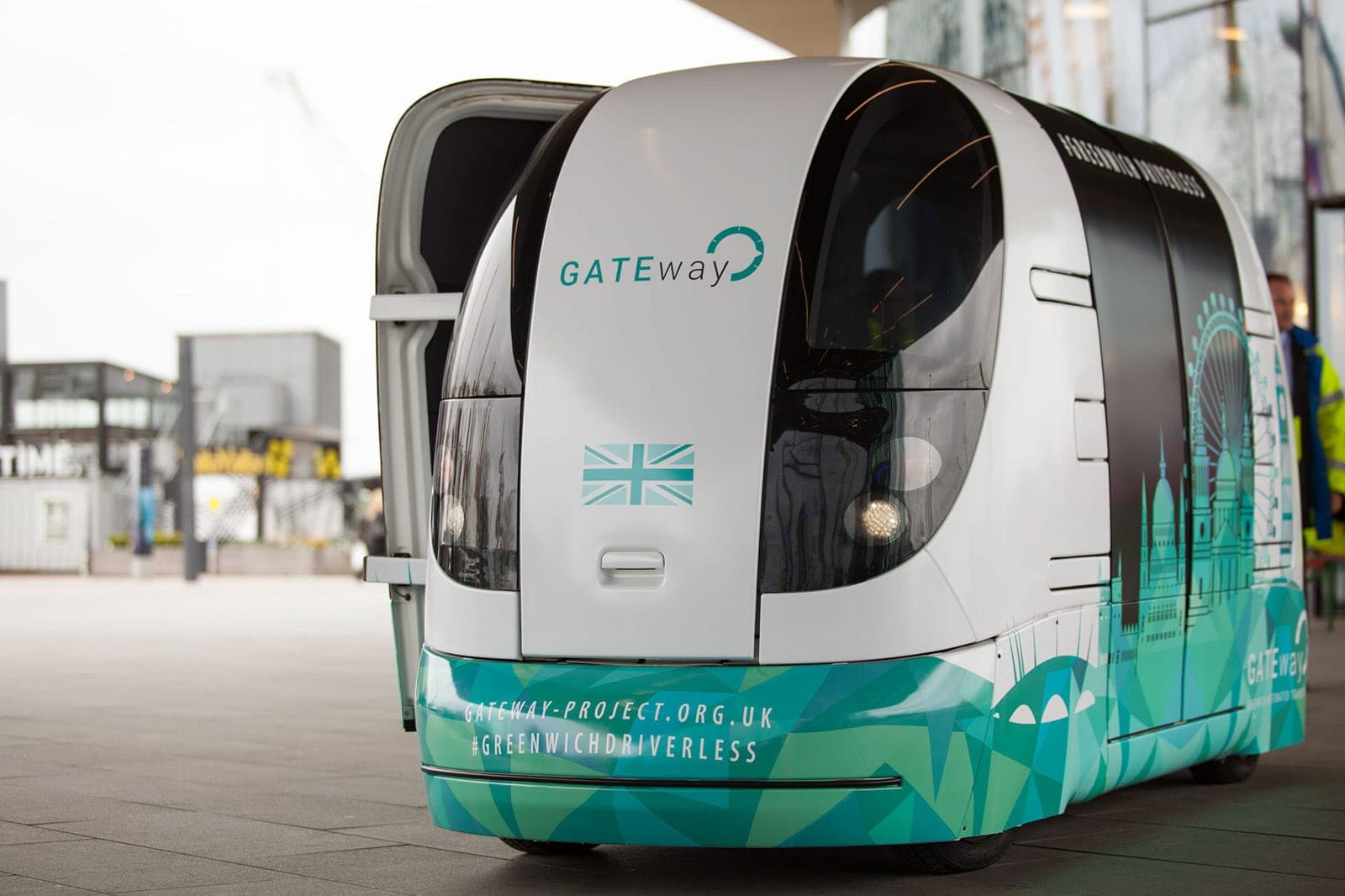
On Greenwich Peninsula in London, the GATEway Project tested how automated vehicles might fit into urban transport and how people would respond to them. Led by the Transport Research Laboratory (TRL), the £8 million initiative was funded by Innovate UK and industry and ran from 2015 to 2018.4811
The project combined public trials with research into people’s attitudes and interactions with automated vehicles. Its activities included a driverless shuttle, automated deliveries, valet-parking trials, remote teleoperation demonstrations and simulator studies.5712 In the shuttle trial, members of the public could ride in the pods and share their views; in the final phase, four vehicles ran on a 3.4-kilometre route, stopping at four designated points.1
The pods were developed by Westfield Sportscars and Heathrow Enterprises and used Fusion Processing’s CAVstar system. The system combined GPS, radar and lidar to help the vehicles detect and navigate around obstacles; the pods had no steering wheels or conventional driver controls.1 The wider consortium included the Royal Borough of Greenwich, the Royal College of Art, the University of Greenwich, RSA, O2, Gobotix, Commonplace, DG Cities, Oxbotica, Shell and Imperial College London. Lord Borwick of Hawkshead chaired the project’s multidisciplinary advisory group.1
The research reported both interest and reservations. In one survey, 43% of 925 University of Greenwich participants felt positively about driverless vehicles, 46% were undecided and 11% felt negatively; road safety and cybersecurity were prominent concerns.13 A separate Commonplace survey found 78% supported self-driving vehicles on urban streets, provided they were safe and resistant to cyberattack.13 The project is now complete.1