Power and industry made two-thirds of the cut; transport and heat are left
The United Kingdom had 69.5 million people in mid-2025, growing at the slowest rate since 2020. Since 2019 the Climate Change Act has required net zero by 2050, and Scotland’s own law brings that forward to 2045.
By 2024 emissions were 52.2% below 1990, against 38% for the EU, on the same basis. Most of that cut came from places cities do not run. Electricity supply alone gave 41% of it, as coal plants closed until the last shut in 2024, and industry another 27%. Domestic transport fell only 11% and is now the largest source, 30% of the total. Transport and heat, the two largest sources left, are where cities hold some levers, and the next section shows how few.
index, 1990 = 100
Show the numbers
| United Kingdom | EU-27 | 2030 commitment | |
|---|---|---|---|
| 1990 | 100.0 | 100.0 | — |
| 1991 | 101.3 | 97.8 | — |
| 1992 | 98.8 | 94.7 | — |
| 1993 | 96.5 | 93.1 | — |
| 1994 | 94.9 | 92.6 | — |
| 1995 | 94.1 | 93.7 | — |
| 1996 | 96.9 | 95.6 | — |
| 1997 | 93.9 | 94.0 | — |
| 1998 | 93.9 | 93.2 | — |
| 1999 | 90.3 | 91.6 | — |
| 2000 | 90.5 | 91.4 | — |
| 2001 | 91.1 | 92.4 | — |
| 2002 | 88.5 | 92.1 | — |
| 2003 | 89.6 | 93.7 | — |
| 2004 | 89.2 | 93.7 | — |
| 2005 | 88.3 | 93.2 | — |
| 2006 | 87.9 | 93.3 | — |
| 2007 | 86.2 | 92.2 | — |
| 2008 | 83.5 | 90.2 | — |
| 2009 | 76.4 | 84.1 | — |
| 2010 | 78.3 | 85.7 | — |
| 2011 | 72.7 | 83.3 | — |
| 2012 | 74.9 | 81.8 | — |
| 2013 | 73.4 | 80.0 | — |
| 2014 | 68.0 | 77.1 | — |
| 2015 | 65.5 | 78.0 | — |
| 2016 | 61.9 | 78.0 | — |
| 2017 | 60.5 | 78.5 | — |
| 2018 | 59.4 | 76.7 | — |
| 2019 | 57.3 | 73.4 | — |
| 2020 | 52.2 | 67.4 | — |
| 2021 | 54.1 | 70.9 | — |
| 2022 | 51.7 | 69.0 | — |
| 2023 | 49.1 | 63.5 | — |
| 2024 | 47.8 | 62.0 | 47.8 |
| 2025 | — | — | 45.2 |
| 2026 | — | — | 42.5 |
| 2027 | — | — | 39.9 |
| 2028 | — | — | 37.3 |
| 2029 | — | — | 34.6 |
| 2030 | — | — | 32.0 |
Territorial greenhouse-gas emissions excluding land use and international aviation and shipping, indexed to 1990, for the UK (DESNZ) and the EU-27 (Eurostat), on the same basis. The third line runs straight from 2024 to the UK’s 2030 international commitment of at least a 68% cut on 1990; the Climate Change Act requires net zero by 2050. One step on the axis is one year. Source: DESNZ, Final UK greenhouse gas emissions statistics 1990-2024, data tables, Table 1.2 (grand total minus LULUCF total, MtCO2e, UK only, excluding international aviation and shipping)
In June 2026 the Climate Change Committee, the independent body the Act set up to check progress, found the current carbon budget well on track but said the government “is not moving fast enough”: credible plans exist for 44% of the cuts still needed. Heat networks supply about 3% of British heat, and renewables only 16.4% of final energy use in 2024, against 25.2% across the EU, because most of them, about 72% of renewable fuel, go into electricity, while heat still runs mostly on gas.

Fibre came late and from the market. In 2018 the government’s own review put full-fibre coverage at only 4% of premises. By January 2026 it reached 82% of homes, built mostly by private operators; the EU’s 74.1% is for 2025, when the UK’s own figure was lower. Openreach alone had passed 23 million premises by March 2026. The government’s programme for hard-to-reach homes, Project Gigabit, was announced at £5bn. It spent £91.8m of capital in 2023–24 and £253.8m in 2024–25; by March 2026 it had helped bring gigabit broadband to 1.4 million premises, with more than £2bn committed in signed contracts, and its 99% target moved from 2030 to 2032.
UK coverage is Ofcom’s, for homes, at January 2026, as reported by the trade press; the EU’s is for 2025, and UK coverage was then rising by about 2.4 million homes a year, so the gap is overstated. Renewables are 2024 for both, on methods that are close but not identical. UK figures for 5G, online public services and digital skills are on different bases and are not compared. Source: Ofcom Connected Nations (via Advanced Television), DESNZ DUKES 2026; EU-27: European Commission Digital Decade 2026, Eurostat nrg_ind_ren
The front door is national. GOV.UK has been a single site since 2012, and in 2025/26 78% of adults used at least one central-government digital service. Behind it, the government’s own review in January 2025 found that 47% of central-government services still had no digital route. GOV.UK One Login served 122 services by January 2026, but councils run their own accounts for waste, parking, council tax and housing.
Age divides the use. In the same survey, 95% of adults had been online in the previous three months, but only 46% of those over 85, and just 32% of over-85s had used any government digital service.
The digital ID is about putting power back in people’s hands, cutting the faff out of rummaging through drawers for documents and pointless bureaucracy we have accepted for too long while bringing Britain into the modern age.That ID never came. A petition against it gathered almost three million signatures, and in July 2026 the new government cancelled the £1.8bn programme. The Post Office Horizon scandal had already shown what a faulty public system can do: sub-postmasters were convicted on evidence from a faulty accounting system, and in July 2025 the inquiry found that Post Office staff “knew or, at the very least, should have known” it could err.

Mayors get systems by statute; councils get little money
Scotland, Wales and Northern Ireland legislate for themselves on much of what cities do. In England, an Act of April 2026 put “strategic authorities”, including mayoral ones, on a statutory footing, while two-tier areas are being merged into single councils. Money is the binding limit: 36 councils had in-principle approval for exceptional government support in 2026–27, and 14 have issued a section 114 notice, which stops all new spending and is often called bankruptcy, since 1988.
- Broadband and mobile: private operators build, Ofcom regulates and BDUK subsidises. A city cannot order fibre; it mostly grants street-works permits.
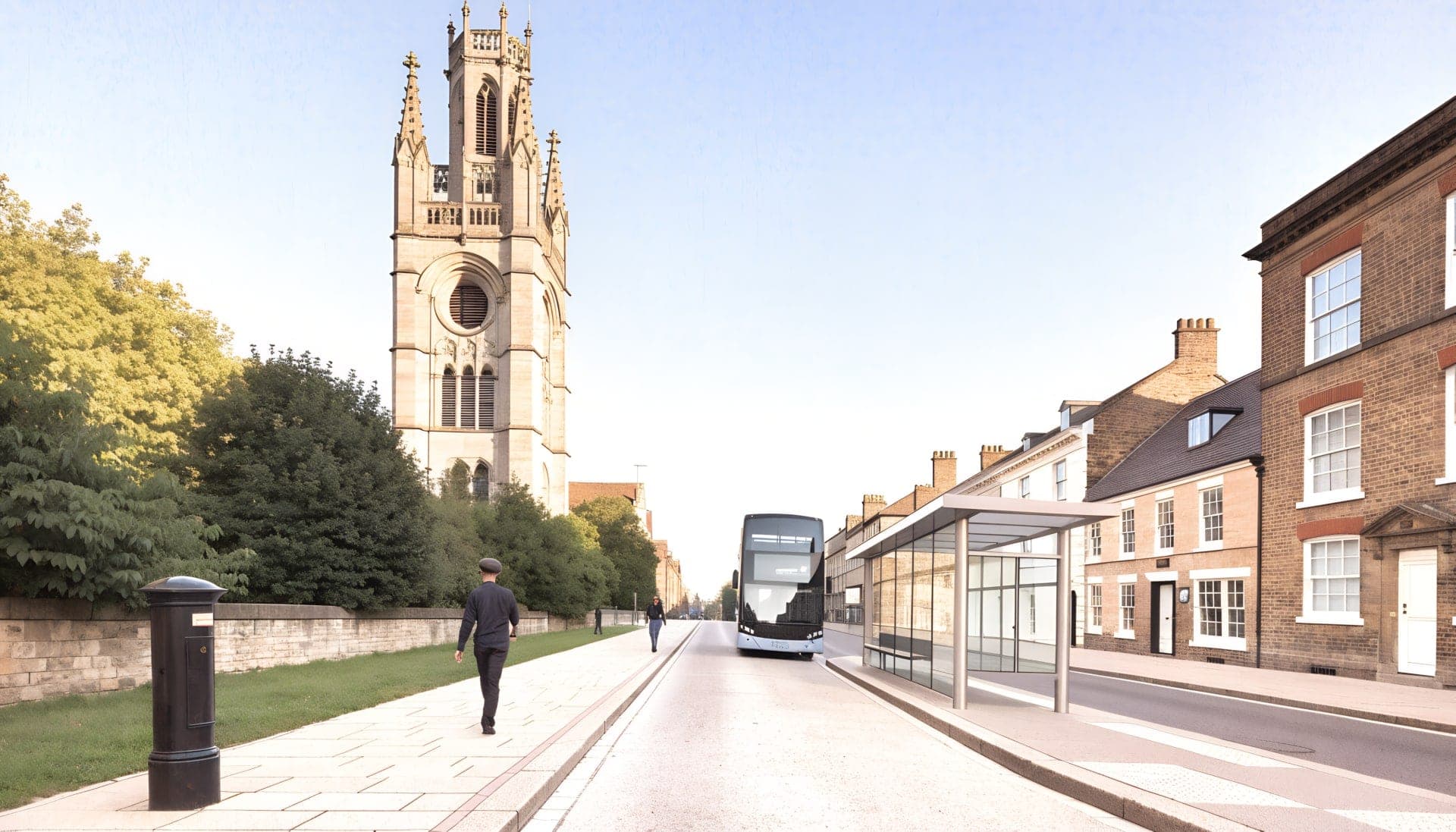
- Buses: outside London, private operators set routes and fares unless the authority franchises them. Since the Bus Services Act 2025 every English transport authority may franchise without the Secretary of State’s consent, and may again set up its own bus company. Wales legislated in 2026 to plan its buses nationally.
- Streets: the 2026 Act gives councils powers over pavement parking and the licensing of rental e-bikes.
- Policing and cameras: police and crime commissioners, or the mayor in London and Greater Manchester, hold the police budget; the government announced in November 2025 that the commissioners will be abolished in 2028, their powers going to mayors wherever possible. Facial recognition has no statute of its own: forces rely on common-law powers, data-protection law and case law.
- Heat and energy: under the Energy Act 2023, councils can coordinate heat-network zones, where certain buildings must connect; regulations for England are due in 2026.
- Planning: councils decide applications, and mayors gain call-in and development-order powers. A national AI tool, Extract, which turns old planning documents into data, has been open to every English planning authority since June 2026.
- Open data: there is no open-by-default law. A transparency code tells English councils what spending, contract and asset data to publish.
- Online services and identity: the Government Digital Service builds GOV.UK and One Login; councils need not use either.
- Procurement: English councils have bought under one regime, the Procurement Act 2023, since February 2025.
- Skills: England’s Adult Skills Fund is devolved to 11 strategic authorities, one council and the Greater London Authority: about 68% of it in 2025–26, planned to rise to about 73% from August 2026.
British cities are strongest where Parliament has handed a mayor a whole system and a statute, as with Greater Manchester’s buses. They are weakest where the centre keeps the platform and the purse: a city cannot shape the citizen’s login, order fibre, regulate police biometrics or raise much of its own money. Councils’ digital and data staff are 2% of their headcount, half the benchmark the government’s review uses.
Around them sit the Government Digital Service, BDUK and Ofcom, all now in the culture and digital department; the Information Commissioner’s Office; and the Climate Change Committee. LOTI, London’s local-government innovation team, began with 15 boroughs in 2019 and now works for 27, the Greater London Authority and London Councils. Big Brother Watch, which brought the latest facial-recognition case, and techUK, the industry body, press from either side.
A former mayor now runs the centre
Andy Burnham, Mayor of Greater Manchester from 2017, won a by-election in June 2026 and became Prime Minister on 20 July, after Keir Starmer resigned. Labour has held a Commons majority since 2024. On his first full day, 21 July, he announced a “No.10 North” in Manchester to run devolution and local growth, taking the work from the housing ministry and the Treasury.
The same announcement closed DSIT, the technology department. The Government Digital Service and digital inclusion moved to a re-created Department for Digital, Culture, Media and Sport under Lisa Nandy; AI strategy went to the Cabinet Office, and science to a merged business department. The government cancelled the digital ID and used its money to take VAT off household electricity bills from 1 October 2026 until the end of March 2027. techUK and the Startup Coalition called the break-up “a terrible signal” to the sector.
Scotland and Wales voted in May 2026. John Swinney of the SNP remains First Minister in Scotland, and Plaid Cymru’s Rhun ap Iorwerth leads the Welsh government. Greater Manchester elected Bev Craig as its mayor in July.
No national smart-city programme exists. The only one, in 2013, gave 30 cities £50,000 each for feasibility studies, shortlisted four and awarded its £24m demonstrator to Glasgow. Since then the money has come through infrastructure programmes, city-region deals and small funds. The Local Digital Fund put more than £16m into 61 council-led projects built to be reused, and has closed. The UK Shared Prosperity Fund, which replaced EU regional money, shared £2.6bn by formula rather than by competition.
Outside the EU, the UK has no recovery money, but it rejoined Horizon Europe, the EU research programme, from January 2024. Bristol and Glasgow are in the EU mission for climate-neutral and smart cities as cities of an associated country, and both hold its label.
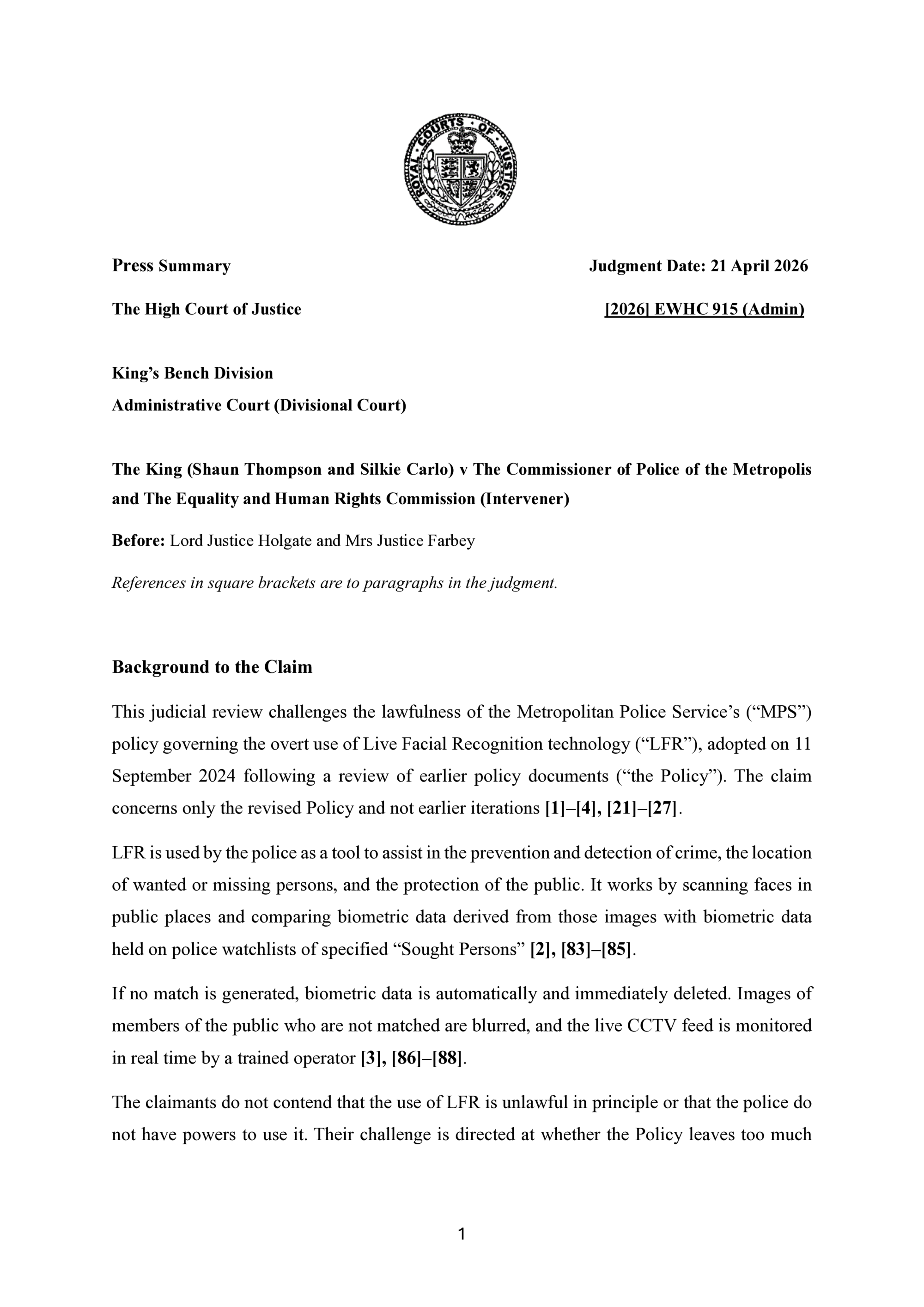
The sharpest argument is over facial recognition. Ten police forces in England and Wales had used live facial recognition by late 2025, and the Met recorded 962 arrests from it in a year. In April 2026 the High Court upheld the Met’s policy against a challenge by Shaun Thompson, a youth worker wrongly stopped after a false match, and Big Brother Watch’s director. The Home Office consulted on a law and a single regulator for it, and the King’s Speech in May 2026 promised the framework in a Police Reform Bill whose text has not yet been published. Residents are more at ease with the cameras than the argument suggests: in IMD’s survey, people in Manchester, Leeds, London and Birmingham are the most likely of 22 cities in six countries to say CCTV makes them feel safer, and 77% in Manchester are comfortable with face recognition to lower crime, the highest share.
London’s mayor already holds the police purse that most English mayors are due to receive in 2028. In May 2026 the Mayor’s Office for Policing and Crime blocked a £50m contract between the Met and Palantir, the US data-analytics firm, because the force had engaged with only one potential supplier. Palantir took the office to the High Court; in October 2026 both sides withdrew their allegations, and the contract is being re-tendered with Palantir free to bid. The argument over suppliers is national too: in July 2025 the competition authority, the CMA, found that competition in cloud services was not working. In October 2026, after a five-month investigation, it proposed to designate Microsoft with ‘strategic market status’ in business software, with a decision due by February 2027.
Whilst it is clear there is a legal framework within which facial recognition can be used now, I believe that confident, safe, and consistent use of facial recognition and similar technologies at significantly greater scale requires a more specific legal framework.Forcing people to enter a digital police lineup in the capital’s busiest and most popular destinations is an affront to the idea that you should not have to identify yourself to the police if you have done nothing wrong.- Nov 2008[source]
Climate Change Act
Carbon budgets in law; net zero added in 2019.
- Jan 2013[source]
Glasgow’s Future City
A £24m national demonstrator for one city.
- Jul 2018[source]
A telecoms review
The government finds full fibre at 4%.
- Jul 2019[source]
LOTI
Fifteen London boroughs found a shared innovation team.
- Aug 2020[source]
Bridges
South Wales Police’s facial recognition is ruled unlawful.
- Jan 2024[source]
Horizon Europe
The UK rejoins the EU research programme.
- Feb 2025[source]
One procurement law
The Procurement Act 2023 comes into force.
- Apr 2026[source]
Strategic authorities
The English Devolution and Community Empowerment Act.
- Jul 2026[source]
A mayor in Downing Street
Burnham becomes PM; the digital ID is cancelled.
- 2028[source]
Police to mayors
Police and crime commissioners are due to be abolished.
- 2032[source]
Gigabit target
The 99% coverage goal, moved from 2030.
- 2050[source]
Net zero
Scotland’s law says 2045.
From the Climate Change Act to the targets in law.
A power in law travelled; a prize stayed in Glasgow
Using a power written into law in 2017, Greater Manchester took its buses back under public control in three tranches, from September 2023 to January 2025, the first franchise in England outside London: the authority sets routes, fares and timetables and private operators run them under contract. TfGM reports that in January 2026, 82.7% of buses ran on time, against 71.9% a year earlier, and that passengers rose 8%, 10% and 2–3% in the three areas.
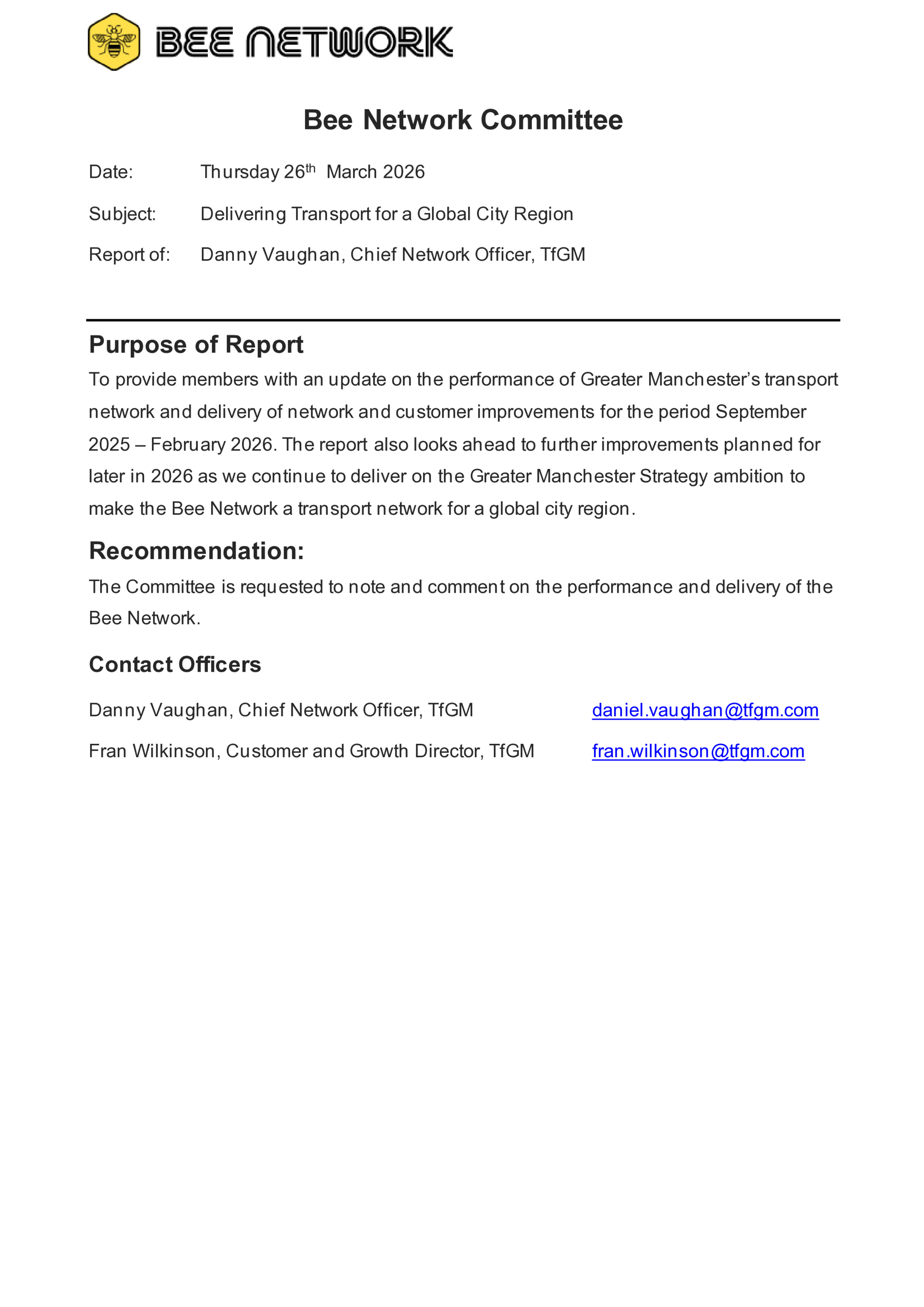
The government said in July 2024 that it wanted the Bee Network replicated across the country, after what it called Manchester’s six-year slog. Other mayoral authorities followed under the 2017 law, among them Liverpool City Region, West Yorkshire, South Yorkshire and the West Midlands; Wales plans to franchise its buses nationwide by 2030; and the 2025 Act extended the power to every transport authority in England.
Glasgow won the 2013 Future City prize and built an operations centre joining traffic management and public-space CCTV, smart street lights and an open-data platform. In 2017 Innovate UK’s case study claimed a £144m return; we found no independent evaluation, its operations centre’s current use could not be confirmed, and no national programme followed.
Birmingham’s replacement of its finance and HR system with Oracle software went live in April 2022 on a 2018 budget of about £20m. By 2024 the budget was £131m. In March 2026 the council projected £144m to 2027–28 and moved a relaunch to July 2026, saying a working system mattered more than the date. We have not been able to confirm whether the relaunch went ahead.
The rules for facial recognition have been set in court. In 2020 the Court of Appeal found South Wales Police’s use in and around Cardiff unlawful: its policy left officers too much discretion, and the force had not checked the software for bias. In 2024 the Met adopted a new policy after a review; in April 2026 the High Court found that it set clear criteria for who may be put on a watchlist and where cameras may go. The Met’s fixed cameras in Croydon, the first in the country, led to 173 arrests in six months with one false alert among more than 470,000 people who passed them, and it plans more in the West End.
Research money carried Newcastle’s Urban Observatory, which had more than 3,600 sensors across Newcastle and Gateshead by 2019, into a £12m partnership with Sheffield and Bristol, later joined by Manchester, Birmingham and Cranfield; its data portal is still online. One-city deals stayed put. Bristol’s 20-year energy joint venture with Ameresco reports heat-network capacity for more than 5,000 homes, without an independent evaluation we could find, and Sunderland signed a 20-year partnership for a shared 5G network on council assets in 2021, with no results published that we could find.
The national planning tool Extract went the other way, built once by the centre and opened to every English planning authority in June 2026. It is aimed at an estimated 250,000 hours a year that officers spend digitising old plans by hand. By then 50 authorities were using it, and in its first weeks it processed more than 1,000 documents, two-thirds of which needed only minor edits.
In the IMD Smart City Index, a survey of how residents experience their city, London ranks 4th of 148, Manchester 46th, Leeds 76th, Birmingham 89th and Glasgow 91st. Asked whether public transport is satisfactory, residents put London third and Manchester eighth of 22 cities in six countries; Glasgow, Leeds and Birmingham come 18th, 19th and 21st. Leeds and Birmingham have yet to franchise. A single year’s survey of perceptions cannot show whether franchising changed anything.
IMD’s score from 0 to 100 for how far residents agree with the statement, in 22 cities in Germany, France, Spain, the Netherlands, Belgium and the United Kingdom; British cities in ink. The IMD Smart City Index surveys residents on how they experience their city; it measures perception, not performance. Source: IMD World Competitiveness Center, Smart City Index 2026 (resident survey)
What travelled was a power in law. Manchester spent six years using one written in 2017; two years after its first franchised buses ran, Parliament gave the same power to every transport authority in England. A shared team travelled across London’s boroughs, and research money carried Newcastle’s sensors to five more places. What one city was given or bought for itself stayed where it was: Glasgow’s demonstrator has no national successor, and Bristol’s energy company and Sunderland’s 5G deal have no British copy that we could find.
References
Statistics1Click on any number to see the source
Population & migration
From our libraries8
- Progress in reducing emissions — 2026 report to Parliament (Climate Change Committee, June 2026) — Knowledge
- Future Telecoms Infrastructure Review (DCMS, July 2018) — Knowledge
- Building Digital UK Annual Report and Accounts 2024 to 2025 — Knowledge
- State of digital government review (Department for Science, Innovation and Technology, January 2025) — Knowledge
- Post Office Horizon IT Inquiry: Final Report, Volume 1 (Sir Wyn Williams, July 2025) — Knowledge
- R (Thompson and Carlo) v Commissioner of Police of the Metropolis [2026] EWHC 915 (Admin) — press summary, 21 April 2026 — Knowledge
- New legal framework for law enforcement use of biometrics, facial recognition and similar technologies (Home Office consultation, December 2025) — Knowledge
- Delivering Transport for a Global City Region — Bee Network performance report to the Bee Network Committee (TfGM, 26 March 2026) — Knowledge
Further sources15
- Final UK greenhouse gas emissions statistics, 1990–2024 (summary) — DESNZ · 2026
- Ofcom: gigabit broadband available to 89% of UK homes — Advanced Television · 13 May 2026
- DSIT Public Engagement Survey 2025/26 — GOV.UK · July 2026
- New PM cuts tax on household electricity bills — GOV.UK · 21 Jul 2026
- English Devolution and Community Empowerment Bill receives Royal Assent — Local Government Lawyer · Apr 2026
- Bus Services Act 2025 — legislation.gov.uk · 2025
- Section 114 notices — Institute for Government
- Burnham merges DBT with DSIT and gives digital back to DCMS — Civil Service World · 21 Jul 2026
- New UK prime minister unveils plan to rewire government — Global Government Forum · 21 Jul 2026
- Andy Burnham succeeds Keir Starmer — OPB · 20 Jul 2026
- Local Digital Fund — MHCLG Local Digital
- Bee Network Committee report, 26 March 2026 — TfGM · 26 Mar 2026
- Glasgow: a world-leading smart city — Innovate UK · 2017
- London cops hail fixed facial recognition cams — The Register · 13 May 2026
- Smart City Index 2026 — IMD World Competitiveness Center · 2026