
A broadband discount for 23 million homes ended in 2024
The United States had 341.8 million residents in July 2025, in 50 states and the District of Columbia. Growth halved as immigration fell. In the 2020 census 80.0% of Americans lived in urban areas, and by 2025 about 18.9% were 65 or older. Public transport had won back about 85% of its riders from before the pandemic by 2024, by the count of APTA, the transit industry’s association.
There is no federal climate law. Gross emissions in 2023 were 6,197 million tonnes of CO₂ equivalent, 5.2% below 1990 and 17.4% below 2005. That inventory reached the public only through a freedom-of-information request by the Environmental Defense Fund, a campaign group. The 2024 figure comes from an independent inventory by the University of Maryland, built on EPA’s methods. Rhodium Group, a research firm, estimates that 2025 emissions rose by 2.4%.
Mt CO₂e
Show the numbers
| United States, gross emissions | |
|---|---|
| 1990 | 6,538.3 |
| 2005 | 7,505.3 |
| 2019 | 6,597.4 |
| 2020 | 6,005.7 |
| 2021 | 6,333.8 |
| 2022 | 6,344.1 |
| 2023 | 6,197.3 |
| 2024 | 6,205.3 |
Gross emissions in million tonnes of CO₂ equivalent, excluding land use, at the years EPA’s inventory publishes, joined by straight lines; 2024 is the University of Maryland’s independent inventory, built for continuity with EPA’s. The 2035 pledge the US withdrew with its Paris exit was set on net emissions and is not drawn. The axis is spaced by year. Source: US EPA, Inventory of US Greenhouse Gas Emissions and Sinks 1990–2023, Table ES-2 (released via EDF FOIA); University of Maryland, GHGIA 2026
The only national target, a 2035 pledge to cut net emissions by 61–66% on 2005, belonged to the Paris Agreement, which the US left on 27 January 2026. In April 2026 the repeal of the endangerment finding took effect: the 2009 decision on which federal vehicle standards rested. Twenty-four states, ten cities including New York, Los Angeles, Chicago and Denver, and five counties are challenging the repeal in the federal appeals court in Washington.
Today’s announcement by EPA authorities is a terrible step backwards.Climate targets now come from below: 22 states and the District have economy-wide emissions targets. Renewables supplied about 9% of primary energy in 2025, a measure that weighs wind and solar less than the EU’s does, and about 24% of the electricity from power plants of 1 MW or more.
The networks were built for television first. In May 2026 the federal regulator, the FCC, reported that more than 96% of locations could get fixed service at 100/20 Mbps or more. That figure counts cable and fixed wireless as well as fibre. Fibre reached 62.6 million of 116.4 million homes and businesses at the end of 2025, or 53.8%; the industry’s own count is just over 60% of households.
Mobile 5G reaches 96.8% of locations, but the FCC counts any 5G service of 7 Mbps down and 1 up. Where fibre is marketed, 46.5% of homes take it, and 4.4 million locations still lack wired or fixed-wireless service at 100/20 Mbps.
Share of broadband-serviceable locations, homes and businesses together, that providers report they can serve. Fixed service at 100/20 Mbps counts every wired and fixed-wireless technology, cable included; the fibre share is CostQuest’s count for the end of 2025, divided by us. These are locations, not households, and are not compared with the EU. Source: FCC, National Broadband Map v8.0 (statement of Chairman Carr, FCC 26-33, May 2026); fibre: CostQuest analysis of FCC data, via Telecompetitor
Much of the gap is price. When the Affordable Connectivity Program ended on 1 June 2024, more than 23 million enrolled households lost its monthly discount of up to $30, or $75 on Tribal lands. In November 2023, 12% of people lived in a household with no internet connection. In Kansas City, the first Google Fiber city, a 2016 survey found home internet in 56% of households earning under $30,000 a year, against 91% of the rest.
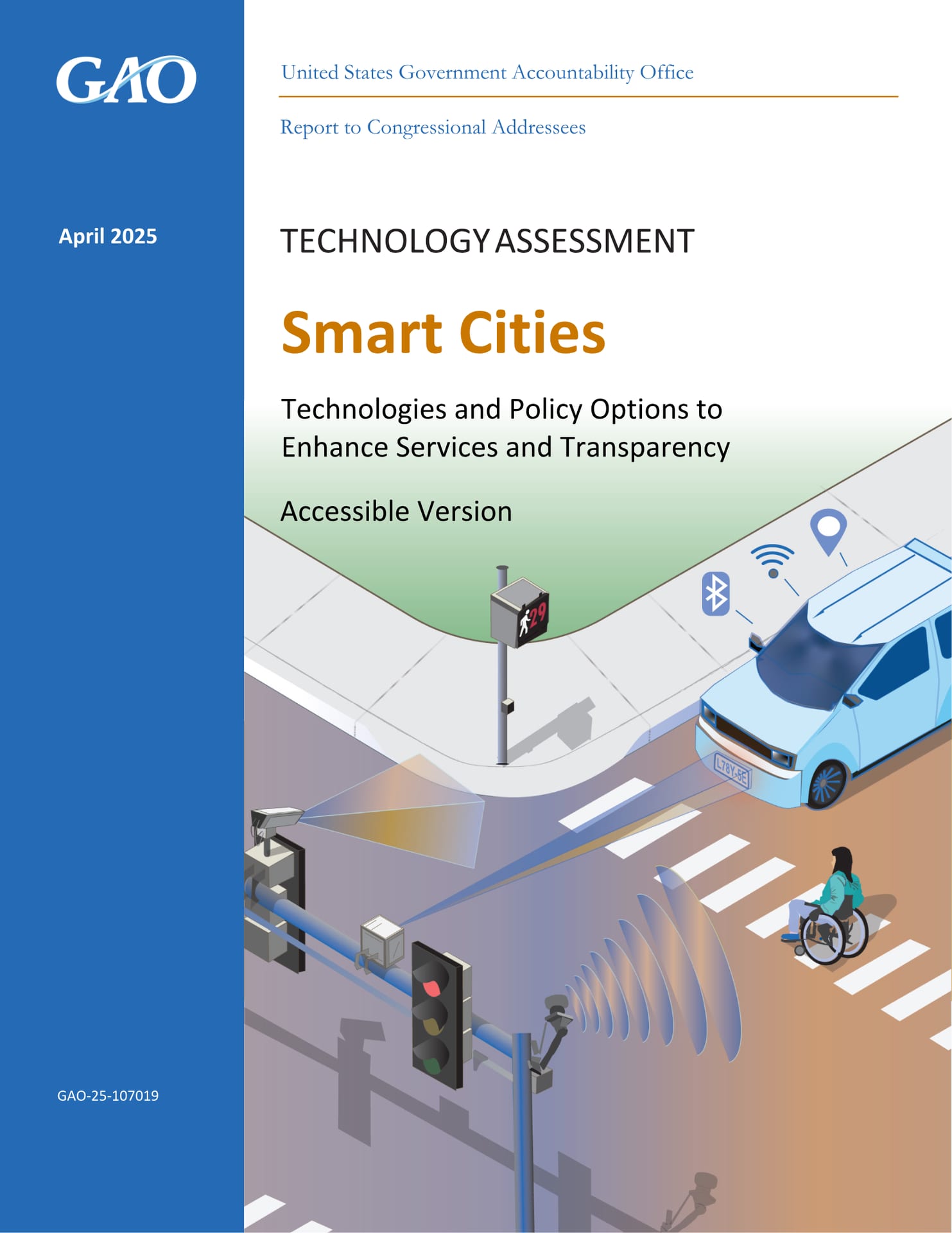
No US agency measures how many adults deal with the authorities online, or their digital skills, on the European basis. In April 2025 the GAO, Congress’s audit office, found that residents are told what city sensors can do “but not potential risks”. It added that the benefits are hard to measure and that the data may identify individuals. Early that year federal datasets cities used for planning were taken offline. A judge ordered the health agency CDC’s pages restored, but EPA’s environmental-justice map, EJScreen, survives only as a copy run by an outside group of data volunteers; a few states run their own tools.
What an American city controls best is a rule about itself
Washington has no digital ministry and no urban programme with smart-city money. The levers are spread across federal agencies, the 50 states, regional transit authorities and private utilities, and each state sets what its cities may do.
- Broadband subsidy: BEAD (Broadband Equity, Access and Deployment), the $42.45bn programme of the 2021 infrastructure law, flows from NTIA, the Commerce Department’s telecoms agency, to state broadband offices, which choose private providers. Since June 2025 it has been technology-neutral, so satellite competes with fibre; cost per location is the main test, and NTIA dropped the rules on government-owned networks.
- Municipal networks: 16 states restrict or bar them, and the FCC’s attempt to override two of those laws failed in court.
- Small cells: a 2018 FCC order, upheld in court in 2020, sets the fees a city is presumed allowed to charge, $270 per cell a year, and deadlines for its decisions. A city controls the pole but not the price.
- Public transport: the biggest networks, such as Boston’s MBTA, Philadelphia’s SEPTA and New York’s MTA, are state or regional authorities, with federal capital money. A mayor can pay for extra service, as Boston does for three fare-free bus routes, but does not run the network.
- Streets and vehicles: cities own their signals and kerbs, but states authorise speed cameras and license driverless cars. In 2023 it was California’s motor-vehicle department that suspended the permits of Cruise, General Motors’ robotaxi company, in San Francisco.
- Policing and cameras: no federal statute governs face recognition or plate readers. Cities may ban, approve or audit their own police technology, and states set the outer limits, as Virginia did in 2025 and Washington State in 2026.
- Energy: state utility commissions regulate the grid, and in 2023 a federal court held that the 1975 Energy Policy and Conservation Act blocked Berkeley’s ban on gas in new buildings. A city shapes its grid only if it owns the utility.
- Buildings: there is no national building or energy code; states adopt codes and zoning is local. Cities can cap emissions from existing buildings, as New York does, and 49 governments have joined a coalition to do the same.
- Data and online services: the 2019 open-data law binds federal agencies only. Login.gov, with more than 180 million accounts, signs people in for 54 federal agencies and states, and 21 states and Puerto Rico issue mobile IDs that airport security accepts. Cities build their own portals, and 18F, a federal digital-services team, was closed in March 2025.
- Procurement and AI: the 2016 federal source-code policy binds federal agencies only, and state law governs what cities buy. The pre-emption the December 2025 AI order seeks would expressly not reach states’ own purchase and use of AI.
The split decides what is easy. A US city is strong where the lever is a rule about its own conduct: what its police may buy, what its buildings may emit, what scooter firms must report. Such rules need no federal money and travel by copying. Where the lever is infrastructure or a grant, the state, a utility or Washington decides.
The National League of Cities lobbies for municipal leaders, and the US Conference of Mayors, founded in 1933, is open to more than 1,500 mid-sized and large cities. Climate Mayors, a network chaired by Phoenix’s Kate Gallego, opposes the federal climate rollback. Two bodies the cities govern carry their standards: the Open Mobility Foundation for street data and the GovAI Coalition, founded by San José, for buying AI.
Philanthropy fills part of the gap: Bloomberg Philanthropies’ What Works Cities had certified 104 cities across the Americas for their use of data by February 2025. Code for America, the best-known civic-tech non-profit, stopped sponsoring its volunteer Brigades in 2023, and some carried on as independent groups. The American Civil Liberties Union and the Electronic Frontier Foundation, a digital-rights group, press cities on surveillance.
Since 2025, Washington has been taking its grants back
Donald Trump began his second term as President in January 2025. Republicans hold both chambers of Congress: 53 of 100 senators and 218 of 435 House seats, against 214 Democrats, one independent and two vacancies. After three funding lapses since October 2025, the government runs on a stopgap law, and November brings the mid-term elections for Congress and most governors.
There has been no national smart-city programme since 2021. USDOT, the transport department, ran the only one, the Smart City Challenge, in which 78 cities competed in 2016. Columbus won $40m from the department and $10m from a foundation. Its successor line, the SMART grants, had awarded nearly $280m by December 2024; the 2026 transport budget cut it by over $200m.
Broadband shows the gap between money announced and money paid. BEAD was announced in 2021 and rewritten in June 2025, and by 25 August 2026 all 56 state and territory plans were approved. NTIA told the GAO that it had awarded about $18.4bn, which it expects to bring service to about 3.8 million locations. By February 2026 Louisiana had released $43m, a tenth of the $430m in contracts it had signed by then. How much has been paid out nationally has not been published.
In September NTIA let states spend part of the roughly $21bn saved by the rewrite on further building rounds. It did not say how much, and its rules for the rest have not been issued.
President Trump promised to put an end to wasteful spending, and thanks to his leadership, the American people will get the benefit of the bargain, with connectivity delivered around the country at a fraction of the cost of the original program.This is an infrastructure project, and renting space on satellite is notOther lines were cancelled. The $2.75bn of Digital Equity Act grants for digital inclusion were terminated in May 2025, after the President called the programme “RACIST and ILLEGAL”; Philadelphia lost an $11.9m grant it had been approved for. In July 2026 a judge struck down only its category for racial or ethnic minorities, and NTIA agreed to run the competitive grants again without it. The larger grants to states for digital-skills plans were not part of the case and remain cancelled.
The budget law of 4 July 2025, the One Big Beautiful Bill Act, took back about $2.4bn that had been awarded but not yet legally obligated from a programme to repair neighbourhoods cut through by highways. EPA terminated its $20bn green-finance fund and its $7bn Solar for All programme.
In August 2026 the full appeals court in Washington kept an order blocking the first termination in place, and the government plans to appeal to the Supreme Court. On 18 September a judge vacated the solar termination, and EPA is considering an appeal. In October 2025 the energy department cancelled 321 awards worth about $7.56bn.
American cities sit outside the EU’s programmes. The US is not associated with Horizon Europe, so no US city could join the EU mission for climate-neutral and smart cities.
Sovereignty here means states against Washington. An executive order of December 2025 set up a task force whose “sole responsibility” is to challenge state AI laws, and tied leftover broadband money to them. The Justice Department joined a company’s lawsuit, moving to invalidate Colorado’s AI Act, and in May 2026 Colorado’s legislature voted to repeal and replace it.
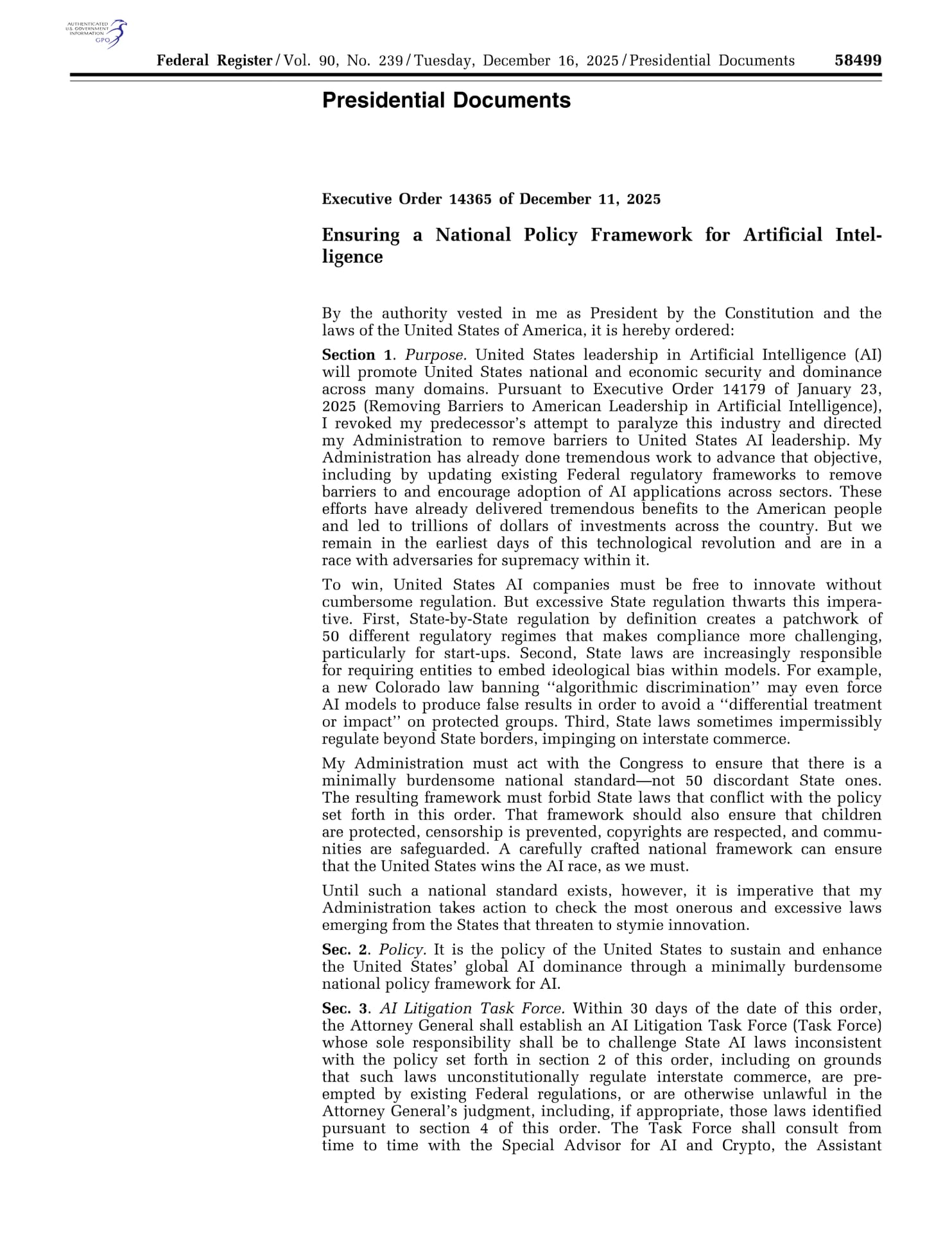
Plate readers that local police share are where the fight is loudest. Flock Safety sells the plate-reading cameras many of them use. 404 Media, a news site, found more than 4,000 searches of that shared data run by local and state police for federal agencies or with a possible immigration motive. Fortune counted at least 30 cities ending Flock contracts since early 2025, against more than 5,000 using the cameras. Garrett Langley, Flock’s chief executive, said police need the tools and “should also hold them accountable to not break the law.”
- Aug 2016[source]
Tennessee v. FCC
An appeals court overturns the FCC’s pre-emption of state limits on city broadband.
- Nov 2018[source]
Seattle amends its ordinance
The amended law on city surveillance technology takes effect.
- Feb 2019[source]
Google Fiber leaves Louisville
Shallow cable trenches failed; the company says it would have to rebuild.
- May 2019[source]
First face-recognition ban
San Francisco’s supervisors bar city departments from using it.
- Jun 2021[source]
Smart Columbus ends
The national challenge’s five-year grant period closes.
- Nov 2023[source]
GovAI Coalition
San José starts a pool of AI policies and contract terms for public agencies.
- Mar 2024[source]
Proposition E
San Francisco’s voters loosen the city’s 2019 surveillance rules.
- Jul 2025[source]
No moratorium
The Senate votes 99–1 to strip a ten-year ban on state AI laws from the budget bill.
- Aug 2026[source]
Flock changes its defaults
Data are kept a week instead of 30 days, and each search needs a reason.
- Nov 2026[source]
Mid-terms
All 435 House seats, 35 Senate seats and 39 governorships are contested.
- Dec 2026[source]
Stopgap runs out
Federal funding and the surface-transport extension expire on 11 December.
- Feb 2027[source]
Out of the UN convention
The US exit from the UNFCCC takes effect.
Court rulings, city rules and federal deadlines that the text does not date.
The rulebooks city halls copied from each other
Smart Columbus, the competition’s winner, cost about $55m over five years. Its clearest result was rides to prenatal care: in a study of 143 pregnant women, 18% of those offered the new ride service took no trips, against 44% of those left with the usual ride line. The researchers said a ride service alone was unlikely to improve birth outcomes much.
A downtown self-driving shuttle carried 16,062 passengers in 2018–19; its successor stopped carrying passengers two weeks after its 2020 launch, when a sudden stop injured a passenger, and delivered food boxes instead. Truck platooning was dropped, and no other city is reported to have adopted the pilots.
Los Angeles went the other way. Its transport department wrote the Mobility Data Specification, an open format in which scooter and bike operators must report trips to the city. The city handed the standard to the Open Mobility Foundation, which says more than 1,200 cities now use it.
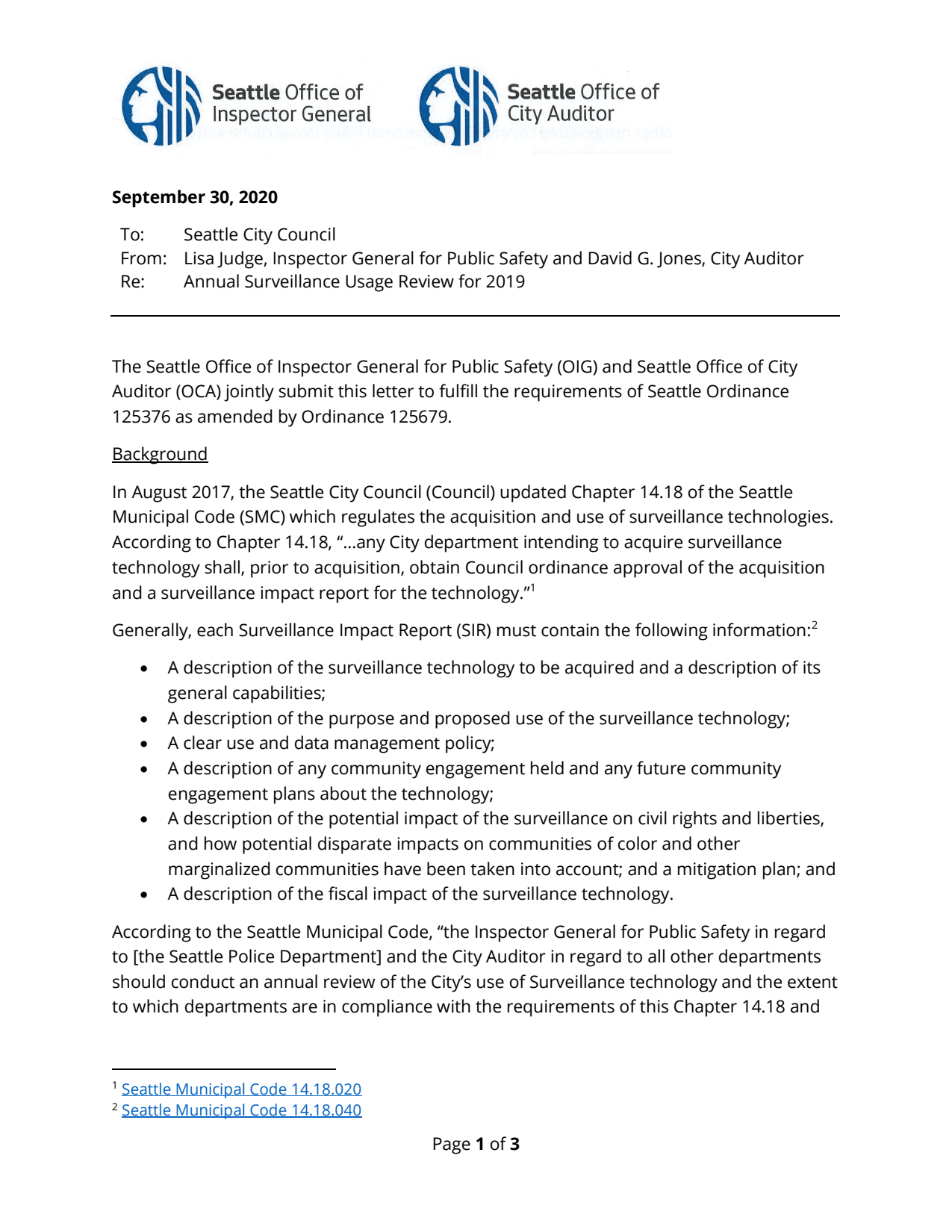
Seattle’s surveillance ordinance requires council approval and an impact report for each surveillance technology the city uses. Its 2019 review counted 710 requests for privacy reviews, but the council had approved reports on only two systems already in use, both traffic tools, and none for the police. By May 2021, 21 cities and counties had passed similar laws. In March 2026 Seattle’s police switched off all their plate readers to comply with a new state law.
San Diego shows the order reversed. In 2016 it put sensors with cameras on about 3,200 streetlights in a $30m programme, and police used the footage in hundreds of cases before the public knew. The city switched them off in 2020, and in 2022 passed an ordinance giving the council a vote on every surveillance technology. Under it, the council approved 500 new cameras with plate readers in 2023, and in December 2025 the police’s continued use of 54 surveillance technologies.
Chattanooga’s smart grid exists because the city owns its electric utility, EPB, which used a $111m federal grant in 2009 for automated switching. A university study published by EPB credits the grid with about 59% fewer outage minutes a year. Tennessee law keeps EPB’s fibre inside its electric territory, so it cannot serve its neighbours.
Fort Collins had to vote for its fibre, because a 2005 Colorado law required a local vote first. In 2017, 57% said yes, against a campaign that spent $900,999 and that ILSR, a community-broadband institute, describes as a front for Comcast and CenturyLink. After more than 120 Colorado communities had voted the same way, the state repealed the law in 2023. The city’s network, Connexion, had 24,772 customers in late 2025, 46% of the homes it passes.
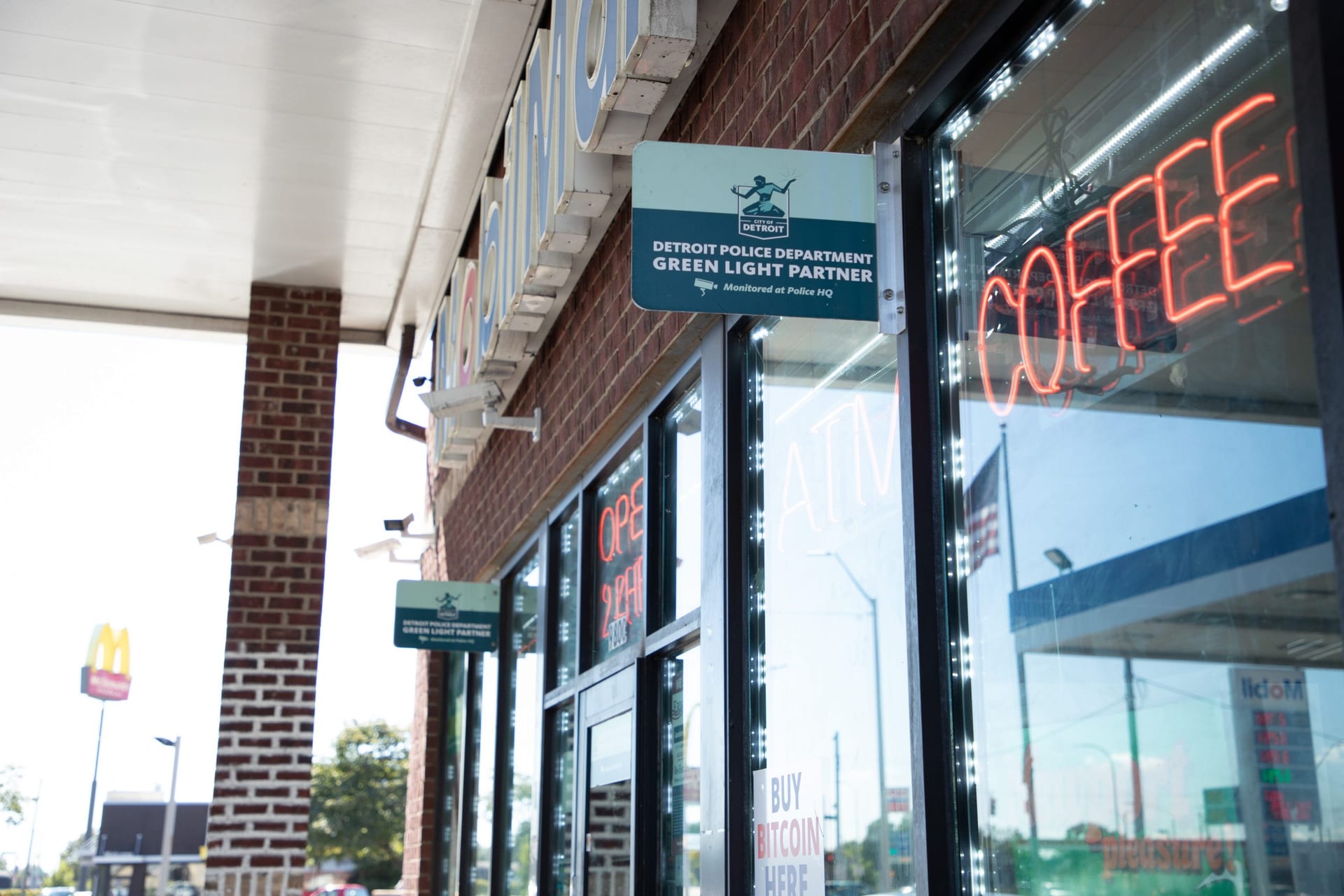
Detroit’s Project Green Light, which links businesses’ cameras live to the police, had 907 partners in 2024. The Justice Department’s evaluation register rates it ineffective for violent and disorder crime. Mountain View, in California, switched off all 30 of its Flock cameras in February 2026 after more than 250 agencies had searched its data without permission. Its police chief, Mike Canfield, said: “I personally no longer have confidence in this particular vendor.”
Seattle’s residents are the most wary of face recognition among the ten US cities in the IMD Smart City Index, a survey of how residents experience their city. Only 50.4% are comfortable with it to lower crime, against 71.2% in Philadelphia. One survey cannot show whether city rules shaped those views.
Share of residents who agree or strongly agree, in 35 cities: 25 in Germany, Spain, France, Poland, the United Kingdom, Denmark, Austria and Switzerland, and 10 in the United States; US cities in ink. The IMD Smart City Index surveys residents on how they experience their city; it measures perception, not performance. Source: IMD World Competitiveness Center, Smart City Index 2026 (resident survey)
City-written rules carried a long way without federal money. A scooter-data format from Los Angeles spread through a foundation the cities govern, Seattle’s camera ordinance became a model, and in Colorado, after more than 120 towns had voted to opt out, the legislature repealed the state law that had held them back. Elsewhere they stopped at the state line. Seattle’s plate readers went dark under a state law rather than the city’s own ordinance, Chattanooga’s fibre cannot cross the boundary Tennessee drew round its utility, and no city rule replaces the skills and street grants Washington took back.
References
Statistics1Click on any number to see the source
Population & migration
From our libraries6
- Smart Cities: Technologies and Policy Options to Enhance Services and Transparency (GAO-25-107019) — Knowledge
- Broadband Deployment: Agencies Should Take Steps to Better Target Underserved Areas and Consider Sustainability (GAO-26-107725, 31 August 2026) — Knowledge
- Executive Order 14365: Ensuring a National Policy Framework for Artificial Intelligence (11 December 2025) — Knowledge
- Smart Columbus — USDOT Smart City Challenge Final Report, Executive Summary (June 2021) — Knowledge
- 2019 Annual Surveillance Usage Review (Seattle Office of Inspector General and City Auditor memo, 30 September 2020) — Knowledge
- Project Green Light Detroit — CrimeSolutions programme profile (US Department of Justice, Office of Justice Programs) — Knowledge
Further sources17
- Population growth slows (Vintage 2025 estimates) — US Census Bureau · 27 Jan 2026
- US greenhouse gas emissions in 2025 — Rhodium Group · 2026
- Greenhouse Gas Inventory Assessment 2026, executive summary — University of Maryland, Center for Global Sustainability · 2026
- Statement of Chairman Carr on the National Broadband Map v8.0 (FCC 26-33) — Federal Communications Commission · 20 May 2026
- Fiber access grew in the last half of 2025 — Telecompetitor · Mar 2026
- Affordable Connectivity Program wind-down — Federal Communications Commission · 2024
- Benefit of the Bargain: BEAD programme restructured — NTIA · 6 June 2025
- State preemption of community broadband — Institute for Local Self-Reliance · Oct 2024
- Surface transportation extension leaves transit funding gap — Metro Magazine · Oct 2026
- Digital Equity Act case: joint status report — Benton Institute for Broadband & Society · 2026
- Congress’s budget reconciliation bill takes back billions from locally led projects — Transportation for America · 8 July 2025
- Cities end Flock partnerships — Fortune · 3 Mar 2026
- Columbus Smart City Challenge ends with successes and shortfalls — WOSU · 16 June 2021
- Surveillance technology — City of Seattle
- City council backs SDPD surveillance policies — Times of San Diego · 9 Dec 2025
- Mountain View police turn off licence-plate cameras — Mountain View Voice · 2 Feb 2026
- Smart City Index 2026 — IMD World Competitiveness Center · 2026