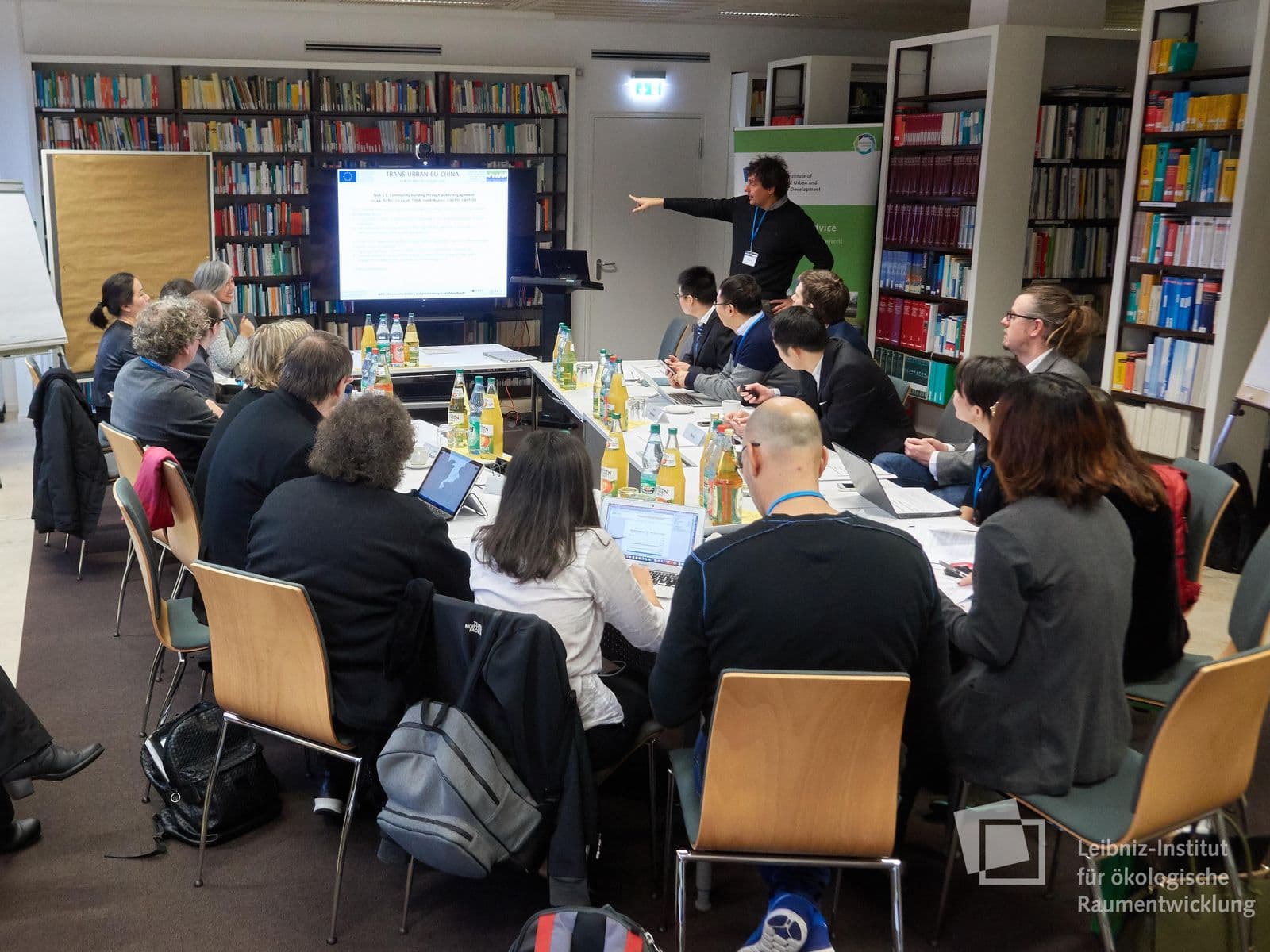
TRANS-URBAN-EU-CHINA set out to help cities become more socially inclusive while remaining environmentally sustainable and financially viable. Its work addressed a challenge especially pressing in China, where rapid urbanisation has made the integration of rural migrants and the social effects of urban growth central concerns. The project also aimed to help European urban stakeholders learn from Chinese approaches and reconsider their own practices.5
Coordinated by TU Dresden, the project ran from 1 January 2018 to 30 June 2021. Its consortium brought together eight European and six Chinese expert organisations, including universities, research institutes, city networks and urban-planning bodies. Among the Chinese participants were the China Academy of Urban Planning and Design, Tsinghua University and Tongji University.45
The partners built a comparative knowledge base on urban transitions in Europe and China, and worked with local stakeholders and citizens to develop and test practical measures. The project focused on neighbourhood community-building and place-making, the gap between plans and implementation in eco- and smart-city development, land-use planning and management, and pathways towards sustainable urban governance. It also tested tools in Chinese urban living labs and discussed recommendations with representatives of reference cities and other stakeholders.45
The work produced the 15-chapter book Towards Socially Integrative Cities – Perspectives of Sustainable Urbanisation in Europe and China, written by joint European-Chinese teams. Other outputs included a compendium of tested tools, policy briefs, city guidelines and recommendations. A policy brief on urban expansion and renewal in China set out four strategic fields and twenty recommendations for the period to 2025.28