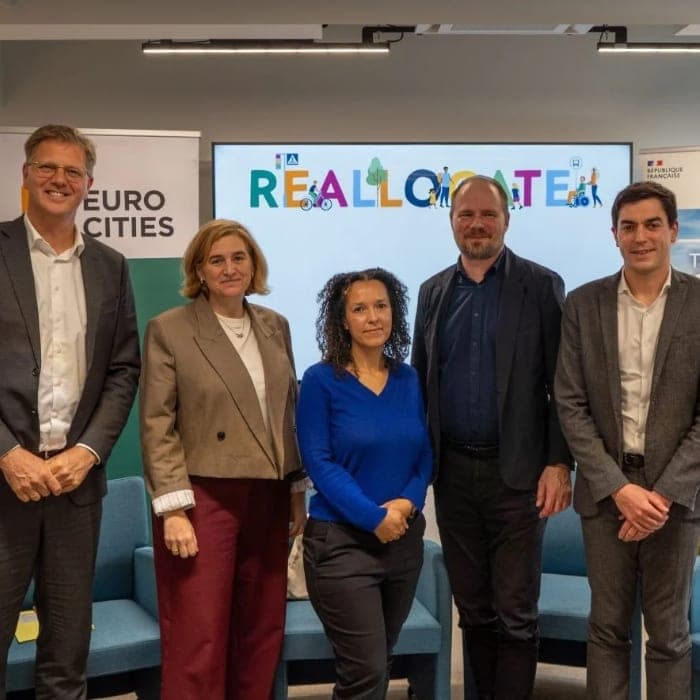
REALLOCATE is a four-year European project focused on changing how streets and public spaces are designed so that more journeys can be made by walking, cycling and other active modes. Coordinated by University College Dublin, it runs from May 2023 to April 2027 and brings together 37 organisations, including city authorities, universities, mobility specialists and civic networks.28
The project works with ten Mission Cities in five twinned pairs: Gothenburg–Tampere, Heidelberg–Utrecht, Lyon–Warsaw, Budapest–Zagreb and Barcelona–Bologna.2 Its approach combines local expertise with city-to-city learning, helping municipal teams develop and test mobility measures suited to the needs of different communities.25
Fifteen pilots in urban and peri-urban areas are intended to demonstrate ways to make streets safer and allocate public space more fairly, with particular attention to active travel.5 Measures include changes to urban design, behavioural nudges and data-driven or technological tools to address both actual and perceived road-safety risks. The pilots also serve as learning sites: city staff exchange knowledge through mentoring, capacity building, twinning and work shadowing.5
REALLOCATE’s stated aim is to support cities’ climate-neutrality efforts while making mobility safer, more inclusive and affordable.2 The project is still underway, so the available sources describe its objectives and pilot programme rather than final results. Its replication work is intended to extend learning beyond the ten core cities; the Eurocities page lists eleven cascade cities, while a CORDIS report describes ten, so the number is inconsistent across sources.2