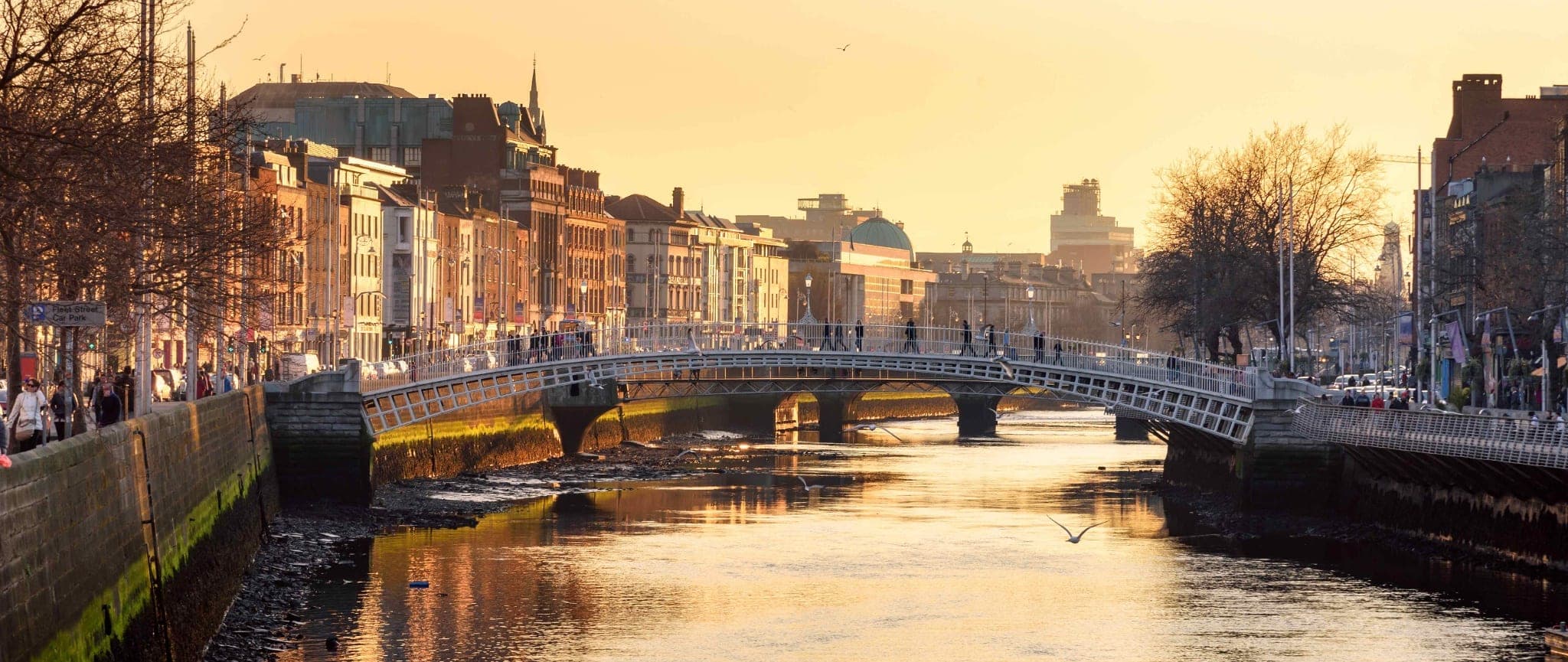
A capital close to the limit of its pipes
In 1759 Arthur Guinness signed a 9,000-year lease on a disused brewery at St James’s Gate. Much of what Dublin needs now takes decades to build. The River Liffey supplies 85% of the water for 1.7 million people in and around the city. On 26 May 2026 Dublin used a record 685 million litres. Uisce Éireann, the national water utility, says supply across the Greater Dublin Area is operating at or close to full capacity at peak times. By 2028 it expects to be unable to connect new buildings to the wastewater network in major parts of the region, three years before a new drainage scheme is due.
The figures here cover the Dublin City Council area, home to 592,713 people at the 2022 census, 6.9% more than in 2016. The four Dublin councils together had 1,597,700 people in April 2026. Housing is the pressure residents name first. New tenancies in the city cost €2,301 a month on average in early 2026, more than in any other Irish city. In the index of IMD, a Swiss business school that surveys residents of 148 cities, 88.0% of Dubliners put affordable housing among their priorities.
At the 2022 census, 63% of the city’s residents who commuted to work, school or college went on foot, by bike, by bus or by rail. For work alone the share was 58.6%. A second measure counts everyone crossing the two canals into the centre on a November morning. In 2024 it found 74.1% arriving by sustainable modes, a record, and 38,930 cars against 58,664 in 2006.
Usual means of travel of residents of the Dublin City Council area to work, school, college or childcare at Census 2022 (324,912 people who travel and stated a mode). Commuting only, not all trips. People working mainly from home and those who did not state a mode are left out. Source: CSO, Census 2022 Small Area Population Statistics, table SAP2022T11T1CTY (shares computed from the published counts)
Ireland’s climate law requires a 51% cut in emissions by 2030 from 2018, and the council’s plan adopts that target. Dublin is also one of the EU’s Mission cities for climate neutrality. In its Climate City Contract, the plan the European Commission reviewed before awarding it the Mission Label in May 2025, it promises an 80% cut by 2030. Neither that contract nor the council’s annual climate report gives a city-wide total for any year after 2018. The contract prints two totals for 2018, 2,042,366 and 2,183,270 tonnes, and says the baseline highlights the need for an improved methodology.
The 2018 baseline of the city’s Climate City Contract, by sector. Building emissions are modelled from energy ratings, not metered use; land use is not yet counted. Source: Dublin City Council, Climate City Contract Action Plan (revision 29 Nov 2024), Table VII-2.1
What is measured is narrower. The council’s own buildings and vehicles emitted 5.7% less from heat and transport in 2024 than in 2016–18. Nationally, emissions in 2025 were 14.5% below 2018, and the Environmental Protection Agency projects a cut of up to 25% by 2030. Data centres weigh heavily. They used 23% of Ireland’s metered electricity in 2025. Codema, a not-for-profit energy agency whose members are the four Dublin councils, attributes 16% of County Dublin’s energy-related emissions to them.
Fibre passes 72.1% of the city’s premises, against 87% nationally. In two of its local electoral areas, Pembroke and the North Inner City, it reaches 44% and 50%. Counting cable as well as fibre, 94.1% of the city’s premises can get gigabit speeds. The city publishes 159 datasets on Smart Dublin’s open-data portal, which it shares with the three county councils around it. Of them, 112 have been updated since January 2025, while 33 have not changed since 2021. The portal holds 935 datasets in all, 418 of them from Fingal, the county north of the city.
Where residents feel the distance is in dealing with the council. In 2025 the Ombudsman, who investigates complaints about public bodies, received 248 about Dublin City Council, more than about any other council. One upheld complaint concerned a man removed from the housing list in 2020 for not returning a posted survey form, although the council held his email address and mobile number. It reinstated him, backdated. Nationally, 34% of people aged 75 or over have never used the internet. Only 41.5% of Dubliners told IMD that reporting a maintenance problem online gets it fixed quickly. They are kinder about identity documents: 67.5% said online processing had cut waiting times.
The survey measures perception rather than performance. It ranks Dublin 49th of 148 cities, up from 66th in 2025. The answers to these pressures are being built by a small set of public teams, researchers and firms.
Pilots priced in thousands, infrastructure in billions
Smart Dublin is not the city council’s alone. It was founded by the four Dublin councils and runs a small regional team, a smart-city coordinator in each council and five districts with their own managers. Two of the districts lie in the city. The others are Smart Balbriggan in Fingal, Smart Sandyford and Smart Dún Laoghaire in Dún Laoghaire-Rathdown. Inside the council, Dublin City Council’s smart-cities team is led by a programme manager, Nicola Graham.
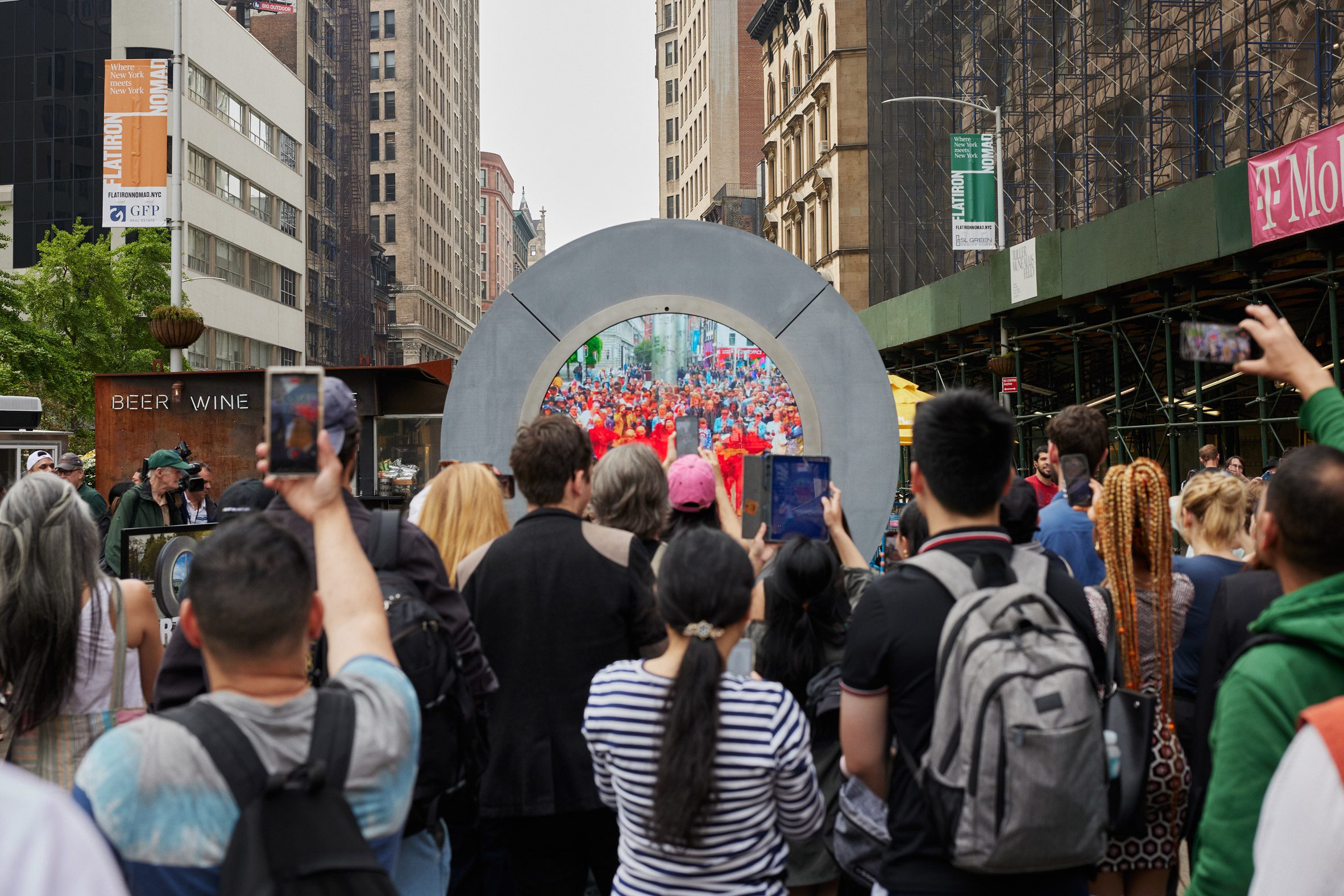
Smart Dublin
The joint smart-city programme of the four Dublin councils.
Read more →Smart Docklands, run by the council with CONNECT, Trinity College’s research centre for future networks, tests ideas in the old port district. Its 2025–26 call drew 53 applications and funded four pilots at €12,500 each, which have not yet reported. Smart D8, a health and wellbeing district around St James’s Hospital, has supported 19 pilots since 2020; no health outcome has been published for any of them. The council’s Generative AI Lab, set up in February 2025 with ADAPT, a Trinity-led research centre for AI, and Trinity Business School, surveyed 567 staff. Over 90% said they were interested in training in AI.
Research money is national. Research Ireland, the state funder formed from Science Foundation Ireland and the Irish Research Council in August 2024, committed €460m over eight years to seven new research centres in June 2026. Through Smart Docklands, IrelandQCI, a €10m EU and national project led by South East Technological University’s Walton Institute for CONNECT, ran its first government use case. It linked two council buildings by quantum key distribution, a way to share encryption keys, over the council’s own fibre. Codema, founded in 1997, plans the region’s energy and its public charging.
Water, rail, buses and the grid are run by national bodies. Uisce Éireann supplies the water. Transport Infrastructure Ireland owns the Luas trams, which KeolisAmey, a joint venture of Keolis and Amey, has run since 1 September 2026 under a contract worth about €1.3bn. The National Transport Authority (NTA) plans and pays for the buses, and in December 2025 it awarded the BusConnects corridor from Ballymun and Finglas to the centre at up to €366m. The Commission for Regulation of Utilities (CRU), the energy regulator, sets the terms on which data centres may connect. Since December 2025 new ones must bring their own generation or storage.
Dogpatch Labs, a start-up hub in the CHQ building on the quays, has run NDRC, the state-backed start-up accelerator, since 2021. Enterprise Ireland, the state agency for exporting firms, put €32.9m into 198 Irish start-ups in 2025; it publishes no Dublin share. Civil society works through complaints and campaigns. The data-protection inquiry into the Public Services Card arose from concerns raised by Digital Rights Ireland, a privacy group, and Dublin 15 residents organised as Drone Action D15 against delivery drones. The clusters face different obstacles. Pilots are cheap and plentiful but rarely publish results, while the large projects wait on grid, water and rail that the city does not control.
Who holds the levers, and who pays
The council’s 63 members were elected in June 2024. Fine Gael (centre-right) won 11 seats, the Social Democrats (centre-left) 10 and Sinn Féin (left-wing republican) 9. Fianna Fáil (centrist), the Greens and independents won 8 each. Daryl Barron of Fianna Fáil became Lord Mayor in June 2026, by 31 votes to 21. The office is largely ceremonial. Executive power lies with the Chief Executive, Richard Shakespeare, appointed in December 2023. Nationally, Fianna Fáil and Fine Gael have governed with independents since January 2025, under Micheál Martin as Taoiseach (prime minister).
Climate Neutral Dublin 2030, the council’s climate plan for 2024–2029, lists 121 actions. Its tables have a budget column, but fewer than half of the actions carry a euro figure, and the plan states no overall total. Its Digital Transformation Strategy 2025–2030 aims to make Dublin “a truly digital city by 2030”. It names indicators such as the share of services online, but sets no numeric targets and no budget. The national Digital Ireland strategy of February 2026 is firmer: 100% of key public services digitalised by 2030 and 90% used online.
Under the 2021 climate law each council chose one or two neighbourhoods, decarbonising zones, to trial projects that cut emissions faster. Dublin City chose Ballymun and Ringsend–Poolbeg. Codema’s plans for them were dated February 2024 but reached councillors only in January 2026. Their priority projects are costed at about €439m. The Department of Climate allocated €70,500. “It’s not a lot of money,” a council engineer, Darby Mullen, told the Dublin Inquirer, a local news site.
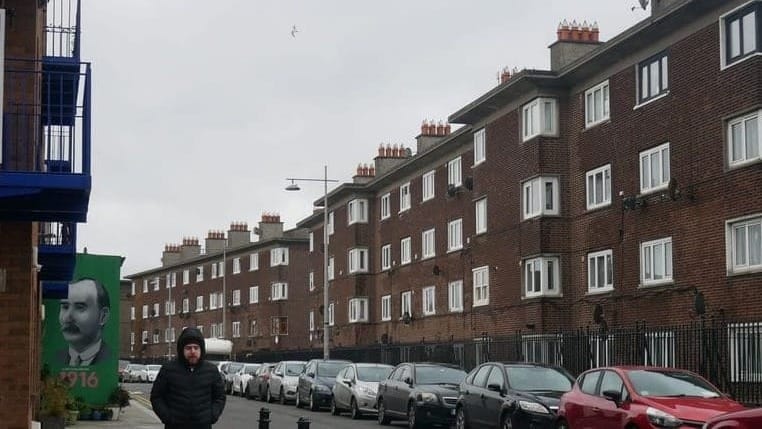
I do think we are losing support from the community, because it’s been such a drawn-out, protracted process.The rules on data are set nationally, and the argument is about policing and public services. In July 2026 a law was enacted that lets the Garda Síochána, Ireland’s police, analyse images it already holds with biometric tools, under codes of practice. Olga Cronin of the Irish Council for Civil Liberties (ICCL) and Róisín Á Costello, a Trinity law lecturer, warned that existing powers already give gardaí powerful tools for surveilling the public. In June 2025 the Data Protection Commission, Ireland’s data-protection watchdog, fined the Department of Social Protection €550,000. It found no lawful basis for the biometric processing behind the Public Services Card, the state’s identity card for welfare services. Dubliners seem less worried: 72.8% told IMD they were comfortable with face recognition to lower crime.
Inside the council the debate is about AI. In November 2025 it opened a preliminary market consultation, a request for information before any tender, on AI tools to raise staff productivity, including for its customer-services centre. Over 300 staff had taken an awareness module, and about 3,000 are to be trained in 2026. Rory Hogan, a Fianna Fáil councillor, said AI “would be incredibly useful”, but that it “must not replace current customer services absolutely”. Jamie Cudden, who led the council’s smart-city programme for over a decade, names the obstacle to scaling.
It can be incredibly difficult to take good projects and good ideas to scale if you don’t have the right architecture or structures within your organisation.- 1975[source]
First metro study
A rail rapid-transit study for Dublin first proposes a metro.
- Apr 2022[source]
EU Mission city
Dublin and Cork are selected for the EU mission for climate-neutral and smart cities.
- Mar 2024[source]
Climate Neutral Dublin 2030
The council adopts its climate action plan for 2024–2029.
- Jun 2024[source]
Local elections
Voters return a council in which no party holds a majority.
- Oct 2025[source]
MetroLink approved
The planning authority grants the railway order for the metro.
- Jul 2026[source]
Garda biometrics law
The Garda Síochána (Recording Devices) (Amendment) Act 2026 is enacted.
- Sept 2026[source]
MetroLink to tender
The government clears the metro for tender at a revised cost of €14.4–17.5bn.
- Sept 2027[source]
Dublinbikes contract ends
JCDecaux’s agreement with the council expires.
- 2030[source]
Climate targets
A 51% cut from 2018 under national law; 80% under the Climate City Contract.
- 2031[source]
New drainage scheme
Greater Dublin Drainage is expected to be commissioned.
- Mid-2030s[source]
Metro opens at the earliest
MetroLink is not expected to run before then.
- 2050[source]
Climate neutrality
The national goal; the council’s plan says it is striving for neutrality before 2050.
From the first metro study to the climate targets the city and the state have set.
Faster on the street than under it
BusConnects, the NTA’s redesign of Dublin’s bus network, publishes before-and-after results. As of November 2025, seven of its 11 phases were running. Comparing the third quarter of 2019 with 2025, boardings on the redesigned routes rose 30%, against 6% on the others, and punctuality improved 12%. The new ticketing system is still only moving into the build stage.
The City Centre Transport Plan is the council’s own. Its first measure, bus gates that close stretches of the quays to cars from 7am to 7pm, began in late August 2024 with signs and road markings. A month later the NTA and Dublin Bus reported public-transport use up 11%, while retailers reported mixed results. Six months on, a council report found a substantial and sustained fall in traffic on the quays. The next step, a plaza at College Green with a preliminary cost of €80m, drew over 1,800 submissions at its pre-planning stage, with 81.2% of respondents in support.
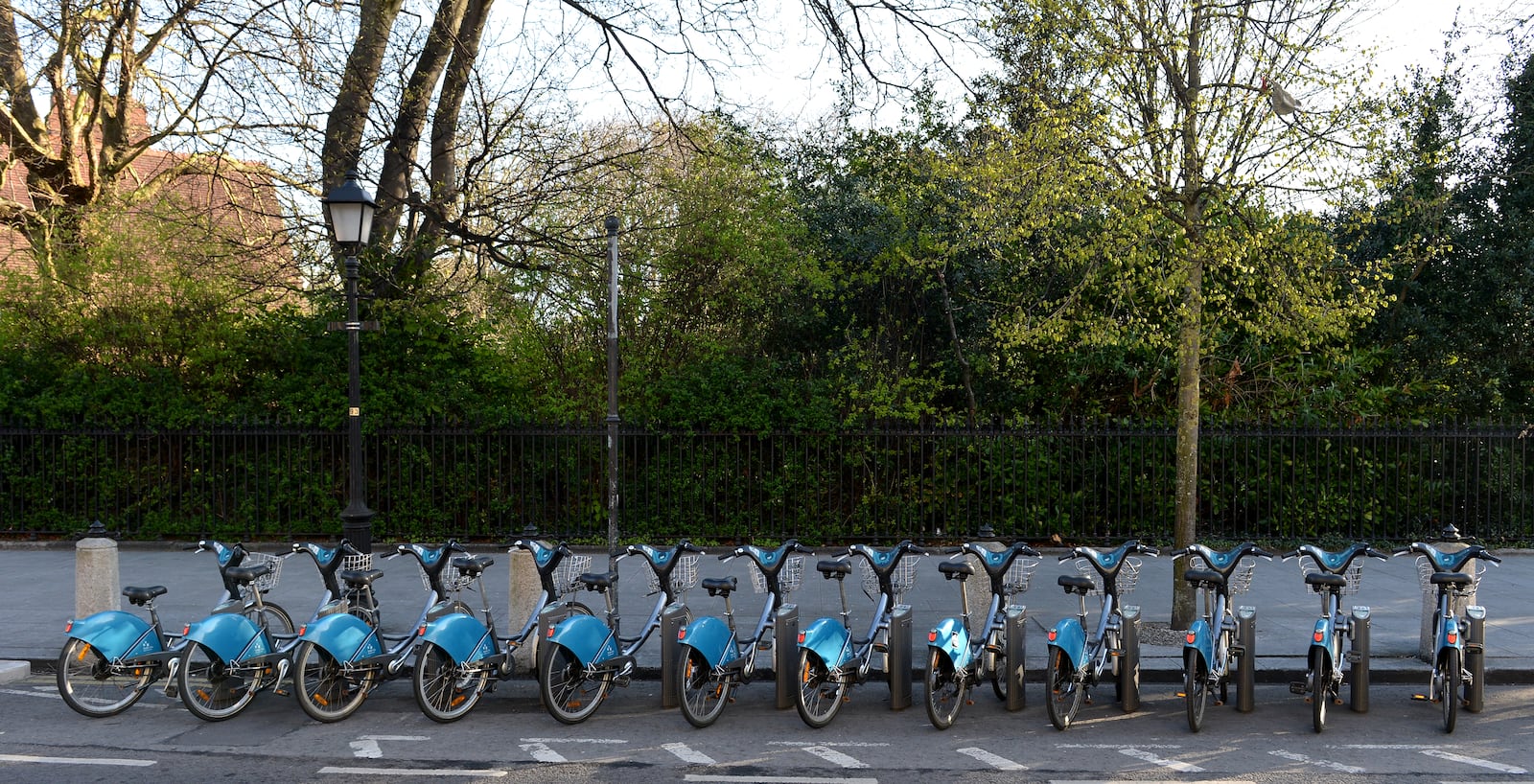
Dublinbikes, launched in 2009 with bikes and docks owned by the advertising company JCDecaux, has lost money since its first day and was hit hard by the pandemic. Trips fell from 3,816,652 in 2019 to 2,001,810 in 2022, when use was only beginning to recover, and the network has not grown in eight years. The council will end it when the contract expires. It plans a system it owns, with about 4,000 bikes, some of them electric.
The Dublin District Heating Project would pipe heat from the Poolbeg waste-to-energy plant, running since 2017, to about 50,000 homes and buildings in the Docklands. A pipe under the Liffey has been in place since 2010, and the scheme was meant to begin about a decade ago. Planning notice was given in September 2026, and the council hopes to connect properties by 2028. In neighbouring South Dublin, the county council’s company HeatWorks already heats a TU Dublin campus, its County Hall and 133 cost-rental flats, let at rents set by cost, in Tallaght. The heat comes from an Amazon Web Services data centre and heat pumps.
Smart Docklands is where the council tests sensors and networks. The council is a partner in Twin for Resilience, a project of the EU’s Interreg cross-border programme on digital twins, virtual models of a place. Its use cases are planning in the Docklands and walking and cycling across the city, and no results have been published. One earlier idea travelled. Sensors on ring buoys, the lifebuoys on the quays, began with a workshop there in 2018. About 15 buoys went missing every week from the council alone, and over 600 sensors were announced for eight councils in 2022. Whether thefts fell has not been reported.
Manna, an Irish drone-delivery firm, flew from bases in Dublin 15, in Fingal. It made nearly 90,000 deliveries from Blanchardstown. Fingal County Council refused to let it keep a hub at River Road in October 2025. In May 2026 it refused the Coolmine hub, finding that it caused serious noise pollution. In June Manna paused its Irish operations, blaming the lack of a clear national framework for drone delivery, and called the pause temporary.
Codema’s public charging programme for the four councils plans up to 200 charge points at 50 sites. Capital funding was secured in early 2026, and all sites are due by the third quarter of 2027. In October 2024 the first chargers had been expected in early 2025.
On its own, the council can change a street within weeks, and the quays show it. It can open its data and run pilots, though few of them have published results. The rest takes longer. MetroLink has only now gone to tender, with trains not before the mid-2030s. Heat from Poolbeg is at the planning stage, about a decade after it was meant to begin. The Shannon pipeline that would add water waits on a planning decision due by July 2027. The bus network, redesigned by a national authority on the council’s roads, already shows measured results.

References
Statistics1Click on any number to see the source
Population & migration
From our libraries15
- Data Centres Metered Electricity Consumption 2025 — Key Findings (CSO, 7 Jul 2026) — Knowledge
- Dublin Region Energy Master Plan (brochure), Codema — Knowledge
- Smart Dublin — Project
- Dublin City Council — Smart City Unit — Organisation
- Smart Docklands Testbed — Organisation
- CONNECT — SFI Research Centre for Future Networks — Organisation
- Smart D8 Health and Wellbeing District — Organisation
- Dogpatch Labs Dublin — Organisation
- In need of €439 million to reduce carbon emissions, the council got €70,500 (Dublin Inquirer, 31 Jul 2026) — Knowledge
- BusConnects Programme Progress Report, December 2025 (National Transport Authority) — Knowledge
- DublinBikes scheme to be discontinued after 18 years with plans for new service (Irish Times, 22 May 2026) — Knowledge
- Heat from Poolbeg incinerator to be piped under Dodder to homes in Dublin's Docklands (Irish Times, 11 Sep 2026) — Knowledge
- Twin for Resilience (T4R) Digital Twin Project — Project
- Fingal refuses Manna permission to continue flying drones from base in Coolmine (Dublin Inquirer, 21 May 2026) — Knowledge
- Timeline: The long journey to Dublin's MetroLink (RTÉ, 16 Sep 2026) — Knowledge
Further sources25
- Census 2022 SAPS: means of travel to work, school, college or childcare — Central Statistics Office · 2023
- Percentage of people in Dublin using sustainable transport modes hits a new high — National Transport Authority · 26 May 2025
- Dublin water use reached a record high — The Irish Times · 29 May 2026
- Climate City Contract Action Plan — Dublin City (revision) — Dublin City Council · 29 Nov 2024
- Climate Neutral Dublin 2030 — Climate Action Plan 2024–2029 — Dublin City Council · Mar 2024
- Climate Action Plan Annual Report 2025 — Dublin City Council · June 2026
- Ireland’s greenhouse gas emissions in 2025 (provisional) — Environmental Protection Agency · 7 July 2026
- Ireland gigabit statistics by local electoral area, Q2 2026 — ComReg · Sept 2026
- Annual Report 2025 — Office of the Ombudsman · 2026
- Smart City Index 2026 — Dublin — IMD World Competitiveness Center · 2026
- Smart Docklands announces €50,000 investment across four community-led innovation pilots — Smart Dublin · 2026
- Smart D8 launches sixth annual open call — Smart Dublin · Mar 2026
- Next-generation Luas O&M contract awarded — Transport Infrastructure Ireland · 12 Mar 2026
- CRU publishes long-awaited final policy on data centre connections — William Fry · 15 Dec 2025
- Digital Transformation Strategy 2025–2030 — Dublin City Council · Jan 2025
- Councillors finally get sight of plans to squash carbon emissions in Ballymun and Ringsend — Dublin Inquirer · 30 Jan 2026
- Garda Síochána (Recording Devices) (Amendment) Bill 2025 — Houses of the Oireachtas · 2026
- Garda AI Bill: ICCL and Trinity — Irish Council for Civil Liberties · 23 June 2026
- Dublin City Council moves towards deploying AI tools — Dublin Inquirer · 19 Nov 2025
- BusConnects Programme Progress Report — National Transport Authority · Dec 2025
- Agreed statement of the Lord Mayor’s working group on the City Centre Transport Plan — Dublin City Council · Sept 2024
- Heat from Poolbeg incinerator to be piped under Dodder — The Irish Times · 11 Sept 2026
- Manna pauses drone delivery in Ireland — Silicon Republic · 19 June 2026
- MetroLink: market bids can begin for construction — The Irish Times · 16 Sept 2026
- EV charging strategy and roll-out — Codema · 2026