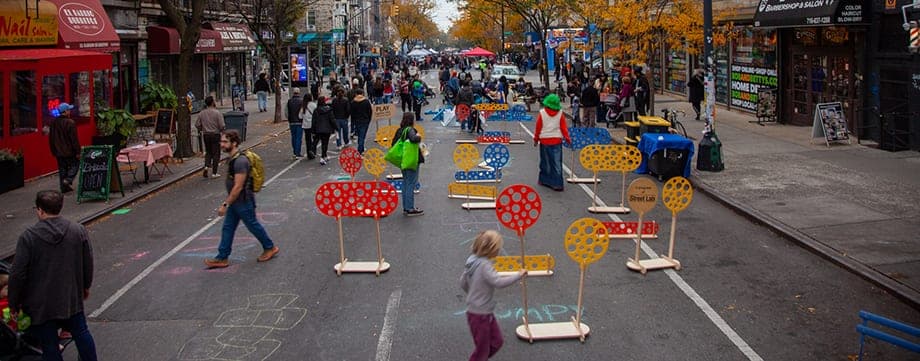
NYC DOT Open Streets is New York City’s program for temporarily turning selected streets into public space for walking, cycling, learning, and local activity. Run by the New York City Department of Transportation, the initiative is based in New York City, United States, and works citywide with community groups, schools, business associations, civic organizations, and houses of worship.
The program’s stated aim is practical rather than symbolic: to give neighborhoods more usable public space and to support everyday city functions at street level. According to NYC DOT, Open Streets can help with economic development, school activities, pedestrian and bike mobility, and cultural programming. The department also links the program to broader public-realm efforts, including the Public Realm Programming initiative and the Public Space Equity Program, which supports under-resourced neighborhoods where local partners need help maintaining public space.
Methodologically, the program is organized through formal applications and operating rules. NYC DOT adopted rules in 2024 to codify the application process, partner eligibility, and operational requirements. The system distinguishes three types of Open Streets: Limited Local Access, Full Closure, and Full Closure: Schools. Applications are accepted on a rolling basis, with a minimum 90-day review period. School-based applications have a specific deadline to secure decisions before the academic year. NYC DOT also provides guidelines and offers meetings with applicants, including language assistance.
The city’s current Open Streets network includes corridors across the five boroughs, with routes managed by different local partners. The program has moved from pilot-style street closures toward a more formal framework, and its continuation in 2026 suggests it has become a stable part of the city’s street-management toolkit.