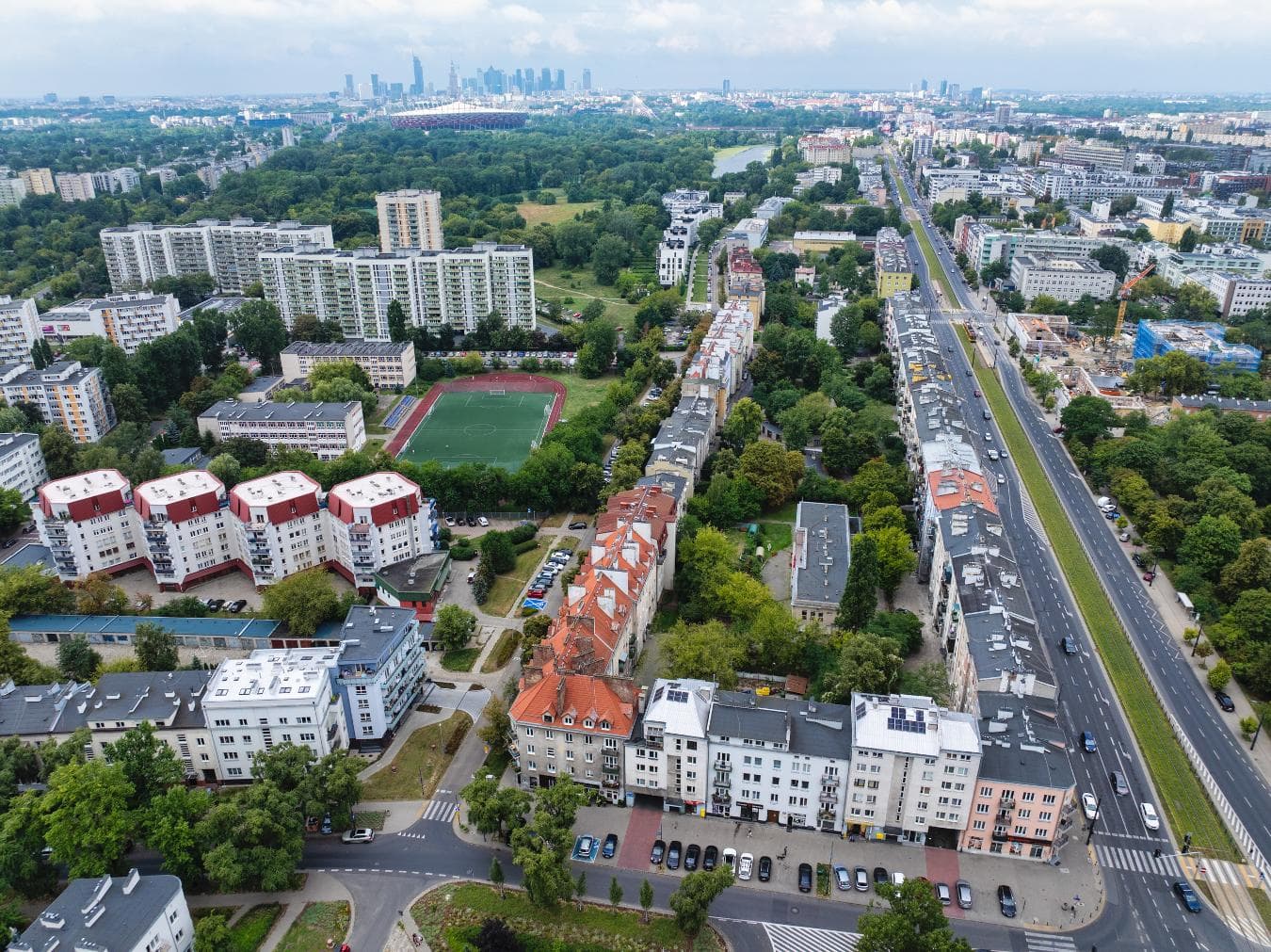
NEEST—NetZero Emission and Environmentally Sustainable Territories—is a pilot project bringing together five Polish cities to develop practical approaches to reducing emissions from buildings and improving the areas around them. It is part of the European Commission’s Mission for 100 climate-neutral and smart cities by 2030. Kraków leads the consortium, with Łódź, Rzeszów, Warsaw and Wrocław as city partners, and Poland’s National Centre for Research and Development (NCBR) as a substantive and technological partner.43
The project examines representative urban areas in each city, including apartment buildings, schools and public buildings. In Warsaw, the study area is in Praga-Południe, between Grochowska and Zbaraska streets and Stanisława Augusta and Międzyborska streets. Researchers used laser scanners to survey buildings and create digital models for further analysis.49
NEEST’s work is intended to produce replicable technical and organisational approaches to building modernisation and the renewal of surrounding spaces, alongside financing models and guidance for cities. Warsaw’s responsibilities include developing financing models and methods for cities to share knowledge; partners are also working on monitoring and evaluation.6 The project’s planned outputs include a guidebook presenting modernisation pathways and examples of solutions that cities can apply.4
In a 2025 update, NCBR reported that the project had developed technology packages tailored to five building types and two urban forms, as well as a toolkit prepared with Danish practice Juul Frost Architects.3 In Warsaw, the work also used a school modernisation concept that would make some sports facilities available to local residents outside school hours.3