More cars from the ring; trains and buses carry the centre
Warsaw had 1.87 million registered residents at the end of 2025, barely more than two years earlier; the city’s travel survey finds growth stronger in the towns around it. That shows on the roads. Cars entering the city rose from 0.96 million in 2015 to 1.7 million in 2024–25, and ride-hailing licences from about 11,000 in 2018 to about 75,000.

Inside the clean-transport zone, public transport carries 40.6% of the trips that end there and cars 23.6%; outside it, cars carry 35.5% and public transport 23.6%. The last published city-wide split, from the 2015 survey, found 67.8% of residents’ weekday trips made on foot, by bike or by public transport; the city’s newer survey says car use has grown since, so today’s share is probably lower. And 23% of working residents now work at home some or all of the time.
Share of trips by main mode, for trips ending inside Warsaw’s clean-transport zone and for those ending outside it, from the city’s 2024–25 travel survey. The survey has not been published as one city-wide split; the last, in 2015, put walking, cycling and public transport at 67.8% of residents’ trips on a working day. Source: City of Warsaw, Warszawskie Badanie Ruchu 2024–2025
The council’s Green Vision of April 2023, drafted with the EBRD, the European development bank, commits Warsaw to climate neutrality by 2050 and a 40% cut by 2030. The city’s climate contract with the EU adds an 80% cut by 2030 in two pilot districts, Praga-Południe and Ursynów. We could not find a published count of the city’s emissions measured against its baseline, so how far it has come is not on record here.
Heat is a lever Warsaw does not hold directly: Veolia runs a network it describes as the EU’s largest, about 1,700 km serving 19,000 buildings and four-fifths of the city’s heat demand, by its 2015 figures. The city watches the air instead: since 2022 more than 160 low-cost sensors, 108 of them in Warsaw and the rest in 17 neighbouring gminas (municipalities), feed a public air index, mostly paid for with EU money.
The connection is there: at mid-2026, 97.2% of Warsaw’s address points were in range of fixed broadband. The front door is Warszawa 19115, the city’s contact centre by phone, app and web. By the city’s own notice, phone waits have lengthened as calls rose, and it steers residents to the app.
Foreign residents meet a door the city does not control. The voivode, the central government’s representative in the region, handles residence permits with 270 posts in an office the interior ministry calls the most heavily loaded in the country. By July 2026 it had decided 11,070 cases that had run for over a year, 738 of them for over two.

An IT office, a contact centre and a fibre ring of its own
The city’s digital work sits in its IT office, the Biuro Informatyki. Its director, Joanna Szafarczyk-Kurek, is the city’s chief IT systems architect, and the office runs a smart-city projects unit as well as the city’s data, internet-of-things platform, fibre network and data centres. A separate digitalisation office, created in 2017, no longer appears among the city’s offices.
Much of what residents touch is contracted or arm’s length. Veolia runs the heat, Nextbike operates the Veturilo bikes, and the city’s own companies run the trams, metro and most buses. The 486 city CCTV cameras across 18 districts are watched in police centres and keep footage for 30 days. Open data is moving to a new city portal, while the national portal lists only 22 datasets from the city office.
- Research: the Warsaw University of Technology works on smart-city research, and Warsaw Medical University experts have spoken for the clean-transport zone’s health case.
- Civic groups: Miasto Jest Nasze, an urban movement with councillors in the districts and, with the Left, a club on the city council, is a persistent critic of the civic budget. Polski Alarm Smogowy and Clean Cities Polska press for camera enforcement of the zone.
- Digital inclusion: Fundacja DigitalPoland, whose managing director sits on the city’s dialogue committee on digitalisation, is running the city’s free digital courses for over-60s in seven districts, which opened for sign-up in October 2026.
- Districts: Warsaw’s 18 dzielnice, the city districts, each have an elected council and an office that runs local services; it was a district, Ursynów, whose chargers stood unconnected for a year.
The contact centre is the machine the rest depends on. It takes reports by phone, app, web and e-mail and passes them to the district or company responsible; in its first years it logged about 2.5 million reports, by the account of the official who ran the city’s digitalisation office. The city’s internet-of-things platform carries the air sensors’ readings and opens them to residents and developers.
A digital-transformation policy, announced in draft by the then head of the digitalisation office, promised an open city platform, an internet-of-things platform, a city e-services portal, a loyalty programme and digital parking. The portal and the platform exist; we found no sign of the rest, or that the policy was adopted.
A mayor back at City Hall, and rules with soft edges
Rafał Trzaskowski of the Civic Coalition (KO), Donald Tusk’s party, has been mayor since 2018 and was re-elected in April 2024, when his party won 37 of the council’s 60 seats and can govern alone. In June 2025 he lost the presidential run-off with 49.11% of the vote to Karol Nawrocki, backed by the Law and Justice party and now president, and said he was concentrating on being mayor. The city is drafting a strategy to 2040 to follow #Warszawa2030.
The climate plan comes with an estimate and a label. Arup, which drafted the Green Vision, puts its potential savings at up to PLN 608m a year. In May 2025 the European Commission gave Warsaw, with Kraków, Łódź, Rzeszów and Wrocław, the mission label for climate-neutral and smart cities.
The region and the State set many of the terms. Mazowieckie’s air programme of 2020 obliged Warsaw to renew its fleet, build tramways and prepare low-emission zones under the 2018 electromobility act. The Supreme Audit Office, NIK, found in 2023 that the city had met the national quota for zero-emission buses, a 9% share in 2021–22, but had not updated its transport plan on time. The government-appointed voivode reviews every council resolution.
The State’s delays land in the city too. In June 2026 an MP, Wioletta Kulpa, asked the interior ministry about residence-permit cases at the voivode’s office that ran for almost two years, writing that such delays for a lawfully employed taxpayer “cannot build citizens’ trust in the State”. The ministry replied that online filing had begun only in April 2026.
The zone is lenient by design. Warsaw taxpayers and over-70s are exempt until the end of 2027 for cars registered before 2024, any car may enter on four days a year, and the municipal police check with four mobile cameras. Of 222,000 vehicles checked in 2025 to August, 0.59% did not meet the zone’s standard, most of them within their four free entries, and none was fined. By the end of June 2026 the guards’ system had read the plates of 635,000 vehicles, and 50 drivers had been fined; the first fine came only at the end of 2025. The city says it has no legal basis to fine automatically from its own CCTV.

Put diplomatically: after more than a year, Warsaw’s clean-transport zone is above all an educational tool. Put more simply: the rule is practically dead.Participation is the other worry. The civic budget, a legal duty since 2018, grew from over PLN 120m for 2026 to PLN 137.9m for 2027, but only 55,366 people voted in June 2026, about 3% of residents and 17,000 fewer than a year earlier, against more than 25% in Białystok and Rzeszów. The city puts it down to a format worn out after more than a decade. Miasto Jest Nasze says the vote filled with projects that belong in the city’s ordinary budget once the district teams that screened them were abolished, and that some winners, such as a Białołęka cycle path, have waited a decade to be built.
From the very start until they were abolished I sat on the district budget team. We firmly rejected such projects. […] Then, when the teams were abolished, it became a free-for-all.Residents who voted in the city’s participatory budget: the record, in its second edition, and the two latest votes, held in June 2025 (more than 73,000) and June 2026. The pot rose from over PLN 120m for 2026 to PLN 137.9m for 2027. Source: Super Express, 22 July 2026; City of Warsaw (warszawa19115.pl)
- Dec 2015[source]
A smarter heat network
Veolia begins a PLN 52m project to control the network remotely.
- Sep 2020[source]
The region sets a duty
Mazowieckie’s air programme tells Warsaw to prepare low-emission zones.
- 2020[source]
Climate panel
Ninety residents drawn by lot make recommendations.
- Apr 2023[source]
Green Vision
The council adopts neutrality by 2050.
- Jul 2024[source]
The zone opens
37 km² of the centre, the first of five stages.
- May 2025[source]
Mission label
The EU recognises Warsaw’s climate city contract.
- Jul 2025[source]
Green building rules
The standard binds every new city-owned building.
- Jan 2026[source]
Stage two
Older petrol cars and diesels are barred; fines remain rare.
- Jan 2028[source]
Exemptions end
Older cars of Warsaw taxpayers lose their exemption.
- 2030[source]
Climate targets
A 40% cut city-wide, 80% in two pilot districts.
- 2032[source]
Final zone stage
The last of the zone’s five stages.
- 2050[source]
Climate neutrality
The Green Vision’s goal.
From the heat network to the climate goal.
A standard for every new building, a zone on four cameras
The clean-transport zone opened on 1 July 2024 over 37 km², about 7% of the city and all of the centre, with five stages planned to 2032. Average nitrogen dioxide at stations inside it fell 18% between 2023 and 2025, against about 5% outside, by the city air office’s figures; Clean Cities Polska calls that “a promising signal, not final proof” of the zone’s effect. Kraków, Szczecin and Katowice have opened zones since; Kraków’s and Katowice’s were compulsory under the 2024 amendment to the electromobility act, where the air breached the nitrogen dioxide limit.

The Warsaw Climate Panel of 2020 drew 90 residents by lot; 49 of their 93 recommendations were adopted, among them a call for a green building standard. By July 2025 about 55% of the panel’s recommendations had been delivered, according to the official in charge of them, who aimed for about 63% by the end of that year. OKO.press’s headline asked why nobody knows.
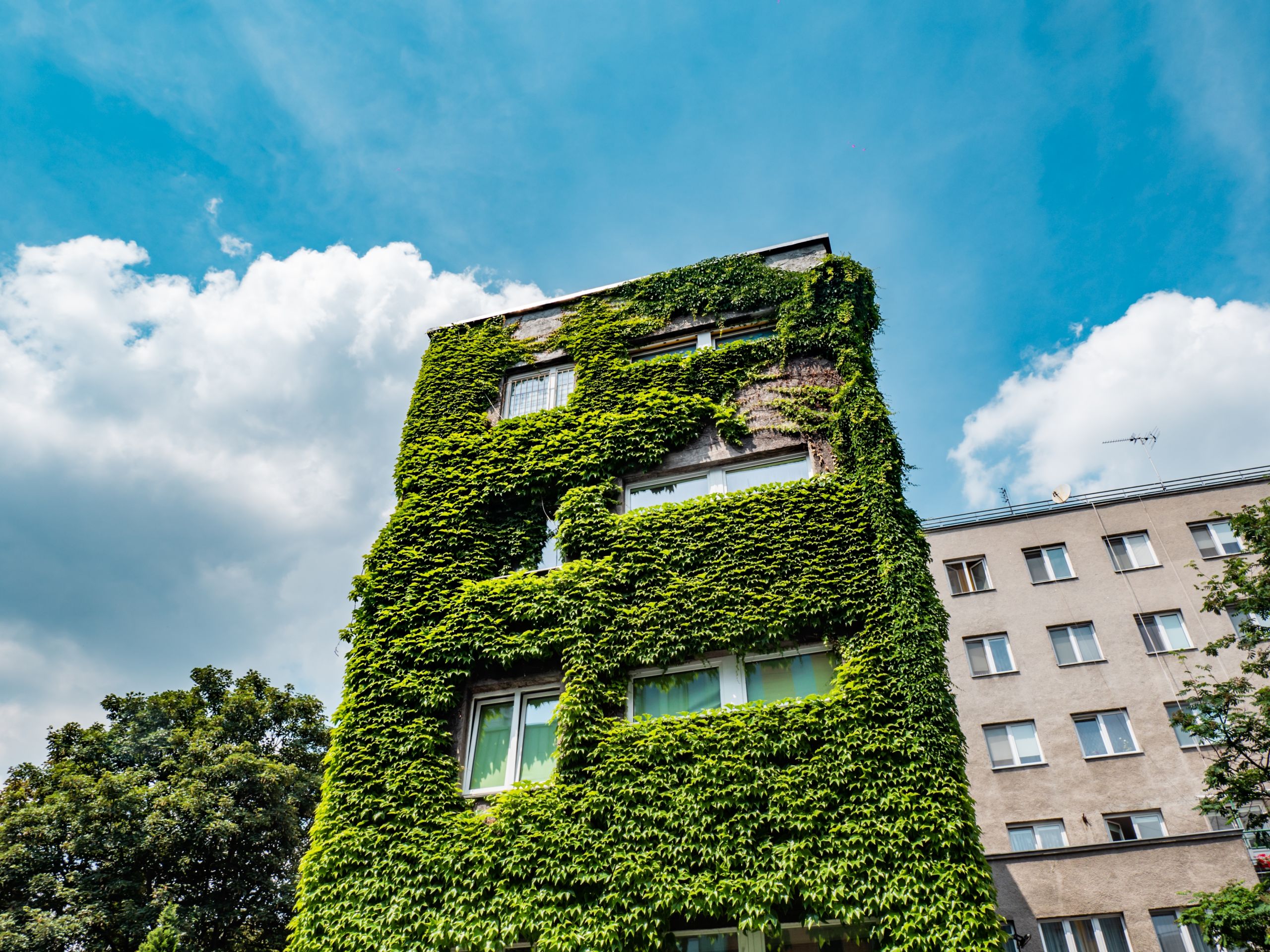
That recommendation became the Warsaw Green Building Standard, binding on every new city-owned building since July 2025 after a ten-month grace period. It covers greenery, water, energy, mobility, materials and health, and requires every new building to keep its rainwater on site. A district building in Białołęka was the first certified, five city projects were certified voluntarily before it became binding, and the Warsaw School of Economics was the first outside the city’s own estate. Retrofits of existing buildings are the next step. By its team’s account, Wrocław, Katowice, Bratislava and Poznań are exploring standards of their own, drawing on Warsaw’s.
We cannot have strategies on paper and business as usual in practice. The Green Building Standard ensures that every new brick we lay brings us closer to climate neutrality.The air-sensor network reaches beyond the city line: its more than 160 sensors measure fine dust and nitrogen dioxide in Warsaw and 17 surrounding gminas, and their readings feed the Warsaw Air Index on the city’s website and in its contact-centre app. Veolia’s smart heat network, a PLN 52m project begun in 2015, was to put 2,500 substations under remote control and save up to 14,000 tonnes of CO₂ a year; we found no published account of what it achieved.
Veturilo, the public bike system, opened its fifteenth season in 2026 with 3,460 bikes at 344 stations in every district, and recorded over 4.6 million rentals in 2025. The bikes work with four suburban systems.
Public charging grew to about 900 points by mid-2025, the most of any Polish city, mostly built by private operators. Clean Cities counted 924 in July 2026, about 0.5 per 1,000 residents against 5.3 in Paris. The city’s own attempt stalled: chargers built by the Ursynów district in 2023 stood unconnected for a year awaiting technical approval, and the city is now piloting, in Ursynów, leases of land to private operators, who have up to three years to build.
The M2 metro extension to Bemowo was promised for 2025. Its cost rose by about PLN 300m, its contract deadline moved to November 2026, and its depot is due in 2027. In October 2026 trains were running tests on the new section. From 17 to 25 October the two stations at its end, Bemowo and Ulrychów, were closed while it was joined to the line. The city’s transport authority was consulting residents until 25 October on bus routes to its three new stations.
Warsaw ranks 31st of 148 in the IMD Smart City Index 2026, down from 28th of 146 a year earlier, on residents’ answers to a survey. Among 27 European and American cities we compared, its residents rate online ID processing, online reporting of street problems and the city’s ideas platform the highest, and its medical services the lowest. Housing is the weakest score: 25.5 out of 100 on finding a home at no more than 30% of a salary.
The rules Warsaw writes for itself are the ones it can show: the green standard binds every new city building, and the official in charge put the climate panel’s recommendations at more than half delivered in mid-2025. The rules that reach drivers are lenient by design: in the zone’s first year almost every car checked already complied, residents’ older cars are exempt until 2028, and the city has no legal power to fine from its own cameras. Whether the zone bites will be known in January 2028, when those exemptions end.
References
Statistics1Click on any number to see the source
Population & migration
From our libraries8
- Warszawskie Badanie Ruchu (WBR 2024–2025 results summary) — Knowledge
- Odpowiedź na interpelację nr 18089 w sprawie przewlekłości postępowań prowadzonych przez Mazowiecki Urząd Wojewódzki (MSWiA, 27 Jul 2026) — Knowledge
- Wystąpienie pokontrolne NIK P/23/064: Działania na rzecz ograniczenia zanieczyszczeń komunikacyjnych w miastach (Urząd m.st. Warszawy) — Knowledge
- Gonienie króliczka, czyli warszawska SCT — Knowledge
- Social aspects of low emission zones: Warsaw case study (IEEP policy brief, July 2024) — Knowledge
- Dwa lata SCT w Warszawie i wyraźny spadek emisji NO₂. Średnio o 18 procent! — Knowledge
- Warszawa. Jak się wdraża zmiany wymyślane przez mieszkańców. I dlaczego nikt o tym nie wie — Knowledge
- Building for the Future: How Warsaw's Green Building Standard is changing the city — Knowledge
Further sources11
- Warszawskie Badanie Ruchu 2024–2025 — City of Warsaw · 2026
- Zielona Wizja Warszawy — City of Warsaw · 2023
- Warszawski Indeks Powietrza — City of Warsaw
- City monitoring system — City of Warsaw
- Crisis in Warsaw’s civic budget — Super Express · 22 Jul 2026
- Clean-transport zone: drivers to be counted, fines issued — TVN24 Warszawa · Feb 2026
- Trzaskowski after the run-off — TVN24 · 4 Jun 2025
- Building for the Future: Warsaw’s Green Building Standard — NetZeroCities · 16 Sep 2025
- Delays on metro line 2 — KB.pl
- Clean-transport zone fines: the official tally — Otomoto News · 27 Jul 2026
- Smart City Index 2026 — IMD World Competitiveness Center · 2026