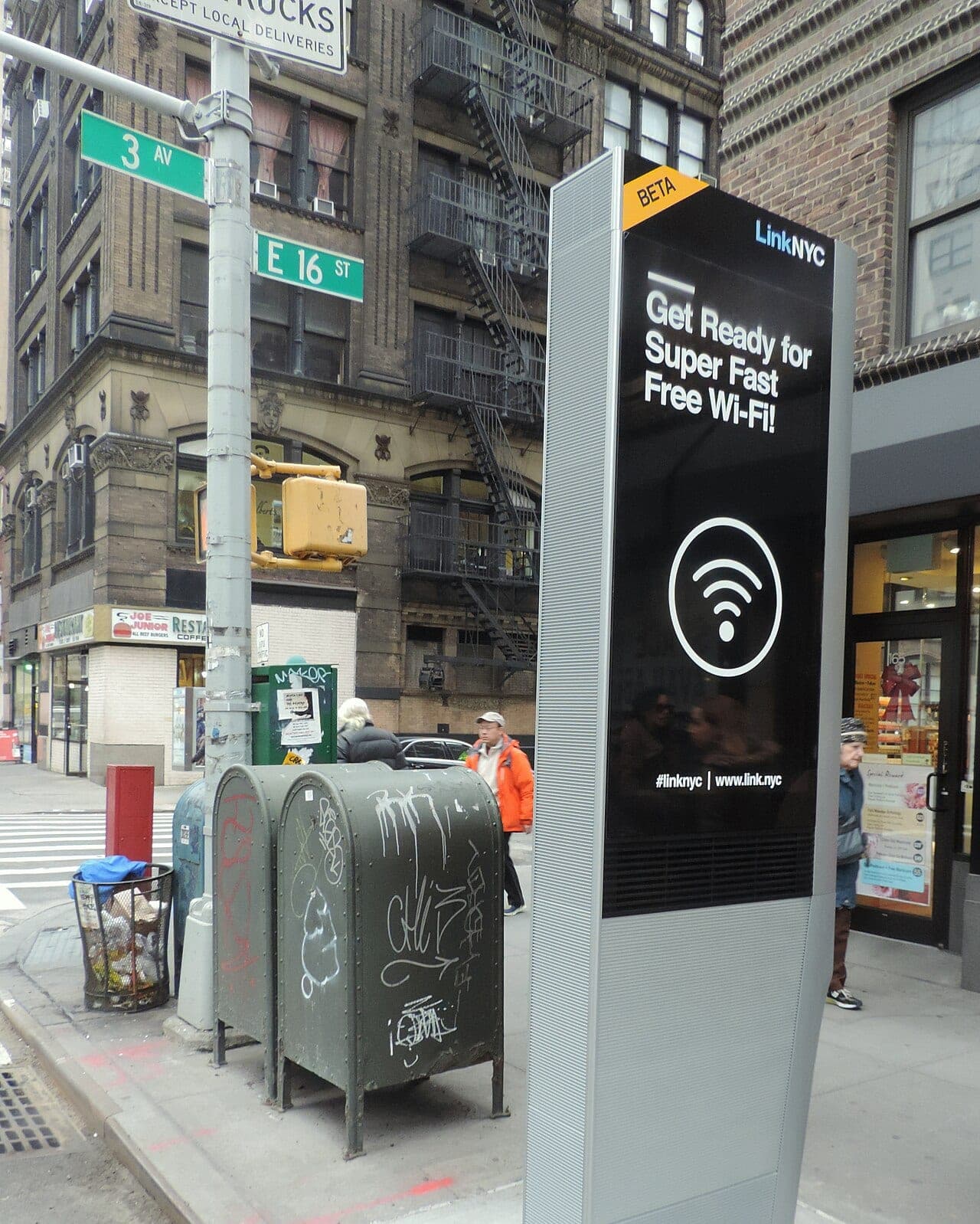
LinkNYC began as New York City’s effort to replace its ageing payphone network with public communications kiosks. The city announced the plan in November 2014, after a competitive process, and awarded a 12-year franchise to CityBridge, the consortium selected to build and operate the system.14 CityBridge brought together Qualcomm, Titan and Control Group—later combined as Intersection—and Comark; other accounts also identify CIVIQ Smartscapes as a partner.156
The kiosks, called Links, were designed to provide free public Wi-Fi alongside phone calls, device charging and access to city information. Their tablets offer maps, directions and city services, while the kiosks also provide access to 911 and 311.26 The model combines public connectivity with advertising displays, which help fund the infrastructure.12 Building the network required new fibre: CityBridge says it invested more than $200 million in fibre-optic cable to connect Links across the five boroughs.4
Installation began in December 2015, with the first kiosks placed on Third Avenue in Manhattan.110 The original plan called for at least 7,500 kiosks, but rollout fell behind schedule: by July 2019, 1,816 of the 2,353 kiosks then due were installed, according to city figures reported by THE CITY.11 CityBridge reported more than 18 million Wi-Fi users and 3.5 billion sessions by February 2025, as well as more than 30 million free phone calls; it also said 30% of users during the COVID-19 pandemic reported having no other broadband access.2 The programme expanded to include Link5G, launched in 2022.2
The project’s public-service aims have been accompanied by concerns about privacy and uneven deployment. Reporting in 2022 described roughly 1,900 kiosks, concentrated largely in Manhattan, and raised questions about whether the rollout was reaching the communities it was intended to serve.7