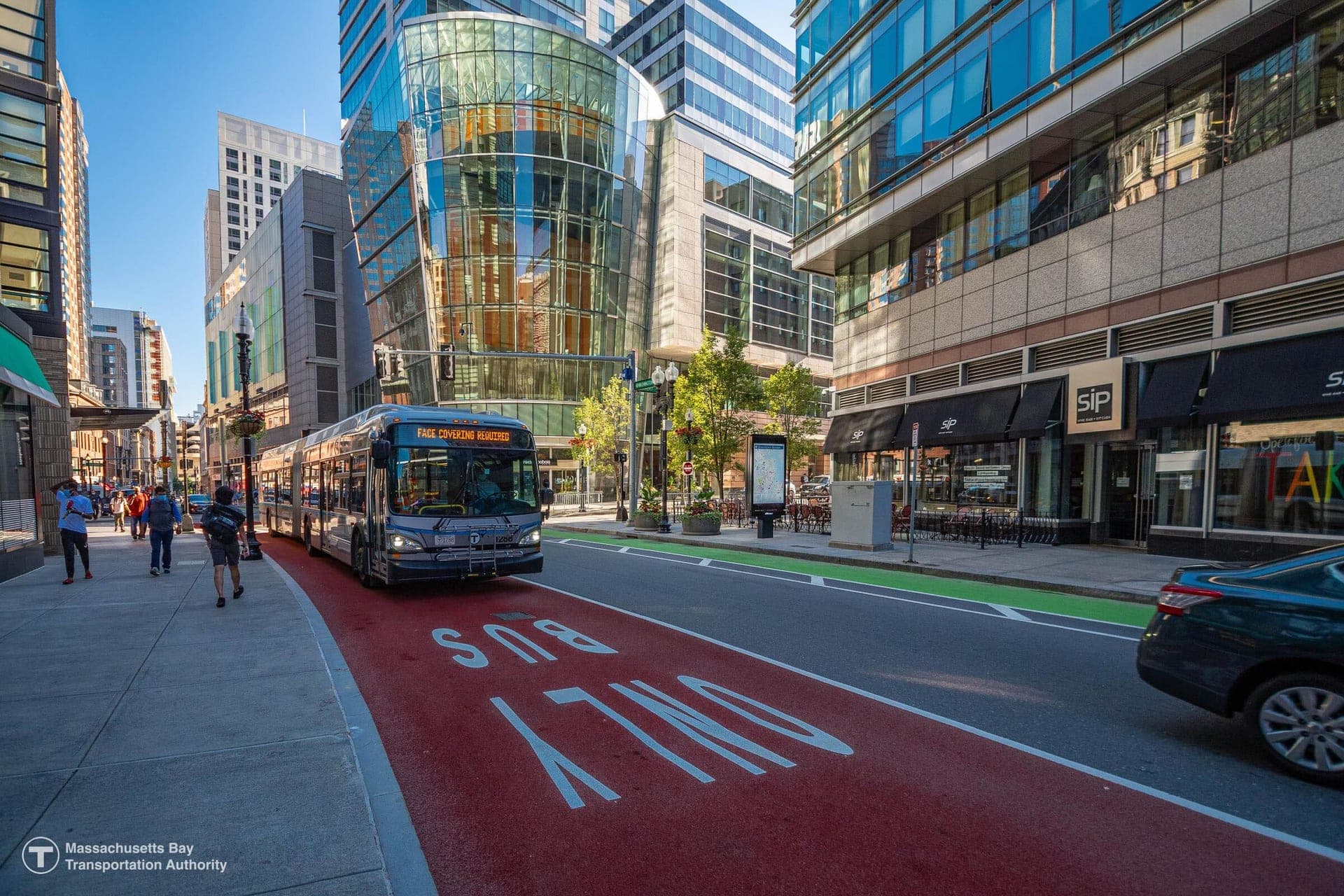
Boston’s Bus Priority Program is a City Transportation Department effort to make bus journeys faster, more reliable and easier to use by changing how streets and intersections work for transit. The city’s Transit Team supports the MBTA’s Transit Priority Vision, focusing on busy, high-ridership corridors where delays have the greatest effect on bus operations.1
The toolkit combines dedicated bus lanes, traffic signals that give buses priority, and improved stops designed for more accessible boarding.1 Corridor plans can also use queue jumps, signal retiming, stop relocations and curb changes, according to a Boston project presentation.11 The measures are intended to improve service and reliability, while some projects also support the MBTA Bus Network Redesign’s planned frequent routes, which are intended to run every 15 minutes or less, seven days a week, from 5 a.m. to 1 a.m.1
The city lists active projects on Blue Hill Avenue, Brighton Avenue, Columbus Avenue, Hyde Park Avenue, North Station to Seaport, Roslindale, the Route 57 corridor and Rutherford Avenue.1 Work is being carried out with the MBTA: for example, the Route 57 corridor project is described as a City of Boston Transportation Department program in partnership with the transit agency, aimed at reducing delay and improving street safety and clarity in Allston and Brighton.
The broader regional strategy helps explain the program’s focus: the MBTA identifies 26 high-traffic corridors for transit priority, which account for 80 percent of bus riders while covering 10 to 15 percent of the bus network.3 The Boston page does not name an individual project lead or provide a founding date for the city program.1