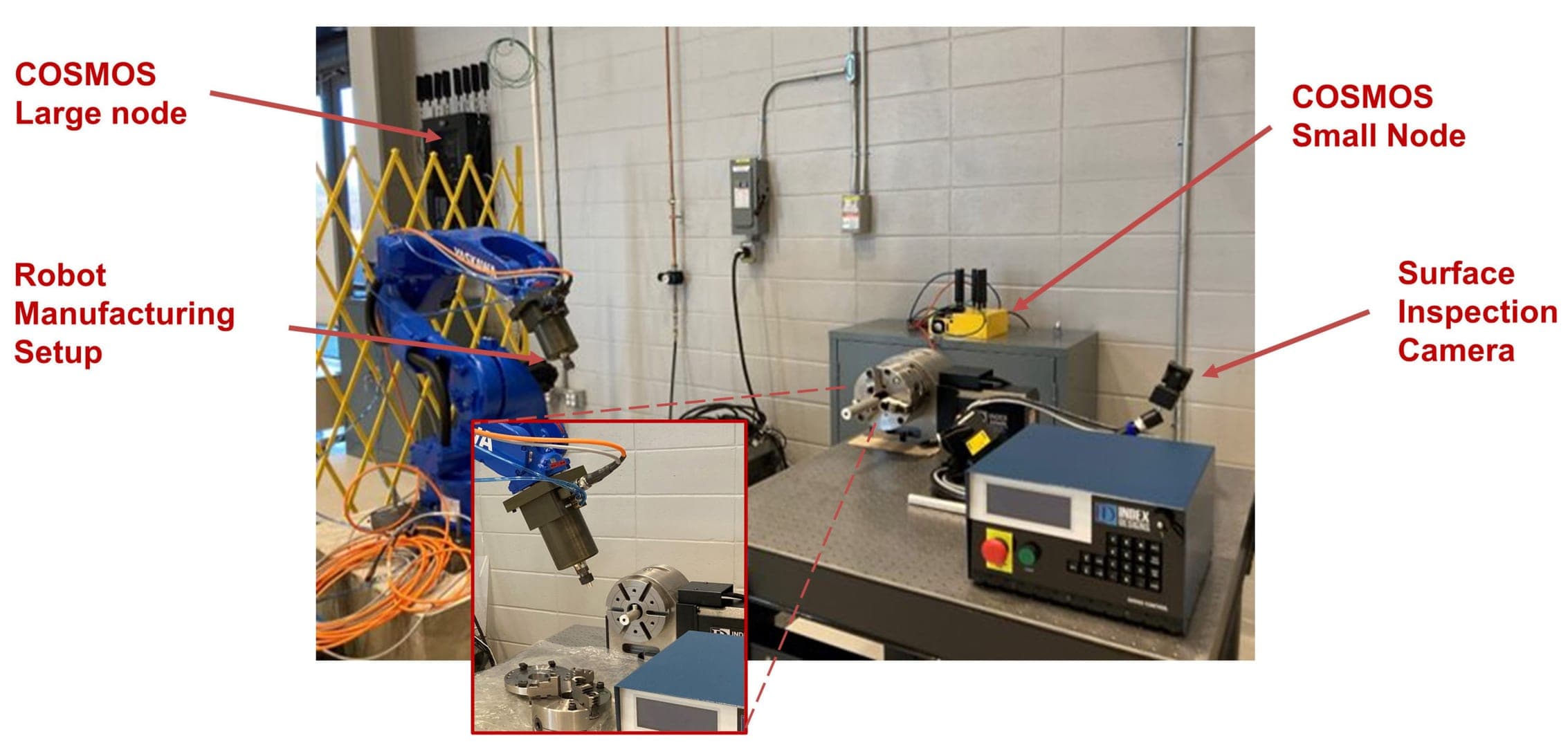
COSMOS is a research project building a city-scale wireless testbed in West Harlem, New York City. Its purpose is to let researchers test next-generation wireless technologies and applications in real-world conditions, with a particular emphasis on high-bandwidth, low-latency mobile communications linked to edge computing.13
The project is a collaboration led by Rutgers University, Columbia University and New York University, with partners including the City of New York, City College of New York, Silicon Harlem, the University of Arizona and IBM.25 Its academic leadership includes principal investigator Dipankar Raychaudhuri and program director Ivan Seskar at Rutgers, co-principal investigators Gil Zussman at Columbia and Sundeep Rangan at NYU.2
The testbed is designed to cover about one square mile of West Harlem, between Columbia’s Morningside Heights campus and City College, with the Hudson River and Apollo Theater marking its western and eastern edges.111 The project began on April 1, 2018, and was launched as part of the National Science Foundation’s Platforms for Advanced Wireless Research program.129 Its infrastructure combines programmable software-defined radio nodes, fiber-optic networks and edge and core cloud computing; researchers can access the platform remotely to run experiments and collect measurements.1
COSMOS supports research into areas such as millimeter-wave communications, optical networking, spectrum access and mobile applications, including augmented and virtual reality and connected vehicles.13 Education and local outreach are also part of its remit: the team has developed a platform and toolkit for K–12 students to learn STEM concepts through experiments conducted locally or on the testbed.13 A later expansion effort, COSMOS³, received a $3.8 million NSF grant to extend and sustain the platform.9