
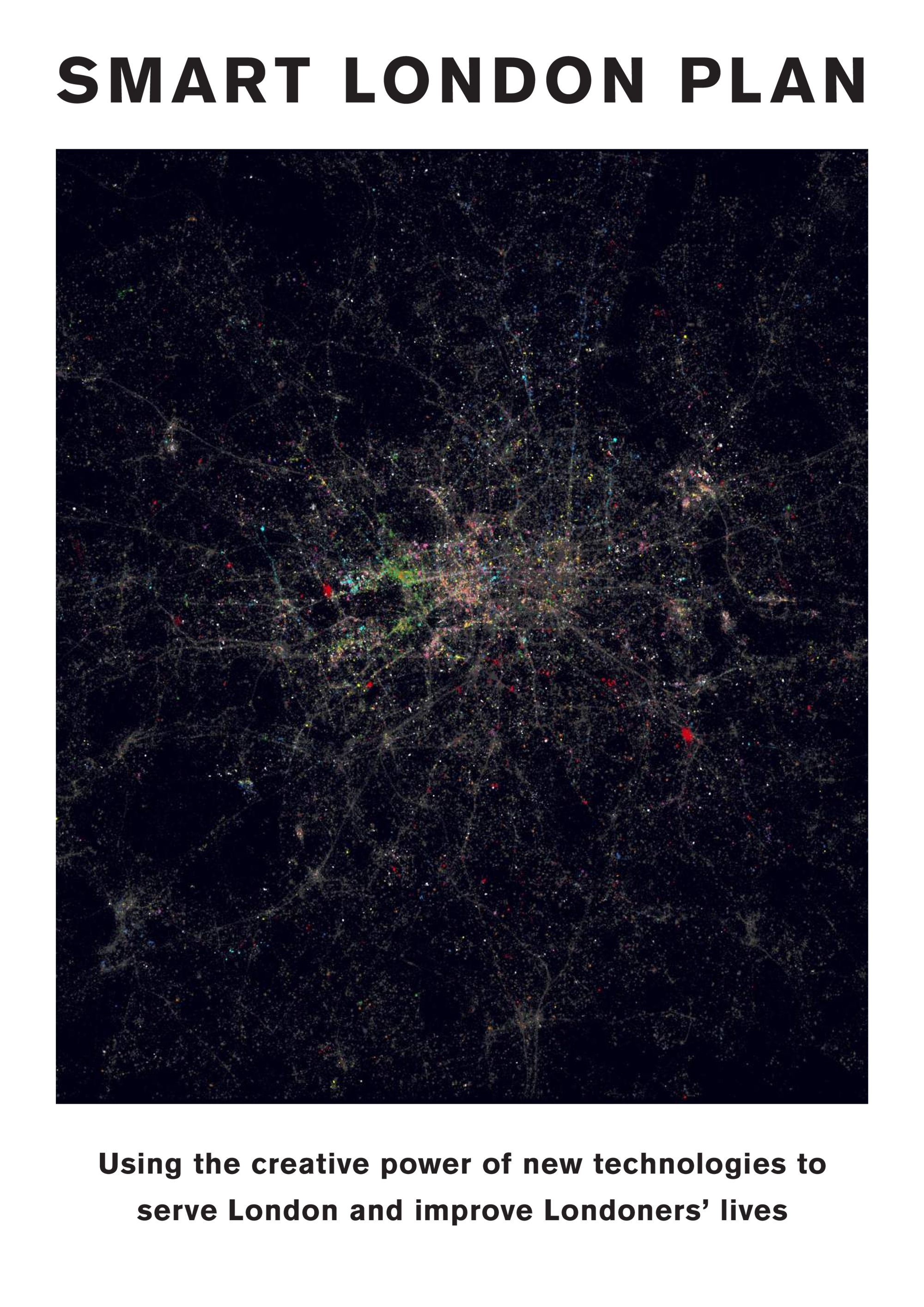
What the Document Is
The Smart London Plan is a policy plan published by the Greater London Authority (GLA), with a foreword by Mayor Boris Johnson and a chair's foreword by Professor David Gann CBE, Chairman of the Smart London Board. It sets out how new digital technologies and data can help London meet growth pressures and improve Londoners' lives. The plan focuses on actions to be taken until the end of the Mayoral term, within the framework of the Mayor's 2020 Vision.
Context and Growth Pressures
The plan states that London's population will grow by a million from 2011 to 2021, reach nine million before New York, and approach ten million by 2030. It projects at least another 641,000 jobs and 800,000 homes, and more than 600,000 extra public transport passengers at peak times by 2031. The document says congestion on London's roads costs the economy an estimated £2 billion, and Londoners spend 70 hours on average in traffic jams annually.
Open Data and Digital Engagement
The plan builds on the London Datastore, described as one of the first platforms to make public data open, which the text says receives over 30,000 visits a month. Planned actions include a Smart London Borough Partnership, a next generation Datastore, and the Talk London online research community, with a target of 1,000 people per borough engaged by 2016.
Innovation, Skills and Growth
The plan targets investing up to £24 million in affordable ultrafast broadband for SMEs, helping up to 22,000 SMEs by 2016, and supporting 200,000 technology employees by 2020. It proposes a Smart London Innovation Challenge, a Smart London Export Programme, and a Smart London Innovation Network, with a target of £200 million levered into London by 2018.
Infrastructure and Environment
Proposed measures include smart grid technologies, 3D mapping of underground utility assets, and new markets for waste. Stated targets include reducing greenhouse gas emissions to 40% below 1990 levels by 2020 and ensuring London has the best air quality of any major world city by 2020, requiring a reduction of c. 50% in transport-sector emissions.
Methodology and Evidence Base
The plan states that the Smart London Board, formed in March 2013 and comprising academics, business leaders and entrepreneurs, advised on its development. Baselines for many measures come from GLA Telephone Polls conducted in November-December 2013. The text is illustrated with case studies, including iCity, CELSIUS, Care Connect and the Tech City Stars programme, and a progress report is to be published in 2016.
Why It Matters for Smart City Development in London
The document describes itself as a live, evolving document that addresses Londoners, businesses, researchers, investors and anyone with an interest in the capital's future, and invites feedback, ideas and collaboration on the future of London as a smart city.