What the Document Is
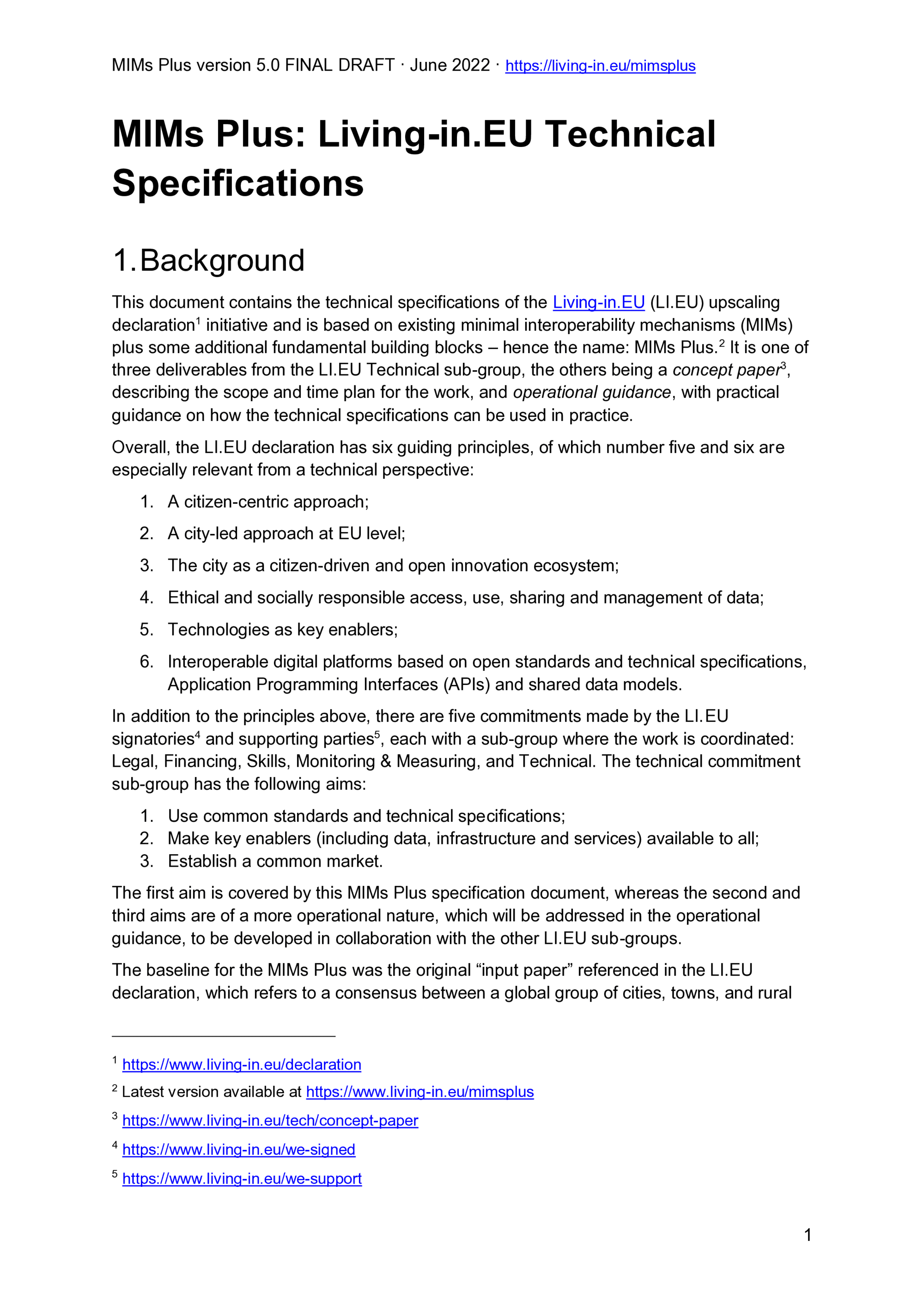
This is the MIMs Plus version 5.0 Final Draft (June 2022), the technical specifications of the Living-in.EU (LI.EU) upscaling declaration initiative. It was developed by the LI.EU Technical sub-group, with OASC as sub-group lead and the European Commission as EC contact. Its subject is minimal interoperability mechanisms for data, systems and services in cities and communities. The document states that it is based on the OASC Minimal Interoperability Mechanisms (MIMs), extended with European specifications and initiatives (the "Plus").
Context and Principles
The document says the LI.EU declaration has six guiding principles, of which numbers five and six are technical: technologies as key enablers, and interoperable digital platforms based on open standards, APIs and shared data models. The technical commitment has three aims: use common standards, make key enablers available to all, and establish a common market. The first aim is covered by this specification; the others are to be addressed in operational guidance.
Architecture Framework
The architecture section sets out design principles such as layered, capability-based architecture, open international standards, modularity, security and privacy by design, and linked data models. It lists recommended specifications, including the DIN SPEC 91357 Open Urban Platform reference architecture, SynchroniCity guidelines, oneM2M, the EIRA library (ELIS) and the CAMSS assessment library.
The MIMs and Their Status
The three foundational MIMs are described in detail: MIM1 Context Information Management (NGSI-LD, with Orion-LD as the CEF context broker), MIM2 Shared Data Models (based on RDF, RDFS and OWL, with the Smart Data Models initiative), and MIM3 Ecosystem Transaction Management (marketplace capabilities, with TM Forum Open APIs). MIMs 4, 5 and 7 are described as under development: MIM4 covers personal data management, MIM5 fair artificial intelligence and MIM7 geospatial information management. MIMs 6, 8, 9 and 10 (security, ecosystem indicators, data analytics and resource impact assessment) are summarised with their objectives.
Methodology and Development
The document states that the baseline was an input paper reflecting a consensus among a global group of cities, towns and rural areas. Its structure follows a fixed pattern for each MIM: goals, capabilities, recommended specifications and means of verification. Version history runs from 1.0 (October 2019) to 5.0 (approved by the LI.EU Steering Board on 23 June 2022). Contributors include many cities, among them Amsterdam, Barcelona and Helsinki-linked partners, and the EC services DG CONNECT, DG DIGIT and DG GROW.
Governance and Verification
The specifications are developed by the Technical sub-group through regular meetings and approved by the LI.EU Steering Board, convened by the European Commission. Each specific element is governed by its own forum. The document notes that means of verification for several MIMs are still "to be included" or under consideration.
Purpose and Audience for Smart City Policy
The document states that it aims to build capacity on standards, mechanisms, services, guidelines and tools that enable interoperability of data platforms for cities and communities. It is intended to mainstream services with strong local positive impact while addressing overall European goals, and to protect governments and the public against vendor lock-in.