About the Document
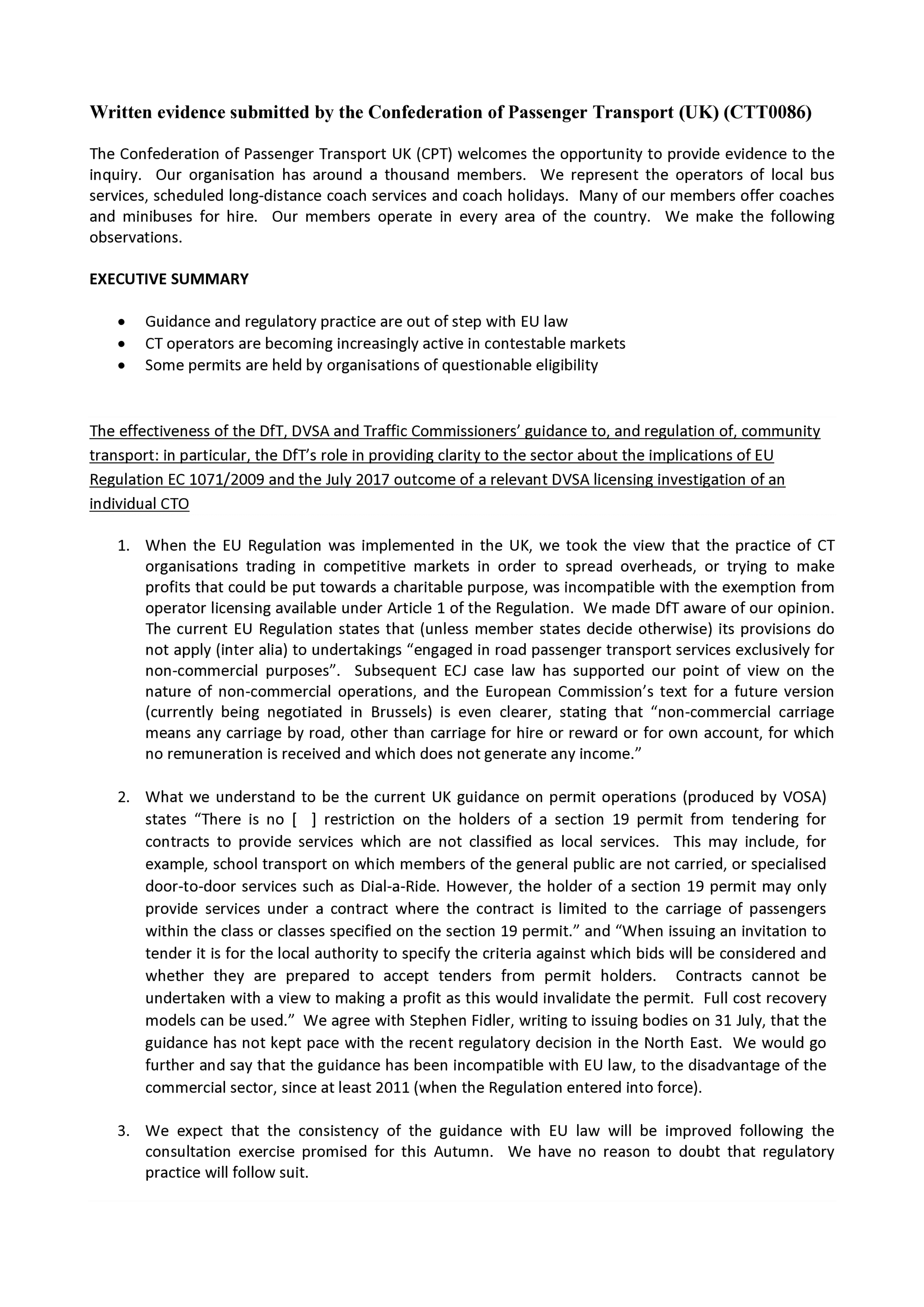
This is written evidence (reference CTT0086) submitted in November 2017 by the Confederation of Passenger Transport UK (CPT) to a UK Parliament inquiry, listed as MAS0037, Evidence on Mobility as a Service. CPT says it has around a thousand members, who operate local bus services, scheduled long-distance coach services, coach holidays and coaches and minibuses for hire across every area of the country.
Scope of the Evidence
The submission addresses the guidance and regulatory practice of the Department for Transport (DfT), the Driver and Vehicle Standards Agency (DVSA) and the Traffic Commissioners on community transport (CT). It focuses on the DfT's role in clarifying the implications of EU Regulation EC 1071/2009, and on a July 2017 DVSA licensing investigation of an individual CT organisation.
Position on EU Law and Guidance
CPT states that, when the Regulation was implemented in the UK, it held that CT organisations trading in competitive markets to spread overheads, or to make profits for a charitable purpose, was incompatible with the exemption in Article 1. CPT cites ECJ case law and a draft European Commission text defining non-commercial carriage as carriage that "does not generate any income". It quotes VOSA guidance allowing permit holders to tender for contracts, provided they carry only the classes of passenger specified on the permit, and stating that "Contracts cannot be undertaken with a view to making a profit". CPT argues this guidance has been incompatible with EU law since at least 2011, and expects consistency to improve after a consultation promised for autumn.
Expansion into Contestable Markets
CPT attributes the impact on commercial operators to CT organisations increasingly entering commercial markets to replace withdrawn funding. A mini case study describes an Alnwick charity operating under section 19 and section 22 permits, which accounts for nearly all its operations, around £½m a year, as charitable activities. Its listed contracts include Northumberland County Council school transport and Dial-A-Ride services, and work for the North East Ambulance Service and NHS trusts. One CPT member has sold vehicles after losing contracts to this charity. CPT reports similar expansion in Wiltshire, East Yorkshire, West Wales and Kent.
Concerns About Permit Eligibility
CPT considers some permit holders ineligible. It cites the Norse Group, with a turnover of around £250m and a multi-million pound annual profit to its owner, which holds permits from more than one issuing body because it is wholly owned by Norfolk County Council. CPT also describes the ECT Charity, which operates in Cheshire, Cornwall, Dorset and Ealing, turns over £4.8m a year and uses more than 100 vehicles. CPT says that, in its members' view, the charity's size and permit-based cost advantages give it an unfair competitive advantage.
Purpose for Community Transport Regulation
The document is addressed to the inquiry and to the bodies it names, including the DfT, DVSA, Traffic Commissioners and local issuing bodies. Its stated purpose is to set out CPT's observations on guidance, regulatory practice and permit operation, and to present CPT's view of how these affect commercial operators.