Document and Publisher
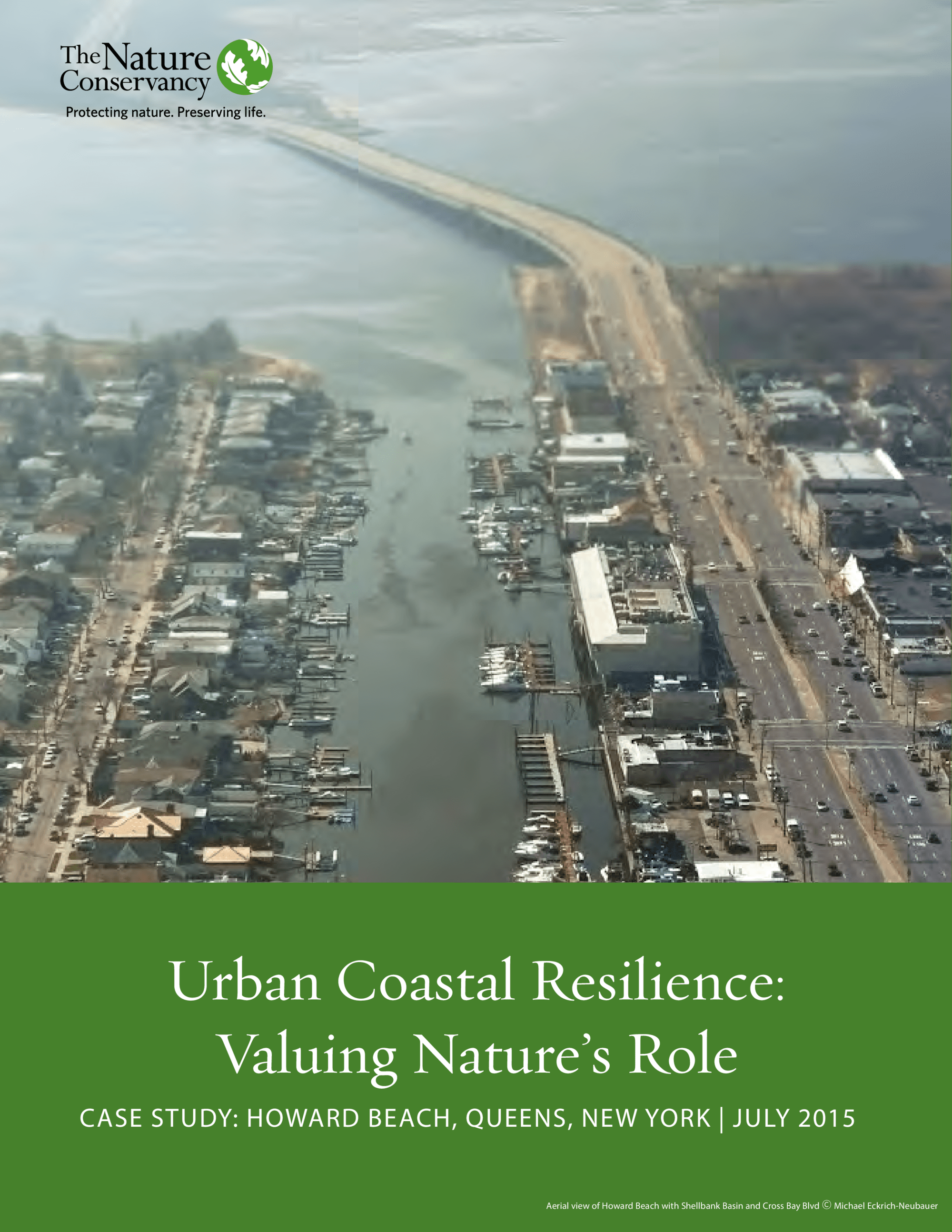
This is a case study report published by The Nature Conservancy (July 2015), developed with technical support from CH2M Hill and Davey Resource Group and funded primarily by The JPB Foundation, with additional support from The Rockefeller Foundation and TD Bank. It examines urban coastal resilience in Howard Beach, a neighborhood in Queens, New York, as a sample community. The report supersedes the Conservancy's 2013 study on integrating natural infrastructure into the same neighborhood.
Objectives and Context
The report states three objectives: to evaluate the relative merits of approaches to climate change resilience using Howard Beach as a case study, to propose an innovative approach to quantifying ecosystem functions and services, and to establish replicable methods for decisions about natural infrastructure. It was commissioned in 2013 by the New York City Special Initiative for Rebuilding and Resiliency (SIRR), following damage from Superstorm Sandy in 2012.
Howard Beach Profile and Climate Risks
The report describes a neighborhood of approximately 14,700 residents, with 85 percent owner-occupied housing and more than 90 percent of residential buildings built before 1980. It identifies coastal flooding and storm surges as the most significant climate risks. The text projects that sea levels could rise 11 to 30 inches, citing Horton et al. (2015) and the New York City Panel on Climate Change.
Alternatives Assessed
Five conceptual alternatives were developed through design charrettes: two all-nature alternatives, a gray-only option, and two hybrids combining nature with gray infrastructure. Their elements include restored marsh, ribbed mussel toes, berms, removable or operable flood gates, and flood walls.
Methodology
The analysis combines cost-benefit analysis (CBA), HAZUS flood loss modeling, hydrodynamic modeling, and habitat equivalency analysis (HEA), with benefit transfer used to monetize a subset of ecosystem services. Discount rates of 3 and 7 percent, a 50-year design life, and a 100-year storm scenario were applied, with sea-level rise scenarios of 12 and 32 inches for selected alternatives.
Key Findings
The report finds that hybrid infrastructure can provide the most cost-effective protection when ecosystem services are included. Alternative 4, a hybrid with operable flood gates, is described as preferable to Alternative 5 because it offers similar risk reduction with added ecological uplift. Alternatives 1 and 2 avoided less than $1 million in damages. The report states that the all-gray Alternative 5 avoided $225 million under the modeled storm and has unintended consequences for the surrounding community.
Limitations and Caveats
The report states that its estimates of benefits are conservative and that not all ecosystem services were fully quantified. HAZUS does not include public infrastructure damage, so loss estimates are limited to building damage, vehicle losses, and business interruption. Sensitivity and uncertainty analyses were outside the study's scope.
Financing Options
An appendix presents financing strategies, including transferable development rights, pay-for-performance contracts, wetlands mitigation banking, and neighborhood improvement districts, with examples from Hudson Yards, Pevensey Bay, Eugene, Waterfront Toronto, and Hudson River Park.
Why It Matters for Coastal Resilience Planning
The report says its methodology, rather than its specific findings, is intended to be replicable, and that its interest extends beyond Howard Beach to coastal communities across New York City, New York State, the nation, and the world. It is addressed to decision makers weighing nature-based and gray infrastructure for neighborhood-scale flood protection.