About the Document
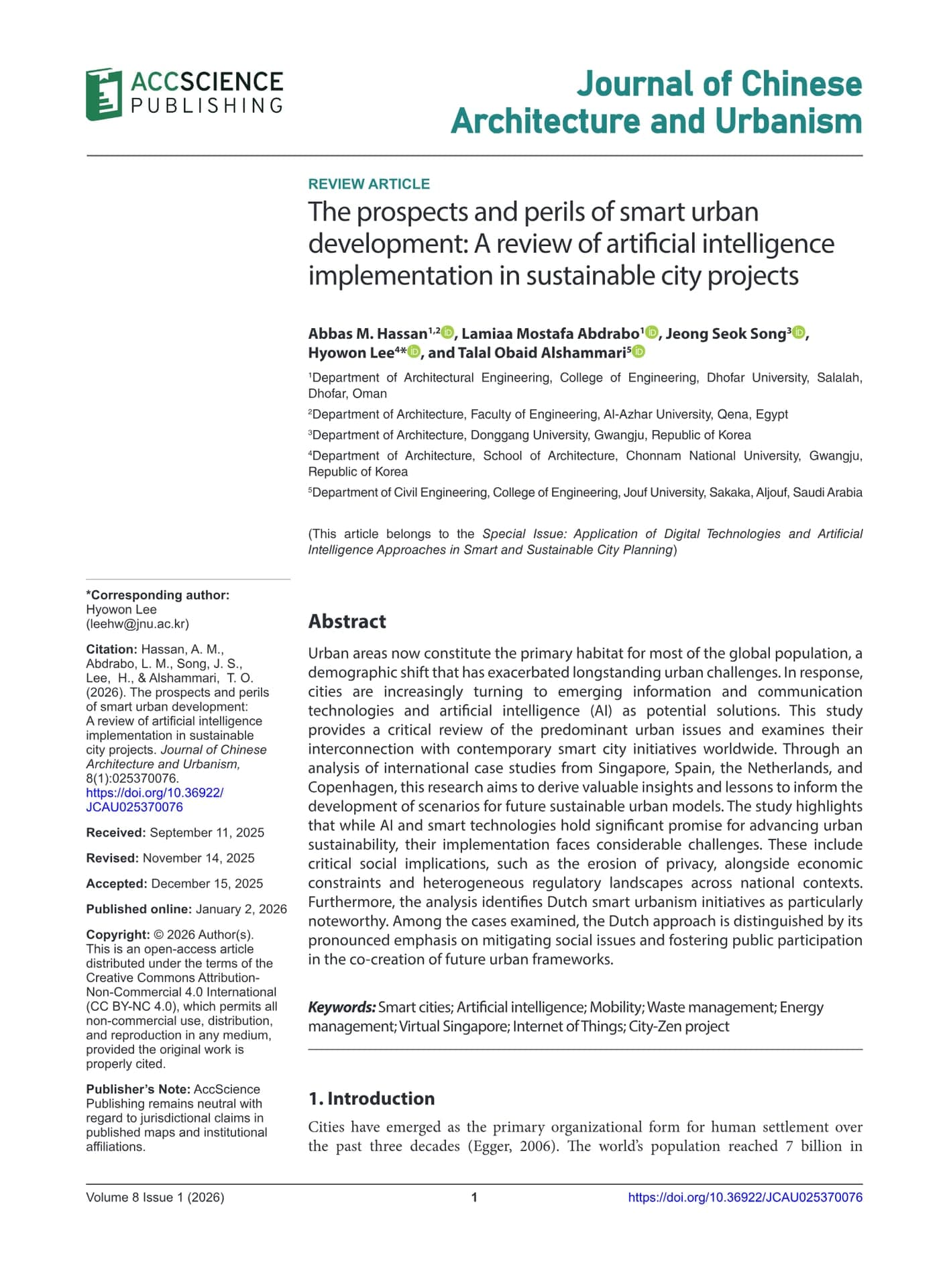
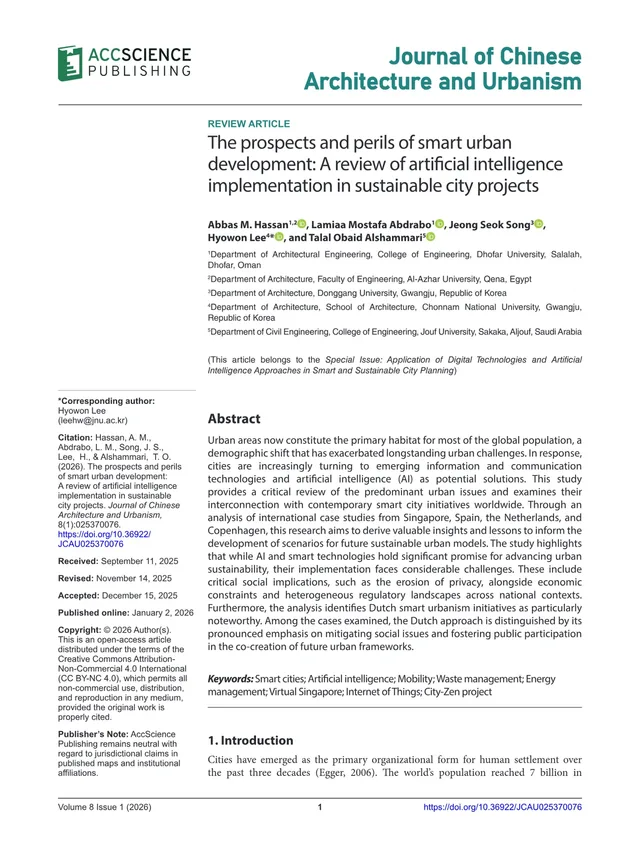
This is a review article published in the Journal of Chinese Architecture and Urbanism (Volume 8, Issue 1, 2026) by Abbas M. Hassan, Lamiaa Mostafa Abdrabo, Jeong Seok Song, Hyowon Lee, and Talal Obaid Alshammari, affiliated with institutions in Oman, Egypt, South Korea, and Saudi Arabia. It is a critical review of how artificial intelligence (AI) and smart technologies are applied in sustainable city projects.
Aims and Scope
The article examines the main urban issues and their links to smart city initiatives worldwide. It aims to derive lessons that inform scenarios for future sustainable urban models. It states that AI and smart technologies hold significant promise, but face social implications such as the erosion of privacy, economic constraints, and heterogeneous regulatory landscapes.
Methodology
The study uses a narrative approach focused on five urban domains: urban planning and design, mobility, waste management, energy systems, and water management. Four cases were selected against five criteria: representativeness, diversity of governance models, empirical reliability, maturity and demonstrated impact, and analytical coherence. The cases are Virtual Singapore, Barcelona's IoT system, Amsterdam's City-Zen project, and Copenhagen's AI-driven hydrological management.
Key Thematic Findings
- Planning: The article describes BIM, GIS, and digital twins as a combined framework, with Virtual Singapore cited for simulating emergency evacuations and thermal comfort.
- Mobility, waste, energy and water: Sensor, RFID, GPS, smart meter and acoustic-sensor technologies are examined with examples such as Seoul's bin-level sensors, Milan's weight-based pricing, and Sabadell's leak detection.
Case Study Insights
Copenhagen's AI-enhanced digital twin of its drainage network, developed after a 2011 cloudburst, is presented as a predictive flood-management model. Amsterdam's City-Zen uses AI to optimise a smart thermal grid. The article reports that the Dutch approach stresses social issues and public participation, and it highlights privacy, data quality, algorithmic bias and digital divides as challenges.
Risks and Controversies
The discussion records that Toronto's Sidewalk project generated public opposition over data ownership and privacy. The article states that the social dimension of AI-enabled sustainability remains relatively underexplored.
Why It Matters for Urban Policy
The review frames its six principles (human-centred design, environmental sustainability, evidence-based planning, system-wide integration, predictive analytics, and participatory governance) as a guide for cities pursuing AI-enabled sustainable and equitable urban futures.