About the Document
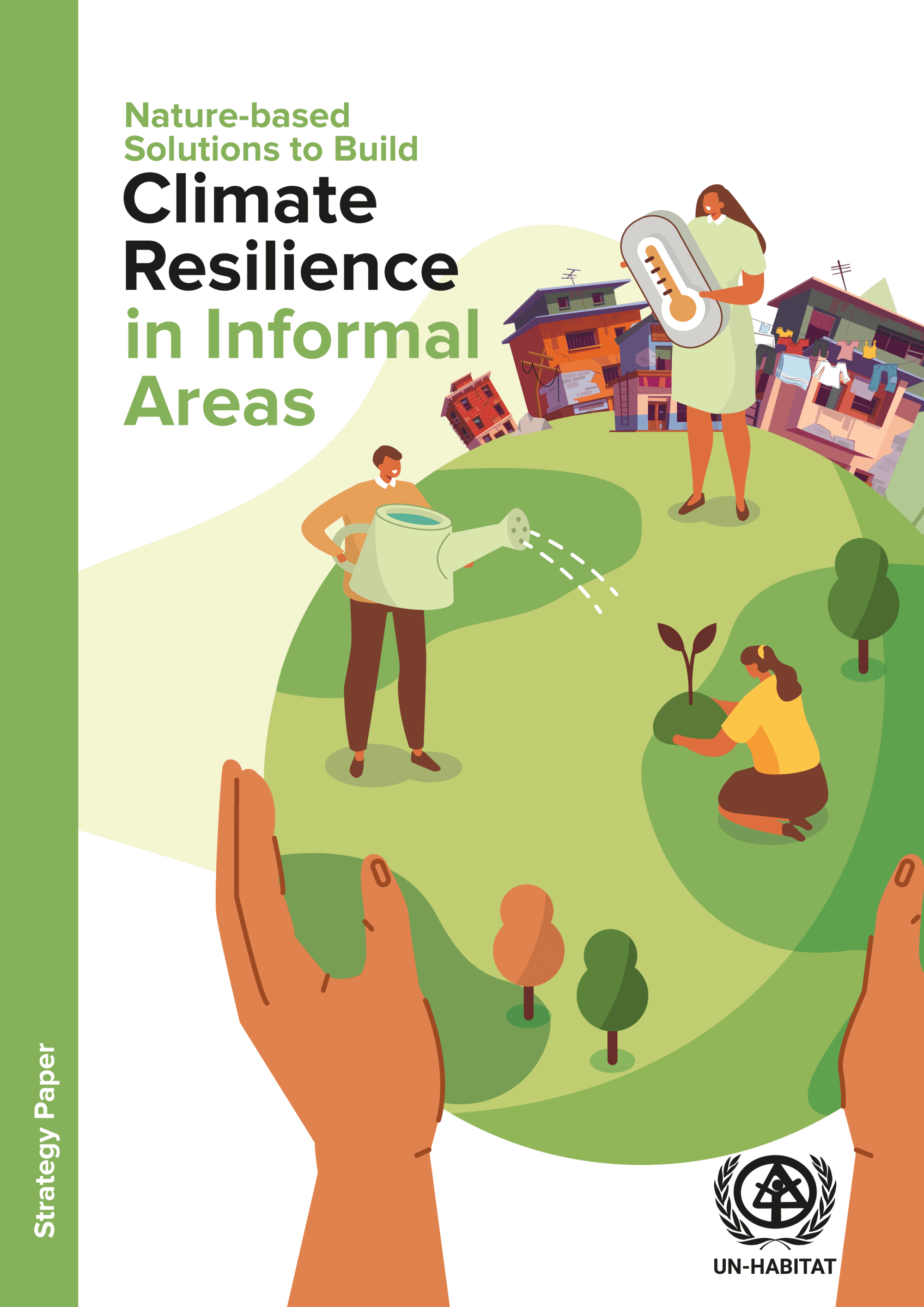
This is a strategy paper published by the United Nations Human Settlements Programme (UN-Habitat), with authors Julie Greenwalt, Clara Bütow, Diana Carrillo Silva, Alex Francisco, Jeroen Klooster and Russ Dudley, and contributors Bernhard Barth, Kim Driesen, Cerin Kizhakkethottam, Andrew Rudd, Fruzsina Straus and Raphaëlle Vignol. It was prepared with the Global Covenant of Mayors for Climate and Energy and financed by the Swedish International Development Cooperation Agency (Sida). Its subject is nature-based solutions (NBS) for climate resilience in informal areas, drawing on the IPCC AR6 and the Innovate4Cities agendas.
Scale of the Challenge
The paper states that more than three billion people live in hotspots highly vulnerable to climate change, and more than one billion urban dwellers live in informal areas. It reports that over 68 percent of the world's population is predicted to live in cities by 2050, with 95 percent of this growth in the developing world. Of all climate finance, 90 percent goes to mitigation, and between 2010 and 2014 cities received less than 5 percent of global adaptation finance.
Nature-based Solutions and Their Benefits
According to the IPCC, NBS can provide urban cooling, improve air quality, manage stormwater, protect coasts and rivers, and support urban agriculture as a food security measure. The paper cites an estimated net benefit of about 1:4 times the money invested in NBS and ecosystem-based adaptation. It notes that NBS in partnership with the urban poor can deliver a triple dividend of mitigation, biodiversity protection and adaptation.
Risks and Maladaptation
The paper examines maladaptation, colonial legacies, transferability between geographies and the effect of climate change on NBS effectiveness. It cites a study finding that maladaptive outcomes mostly occur with insufficient consideration of vulnerability context, weak inclusive participation, retrofitting adaptation into existing agendas, and insufficient conceptualization of adaptation success.
Methodology
The paper combines a review of IPCC AR6 findings and the Global Research and Action Agenda (GRAA) and City Research and Innovation Agenda (CRIA) with practice-based material. The practice sources are projects shared at the Innovate4Cities conference in October 2021, UN-Habitat projects in informal settlements, and an international best-practice analysis by the Arcadis Shelter Program. It also includes an Expert Group Meeting held virtually from 14 to 16 June 2022.
Practice and Case Examples
The paper describes UN-Habitat projects in Honiara (Solomon Islands), Lao PDR, Ulaanbaatar (Mongolia), Fiji, Lilongwe (Malawi) and Morondava (Madagascar). It also presents global examples such as Philadelphia's Green City, Clean Waters programme, which has implemented more than 2,800 green tools, and New Jersey's Resilient NJ programme. A table of NBS by scale lists benefits and limits in informal settlements for measures such as green roofs, rain gardens and tree canopy expansion.
Purpose and Intended Audience
The paper states that it is intended to support strategic discussions and programming, and to catalyse research and action on NBS in informal areas that reduce vulnerability and address climate risk. It names three intended audiences: researchers, practitioners and organisations implementing NBS, and policymakers seeking to improve enabling environments.