Overview of the Study
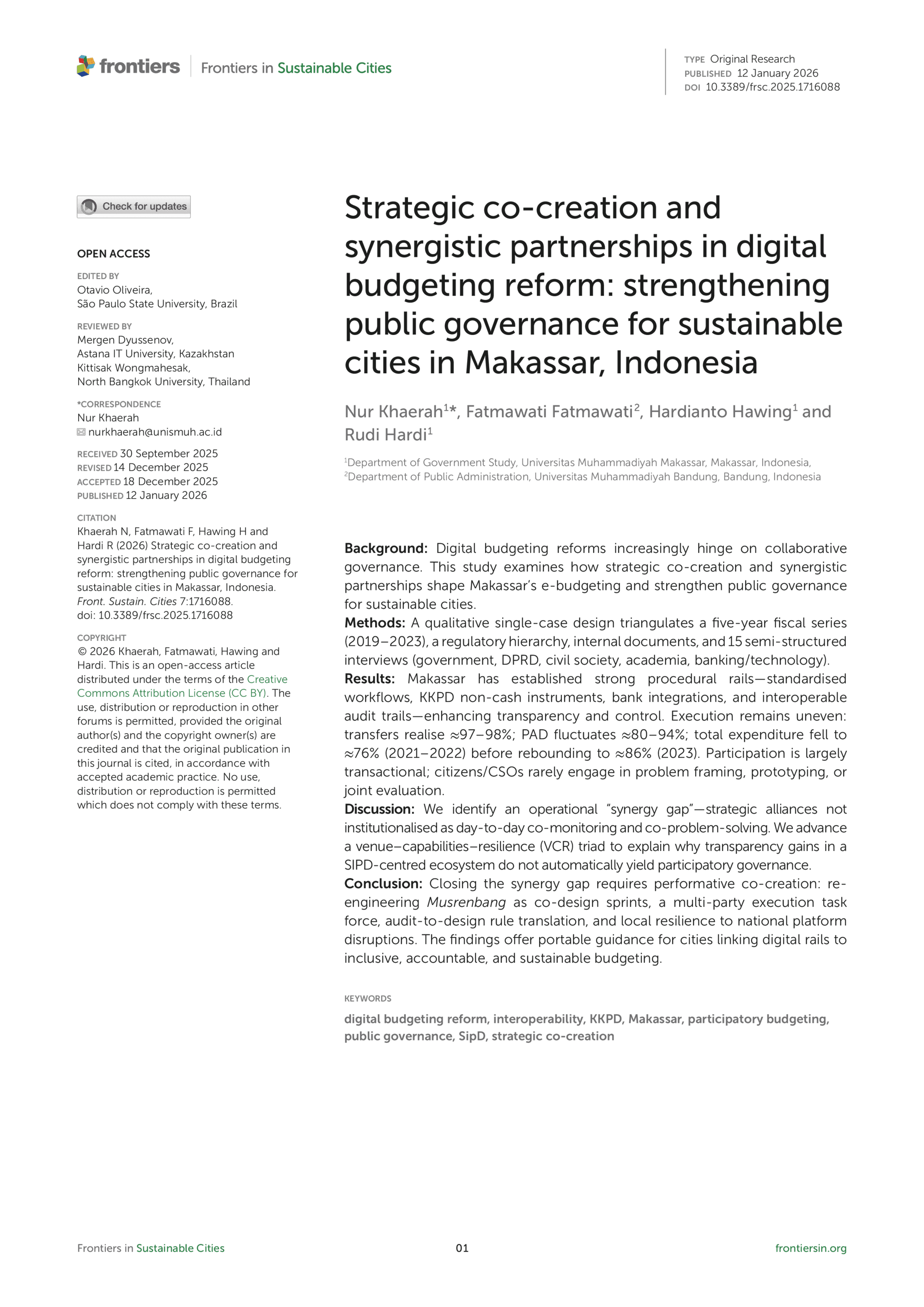
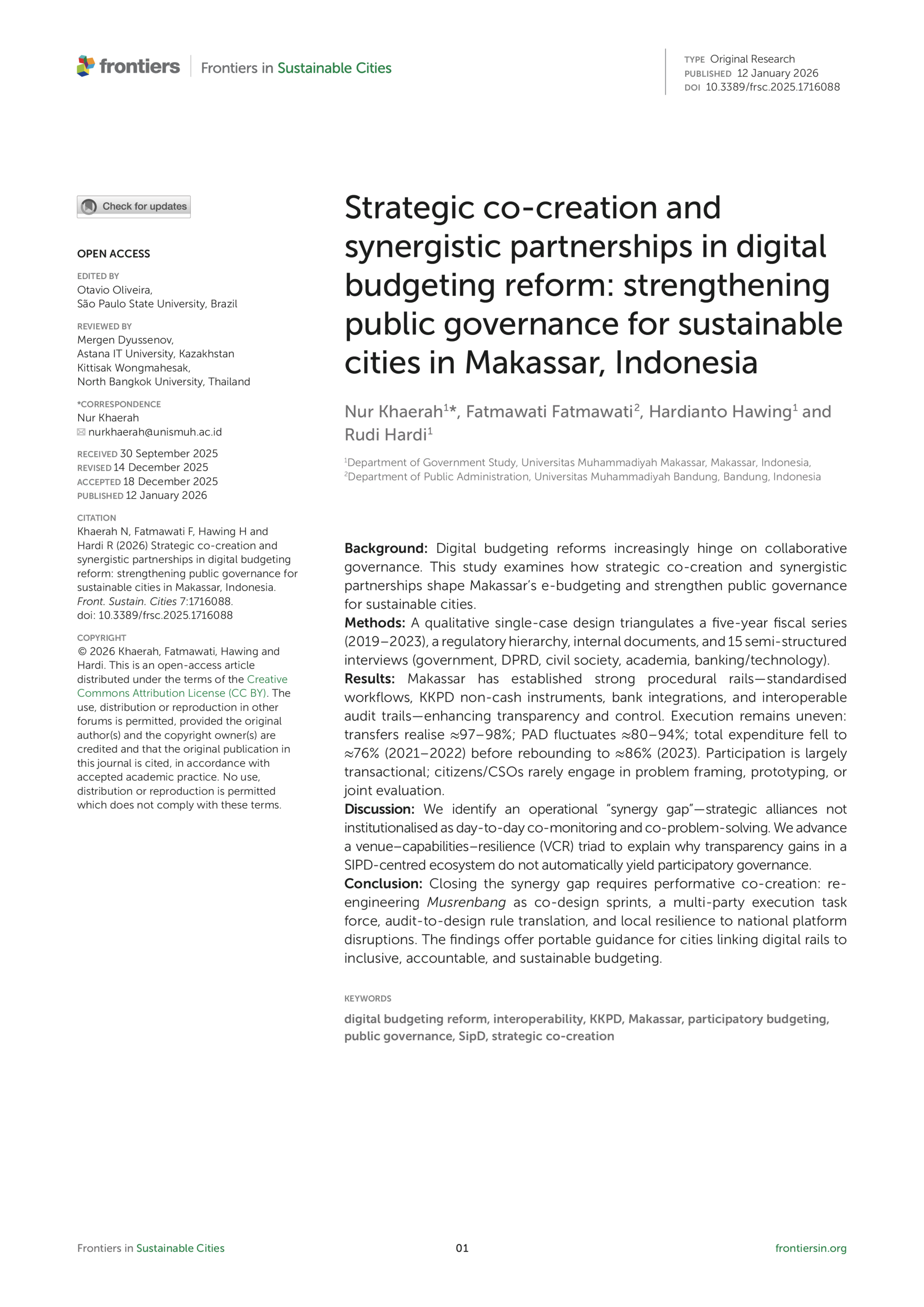
The article, published in Frontiers in Sustainable Cities in 2026, presents original research on how strategic co‑creation and synergistic partnerships influence digital budgeting reforms in Makassar, Indonesia. Authors Nur Khaerah, Fatmawati Fatmawati, Hardianto Hawing, and Rudi Hardi are affiliated with the Department of Government Study at Universitas Muhammadiyah Makassar and the Department of Public Administration at Universitas Muhammadiyah Bandung. The research is AI‑generated and has completed processing, with its PDF available through the journal’s website.
Fiscal Trends and Results
Analysis of five fiscal years (2019‑2023) shows that Makassar’s budget expanded from IDR 4.06 trillion in 2019 to IDR 5.26 trillion in 2023. Transfer revenues (inter‑governmental allocations) consistently realized 97‑98 % of planned amounts, while own‑source revenue (PAD) fluctuated between 80‑94 %. Total expenditure realization dipped to about 76 % in 2021‑2022 before rebounding to 86 % in 2023. These figures illustrate strong procedural rails—standardised workflows, non‑cash instruments (KKPD), bank integrations, and interoperable audit trails—yet uneven execution across cycles.
Nature of Synergistic Partnerships
The reform rests on a dense network of actors: municipal executives (Mayor, BPKAD, Bappeda), the Regional People’s Representative Council (DPRD), civil‑society organisations, academic experts, and private‑sector partners (IT vendors, banks, media). Partnerships enable technical infrastructure, financial rail‑ways, and data transparency, but the study identifies an “operational synergy gap”: strategic alliances are not institutionalised as day‑to‑day co‑monitoring or joint problem‑solving routines. CSOs mainly act as watchdogs, academia contributes episodic advice, and private firms provide primarily technical services.
Co‑Creation Practices in Budgeting
Co‑creation is examined through four meta‑models: joint space of creation, co‑creation spectrum, type configuration, and process institutionalisation. Makassar has expanded the joint space to include executive‑legislative and limited executive‑CSO interfaces, yet power remains centred in the executive. Participation largely resides on the consultation‑to‑lower‑collaboration rung of Arnstein’s ladder. Citizens engage primarily in Musrenbang proposal submission; subsequent stages of problem framing, prototyping, and joint evaluation are rarely inclusive. The city’s co‑design efforts are characterised as “co‑design lite,” integrating inputs without redesigning system architecture or decision‑making rules.
Digital Literacy and Capacity Gaps
Digital competence is concentrated among a small cadre of municipal IT staff, creating bottlenecks when they are unavailable. Training is episodic and compliance‑oriented, lacking continuous peer‑learning mechanisms. Among citizens, digital literacy varies markedly; many rely on intermediaries to submit proposals and struggle to interpret budget data. These disparities reinforce a stratified participation landscape, limiting broader co‑creation and inclusive governance.
Platform Dependency and Resilience Risks
Makassar’s e‑budgeting processes are tightly coupled to the national Sistem Informasi Pemerintahan Daerah (SIPD). System outages or abrupt regulatory changes at the national level directly halt local budgeting cycles, forcing ad‑hoc workarounds such as spreadsheets. The reliance on a centralised platform introduces systemic vulnerability, constraining local experimentation and undermining resilience, especially during critical deadline periods.
Key Findings for Sustainable Housing Stakeholders
- Digital budgeting has improved transparency and traceability, essential for monitoring housing‑related expenditures.
- Execution gaps (e.g., 76 % expenditure realization in 2021‑22) indicate that funds earmarked for sustainable housing may not be fully deployed without stronger coordination.
- The synergy gap and limited citizen co‑creation suggest that community‑driven housing design and allocation remain under‑realised.
- Strengthening digital literacy, institutionalising joint monitoring bodies, and building fallback procedures for SIPD disruptions are recommended to enhance fiscal reliability for sustainable‑housing projects.
Implications for Pan‑European Audiences
The Makassar case illustrates how digital budgeting can provide data‑rich platforms for tracking sustainable‑housing investments, yet the effectiveness of such tools depends on robust multi‑stakeholder partnerships, inclusive co‑creation mechanisms, and resilient platform governance. European cities considering similar e‑budgeting reforms can draw lessons on the importance of institutionalising synergistic partnerships beyond technical deployment, ensuring broad digital competence, and designing contingency plans for centralised system dependencies.