About the Document
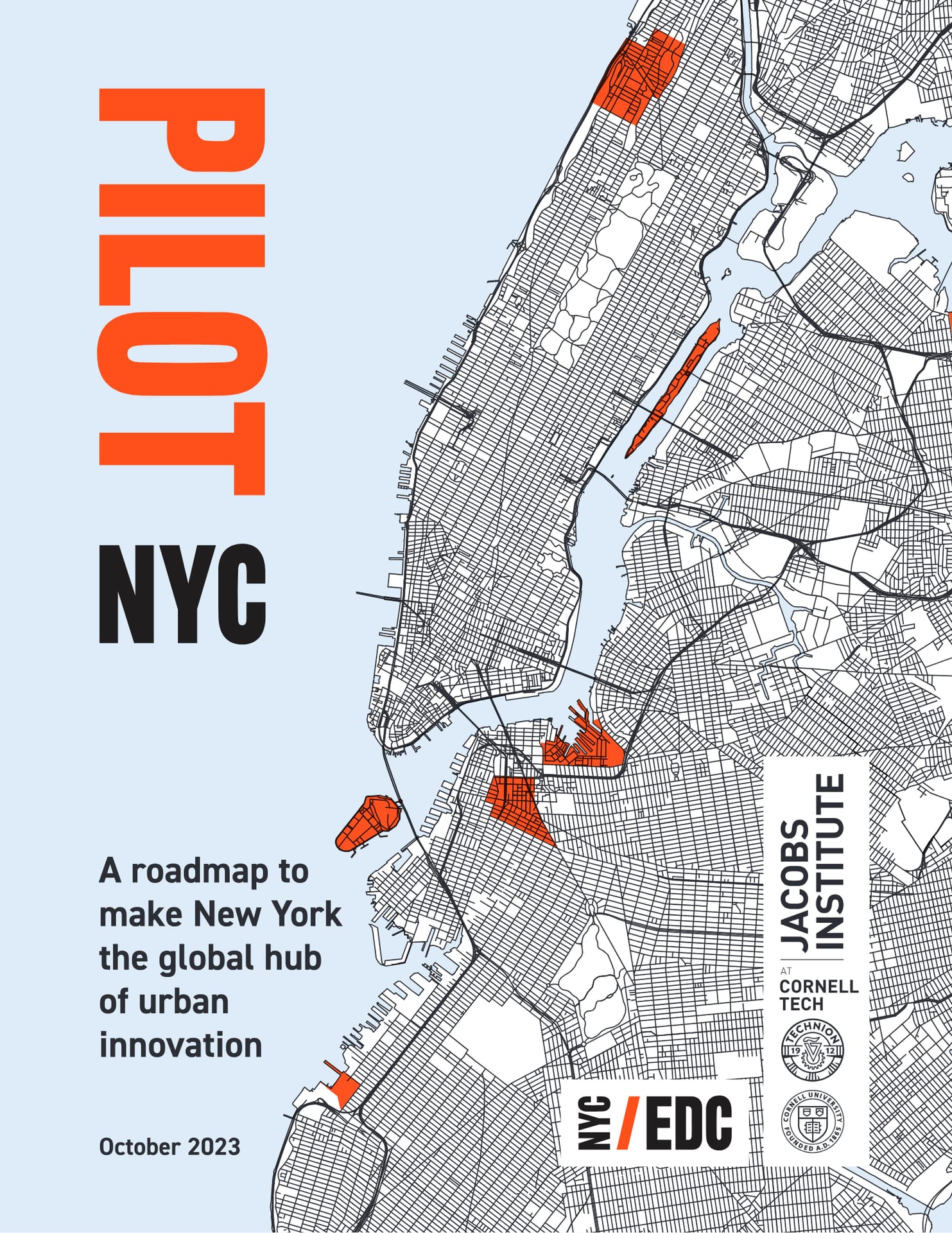
This report, published in October 2023, is the result of a nine-month research collaboration between the Jacobs Urban Tech Hub at Cornell Tech and the New York City Economic Development Corporation (NYCEDC). It provides a strategic roadmap to establish New York City as a global center of urban innovation by addressing "pilot purgatory"—the persistent failure of successful technology pilots to transition into full-scale government procurement or lasting policy changes.
Methodology and Scope
The authors conducted a 360-degree review of New York's urban innovation ecosystem between January and September 2023. The methodology encompassed 120 anonymized stakeholder interviews across five key groups: approximately 25 municipal and state government agencies, 30 startups in place-based sectors (mobility, energy, buildings, and digital infrastructure), 10 accelerator and pilot site program operators, 15 university representatives, and 15 private venture investors. It also incorporated insights from 25 external experts, including municipal practitioners from cities such as Boston, Berlin, Seattle, and Los Angeles.
Bolstering Government Innovation Capacity
Across New York City agencies, the report identifies risk-averse cultures, resource constraints, and a shortage of technical personnel as major bottlenecks. Place-based operating agencies bear operational risks when executing pilots, with third-party installation costs ranging between $20,000 and $250,000, and validation expenses running from $20,000 to $150,000. To address these hurdles, the report recommends:
- Embedding dedicated in-house innovation leads in place-based agencies who report directly to executive decision-makers, supported by models like philanthropic fellowship funding.
- Launching structured university partnership trials, pairing agencies with academic institutions to define, scope, and validate pilot trials objectively.
- Establishing outcome metrics adapted from the federal Defense Innovation Unit (DIU) and Green Proving Ground, specifically tracking a transition rate (the percentage of pilot solicitations resulting in formal procurement or policy shifts).
Modernizing City Procurement Processes
Current municipal pilot pathways—including no-cost pilots, micro-purchases under $20,000, and Demonstration Projects—lack clear mechanisms to scale into production contracts. Traditional methods like Requests for Proposals (RFPs) and Competitive Sealed Bids (CSBs) mandate prescriptive requirements and lengthy timelines that disadvantage young enterprises. The report proposes:
- Piloting challenge-based procurement across at least two agencies, allowing the City to define a problem, test several competing prototypes, and proceed to purchases based on real-world performance.
- Training agency staff and vendors on cybersecurity and information privacy rules enforced by the Office of Technology and Innovation (OTI).
- Amending Procurement Policy Board rules over the long term to permanently codify challenge-based methods and align procurement terms with New York State for cooperative purchasing.
Coordinating Startup Support Infrastructure
While New York possesses major urban testbeds, 29 out of 30 surveyed startups requested caseworker assistance to navigate fragmented agency jurisdictions, and complex energy projects face up to 17 required permits across four municipal departments. Moreover, equity hurdles persist, as venture-backed minority- and women-led ventures frequently forfeit M/WBE certification when institutional funding dilutes founder equity below 51 percent. Recommended actions include:
- Deploying a centralized business portal providing dedicated navigation and regulatory guidance for urban technology firms.
- Formalizing a cohesive pilot network linking physical sites like the Brooklyn Navy Yard and Brooklyn Army Terminal to pool operational templates, coordinate site matching, and pursue federal grants under the IRA, IIJA, and CHIPS Act.
- Establishing specialized debt financing instruments for capital expenditures and creating a dedicated Zero-Emission Test Zone in a federally recognized Justice40 disadvantaged neighborhood.
Why It Matters for Urban Innovation
The roadmap establishes actionable milestones for New York City municipal agencies, urban technology startups, university researchers, and civic program operators seeking to deploy place-based innovations. It directly operationalizes Initiative 31 of the "New" New York Plan and aligns municipal purchasing power with the climate objectives of PlaNYC and federal Justice40 standards.