Document Overview
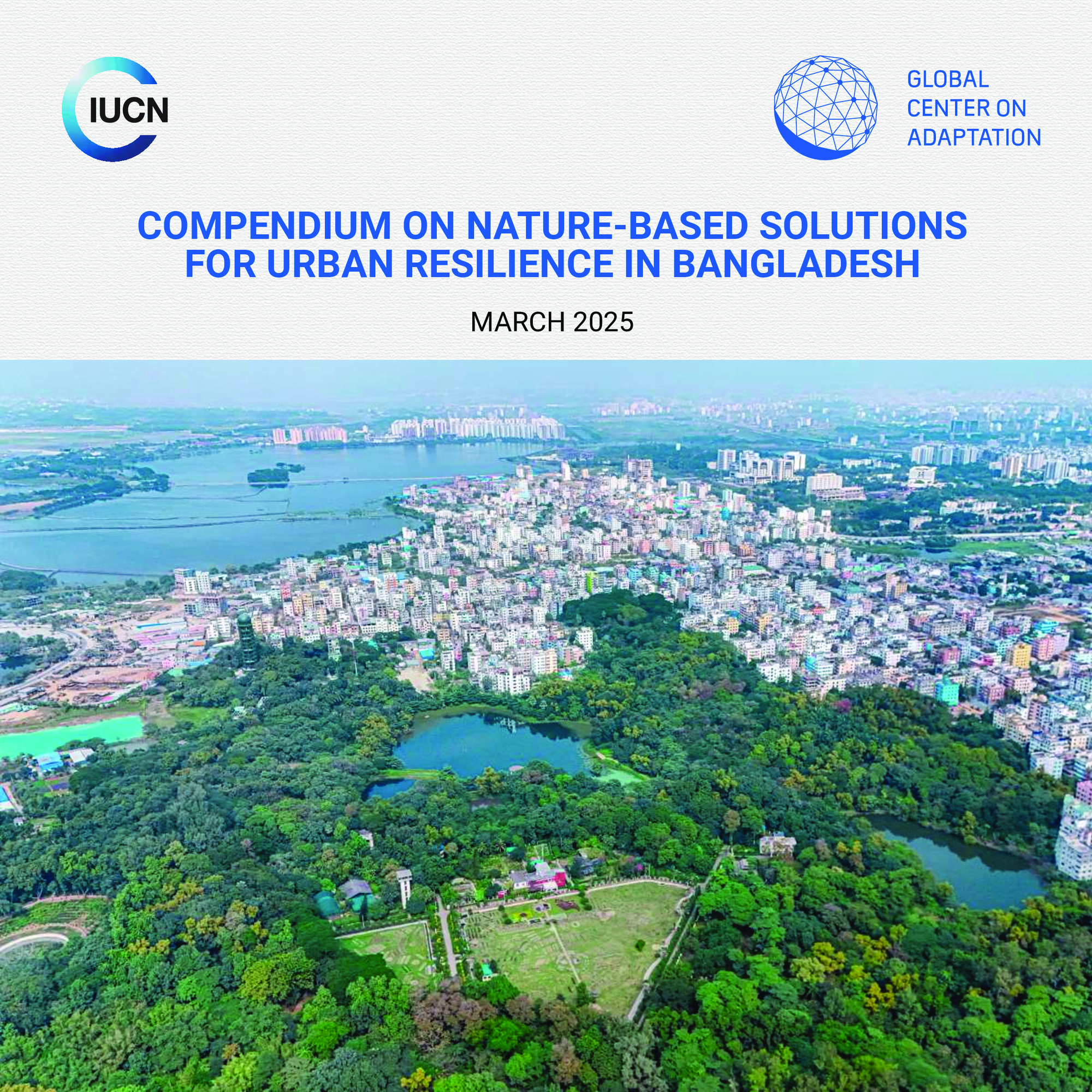
This is a compendium (guidance document) titled Compendium on Nature-Based Solutions for Urban Resilience in Bangladesh, published in March 2025 by IUCN (International Union for Conservation of Nature and Natural Resources) and the Global Center on Adaptation (GCA). It was developed with funding from the UK Government under the Bangladesh Climate and Environment Programme and forms part of GCA's technical assistance to the Improving Urban Governance and Infrastructure Project (IUGIP), implemented by the Local Government Engineering Department (LGED). Its subject is nature-based solutions (NbS) for urban challenges in Bangladesh.
Background and Context
The document notes that Bangladesh is densely populated, with 170 million people (BBS 2022), and that its cities face floods, heat, drought, cyclones, salinity intrusion, erosion and landslides. It cites the National Adaptation Plan (2022) and states that Bangladesh's Local Government Division guidelines allow cities to use 10% of their ADP for green and climate-resilient investments.
Methodology
The compendium used mixed methods in two phases. The first phase involved piloting in five case cities (Nilphamari, Kulaura, Moulvibazar, Sandwip, Bandarban) and two example cities (Narayanganj and Rajshahi city corporations), using Key Informant Interviews (KIIs), Focus Group Discussions (FGDs), site visits and a literature review. The second phase identified cases at city, neighbourhood and community scales through national workshops and sounding board meetings. Each case was assessed against the eight criteria of the IUCN Global Standard for NbS on a 1 to 5 Likert scale.
Key Findings
- Six key urban challenges were identified: floods and waterlogging, heat risks, droughts, cyclonic winds and storm surges, landslides and erosion, and salinity intrusion, plus other issues such as encroachment on green and blue spaces.
- Nine potential NbS types were identified and used to showcase twenty cases.
- The document states that the cases were not initially designed as NbS and may not fully meet all IUCN criteria.
- Case examples include the Kudalichora Canal restoration in Moulvibazar, the Katakhali Khal in Sirajganj, Dhanmondi Lake in Dhaka, and the Miyawaki Forest at the University of Chittagong.
Policy, Funding and Capacity
Chapter 3 examines governance, policy and regulatory frameworks, funding and financing mechanisms, and technical capacity of local government institutions (LGIs). It discusses existing gaps and opportunities in the current policy landscape.
Cost-Benefit Framework
Chapter 4 introduces a cost-benefit analysis framework for assessing NbS projects in Bangladesh, with an application example. The document describes it as a practical and systematic approach for users.
Purpose and Audience for Urban Policy and Investment
The document says it is designed as a hands-on resource for policymakers, planners, development partners and investors. It aims to enhance awareness among local government institutions, support the integration of NbS into urban strategies, inform policy and regulatory reform, and help identify viable investment opportunities in Bangladeshi cities.