Overview of the Research Initiative
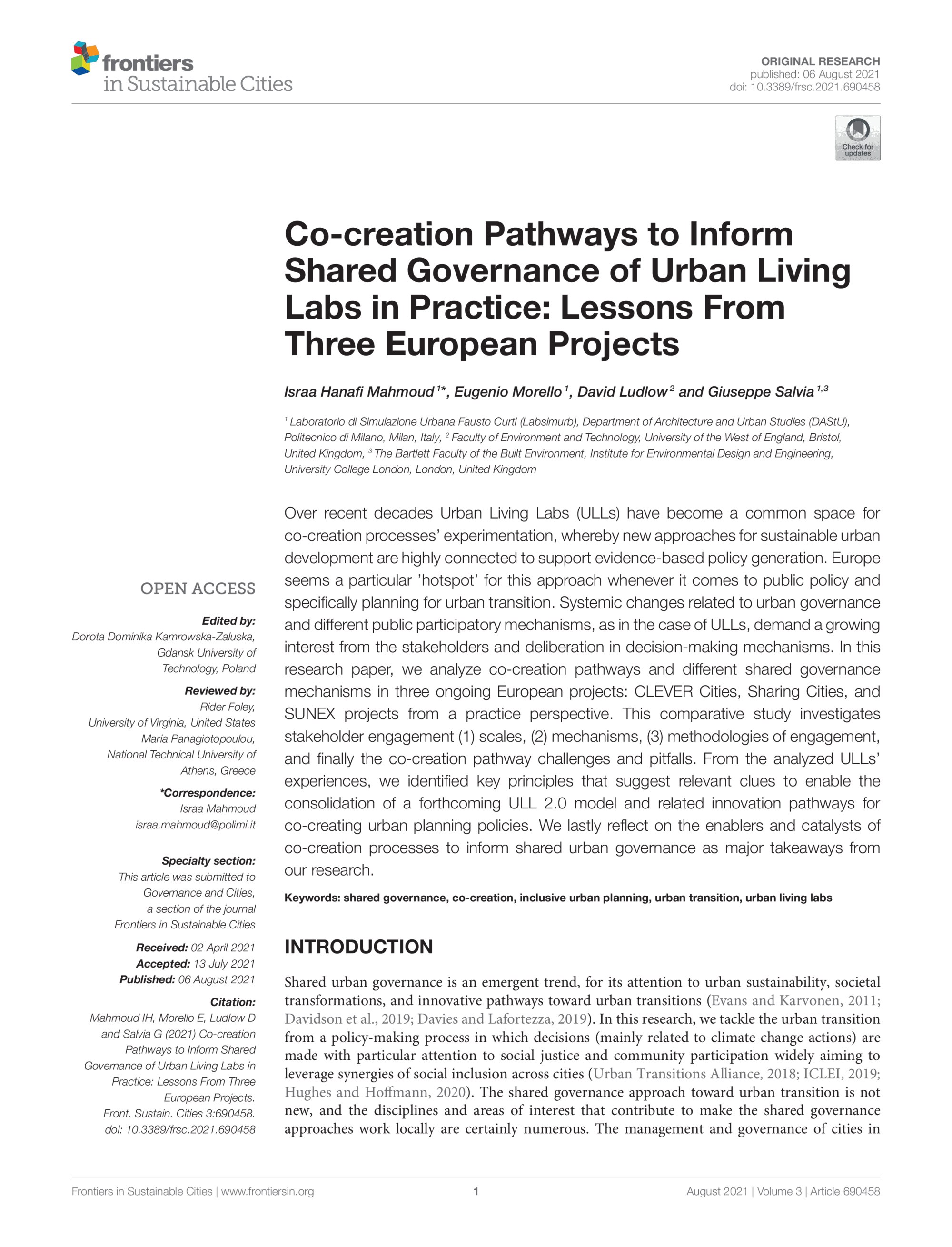
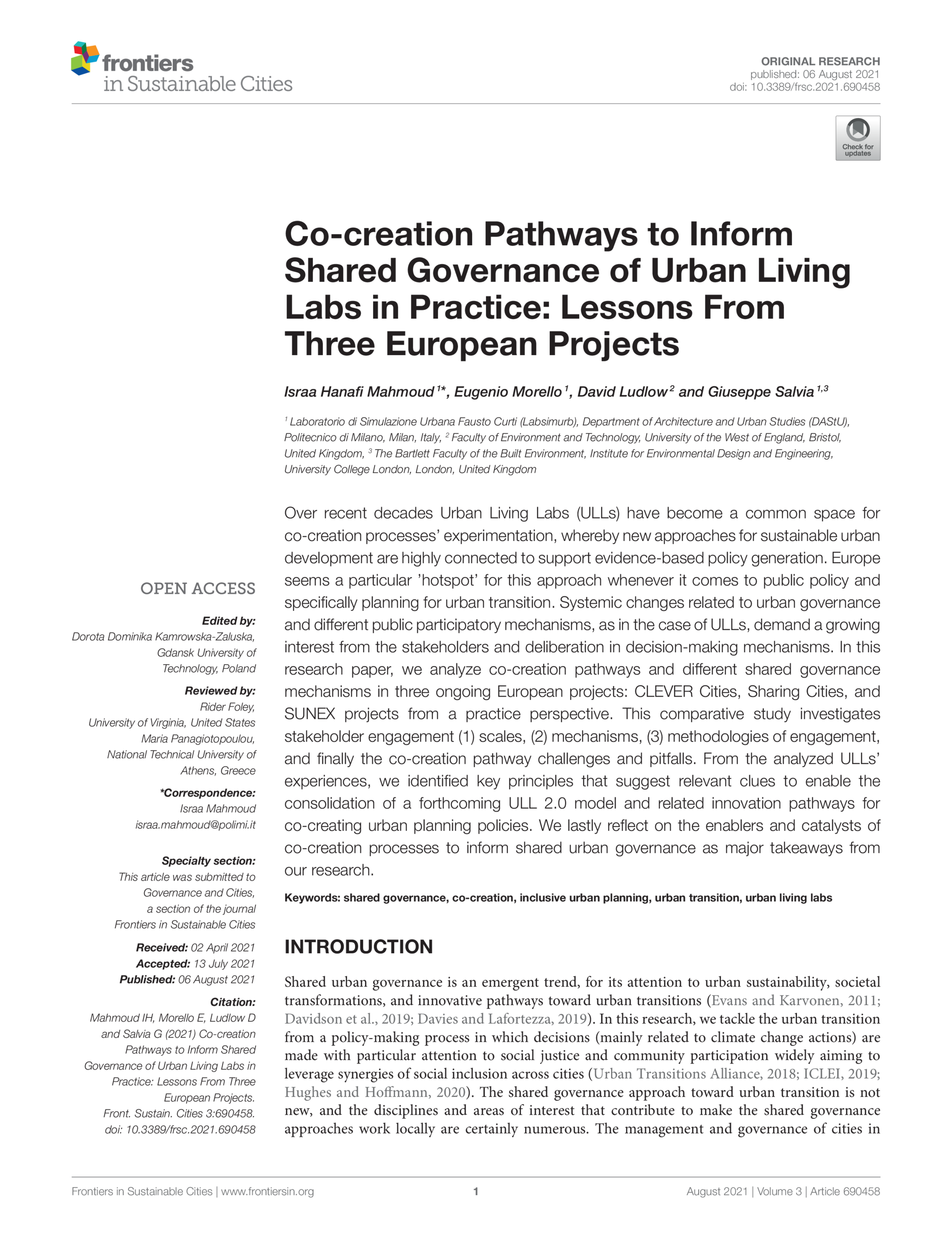
The paper “Co‑creation Pathways to Inform Shared Governance of Urban Living Labs in Practice: Lessons From Three European Projects” is published in Frontiers in Sustainable Cities and authored by Israa Hanafi Mahmoud, Eugenio Morello, David Ludlow and Giuseppe Salvia. It examines how co‑creation and shared governance are applied in three Horizon 2020‑funded urban living lab (ULL) projects—CLEVER Cities, Sharing Cities and SUNEX—across multiple European cities. The authors, affiliated with Politecnico di Milano, the University of the West of England and University College London, bring multidisciplinary expertise in architecture, urban studies and environmental design.
Core Objectives and Methodology
The study aims to identify stakeholder engagement scales, mechanisms and methodologies, and to pinpoint challenges and enablers of co‑creation pathways. It conducts a comparative analysis of nine CLEVER Action Labs (CALs), several Sharing Cities workshops, and SUNEX back‑casting workshops, focusing on three dimensions: (1) stakeholder engagement (scale, level, modality), (2) co‑creation phases (co‑design, co‑implementation, co‑monitoring, co‑development) and (3) outcomes for shared governance. Data are drawn from project reports, workshop logs and published sources, with a particular emphasis on the European context of Horizon 2020 funding.
Key Findings: Engagement Patterns
- Multi‑level, multi‑scalar participation: CLEVER Cities operates at consortium, city and local Urban Innovation Partnership (UIP) scales; Sharing Cities integrates individual (people), urban (place) and platform (digital) layers; SUNEX aligns local and regional governance for the FEW nexus.
- Stakeholder ladder: All three projects move from information (general audience) through consultation and involvement to collaboration and empowerment, with empowerment concentrated on citizens in CLEVER Cities and on policy actors in SUNEX.
- Modalities used: Forecasting via Theory of Change (TOC) in CLEVER Cities, back‑casting in SUNEX, and mixed digital‑physical workshops in Sharing Cities.
Co‑creation Pathways and Outcomes
The projects follow a non‑linear, iterative cycle: co‑design workshops generate locally tailored Nature‑Based Solutions (NBS) in CLEVER Cities (e.g., green roofs, community parks); Sharing Cities applies human‑centred design for energy‑efficient services; SUNEX develops policy guidelines for the Food‑Energy‑Water (FEW) nexus. Successful outcomes include:
- Implementation of nine CALs delivering green infrastructure in Milan, London and Hamburg.
- Creation of a digital platform for data collection and citizen interaction in Sharing Cities.
- Drafted policy recommendations for carbon‑neutral urban transitions in Bristol and other pilot cities.
Challenges and Enablers Identified
Common obstacles are temporal delays (e.g., COVID‑19 lockdowns causing 6–12 month schedule shifts), financial constraints (project‑specific budgets, limited municipal co‑funding), legal procurement complexities, and digital exclusion of vulnerable groups. Enablers highlighted are strong multi‑actor networks, transparent communication, adaptable governance structures, and the use of tools such as RASCI matrices to clarify responsibilities.
Implications for Sustainable Housing
The research underscores that co‑creation can accelerate the integration of sustainable housing measures—such as energy‑efficient retrofits, green façades and shared community spaces—by embedding residents, planners and private partners in decision‑making. The multi‑modal engagement approaches demonstrate how housing projects can align with broader urban sustainability goals, including climate‑neutral targets, nature‑based solutions and the FEW nexus. The findings suggest that scaling these pathways across Europe could foster more resilient, inclusive and low‑carbon residential environments.
Policy Recommendations for Europe
- Institutionalise ULLs as permanent governance mechanisms within city administrations.
- Allocate dedicated municipal co‑funding to complement EU project budgets, ensuring long‑term maintenance of housing‑related interventions.
- Promote back‑casting and TOC tools in urban planning curricula to build capacity for forward‑looking policy design.
- Strengthen digital inclusion strategies to ensure all household types can participate in co‑creation processes.
Access and Further Reading
The article is available online via Frontiers’ website (doi:10.3389/frsc.2021.690458) and includes supplementary material detailing the nine CLEVER Action Labs, workshop protocols and policy briefs for each case study city.