Overview of the Study
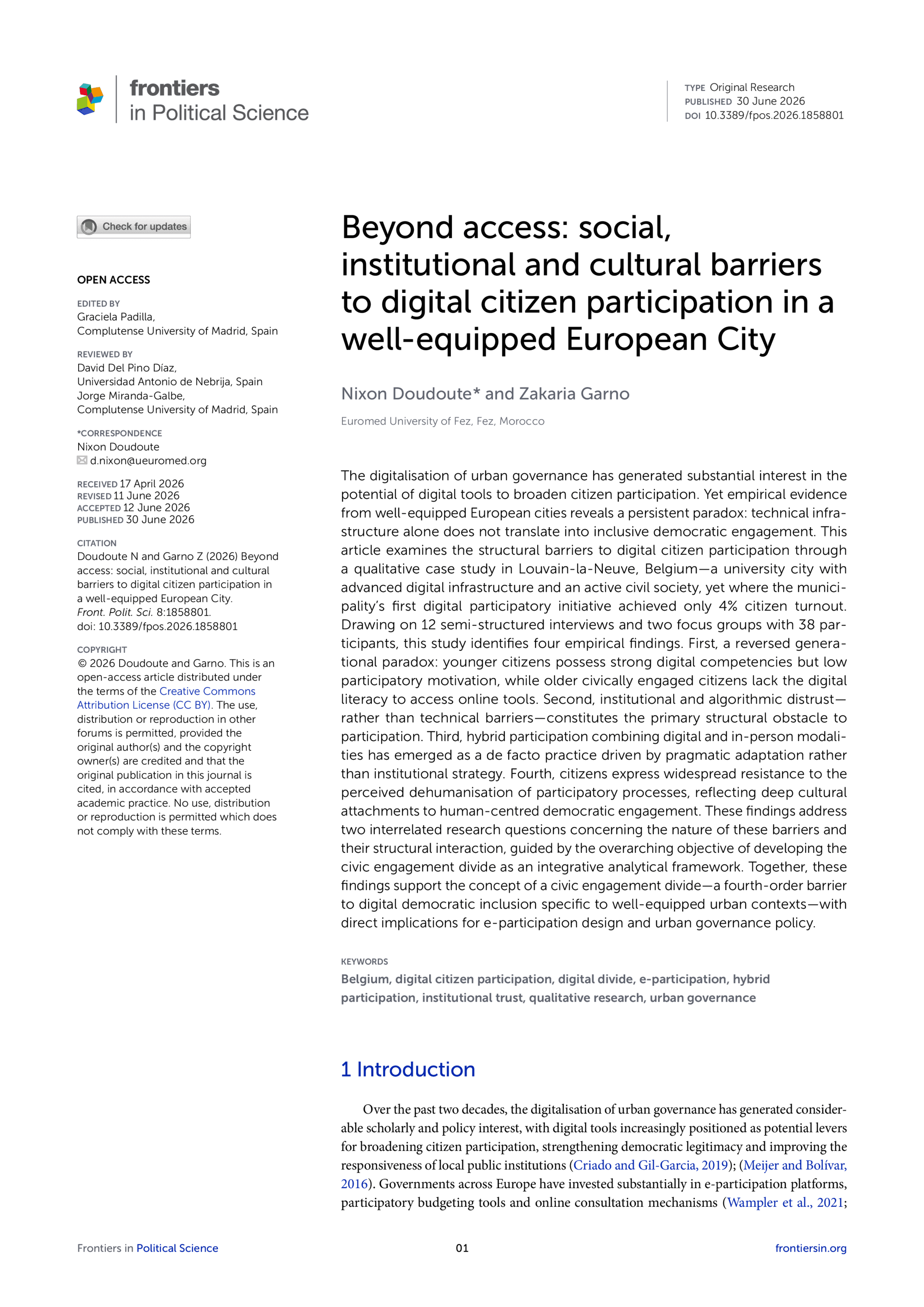
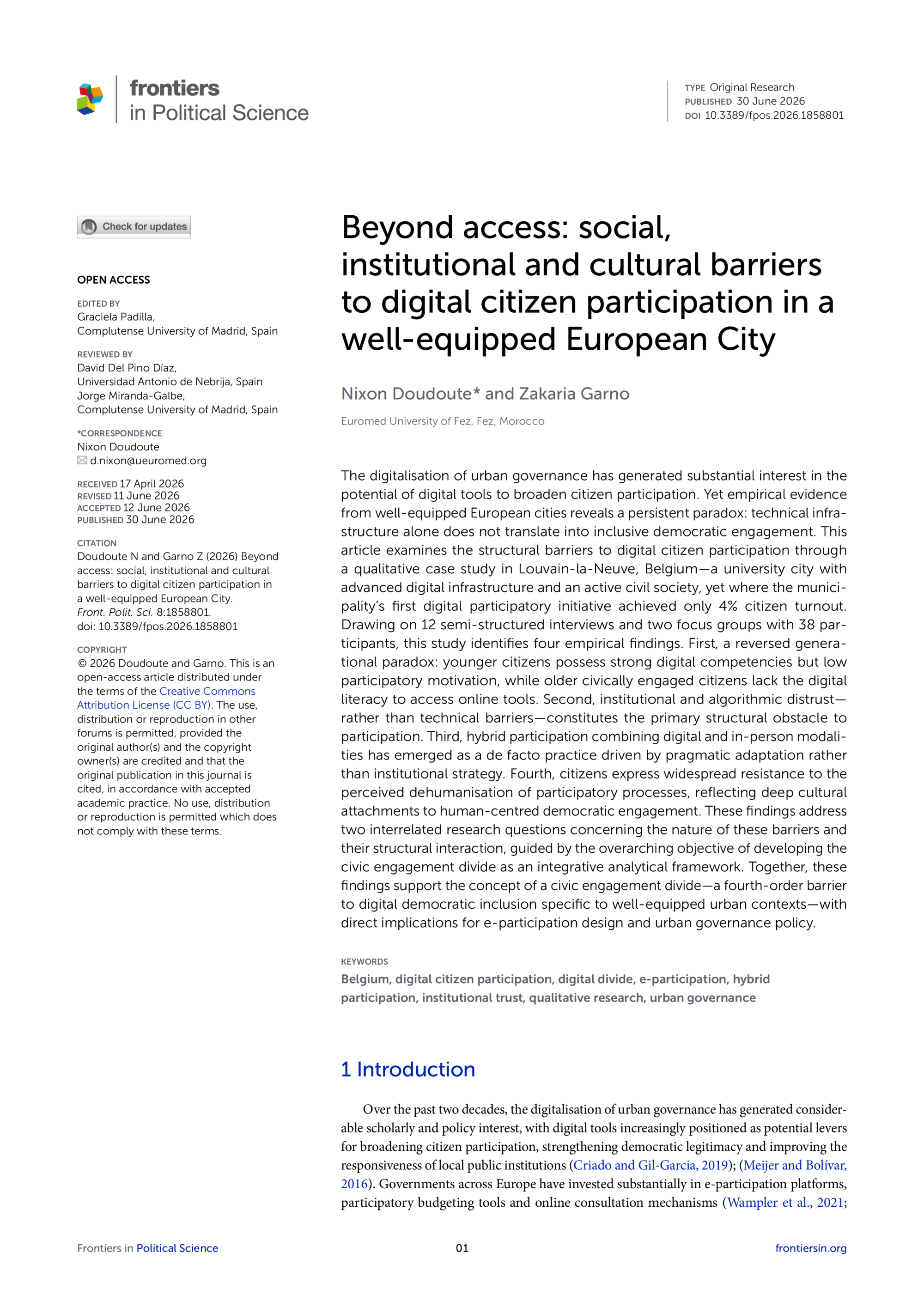
This article, published in Frontiers in Political Science, investigates why digital citizen participation remains low in a well‑equipped European city despite advanced digital infrastructure, a highly educated population, and an active civil society. The research was conducted by Nixon Doudoute and Zakaria Garno, both affiliated with Euromed University of Fez, Morocco. It draws on a qualitative case study of Louvain‑la‑Neuve, Belgium, a university city noted for its robust digital services and strong civic associations.
Research Context and Methodology
The authors examined a municipal digital participatory budgeting initiative that achieved only ≈4 % citizen turnout. Data were collected between September and November 2025 through 12 semi‑structured interviews and two focus groups, involving 38 participants from institutional, civil‑society, academic, and citizen groups. Thematic analysis followed Braun & Clarke’s six‑phase framework, with peer debriefing and negative case analysis to ensure credibility. The study reached thematic saturation after the ninth interview.
Key Findings: Generational Paradox
A central finding is a reversed generational paradox: younger residents (students and young adults) possess strong digital skills but show low motivation to engage in civic processes, while older, long‑standing citizens are highly motivated yet lack digital competence. This mismatch creates a structural gap where neither group exhibits both digital literacy and civic motivation, limiting the reach of purely digital participation tools.
Institutional and Algorithmic Distrust
Across all demographics, participants reported institutional distrust—skepticism that digital contributions influence real decisions—and algorithmic distrust, concerns about opaque data handling, lack of transparency, and privacy risks associated with tools like Itsme and electronic ID verification. These trust deficits were identified as primary barriers, outweighing technical access issues.
Emergent Hybrid Participation Practices
The research documents a spontaneous hybrid model in which digital channels (newsletters, surveys, messaging apps) are combined with in‑person meetings for deliberation and decision‑making. This hybrid approach emerged organically from both municipal officials and civil‑society groups rather than from top‑down policy design, highlighting a normative practice that balances reach and relational depth.
Cultural Resistance to Dehumanisation
Participants expressed a cultural resistance to the perceived dehumanisation of participatory processes through digitalisation. They emphasised the importance of face‑to‑face interaction, emotional attunement, and spontaneous dialogue for genuine democratic engagement, arguing that digital platforms risk reducing participation to data collection.
Introduction of the Civic Engagement Divide
The authors propose the concept of a civic engagement divide, a fourth‑order barrier comprising: (1) motivational asymmetry across generations, (2) compounded institutional and algorithmic trust deficits, (3) emergent hybrid norms, and (4) cultural resistance to digital dehumanisation. This framework extends existing digital‑divide models by addressing post‑access motivational and legitimacy dimensions specific to democratic participation.
Practical Implications for Sustainable Urban Governance
For pan‑European stakeholders in sustainable housing and urban development, the study suggests that digital tools alone cannot ensure inclusive participation in planning processes. Effective engagement requires: (a) targeted digital literacy support for motivated seniors, (b) transparent feedback loops demonstrating the impact of citizen input, (c) institutional recognition and support of existing hybrid practices, and (d) preservation of human‑centred facilitation to maintain relational trust. These measures can help align digital participation with broader sustainability goals, ensuring that housing policies reflect diverse citizen perspectives.
Contribution to Academic Literature
The article contributes empirically to three scholarly strands: (1) the evolving digital‑divide literature, highlighting a motivational layer, (2) the trust literature, adding an algorithmic dimension, and (3) hybrid participation research, documenting emergent, bottom‑up hybridisation. It also offers a new analytical lens for future comparative studies across well‑equipped European cities.