Overview of the Research Initiative
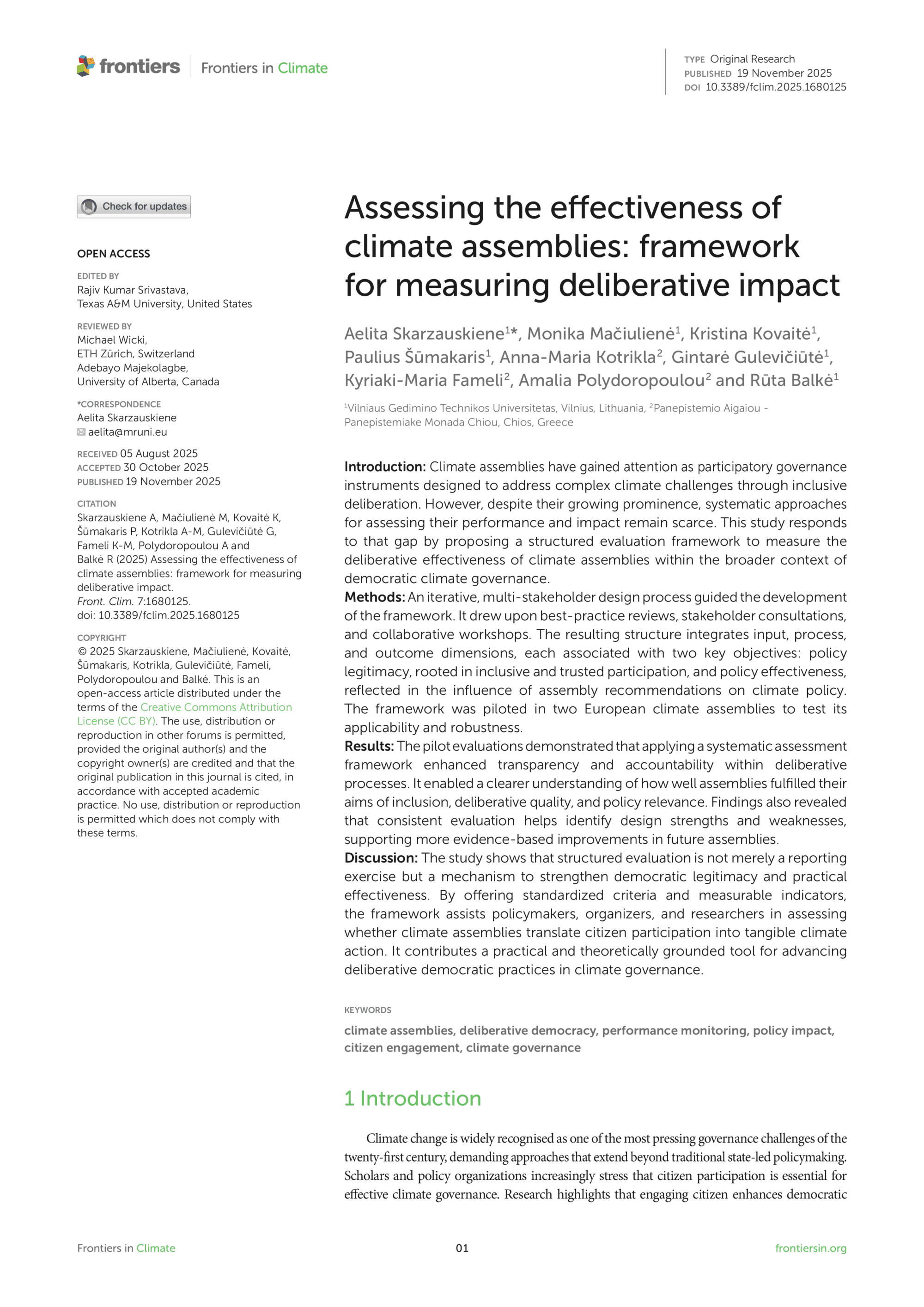
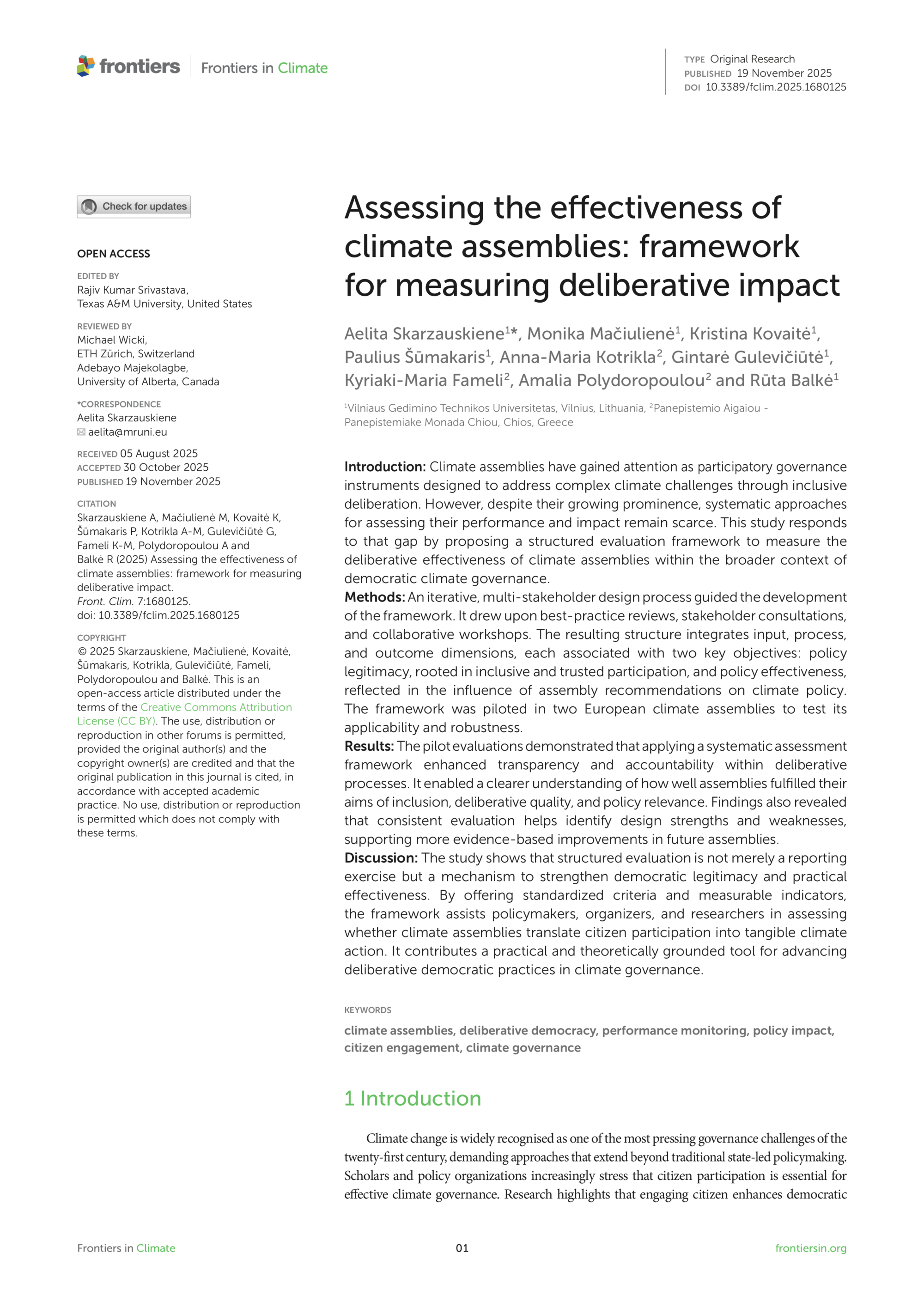
The paper “Assessing the effectiveness of climate assemblies: framework for measuring deliberative impact” presents a newly developed evaluation framework for climate assemblies. It is authored by a multidisciplinary team including Aelita Skarzauskiene, Monika Mačiulienė, Kristina Kovaitė, Paulius Šūmakaris, Anna‑Maria Kotrikla, Gintarė Gulevičiūtė, Kyriaki‑Maria Fameli, Amalia Polydopoulou and others. The research is published in Frontiers in Climate, a peer‑reviewed open‑access journal that disseminates climate‑related scholarship under a Creative Commons Attribution license.
Aim and Rationale
The study addresses a documented gap: while climate assemblies are increasingly used to involve citizens in climate policy, systematic methods for assessing their legitimacy, deliberative quality, and policy impact are scarce. The authors propose a structured, climate‑specific monitoring framework that integrates input, process, outcome and impact dimensions, linking procedural legitimacy to tangible policy effectiveness.
Framework Design and Components
The framework was co‑designed through an iterative, multi‑stakeholder process involving literature reviews, stakeholder consultations and workshops. It comprises four dimensions:
- Input – resources, political commitment, facilitator training, and preparatory materials.
- Process – inclusivity, participant learning, quality of deliberation, diversity of perspectives, mutual learning and facilitation effectiveness.
- Outcome – publication of reports, policy recommendations, updates to tools/guidelines, and participant experience documentation.
- Impact – public engagement, policy adoption, changes in governance practices, and empowerment of participants. Each dimension includes quantitative and qualitative indicators (e.g., budget allocation, demographic representativeness, pre‑/post‑assembly knowledge scores, number of policy documents referencing assembly recommendations). Methods recommended are documentary review, surveys, interviews, content analysis and media monitoring.
Pilot Testing Across Three Cases
The framework was piloted in three European climate assemblies (2024‑2025):
- Catalonia, Spain – regional assembly focusing on long‑term climate scenarios; achieved broad policy relevance but required extensive coordination and resources.
- Edermünde, Germany – municipal assembly on concrete adaptation measures; facilitated close interaction and clear policy links, yet faced challenges in representativeness and political visibility.
- Riga, Latvia – urban assembly addressing flooding risk; combined technical expertise with citizen input, producing balanced recommendations but encountering time constraints and uneven political support. Across all pilots, participants reported increased climate knowledge, higher deliberative confidence and a strong willingness to engage in future assemblies. Facilitators were deemed neutral and effective, though limited deliberation time was a recurring limitation.
Key Findings and Evidence
- The framework enabled systematic tracking of budget and human resources, confirming that adequate funding is essential for robust assemblies.
- Inclusivity metrics showed that stratified random sampling improved demographic representativeness in Catalonia and Riga, while Edermünde required additional outreach.
- Pre‑/post‑assembly surveys indicated an average knowledge gain of 25 % on local climate risks and mitigation options.
- Policy analysis revealed that 30‑40 % of assembly recommendations were referenced in subsequent municipal or regional climate strategies within six months, demonstrating a measurable policy impact.
- Media analysis captured a 50 % increase in climate‑related public discourse in the regions following the assemblies, indicating broader public engagement.
Relevance for Sustainable Housing Stakeholders
For a pan‑European audience focused on sustainable housing, the framework offers a replicable tool to evaluate citizen deliberations on housing‑related climate measures such as energy‑efficient retrofits, green building standards and adaptation of residential areas to heatwaves or flooding. By applying the framework, housing authorities and NGOs can:
- Ensure inclusive participation of residents, landlords and experts in designing sustainable housing policies.
- Quantify knowledge improvements about energy performance, carbon footprints and climate‑resilient design among participants.
- Track policy uptake, e.g., incorporation of citizen‑generated housing recommendations into national or local building codes.
- Monitor long‑term impacts on housing market practices, financing mechanisms and community resilience.
Conclusion and Outlook
The authors conclude that a standardized, climate‑specific evaluation framework enhances transparency, accountability and learning in climate assemblies. It bridges the gap between deliberative legitimacy and concrete policy outcomes, facilitating evidence‑based improvements in future assemblies. The framework will be publicly released as part of the Horizon Europe CLIMAS deliverables, providing templates, survey instruments and coding guides in multiple languages for wide adoption across Europe’s climate governance initiatives.