Document Overview
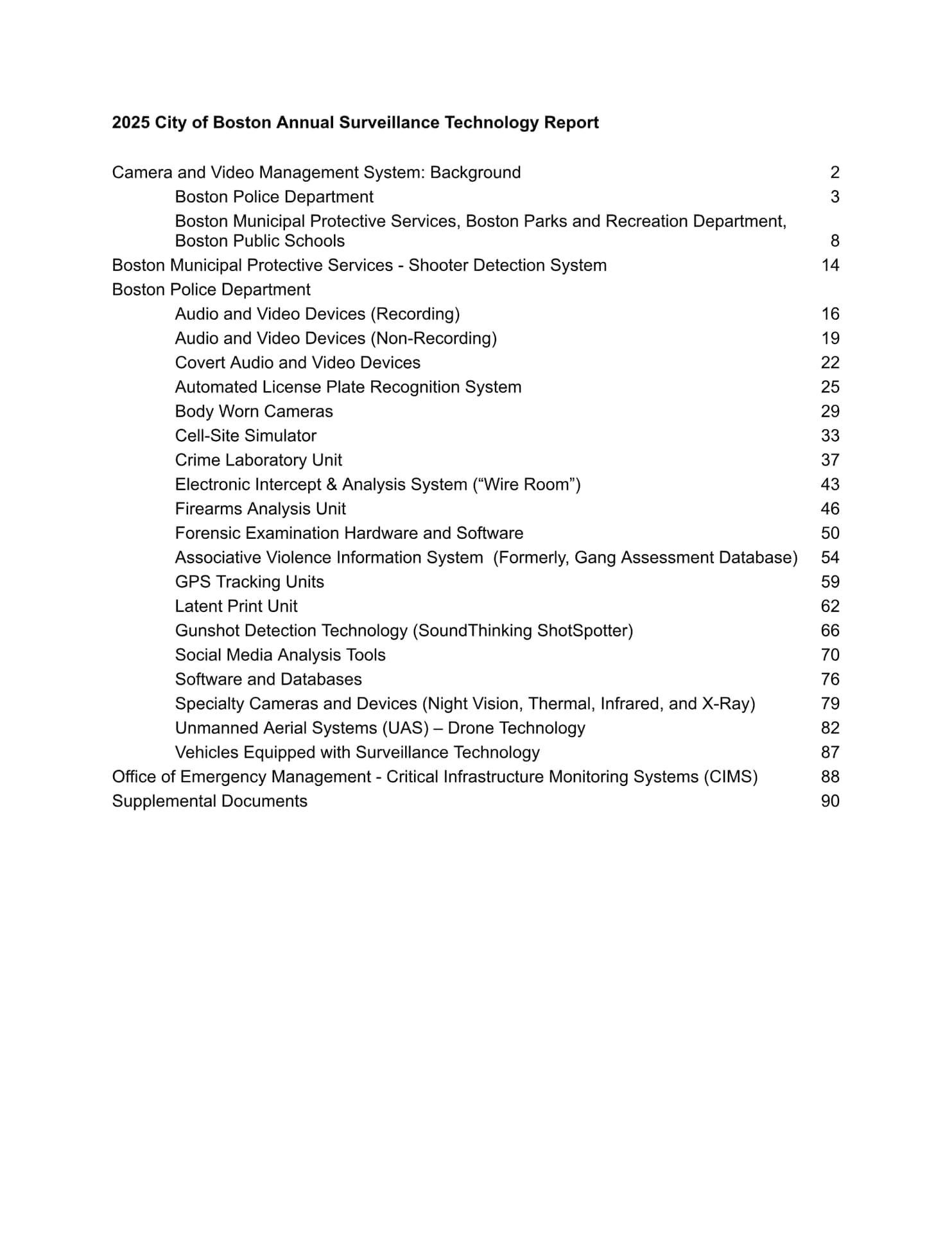
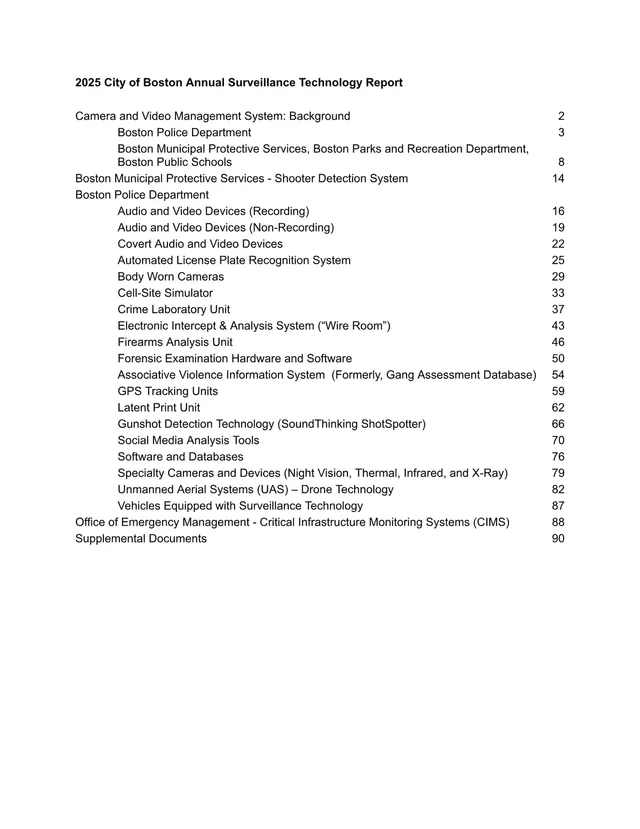
This is the City of Boston's 2025 Annual Surveillance Report, published by the City of Boston in September 2026 according to its metadata. It is a compiled set of annual reports, required under the Surveillance Oversight Ordinance, that each covered department files on the surveillance technologies it uses. The document covers the Boston Police Department (BPD), Boston Municipal Protective Services (BMPS), Boston Parks and Recreation Department (BPRD), Boston Public Schools (BPS), and the Office of Emergency Management (OEM).
Camera and Video Systems
The report explains that the City's camera and video management system spans multiple departments and uses the Genetec Video Management System. Cameras record video but not audio, and footage is kept for 30 days before being overwritten unless it becomes part of an investigation. As of December 31, 2025, BPD's Bureau of Administration and Technology maintained about 1,400 cameras, and BPD had access to roughly 400 more through DoIT and BTD. The Video Evidence Unit received 5,711 requests for recorded video from these systems in 2025, including about 2,550 public records requests.
Automated License Plate Recognition
BPD reports that its earlier ALPR system was not operable in 2025. A Flock Safety trial with about 45 cameras ran from April 1 to September 4, 2025. BPD states that within three days of starting the pilot it learned that other agencies could access its data through a nationwide lookup feature that the vendor had enabled in error, and that the function was then disabled. During the trial, BPD received 15 Hot List requests, and 12 were approved. A Motorola ALPR trial began in February 2026, and an Axon trial is scheduled to begin around June 1, 2026. The Boston Police Audit and Review Unit audited the Flock trial.
Shooter Detection and Other Technologies
BMPS reports that its Shooter Detection System was not activated in 2025 because no firearm was discharged on covered City property, so it captured no data. Other reported technologies include recording and non-recording audio and video devices, covert devices, cell-site simulators (used twice in 2025 under exigent circumstances), Body Worn Cameras (8,076 law enforcement requests and 1,273 public records requests for BWC video), and drones. BPD also reports spending $4,816,874.14 on Body Worn Cameras in calendar year 2025.
Oversight, Complaints, and Audits
Each section reports on complaints, data sharing, audits, and public records requests. BPD states it located no specific community complaints about its technologies in 2025, and it reports zero IAD complaints alleging misuse of cameras, recording devices, covert devices, ALPR, cell-site simulators, or drones. The report also states that 18 IAD investigations involved potential violations of BPD Rule 405, all related to officers' activation of body-worn cameras. BPS reports sharing video footage 26 times in 2025, mainly on subpoena and public records requests.
Costs and Funding
The report lists costs and funding sources by department. BMPS reports $139,849.50 in total camera costs. BPS reports $1,516,368 in capital budget funding. OEM reports about $744,000 in federal UASI grant funding for its Critical Infrastructure Monitoring System. BPD reports a drone-related total of $75,000 in 2025, and in January 2026 it reports receiving a $10,925,140 FEMA grant for counter-unmanned aerial systems technology.
Impact and Fairness Statements
BPD states that it is not aware of any finding of disparate impact from its technologies and points to its Bias-Free Policing policy (BPD Rule 113A). BPS describes its approach to privacy and racial equity in camera installation, and OEM states it is not aware of any disproportionate impact. These are the departments' own assessments.
Purpose and Intended Readers
The report is written to meet the reporting requirements of the Surveillance Oversight Ordinance. It asks each department to describe how its technology was used, what data was shared, any complaints and audits, its effectiveness, costs, and any new agreements with non-City entities. It is intended for the public and city oversight bodies, and the supporting attachments are available through a linked Google Drive folder.